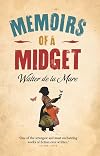
Memoirs of a Midget
by Walter De la Mare
On This Page
Description
The tiny Miss M. relates her orphan childhood, and the pain caused by her realization that she must either learn to tolerate her size or live with it in hatred. Hailed as "a poet's book," by critic J. C. Squire, the novel won the prestigious James Tait Black Memorial Prize for fiction.Tags
Recommendations






















Member Reviews
Successful historical fiction invokes a point of view alien to both reader and writer-- that of the past. The farther back into history an author sets a novel, the more alien the point of view becomes. First person narratives further complicate this problem of historical sensibility and challenge their authors skill. The further the point of view ventures from that of the author the more challenging the narrative becomes. Setting a story 100 years in the past, selecting a narrator of the opposite gender, and making that narrator physically different seems almost like asking for it.
But Walter de la Mare pulls it off in Memoirs of a Midget. His narrator is a nineteenth century woman and a midget. (No one in her day would have considered show more using any other term.)
Mr. de la Mare's heroine, Miss M., brings her own personality to the forefront of her memoir. Hers is a life of solitude. Protected by her father throughout her childhood and young adulthood, she has few friends outside her family servants. After her father dies, the narrator finds she has just enough income to provide food, lodging and a minimum of expenses. This and the fear of society's reaction to her size forces her to live a largely cloistered life, and gives the novel just a handful of characters: Miss M., her landlady and her landlady's daughter.
Since so little happens in the narrator's life and her world is so reduced, Memoirs of a Midget becomes a story of isolation. Many 19th century women led reduced lives but Miss M.'s is literally reduced, even the furniture in her single room is smaller than average. She is a doll living in a doll's house with little to do but observe the personalities of the two women who share the same home. It's no wonder that she falls in love with them.
Throughout her memoir, Miss M. longs to become her own person. She pursues the study of science through books and observation as she seeks the means to achieve some level of independence. The expected path of marriage to an appropriate young man is not open to Miss M., but once high society finds out about her, she receives an invitation and becomes the permanent guest of a wealthy widow, kept as a sort of pet, expected to recite poetry to entertain party quests whenever her benefactress demands. Thus Miss M. can move to London, visit France, find the means to further her self-education in the sciences, but she pays a very high price for this. It becomes clear to Miss M. that none of the people she interacts with see her a fully adult even fully human. They are pleased that she can recite poetry because they did not expect a such a small person to possess the faculties for memorization.
That Mr. de la Mare can make Miss M. a believable character and make such a strange story speak to a readership at least twice removed from its reality, is a remarkable achievement. Memoirs of a Midget is not a fast read, but it is a deep one. Though very little happens in her life. Miss M. has much to say to her readers. In the end her story is something akin to My Brilliant Career, a story of the artist as a young woman. Just what kind of artist Miss M. will become is left to the reader to decide. Her story ends when she strikes a final blow for her own freedom and cuts all ties with high society. Memoirs of a Midget is an impressive feat. I expect to find it a contender for my top ten reads of the year. show less
But Walter de la Mare pulls it off in Memoirs of a Midget. His narrator is a nineteenth century woman and a midget. (No one in her day would have considered show more using any other term.)
Mr. de la Mare's heroine, Miss M., brings her own personality to the forefront of her memoir. Hers is a life of solitude. Protected by her father throughout her childhood and young adulthood, she has few friends outside her family servants. After her father dies, the narrator finds she has just enough income to provide food, lodging and a minimum of expenses. This and the fear of society's reaction to her size forces her to live a largely cloistered life, and gives the novel just a handful of characters: Miss M., her landlady and her landlady's daughter.
Since so little happens in the narrator's life and her world is so reduced, Memoirs of a Midget becomes a story of isolation. Many 19th century women led reduced lives but Miss M.'s is literally reduced, even the furniture in her single room is smaller than average. She is a doll living in a doll's house with little to do but observe the personalities of the two women who share the same home. It's no wonder that she falls in love with them.
Throughout her memoir, Miss M. longs to become her own person. She pursues the study of science through books and observation as she seeks the means to achieve some level of independence. The expected path of marriage to an appropriate young man is not open to Miss M., but once high society finds out about her, she receives an invitation and becomes the permanent guest of a wealthy widow, kept as a sort of pet, expected to recite poetry to entertain party quests whenever her benefactress demands. Thus Miss M. can move to London, visit France, find the means to further her self-education in the sciences, but she pays a very high price for this. It becomes clear to Miss M. that none of the people she interacts with see her a fully adult even fully human. They are pleased that she can recite poetry because they did not expect a such a small person to possess the faculties for memorization.
That Mr. de la Mare can make Miss M. a believable character and make such a strange story speak to a readership at least twice removed from its reality, is a remarkable achievement. Memoirs of a Midget is not a fast read, but it is a deep one. Though very little happens in her life. Miss M. has much to say to her readers. In the end her story is something akin to My Brilliant Career, a story of the artist as a young woman. Just what kind of artist Miss M. will become is left to the reader to decide. Her story ends when she strikes a final blow for her own freedom and cuts all ties with high society. Memoirs of a Midget is an impressive feat. I expect to find it a contender for my top ten reads of the year. show less
The fictional introduction to these fictional memoirs promises an account of a remarkable woman, of keen intellect, whose travels and experiences are such a marvel that they must be shared via publication.
What are we delivered? A single year in the life of this woman. During this year, her twentieth, she loses her parents and her home; is set up with a livable income and provided a home-for-life as a boarder; becomes a spoiled pet of the bored nobility; and finally, joins the circus for three nights to earn enough money to return to her life as a boarder. Throughout this, she treats those around her with contempt or at least disrespect, living the life of a privileged shut-in. We are, in summary, offered no evidence of a keen intellect show more nor of a remarkable personality, and the travels and experiences of a shut-in are neither extensive or interesting.
Oh, and the woman is a midget. Not an actual midget or little-person or insufficiently-altitudinous or whatever the proper term might be, but a scale model of an attractive woman, about two feet high. show less
What are we delivered? A single year in the life of this woman. During this year, her twentieth, she loses her parents and her home; is set up with a livable income and provided a home-for-life as a boarder; becomes a spoiled pet of the bored nobility; and finally, joins the circus for three nights to earn enough money to return to her life as a boarder. Throughout this, she treats those around her with contempt or at least disrespect, living the life of a privileged shut-in. We are, in summary, offered no evidence of a keen intellect show more nor of a remarkable personality, and the travels and experiences of a shut-in are neither extensive or interesting.
Oh, and the woman is a midget. Not an actual midget or little-person or insufficiently-altitudinous or whatever the proper term might be, but a scale model of an attractive woman, about two feet high. show less
384. Memoirs of a Midget, by Walter de la Mare (read 17 Jun 1951)(James Tait Black Memorial fiction prize for 1921) I began reading this book on June 16, 1951 and on that day wrote; "it is a teen-age girl's book." But I finished the book the next day and commented on it as follows: "Not bad at the end, though as a whole it was a poor book and I had little patience with the midget, acting like a child though she was 20 years old."
Ratings
Members
- Recently Added By
Lists

Harold Bloom - The Western Canon: D. The Chaotic Age
833 works; 24 members

Trinity College Booklist (1951): Class Ten, English Literature
358 works; 5 members

For Further Reading: A List of 160 Novels from 15 Literatures
160 works; 4 members

Best 20th Century Books as of 1924
100 works; 6 members

Canon de la narrativa universal del s. XX (cicutadry)
499 works; 3 members
Author Information

265+ Works 4,419 Members
Born in a Kent village, Walter de la Mare was born on April 25, 1873. He was an English poet, short story writer and novelist. He is probably best remembered for his works for children and for his poem "The Listeners". His 1921 novel Memoirs of a Midget won the James Tait Black Memorial Prize for fiction and his post-war Collected Stories for show more Children won the 1947 Carnegie Medal for British children's books. De la Mare's first book, Songs of Childhood, was published under the name Walter Ramal. He worked in the statistics department of the London office of Standard Oil for eighteen years to support his family, but nevertheless found time to write. De la Mare suffered from a coronary thrombosis in 1947 and died of another in 1956. His ashes are buried in the crypt of St Paul's Cathedral, where he had once been a choirboy. (Bowker Author Biography) Walter de la Mare (1873-1956) was a poet, novelist, & anthologist. The recipient of numerous awards, he held honorary degrees from Oxford, Cambridge, & several other universities. (Publisher Provided) show less
All Editions
Some Editions
Awards and Honors
Awards
Notable Lists
Series
Belongs to Publisher Series
Common Knowledge
- Canonical title*
- Memorias de una enana
- Original publication date
- 1921
- Dedication
- To the memory of my Mother
- First words
- Some few years ago a brief account of me found its way into one or country newspapers.
- Last words
- (Click to show. Warning: May contain spoilers.)That is so; and so I must leave it, hoping against hope that one friend at any rate will consent in his love and wisdom to take me seriously, and to remember me, not with scorn or even with pity, but as if, life for life, we had shared the world on equal terms.
*Some information comes from Common Knowledge in other languages. Click "Edit" for more information.
Classifications
Statistics
- Members
- 354
- Popularity
- 89,166
- Reviews
- 3
- Rating
- (3.36)
- Languages
- 5 — English, French, German, Italian, Spanish
- Media
- Paper, Ebook
- ISBNs
- 36
- ASINs
- 30