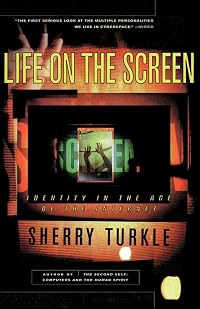
Life on the Screen: Identity in the Age of the Internet
by Sherry Turkle
On This Page
Description
Life on the Screenis a book not about computers, but about people and how computers are causing us to reevaluate our identities in the age of the Internet. We are using life on the screen to engage in new ways of thinking about evolution, relationships, politics, sex, and the self. Life on the Screen traces a set of boundary negotiations, telling the story of the changing impact of the computer on our psychological lives and our evolving ideas about minds, bodies, and machines. What is show more emerging, Turkle says, is a new sense of identity-- as decentered and multiple. She describes trends in computer design, in artificial intelligence, and in people's experiences of virtual environments that confirm a dramatic shift in our notions of self, other, machine, and world. The computer emerges as an object that brings postmodernism down to earth. show lessTags
Recommendations




Member Reviews
An interesting study on the first effects of personal computers and Internet on the way we think our personal and our collective identities.
Turkle first introduces the notions of simulation, taking the computer one step further from the 'big calculator' and toward a more 'friendly machine' and 'helpful machine' popular view. She spends a lot of time discussing artificial intelligence and its possibilities, which is the weak point of the book, in my opinion. Many of the interventions she collects for this part of the book seem to bring nothing to the point she is trying to expose.
The last part of the study is definitively the most interesting, focusing on how Internet changed our lives and discussing the experience value that a 'multiple show more life on the web' can or can not really have.
This book was published in 1995 ; of course the author had no way of knowing how much the Internet would change again and what kind of new possibilities it would offer. I think that it what makes the interest of this book : you can really have a clear idea of the expectations people had of future technologies and compare with what actually happened. show less
Turkle first introduces the notions of simulation, taking the computer one step further from the 'big calculator' and toward a more 'friendly machine' and 'helpful machine' popular view. She spends a lot of time discussing artificial intelligence and its possibilities, which is the weak point of the book, in my opinion. Many of the interventions she collects for this part of the book seem to bring nothing to the point she is trying to expose.
The last part of the study is definitively the most interesting, focusing on how Internet changed our lives and discussing the experience value that a 'multiple show more life on the web' can or can not really have.
This book was published in 1995 ; of course the author had no way of knowing how much the Internet would change again and what kind of new possibilities it would offer. I think that it what makes the interest of this book : you can really have a clear idea of the expectations people had of future technologies and compare with what actually happened. show less
Many interesting points, and a lot of angles covered, the only real flaw with this book is the abundance of separate directions that it takes the reader in, with similar conclusions. There is a tonne of good information here, and this is a perfect grounding book for how real and simulated (through digital media) life interact with one another. Also, loads of interesting case studies and stories.
I picked up this book from the free pile on our office clean up day, and it's not too hard to see why it was discarded. Published in 1996, it is painfully dated, but at the same time still useful in examining how the Internet has changed people's behaviours. She could probably write a revised version that substitutes MUDs for MMPORGs, but the effect would still be the same - when people go online they reveal or create identities for themselves and how they use them either to simply "be" or safely explore parts of their identity or gender swapping. It's hard to recall how a relatively short time span has passed since the Internet became popular 10-12 years and just how much the technology has changed. Before I used to have to stay up to show more go online so as not to hog the phone line, now the Internet is "always on" in our house. Something so new has become so commonplace that one doesn't really think about how it got to this point, and Sherry Turkle's book is that explanation. show less
I read this back in 2002 after reading an article by Turkle in a mass comm class. I should really come back to it and see how things have changed in ten years, and how Turkle's arguments have played out.
Aleks Krotoski, broadcaster, journalist, and academic specialising in technology and interactivity, has chosen to discuss Sherry Turkle’s Life on the Screen: Identity in the Age of the Internet on FiveBooks as one of the top five on her subject - Virtual Living, saying that:
"... Turkle is a brilliant observer of the online world, and what makes the Net incredibly interesting is that it was never intended to be a social medium. They created this kind of pipeline for trading hard data between scientists and sharing computer resources in the military and for some reason we insane people decide to start pouring other things down that pipeline, like, for example, our social lives...."
The full interview is available here: show more target="_top">http://five-books.com/interviews/aleks-krotoski
Writer Lev Grossman has chosen to discuss Sherry Turkle’s Life on the Screen: Identity in the Age of the Internet on FiveBooks as one of the top five on his subject- The World Wide Web, saying that:
"...What is emerging, Turkle argues, is a new sense of identity, one which is de-centred and multiple. She describes the trends in computer design, in artificial intelligence, and in people's experience of virtual environments..."
The full interview is available here: http://five-books.com/interviews/lev-grossman show less
"... Turkle is a brilliant observer of the online world, and what makes the Net incredibly interesting is that it was never intended to be a social medium. They created this kind of pipeline for trading hard data between scientists and sharing computer resources in the military and for some reason we insane people decide to start pouring other things down that pipeline, like, for example, our social lives...."
The full interview is available here: show more target="_top">http://five-books.com/interviews/aleks-krotoski
Writer Lev Grossman has chosen to discuss Sherry Turkle’s Life on the Screen: Identity in the Age of the Internet on FiveBooks as one of the top five on his subject- The World Wide Web, saying that:
"...What is emerging, Turkle argues, is a new sense of identity, one which is de-centred and multiple. She describes the trends in computer design, in artificial intelligence, and in people's experience of virtual environments..."
The full interview is available here: http://five-books.com/interviews/lev-grossman show less
internet personas at the dawn of the cyber age.
My review of this book: http://waywind.livejournal.com/774270.html
Members
- Recently Added By
Lists

culture
320 works; 1 member

Books in the Bibliography of The Illusion of Conscious Will by Daniel Wegne
273 works; 1 member
Author Information

12+ Works 4,217 Members
Sherry Turkle is the Abby Rockefeller Mauz Professor of the Social Studies of Science and Technology at MIT, the founder and director of the MIT Initiative on Technology and Self, and a licensed clinical psychologist. She is the author of The Second Self and Life on the Screen, with which Alone Together forms a trilogy, and most recently show more Reclaiming Conversation. Turkle is the recipient of the Harvard Centennial Medal and is a fellow of the American Academy of Arts and Sciences. show less
Classifications
- Genres
- Technology, Nonfiction, Sociology, General Nonfiction, Science & Nature
- DDC/MDS
- 155.9 — Philosophy & psychology Psychology Differential and developmental psychology Environmental psychology
- LCC
- QA76.9 .C66 .T87 — Science Mathematics Mathematics Instruments and machines Calculating machines Electronic computers. Computer science
- BISAC
Statistics
- Members
- 749
- Popularity
- 37,608
- Reviews
- 9
- Rating
- (3.43)
- Languages
- 6 — English, German, Italian, Portuguese, Spanish, Swedish
- Media
- Paper, Ebook
- ISBNs
- 12
- ASINs
- 3