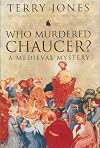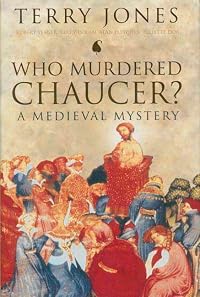
Who Murdered Chaucer?: A Medieval Mystery
by Terry Jones
On This Page
Description
Terry Jones investigates the mystery surrounding the death of Geoffrey Chaucer. He offers an introduction to Chaucer's writings as evidence that might be held against him, interwoven with a portrait of one of the most turbulent periods in English history, its politics and its personalities.Tags
Recommendations












Member Recommendations
Member Reviews
I picked up this text as part of a presentation requirement for a graduate seminar on The Canterbury Tales, so my intentions in reading it were largely academic in nature. The premise of the book (that is, that Chaucer himself may have been the victim of political assassination) is based on the lack of material evidence regarding Chaucer's last days, and what that lack of evidence (such as a will, funeral announcements, etc) may suggest about the poet's demise. Terry Jones and the four scholars he worked with present an interesting rereading of what is arguably a tainted history (limited records and the possibility of censorship render it difficult to gain an accurate account of the times), and situate their theories in the realm of show more possibility, while maintaining that speculation is all that is possible at this time.
From my perspective, Who Murdered Chaucer? is itself more speculation than scholarship, and Chaucer himself seems to often be lost among the shuffle of stories and plots (leading me to question the true focus of the book, be it Chaucer’s death, or a reexamination of the political atmosphere from which he disappeared). As a casual read, Terry Jones' publication is grossly entertaining and rewarding in terms of style and presentation, and would certainly delight any Chaucer, medieval, or Jones enthusiast. As a scholarly text, I can’t help but feel it falls short of its mark. show less
From my perspective, Who Murdered Chaucer? is itself more speculation than scholarship, and Chaucer himself seems to often be lost among the shuffle of stories and plots (leading me to question the true focus of the book, be it Chaucer’s death, or a reexamination of the political atmosphere from which he disappeared). As a casual read, Terry Jones' publication is grossly entertaining and rewarding in terms of style and presentation, and would certainly delight any Chaucer, medieval, or Jones enthusiast. As a scholarly text, I can’t help but feel it falls short of its mark. show less
Erudite and authorative, though at times shows the nature of co-authorship in repetition, at least for the first two thirds of the book. (No bad thing perhaps when one is new to the subject!). I am presently immersed in the denoument and cannot wait for the conclusion.
Terry Jones' wish to 'provoke debate and stimulate further study that will shed more light on this rather shady corner of history' is, for me, fulfilled. Sadly, however, much of what is available does, as Jones states, perpetuate the propaganda created by the winning side - 'Forget the traditional image of a Happy England overjoyed to see the tyrannical Richard II gone and the throne occupied by the popular and pious Henry IV.' Perhaps an era for Sharon Kay Penman's show more excellent skills? show less
Terry Jones' wish to 'provoke debate and stimulate further study that will shed more light on this rather shady corner of history' is, for me, fulfilled. Sadly, however, much of what is available does, as Jones states, perpetuate the propaganda created by the winning side - 'Forget the traditional image of a Happy England overjoyed to see the tyrannical Richard II gone and the throne occupied by the popular and pious Henry IV.' Perhaps an era for Sharon Kay Penman's show more excellent skills? show less
A well researched book that leaves you asking more questions than when you started. Highly reccomended!
haven't read it yet
Ratings
Members
- Recently Added By
Author Information

84+ Works 20,552 Members
Terry Jones was born in Colwyn Bay, Wales on February 1, 1942. He was a writer for such BBC programs as The Frost Report and Do Not Adjust Your Set, before joining with Graham Chapman, John Cleese, Eric Idle, and Michael Palin to form the Monty Python comedy troupe. Best remembered as the nude organist, Jones co-directed Monty Python and the Holy show more Grail (1975), and directed Life of Brian (1979) and Monty Python's The Meaning of Life (1983). Along with many Python-related books, screenplays, and records, he has written several non-fiction works including Chaucer's Knight: The Portrait of a Medieval Mercenary, Who Murdered Chaucer?: A Medieval Mystery, and Terry Jones's War on the War on Terror. He also wrote numerous children's books including The Saga of Erik the Viking, which won the Children's Book Award in 1984, Fantastic Stories, The Beast with a Thousand Teeth, The Curse of the Vampire Socks, and Bedtime Stories. (Bowker Author Biography) show less
All Editions
Awards and Honors
Notable Lists
Common Knowledge
- Original publication date
- 2003
- People/Characters
- Geoffrey Chaucer; John Hawkwood
- Important places
- England, UK (as England)
- First words
- This book is less of a Whodunnit? than a Wasitdunnatall?
- Blurbers
- Saul, Nigel; Ackroyd, Peter
Classifications
- Genres
- History, Nonfiction, Literature Studies and Criticism, Biography & Memoir
- DDC/MDS
- 821.1 — Literature & rhetoric English & Old English literatures British Poetry 1066-1400 Early English period, medieval period
- LCC
- PR1905 .W48 — Language and Literature English English Literature Anglo-Norman period. Early English. Middle English
- BISAC
Statistics
- Members
- 488
- Popularity
- 61,775
- Reviews
- 5
- Rating
- (4.09)
- Languages
- English
- Media
- Paper
- ISBNs
- 5