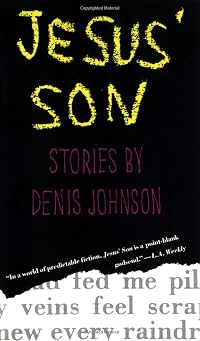
Jesus' Son: Stories
by Denis Johnson
On This Page
Description
Denis Johnson chronicles the wanderings of a young man as he struggles with addictions to drugs and alcohol. Separated into eleven stories, the young man eventually snaps out of his downward spiral and checks into rehab.Tags
Recommendations
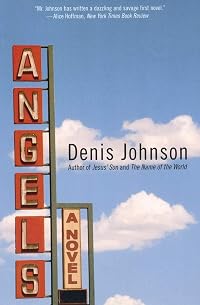


































Member Recommendations

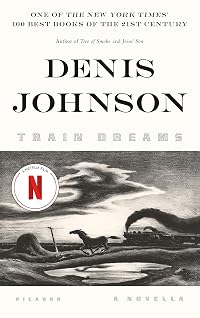
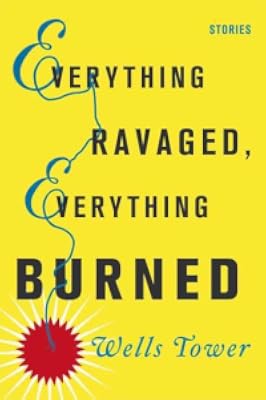
anonymous user Like Jesus Son, Between Nowhere and Happiness follows a young artistic type through Heroin addiction and love.
whitewavedarling Starve the Vulture is a memoir, and far removed from Johnson's fiction, but if you can handle and appreciate the content and the humor of one of them, you'll be glad to have found the second.

Member Reviews
“The vine was different every day. Some of the most terrible things that had happened to me in my life had happened in here. But like the others I kept coming back.”
“That moment in the bar, after the fight was narrowly averted, was like the green silence after the hailstorm. Somebody was buying a round of drinks. The cards were scattered on the table, face up, face down, and they seemed to foretell that whatever we did to one another would be washed away by liquor or explained away by sad songs.”
This story collection, feels like a potent brew, cooked up by Ken Kesey, Charles Bukowski and Lou Reed. A hallucinogenic stew of barflies, addicts, mental patients and misfits, living at the bottom or on the fringes of a derelict world. show more There is sadness and pain in these stories but there is also a glimmer of redemption. Obviously, this not for all tastes, some readers will flee in horror, but I found Johnson's wounded prose a transcendent joy.
“All these weirdos, and me getting a little better every day right in the midst of them. I had never known, never even imagined for a heartbeat, that there might be a place for people like us.” show less
“That moment in the bar, after the fight was narrowly averted, was like the green silence after the hailstorm. Somebody was buying a round of drinks. The cards were scattered on the table, face up, face down, and they seemed to foretell that whatever we did to one another would be washed away by liquor or explained away by sad songs.”
This story collection, feels like a potent brew, cooked up by Ken Kesey, Charles Bukowski and Lou Reed. A hallucinogenic stew of barflies, addicts, mental patients and misfits, living at the bottom or on the fringes of a derelict world. show more There is sadness and pain in these stories but there is also a glimmer of redemption. Obviously, this not for all tastes, some readers will flee in horror, but I found Johnson's wounded prose a transcendent joy.
“All these weirdos, and me getting a little better every day right in the midst of them. I had never known, never even imagined for a heartbeat, that there might be a place for people like us.” show less
“And sometimes a dust storm would stand off in the desert, towering so high, it was like another city – a terrifying new era approaching, blurring our dreams.”
Denis Johnson’s stories in [Jesus’ Son] are like the desert wind. In one minute they are whip around you and scour the earth. In the next, they are a gentle, welcoming breeze on your face. They touch down in whims, unheralded and capricious. They wreak havoc in one place while leaving the sand untouched just a few feet away. In their wake, you feel changed. Not exactly refreshed so much as different, altered.
That Johnson first came to attention as a poet is evident in the elegant language on display throughout:
“Sometimes I went during my lunch break into a big nursery show more across the street, a glass building full of plants and wet earth and feeling of cool dead sex>”
“We lay down on a stretch of dusty plywood in the back of the truck with the daylight knocking against our eyelids and the fragrance of alfalfa thickening our tongues.”
“For a while the day was clear and peaceful. It was one of the moments you stay in, to hell with all the troubles before and after. The sky is blue and the dead are coming back. Later in the afternoon, with sad resignation, the county fair bares its breasts.”
But beyond the language, Johnson’s keen eye for humanity is also at work. His stories are an exhibition of the fringe, the life that exists in the periphery. In these stories about the lost, he captures us all – the longing for something more in the same mind that works against us in the scrabble. If you can’t see yourself in the unnamed narrator, you’re deluded beyond any chemical alteration. But seeing yourself there will be painful.
Bottom Line: Spare, surreal, and provocative – beautiful language describing us all, even if we don’t want to see it.
5 bones!!!!!
A favorite for the year. show less
Denis Johnson’s stories in [Jesus’ Son] are like the desert wind. In one minute they are whip around you and scour the earth. In the next, they are a gentle, welcoming breeze on your face. They touch down in whims, unheralded and capricious. They wreak havoc in one place while leaving the sand untouched just a few feet away. In their wake, you feel changed. Not exactly refreshed so much as different, altered.
That Johnson first came to attention as a poet is evident in the elegant language on display throughout:
“Sometimes I went during my lunch break into a big nursery show more across the street, a glass building full of plants and wet earth and feeling of cool dead sex>”
“We lay down on a stretch of dusty plywood in the back of the truck with the daylight knocking against our eyelids and the fragrance of alfalfa thickening our tongues.”
“For a while the day was clear and peaceful. It was one of the moments you stay in, to hell with all the troubles before and after. The sky is blue and the dead are coming back. Later in the afternoon, with sad resignation, the county fair bares its breasts.”
But beyond the language, Johnson’s keen eye for humanity is also at work. His stories are an exhibition of the fringe, the life that exists in the periphery. In these stories about the lost, he captures us all – the longing for something more in the same mind that works against us in the scrabble. If you can’t see yourself in the unnamed narrator, you’re deluded beyond any chemical alteration. But seeing yourself there will be painful.
Bottom Line: Spare, surreal, and provocative – beautiful language describing us all, even if we don’t want to see it.
5 bones!!!!!
A favorite for the year. show less
Some books you read, some books you read you back. Jesus’ Son is the latter—quietly dismantling whatever illusion you walked in with, then leaving you alone with the pieces.
This is not a clean narrative. Not redemption packaged for comfort. It’s fragmented, hallucinatory, stitched together through addiction, violence, grace—sometimes all in the same breath. The narrator drifts through hospitals, highways, rooms thick with smoke and consequence, chasing something he can’t name and can’t outrun.
Denis Johnson writes like a man who has seen too much and decided not to look away. The prose is sparse but loaded—every sentence feels like it’s been stripped down to the bone and still somehow bleeding. There’s a strange, almost show more unbearable beauty here. Moments of clarity that hit harder because of how rare they are.
This is a book about addiction, yes—but more than that, it’s about being human when you’ve gone too far to pretend you’re not broken. It asks: what does grace look like when it arrives late, or not at all?
If you’re looking for plot, this won’t give it to you. If you’re looking for truth—uncomfortable, unfiltered, occasionally transcendent—this might be one of the most important books you’ll read. I certainly won’t forget it. show less
This is not a clean narrative. Not redemption packaged for comfort. It’s fragmented, hallucinatory, stitched together through addiction, violence, grace—sometimes all in the same breath. The narrator drifts through hospitals, highways, rooms thick with smoke and consequence, chasing something he can’t name and can’t outrun.
Denis Johnson writes like a man who has seen too much and decided not to look away. The prose is sparse but loaded—every sentence feels like it’s been stripped down to the bone and still somehow bleeding. There’s a strange, almost show more unbearable beauty here. Moments of clarity that hit harder because of how rare they are.
This is a book about addiction, yes—but more than that, it’s about being human when you’ve gone too far to pretend you’re not broken. It asks: what does grace look like when it arrives late, or not at all?
If you’re looking for plot, this won’t give it to you. If you’re looking for truth—uncomfortable, unfiltered, occasionally transcendent—this might be one of the most important books you’ll read. I certainly won’t forget it. show less
First, issue your disclaimer. Mine is that I’m not a big fan of short stories. Denis Johnson changed my mind with this, now one of my all-time favorite books, and showed how to braid narrative and use the lyric register (poetic language). Jesus’ Son is a mosaic of short stories that could be also considered an episodic novel (ha!). Titled from Lou Reed’s song, Heroin, these linked stories chronicle the progress of the addiction and tentative recovery of its narrator. One of the first locations mentioned in the first story is Bethany, Missouri. Bethany was best known as the place where Jesus raised Lazarus from the dead. Here, the man from Bethany is not just killed, but “killed forever” in a head-on collision, containing the show more dark humor with a subtle biblical reference that suffuses most of the stories. The stories contain a through line to the redemption of the narrator in eleven chapters, one short of the twelve steps of recovery, as well as the biblical significance of the twelve apostles, twelve tribes of Israel, twelve Stations of the Cross, and so on, indicating that the final chapter of this man’s life is yet unwritten.
More at http://annotationnation.wordpress.com/2009/04/30/jesus-son/ show less
More at http://annotationnation.wordpress.com/2009/04/30/jesus-son/ show less
The man we know only as Fuckhead is a total mess. As the main character in the interconnected short stories comprising Denis Johnson’s enthralling Jesus’ Son, he has little to recommend for himself, including being an inveterate liar and thief who is addicted to both drugs and alcohol, as well as a Peeping Tom and even a bunny killer. What may be even worse, though, is that he is a consistently unreliable narrator whose fractured, drug-addled memories give the entire volume a frenetic and disjointed presentation style. In tale after tale, the reader is introduced to the seedier side of life as Fuckhead and his reprobate associates move from run-down bars to squalid hotels to dead-end jobs when they are not in rehab facilities in an show more often-cynical attempt to clean up their lives. In short, this is a book that, collectively, paints a very grim picture of society’s underbelly with virtually no hope or salvation in sight.
So, why did I love reading this brief book so much? There are many reasons, really, but chief among them would have to be the author’s brutally direct but incredibly electric writing. In Fuckhead, Johnson perfectly captures the rhythms and mindset of an intelligent, but highly troubled young man who cannot manage to pull himself out the self-inflicted hole he’s put himself in and, for the most part, does not seem to care to try. Among the best of the stories, most of which were published independently in prestigious literary magazines before being collected into a single volume, were ‘Two Men', ‘Work’, ‘Emergency', ‘The Other Man’, and ‘Beverly Home’. Although each of these works involve different events—and is set in various locales, from somewhere in the Midwest to Seattle to Phoenix, underscoring the shiftlessness of Fuckhead’s existence—by the end they combine into a fully realized narrative. There is nothing pretty or redemptive to be found in Jesus’ Son, but it is riveting nonetheless and an absolute classic. show less
So, why did I love reading this brief book so much? There are many reasons, really, but chief among them would have to be the author’s brutally direct but incredibly electric writing. In Fuckhead, Johnson perfectly captures the rhythms and mindset of an intelligent, but highly troubled young man who cannot manage to pull himself out the self-inflicted hole he’s put himself in and, for the most part, does not seem to care to try. Among the best of the stories, most of which were published independently in prestigious literary magazines before being collected into a single volume, were ‘Two Men', ‘Work’, ‘Emergency', ‘The Other Man’, and ‘Beverly Home’. Although each of these works involve different events—and is set in various locales, from somewhere in the Midwest to Seattle to Phoenix, underscoring the shiftlessness of Fuckhead’s existence—by the end they combine into a fully realized narrative. There is nothing pretty or redemptive to be found in Jesus’ Son, but it is riveting nonetheless and an absolute classic. show less
An out-and-out knockout. This one's a short read, but after I finished the first story I knew that I wanted to take my time with it. Oddly enough, I kept thinking of Raymond Carver while I read this one. I'm not a Carver fan: his stuff is too neatly arranged, too focused on loneliness, and too spare for my tastes. But Johnson's got Carver's knack for imbuing life's most ordinary moments with extraordinary significance. Of course, Carver focused almost exclusively on the straight crowd, while Johnson's broadcasting from another America altogether, one that's filled with junkies, drifters, and down-and-outs. Death always seems to be close at hand in these stories, but so are liberating moments of seemingly accidental transcendence. Among show more all the bad behavior, there's several lifetimes worth of love, yearning, camaraderie and hope. Johnson relates his stories in an easy, fluid, familiar voice, but the stories here aren't just reportage from the rougher edges of society: there's a touch of weird mystery and magic in most of them, too. Junkies are compared to mermaids, trips to score dope turn into epic journeys, elements and characters seemingly drawn from fairy tales and mythology pop up in the most unexpected situations, mind-altering drugs are never, ever refused. If Carver's America is all about routine and the daily grind, everything that happens in "Jesus' Son" is a potential doorway to some sublime, or surreal, encounter. This is due, at least in part, to the author's absolutely first-rate prose: his descriptions can be both wildly original and impressively precise, and he's capable of lending the most banal, tossed-off conversations enormous emotional resonance. Of course, he makes it look effortless, but that only goes to show how good a writer he really was.
I suppose the other reason that Johnson's stories reminded me of Carver's is that they convey the enormous size of the American landscape in a similar sort of way. This is particularly true, I think, of the stories in "Jesus' Son" that are set in Iowa and mostly concern small-town drug addicts. His characters might be obsessed with getting their next fix, but Johnson also manages to convey the epic scale of the Midwestern plains, making them seem like a boundless, open space where anything might happen. Some readers may find the subject matter of these stories sort of distasteful, and I can understand that. But there's also something quintessentially American about them. For all the wandering that their characters do, part of the reason they work is that they seem so rooted in the American landscape. In Johnson's hands, scheming heroin addicts seem as much a part of the Midwest as cornfields. The subject matter can get pretty lurid, its characters -- no matter how desperate, addicted, or morally compromised, always come off as regular folks: there aren't any bohemians here. In a way, it's an incredibly deft reframing of what it means to live in, or write about, the United States, and that makes this little book of short stories seem downright important. Astonishing. Great. Five stars. Get your copy now. show less
I suppose the other reason that Johnson's stories reminded me of Carver's is that they convey the enormous size of the American landscape in a similar sort of way. This is particularly true, I think, of the stories in "Jesus' Son" that are set in Iowa and mostly concern small-town drug addicts. His characters might be obsessed with getting their next fix, but Johnson also manages to convey the epic scale of the Midwestern plains, making them seem like a boundless, open space where anything might happen. Some readers may find the subject matter of these stories sort of distasteful, and I can understand that. But there's also something quintessentially American about them. For all the wandering that their characters do, part of the reason they work is that they seem so rooted in the American landscape. In Johnson's hands, scheming heroin addicts seem as much a part of the Midwest as cornfields. The subject matter can get pretty lurid, its characters -- no matter how desperate, addicted, or morally compromised, always come off as regular folks: there aren't any bohemians here. In a way, it's an incredibly deft reframing of what it means to live in, or write about, the United States, and that makes this little book of short stories seem downright important. Astonishing. Great. Five stars. Get your copy now. show less
I've always been drawn to intensely literate depictions of squandered lives in various states of disrepair via the chemical catalysts of substances and/or booze. Whether it's Permanent Midnight, Leaving Las Vegas -- in my mind as bleak and brilliant as Malcolm Lowry's bacchanalian masterpiece, Under the Volcano -- or, even, going back a ways (a couple centuries or so) to Thomas De Quincey's, Confessions of an English Opium-Eater, I'm always moved by the emotional and psychological rawness of the harrowing accounts -- and reminded -- by these addict's sad stories, of the kind of person I'm glad I'm not (knock on wood) and never hope to be, again.
Denis Johnson's Jesus' Son: Stories (1992), for me, is as close to being high on dope you show more can be from merely ingesting words and sentences and paragraphs through your eyes. Fear and Loathing in Las Vegas doesn't come close to Jesus' Son's acute hallucinatory intensity, and that's no jab at Hunter S. Thompson, whose outrageous drunken romp in the desert I absolutely love. Perhaps Trainspotting would rank up there as highly with me as well, were I able to navigate at least half of its nearly indecipherable heavy accent that gives even Ozzy Osbourne a run for his money in interpreting whatever the hell that slangy dialogue of incoherent and rapid-fire colloquialisms means. If there's a Junky Canon of Literature, next to Burroughs and Hubert Selby's finest work, Denis Johnson deserves his trophy too -- say a gilded brick of cocaine with his name engraved, or maybe a diamond encrusted rock of black tar heroin he could wear on some bling bling.
In A Fan's Note (another boozer-loser's masterpiece), and the book that upon its publication in 1968 finally made its heretofore author's drunkard's existence mean something more than merely another wasted alcoholic's life, Frederick Exley said, speaking through one of his recently sobered-up characters in a rehab facility, that "alcoholism is hopelessness."
Assuming Exley's pithy, but profound, assessment is true, and it certainly rings true for me in its cut-through-the-crap clarity shed of all that extraneous, overly-analytical psychological hullabaloo of excuses your average drunk might stake his or her "disease" on, then, I ask, what the hell does that make heroin addiction? Comatose despondency? Suicide? I mean, what's more hopeless, besides child starvation, surviving under a tyrant's rule, or being on an airplane hijacked by terrorists, than heroin?
Jesus' Son nails that heroin hopelessness like no other book on the subject I've read. I can't say enough how much I appreciated the unreliable, deluded, deranged, doped-up, just plain odd perspective this unnamed narrator brings to some bizarre scenarios he encounters. Whether he's wading surreally through the slow-mo aftermaths of a head on car crash that killed the driver but left him unscathed in "Car Crash While Hitchhiking;" or, stripping copper wire out of a friends former low-rent habitation, hacking all day through dry wall, to earn enough scrap metal dough so that they can go out drinking that night, in "Work;" or, the black (unintentionally funny) comic reactions the narrator has in witnessing an unfortunate man walk into the E.R. with a knife sticking in his eye, where our anti-hero works as a constantly inebriated nurse's attendant, in "Emergency," I can't stop thinking to myself as I read, "this can't be; this is crazy" while remaining mesmerized by this guys weird (but not so weird as to be unbelievable) thought processes.
And I think Denis Johnson's characterization of this no-name junky alcoholic is indeed an accurate portrayal. It's an evocative and artistic (not to mention poetic; my God, Denis Johnson's spare poetic prose!) glimpse inside the messed up mind of a hardcore addict. It's terse inside that moody, manipulative mind; it's disjointed as a shoulder separation; it's non-sensical sometimes while remaining cogent (the twisted paradox of it!); it's past credulity yet makes perfect sense; it's beyond blackly comic (try Dr. Strangelove on steroids), like being miniaturized and shot inside the very user's veins along with the spoon-heated smack straight into the bloodstream and brain of one sick and pathetically warped (and yet so endearing and sympathetic) individual, so that you can see how he sees, think how he thinks, feel how he feels -- all of this, the dense under-statedness of it and the lack of fleshing out of the details or making complete narrative connections in the stories -- all of it -- by Denis Johnson's deft design. Johnson showcases the agony and sometimes unintended artfulness of the addict's mind in revelatory ways. A marvel of a little book.
This hopeless narrator of Jesus' Son literally perceives reality not in any manner the non-addict can ever hope to recognize, relate to, or understand -- and it's that difference in reality-perception captured so well by Denis Johnson that elevates Jesus' Son above the other better known and lionized classics of the inebriated and/or high literary tradition. show less
Denis Johnson's Jesus' Son: Stories (1992), for me, is as close to being high on dope you show more can be from merely ingesting words and sentences and paragraphs through your eyes. Fear and Loathing in Las Vegas doesn't come close to Jesus' Son's acute hallucinatory intensity, and that's no jab at Hunter S. Thompson, whose outrageous drunken romp in the desert I absolutely love. Perhaps Trainspotting would rank up there as highly with me as well, were I able to navigate at least half of its nearly indecipherable heavy accent that gives even Ozzy Osbourne a run for his money in interpreting whatever the hell that slangy dialogue of incoherent and rapid-fire colloquialisms means. If there's a Junky Canon of Literature, next to Burroughs and Hubert Selby's finest work, Denis Johnson deserves his trophy too -- say a gilded brick of cocaine with his name engraved, or maybe a diamond encrusted rock of black tar heroin he could wear on some bling bling.
In A Fan's Note (another boozer-loser's masterpiece), and the book that upon its publication in 1968 finally made its heretofore author's drunkard's existence mean something more than merely another wasted alcoholic's life, Frederick Exley said, speaking through one of his recently sobered-up characters in a rehab facility, that "alcoholism is hopelessness."
Assuming Exley's pithy, but profound, assessment is true, and it certainly rings true for me in its cut-through-the-crap clarity shed of all that extraneous, overly-analytical psychological hullabaloo of excuses your average drunk might stake his or her "disease" on, then, I ask, what the hell does that make heroin addiction? Comatose despondency? Suicide? I mean, what's more hopeless, besides child starvation, surviving under a tyrant's rule, or being on an airplane hijacked by terrorists, than heroin?
Jesus' Son nails that heroin hopelessness like no other book on the subject I've read. I can't say enough how much I appreciated the unreliable, deluded, deranged, doped-up, just plain odd perspective this unnamed narrator brings to some bizarre scenarios he encounters. Whether he's wading surreally through the slow-mo aftermaths of a head on car crash that killed the driver but left him unscathed in "Car Crash While Hitchhiking;" or, stripping copper wire out of a friends former low-rent habitation, hacking all day through dry wall, to earn enough scrap metal dough so that they can go out drinking that night, in "Work;" or, the black (unintentionally funny) comic reactions the narrator has in witnessing an unfortunate man walk into the E.R. with a knife sticking in his eye, where our anti-hero works as a constantly inebriated nurse's attendant, in "Emergency," I can't stop thinking to myself as I read, "this can't be; this is crazy" while remaining mesmerized by this guys weird (but not so weird as to be unbelievable) thought processes.
And I think Denis Johnson's characterization of this no-name junky alcoholic is indeed an accurate portrayal. It's an evocative and artistic (not to mention poetic; my God, Denis Johnson's spare poetic prose!) glimpse inside the messed up mind of a hardcore addict. It's terse inside that moody, manipulative mind; it's disjointed as a shoulder separation; it's non-sensical sometimes while remaining cogent (the twisted paradox of it!); it's past credulity yet makes perfect sense; it's beyond blackly comic (try Dr. Strangelove on steroids), like being miniaturized and shot inside the very user's veins along with the spoon-heated smack straight into the bloodstream and brain of one sick and pathetically warped (and yet so endearing and sympathetic) individual, so that you can see how he sees, think how he thinks, feel how he feels -- all of this, the dense under-statedness of it and the lack of fleshing out of the details or making complete narrative connections in the stories -- all of it -- by Denis Johnson's deft design. Johnson showcases the agony and sometimes unintended artfulness of the addict's mind in revelatory ways. A marvel of a little book.
This hopeless narrator of Jesus' Son literally perceives reality not in any manner the non-addict can ever hope to recognize, relate to, or understand -- and it's that difference in reality-perception captured so well by Denis Johnson that elevates Jesus' Son above the other better known and lionized classics of the inebriated and/or high literary tradition. show less
Members
- Recently Added By
Lists

The Top Ten: Writers Pick Their Favorite Books
240 works; 31 members

Backlisted
109 works; 9 members

100 New Classics
101 works; 13 members

Powell's 50 Books for 50 Years
50 works; 4 members

Books Read in 2020
4,379 works; 124 members

books to check out in 2014
9 works; 1 member

Books Read in 2013
1,630 works; 51 members

Read These Too
458 works; 9 members

Harold Bloom - The Western Canon: D. The Chaotic Age
833 works; 24 members

to get
244 works; 2 members
Backlisted Podcast
65 works; 3 members

2023
32 works; 1 member
Author Information

36+ Works 14,367 Members
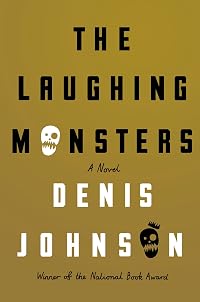
Denis Johnson was born in Munich, Germany on July 1, 1949. He received a bachelor's degree and a master's degree from the University of Iowa. He published his first book of poetry, The Man Among the Seals, at the age of 19. However, addictions to alcohol and drugs derailed him and he was in a psychiatric ward at the age of 21. He was sober by the show more early 1980s. Along with writing several volumes of poetry, Johnson wrote short stories for The New Yorker, Atlantic Monthly, Esquire, Paris Review, and Best American Short Stories. His novels included Angels, Jesus' Son, Resuscitation of a Hanged Man, Already Dead, Nobody Move, Train Dreams, and The Laughing Monsters. He won the National Book Award in 2007 for Tree of Smoke. He also received the Award for Literature from the American Academy of Arts, the Robert Frost Award, and the Library of Congress Prize for American Fiction. He died of liver cancer on May 24, 2017 at the age of 67. (Bowker Author Biography) show less
Some Editions
Awards and Honors
Awards
Distinctions
Series
Belongs to Publisher Series
Work Relationships
Is contained in
Common Knowledge
- Canonical title*
- Jesus' Son
- Original title
- Jesus' Son
- Original publication date
- 1992
- Related movies
- Jesus' Son (1999 | IMDb)
- Epigraph
- When I'm rushing on my run
And I feel just like Jesus' Son...
-Lou Reed, Heroin - Dedication
- For Bob Cornfield
- First words
- A salesman who shared his liquor and steered while sleeping...A Cherokee filled with bourbon...A VW no more than a bubble of hashish fumes captained by a college student...And a family from Marshalltown who head-onned and kil... (show all)led forever a man driving west out of Bethany, Missouri...
- Last words
- (Click to show. Warning: May contain spoilers.)I had never known, never even imagined for a heartbeat, that there might be a place for people like us.
- Blurbers
- Bass, Rick; Gaitskill, Mary
*Some information comes from Common Knowledge in other languages. Click "Edit" for more information.
Classifications
Statistics
- Members
- 3,197
- Popularity
- 5,418
- Reviews
- 87
- Rating
- (4.07)
- Languages
- 12 — Dutch, English, Finnish, French, German, Italian, Japanese, Polish, Portuguese, Spanish, Swedish, Turkish
- Media
- Paper, Audiobook, Ebook
- ISBNs
- 42
- ASINs
- 9