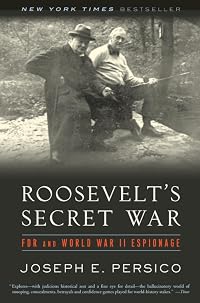
Roosevelt's Secret War: FDR and World War II Espionage
by Joseph E. Persico
On This Page
Description
"Despite all that has already been written on Franklin Delano Roosevelt, Joseph Persico has uncovered a hitherto overlooked dimension of FDR's wartime leadership: his involvement in intelligence and espionage operations." "Roosevelt's Secret War also describes how much FDR had been told - before the Holocaust - about the coming fate of Europe's Jews. And Persico also provides a definitive answer to the perennial question: Did FDR know in advance about the attack on Pearl Harbor?"--Jacket.Tags
Recommendations









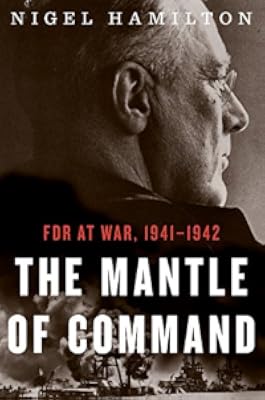

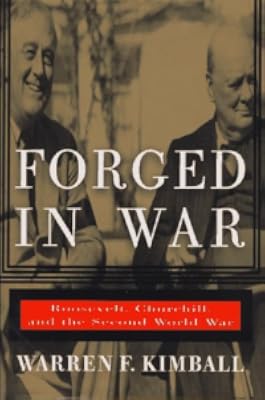
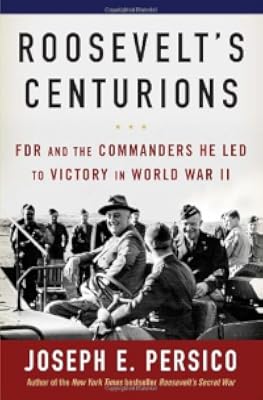
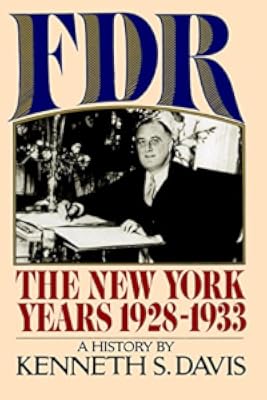


Member Reviews
A very interesting, if sometimes slow, account of a fascinating aspect of World War II, the clandestine operations orchestrated from the FDR White House. There's quite a bit of good information here.
A lot of the book deals with Roosevelt's personality and style of leadership. He enjoyed having several competing agencies at work at the same time, for example, and his love for the swash-buckling made him value dashing espionage work and the theories of his sometimes very imaginative field agents more than the generally more reliable information received from the purloined messages that his code-breakers gathered.
There's lots more like this. Lot's of very interesting information for history buffs. The roots of the Cold War are also laid show more out quite clearly here.
The flaws of the book involve often drawn out and frequently repetitive sections dealing with personality conflicts and competitions between the various intelligence gathering/spying agencies. Also, there are some very irritating editing miscues. Too frequently, quotes and anecdotes are presented more than once, and each time as if for the first time, as if the author did remember having used the material already. So not all of the books flows as readily as a reader would like it to. When I was finished, I was certainly ready to be finished, but also happy to have read the work. show less
A lot of the book deals with Roosevelt's personality and style of leadership. He enjoyed having several competing agencies at work at the same time, for example, and his love for the swash-buckling made him value dashing espionage work and the theories of his sometimes very imaginative field agents more than the generally more reliable information received from the purloined messages that his code-breakers gathered.
There's lots more like this. Lot's of very interesting information for history buffs. The roots of the Cold War are also laid show more out quite clearly here.
The flaws of the book involve often drawn out and frequently repetitive sections dealing with personality conflicts and competitions between the various intelligence gathering/spying agencies. Also, there are some very irritating editing miscues. Too frequently, quotes and anecdotes are presented more than once, and each time as if for the first time, as if the author did remember having used the material already. So not all of the books flows as readily as a reader would like it to. When I was finished, I was certainly ready to be finished, but also happy to have read the work. show less
This book could have been better written. Most annoying were the instances of repetition of material, sometimes word-for-word, which pulled me out of the "moment in time" in which Persico had me immersed, to sit for a minute or two casting my memory back to examine whether I was right that this had already been covered. For it to happen once is forgiveable, to happen 4-5 times is not. Where were the editor and proofreader?
Further, Persico often covered unnecessary and unimportant things in minute detail when a more detached rendering would have been sufficient and, frankly, welcomed by this reader.
From other readings, I knew much of what is reported here, but Persico did an excellent job of explaining what FDR was like as an show more administrator and how carefully he managed the thousands of balls he had in the air at any one time. He was a true master of illusion, never letting anyone know what he or anyone else was doing.
I was surprised to learn that the Army and Navy were competing in espionage collection and that they had a screwy system for giving the information they gleaned from the Japanese encryptions to the President (on some kind of 'need to know basis' which only they decided [and which had a very big effect on Pearl Harbor]), how very early the Manhattan Project began, how very underprepared the U. S. was for the war, that England was both spying on the U. S. and not reporting important information to us even though we were supposedly equal partners in the quest to crush Germany, that even though Japan has clear proof that their codes had been broken by the U. S. they never changed them, giving us an open line not only into their workings, but through one of their spies, into the German plans as well, that Churchill and Roosevelt both turned a blind eye to Stalin's massacre of thousands Polish officers, and how excellent and effective the Russian spies were in the U. S. show less
Further, Persico often covered unnecessary and unimportant things in minute detail when a more detached rendering would have been sufficient and, frankly, welcomed by this reader.
From other readings, I knew much of what is reported here, but Persico did an excellent job of explaining what FDR was like as an show more administrator and how carefully he managed the thousands of balls he had in the air at any one time. He was a true master of illusion, never letting anyone know what he or anyone else was doing.
I was surprised to learn that the Army and Navy were competing in espionage collection and that they had a screwy system for giving the information they gleaned from the Japanese encryptions to the President (on some kind of 'need to know basis' which only they decided [and which had a very big effect on Pearl Harbor]), how very early the Manhattan Project began, how very underprepared the U. S. was for the war, that England was both spying on the U. S. and not reporting important information to us even though we were supposedly equal partners in the quest to crush Germany, that even though Japan has clear proof that their codes had been broken by the U. S. they never changed them, giving us an open line not only into their workings, but through one of their spies, into the German plans as well, that Churchill and Roosevelt both turned a blind eye to Stalin's massacre of thousands Polish officers, and how excellent and effective the Russian spies were in the U. S. show less
Decent but not thrilling.
I need to keep better track of my Goodreads... This was a very informative and interesting read. I recommend.
(I also should work on a better review system, I know :P)
(I also should work on a better review system, I know :P)
I need to keep better track of my Goodreads... This was a very informative and interesting read. I recommend.
(I also should work on a better review system, I know :P)
(I also should work on a better review system, I know :P)
Ratings
Members
- Recently Added By
Lists

Book Titles Mentioned In Newberry Medal And Honor Books
884 works; 3 members
Author Information

15+ Works 4,665 Members
Was a contributing writer for Colin Powell's My American Journey. He also wrote Piercing the Reich, which is about the penetration of Nazi Germany by American Agents, and Nuremburg, which was made into a major television docudrama. (Publisher Provided) Joseph E. Persico was born in Gloversville, New York on July 19, 1930. He graduated from the New show more York State College for Teachers in 1952 and entered the Navy, serving aboard a minesweeper during the Korean War. Before becoming a speechwriter for Nelson A. Rockefeller, he worked for the United States Information Agency in Rio de Janeiro, Buenos Aires, and Washington. He stopped working for Rockefeller in 1977. During his lifetime, he wrote 12 books including The Imperial Rockefeller, Roosevelt's Secret War: FDR and World War II Espionage, and Franklin and Lucy: President Roosevelt, Mrs. Rutherfurd, and the Other Remarkable Women in His Life. He co-wrote My American Journey: An Autobiography with Colin L. Powell. Nuremberg: Infamy on Trial was adapted into an Emmy-winning TNT mini-series in 2000. He died after a long illness on August 30, 2014 at the age of 84. (Bowker Author Biography) show less
Awards and Honors
Distinctions
Common Knowledge
- Canonical title
- Roosevelt's Secret War: FDR and World War II Espionage
- Original publication date
- 2002
- People/Characters
- Franklin Delano Roosevelt; Winston Churchill; William J. Donovan; Harry Hopkins; George C. Marshall; Eleanor Roosevelt (show all 7); Grace Tully
- Important places
- Washington, D.C., USA
- Important events
- World War II (1939 | 1945); Operation Fortitude (1943-12 | 1944-03)
- Dedication
- To the next generation, Amanda, Joshua, and Georgia, and my literary agent, Clyde Taylor
Classifications
- Genres
- History, Nonfiction, General Nonfiction, Biography & Memoir
- DDC/MDS
- 940.548673 — History & geography History of Europe History of Europe 1918- Military history of World War II Other Topics Unconventional warfare of Allies
- LCC
- D810 .S7 .P45 — History of Europe, Asia, Africa and Oceania History (General) World War II (1939-1945)
- BISAC
Statistics
- Members
- 570
- Popularity
- 51,670
- Reviews
- 5
- Rating
- (3.62)
- Languages
- English
- Media
- Paper, Ebook
- ISBNs
- 4
- ASINs
- 3