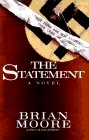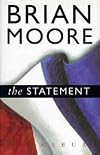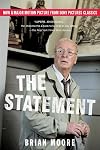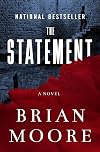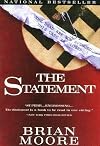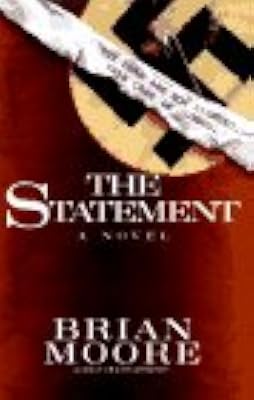
The Statement
by Brian Moore
On This Page
Description
Jews set out to assassinate a Frenchman as punishment for the murder of fellow Jews during World War II. The villain is Pierre Brossard, 70, who was a police officer in occupied France and who has been in hiding since the war, protected by the Catholic Church. By the author of Lies of Silence.Tags
Recommendations



















Member Recommendations
Member Reviews
Very well written. My eyes rushed over line after line of apparently effortless prose, though I found his use of italicised French phases like 'le parking' when English terms exist poncey and smug.
There are two moments that stand out for me.
First, amongst the Catholic-bashing there's a nice bit where a monk is told by his superior that hiding Brossard’s whereabouts is not a matter for his conscience. He quietly disagrees and the next thing we the readers are told, Brossard’s movements have been reported.
Secondly, on page 62, as he begs for God’s help, Brossard says “If God forgives me then I don’t give a damn about this world.” And in that one phrase all the hypocrisy of his evil little soul is betrayed.
However I feel show more that this novel is betrayed by its own almost wordlessly terse style. Compare Joseph’s soliloquy on page 169 to Father Callahan’s soliloquy in ‘Salem’s Lot (no, seriously, I’m comparing a Booker-nominated writer with Stephen King) and you’ll see a bony statement of fact against a prose poem of humane understanding. Who does Moore think he is... Thomas Keneally?
Frankly, I just didn’t give a damn. Brossard is unambiguously uninteresting psychologically, and the only sympathetic characters, Livi and Roux, are shunted off into formal plot pushing roles.
I see this is one of Moore’s few books that wasn’t up for a major award, but considering the quality of the prose I think I would be interested in reading more of his work. show less
There are two moments that stand out for me.
First, amongst the Catholic-bashing there's a nice bit where a monk is told by his superior that hiding Brossard’s whereabouts is not a matter for his conscience. He quietly disagrees and the next thing we the readers are told, Brossard’s movements have been reported.
Secondly, on page 62, as he begs for God’s help, Brossard says “If God forgives me then I don’t give a damn about this world.” And in that one phrase all the hypocrisy of his evil little soul is betrayed.
However I feel show more that this novel is betrayed by its own almost wordlessly terse style. Compare Joseph’s soliloquy on page 169 to Father Callahan’s soliloquy in ‘Salem’s Lot (no, seriously, I’m comparing a Booker-nominated writer with Stephen King) and you’ll see a bony statement of fact against a prose poem of humane understanding. Who does Moore think he is... Thomas Keneally?
Frankly, I just didn’t give a damn. Brossard is unambiguously uninteresting psychologically, and the only sympathetic characters, Livi and Roux, are shunted off into formal plot pushing roles.
I see this is one of Moore’s few books that wasn’t up for a major award, but considering the quality of the prose I think I would be interested in reading more of his work. show less
What seems to be long time ago already, World War II changed not only the lives of those who were invaded, it changed the way countries looked at factions within themselves. France being just one example where internal groups either fought against or collaborated with the Nazis. Although the internal structure of invaded countries changed, what it did not change were the personalities of those who committed the holocaust crimes. Hannah Arendt calls this appropriately: The Banality of Evil, a theme quite fitting to this novel. Those collaborators were, you could say 'activated', not altered or changed. Their tendencies were already there, but were suppressed because of regular pressure and laws not present during Nazi occupation.
The show more Statement is a novel that carefully explores what happens when a man did not choose his destiny abut instead went along with his brutal instincts, when given the opportunities to explore those instincts encouraged by the Germans. We find him, Pierre Brossard, much later on the run at the age of 70 in the south of France. There he moves from safe house to safe house and spends most of his time hiding in monasteries. His paranoia becomes justified when he barely walks out of an assassin's trap. Most of the book revolves around finding out who sent the assassin and who is still trying to bring Brossard to trial. All the while we learn more and more about the Nazi collaborator's inner empty world and his motivations, or lack thereof.
The books starts with a man on the run from ultimate justice, but this is not what the novel is about. Using rapidly changing perspectives (the author constantly and casually changes who the 'I' speaker is) Brian Moore attempts to show that decisions have, and more importantly: indecision has, wider spread effects than just one person's choice of a course of action a long time ago. It is not Brossard's decision to commit impulsive crimes for the brief sensation of ultimate power, that sets things in motion. It is they, who have from the beginning placed themselves in carefully protected fortresses of control, who this book is about. Ultimately this novel is about decisions and knowing and thinking about the consequences of decisions.
To reveal the inner workings of complex personality issues, Moore wrote the novel in a solipsistic fashion, as in the reader moves from head to head and sees the world through those eyes. This gives the book a very claustrophobic and confusing feel and might not work for everyone. Part of this is due to Moore's own outlook and his own personal life, but I'm sure the style was carefully chosen as well to fit the theme of the book. I can't say I know if I really liked the novel. The issues and handling of important questions was handled carefully and appropriately, but I felt there was a bit of humanity missing that, when added, could have made a much richer book with even a lot more contrast between good and evil. show less
The show more Statement is a novel that carefully explores what happens when a man did not choose his destiny abut instead went along with his brutal instincts, when given the opportunities to explore those instincts encouraged by the Germans. We find him, Pierre Brossard, much later on the run at the age of 70 in the south of France. There he moves from safe house to safe house and spends most of his time hiding in monasteries. His paranoia becomes justified when he barely walks out of an assassin's trap. Most of the book revolves around finding out who sent the assassin and who is still trying to bring Brossard to trial. All the while we learn more and more about the Nazi collaborator's inner empty world and his motivations, or lack thereof.
The books starts with a man on the run from ultimate justice, but this is not what the novel is about. Using rapidly changing perspectives (the author constantly and casually changes who the 'I' speaker is) Brian Moore attempts to show that decisions have, and more importantly: indecision has, wider spread effects than just one person's choice of a course of action a long time ago. It is not Brossard's decision to commit impulsive crimes for the brief sensation of ultimate power, that sets things in motion. It is they, who have from the beginning placed themselves in carefully protected fortresses of control, who this book is about. Ultimately this novel is about decisions and knowing and thinking about the consequences of decisions.
To reveal the inner workings of complex personality issues, Moore wrote the novel in a solipsistic fashion, as in the reader moves from head to head and sees the world through those eyes. This gives the book a very claustrophobic and confusing feel and might not work for everyone. Part of this is due to Moore's own outlook and his own personal life, but I'm sure the style was carefully chosen as well to fit the theme of the book. I can't say I know if I really liked the novel. The issues and handling of important questions was handled carefully and appropriately, but I felt there was a bit of humanity missing that, when added, could have made a much richer book with even a lot more contrast between good and evil. show less
After Nazi Germany occupied France, many Frenchmen took a direct hand in the deportation of more than 80,000 Jews. Following the war, some -- Paul Touvier among them -- were convicted of treason, pardoned in the 1970s, and then rearrested and jailed. Brian Moore takes off from there with a fictional account of Pierre Brossard, who lives a shadowy life, flees from pursuers and confronts some of France's most vexing questions from an horrific time in its history.
While Moore's new novel can be called a thriller, it is in fact another of his stunning moral visions of modern life (Lies of Silence; The Colors of Blood) that have marked him as an astute, impassioned chronicler of 20th-century spiritual malaise. Here he has taken inspiration show more from a real situation, that of a former pro-Nazi Vichy military officer, Maurice Papon, who for four decades evaded punishment for his complicity in WWII crimes against Jews. Moore's antihero is called Pierre Brossard. He is introduced to us as an apparently nervous old man who travels only with a suitcase and a prayer. But he is soon revealed as a ruthless, twisted fascist whose piousness hides a vicious core of bigotry. Under the protection of an intricate web of aging Nazi collaborators and extreme conservatives entrenched in the Catholic Church, he has eluded capture for 44 years. We follow him as a secret terrorist organization attempts to exact final vengeance for his wartime crimes and discover that not one ounce of contrition shadows his mind. A wily and murderous veteran of the game, Brossard eliminates his would-be assassins and re-exposes his case to the world, with shocking results. The chase is riveting, and Moore's exploration of the chilling self-righteousness behind Brossard's reasoning is provocative and disturbing, showing how hatred can spew its own, distorted rationality. In the end, Moore extrapolates from real life a masterful puzzle of spiritual and historical dimensions. show less
While Moore's new novel can be called a thriller, it is in fact another of his stunning moral visions of modern life (Lies of Silence; The Colors of Blood) that have marked him as an astute, impassioned chronicler of 20th-century spiritual malaise. Here he has taken inspiration show more from a real situation, that of a former pro-Nazi Vichy military officer, Maurice Papon, who for four decades evaded punishment for his complicity in WWII crimes against Jews. Moore's antihero is called Pierre Brossard. He is introduced to us as an apparently nervous old man who travels only with a suitcase and a prayer. But he is soon revealed as a ruthless, twisted fascist whose piousness hides a vicious core of bigotry. Under the protection of an intricate web of aging Nazi collaborators and extreme conservatives entrenched in the Catholic Church, he has eluded capture for 44 years. We follow him as a secret terrorist organization attempts to exact final vengeance for his wartime crimes and discover that not one ounce of contrition shadows his mind. A wily and murderous veteran of the game, Brossard eliminates his would-be assassins and re-exposes his case to the world, with shocking results. The chase is riveting, and Moore's exploration of the chilling self-righteousness behind Brossard's reasoning is provocative and disturbing, showing how hatred can spew its own, distorted rationality. In the end, Moore extrapolates from real life a masterful puzzle of spiritual and historical dimensions. show less
There are three basic rule that apply to all books and for sure all novels. It should make you want to turn the page, It should not be predictable. And it should treat readers like thinking adults. This book passes on all these questions. But never really takes it to the next level where the writing is exquisite, or expounds a new truth of reality. Worth reading none the less. Warning contains spoiler where the plot falls down is that one of the characters wonders how these assasins manage to find him, and I assume he's fairly smart, that he can't figure it out himself. If you tell one person where you are and you keep getting followed then that one person is the mole.
Pretty interesting story, and it was enjoyable to listen to, but it never really hooked me.
A gripping read.
Ratings
Members
- Recently Added By
Author Information

31+ Works 5,937 Members
Brian Moore, 1921 - 1999 Brian Moore was born in Belfast on August 25, 1921 to Doctor James Bernard Moore and Eileen McFadden. He attended St. Malachy's College, a Catholic school, where the students where beaten on the hands daily. He left the college without a School Leaving Certificate because he failed Math. In 1941, a bomb damaged the family show more home, so they moved to a house on Camden Street. A year later, his father died. In 1942, he joined the National Fire Service, but knew that he wanted to be a writer. Moore knew some French, so he was hired by the British Ministry of War Transport to go as a port official to Algiers, North Africa. Afterwards, he traveled to Italy, France, and after the war, Warsaw (1945), Spain, Canada (1948), the United States and England, finally settling in California. Moore immigrated to Canada in 1948, where he worked as a proofreader and reporter for the Montreal Gazette. In 1951, he published his first story in the Northern Review and married Jacqueline Sirois, a fellow journalist. His only child, Michael, was born on November 24, 1953. He split with his wife in 1964 and then married Jean Denney, who he stayed married to until his death. Moore published "The Lonely Passion of Judith Hearne" (1955), "The Feast of Lupercal" (1957) and "The Emperor of Ice Cream" (1966), which is his most autobiographical novel. He recounts his school experiences, as well as what is was like during the bombing. In the 1990's, he wrote political fables and four novels. "Lies of Silence" is a thriller set in Belfast and was a more political statement than the previous novels. It was nominated for the Booker Prize and was his bestselling book. Several of his books were made into films such as "The Luck of Ginger Coffey," "Catholics," "The Lonely Passion of Judith Hearne" and "The Temptation of Eileen Hughes" was adapted for television. Moore received many awards, which included the Governor General's Award in 1961 for "The Luck of Ginger Coffey" and again in 1975 for "The Great Victorian Collection," which also won the James Tait Black Award in England. He was short listed for the Booker Prize in 1987 for "The Colour of Blood" and again in 1990 for "Lies of Silence." In July 1987, he conferred an honorary doctorate by Queen's University, Belfast. His film "Catholics" received the W.H. Smith Award in 1973 and the Peabody Award in 1974. In 1999, Brian Moore died at his home in Malibu, California. (Bowker Author Biography) show less
Awards and Honors
Awards
Work Relationships
Has the adaptation
Common Knowledge
- Original title
- The Statement
- Original publication date
- 1984
- Important events
- World War II
- Related movies
- The Statement (2003 | IMDb)
- Dedication*
- Voor Jean
encore et toujours - First words*
- R voelde zich niet thuis in het zuiden.
- Last words*
- (Click to show. Warning: May contain spoilers.)Hij bukte zich en spelde zorgvuldig, met behulp van twee grote veiligheidsspelden, de verklaring op de borst van de dode man.
- Original language*
- Engels
*Some information comes from Common Knowledge in other languages. Click "Edit" for more information.
Classifications
Statistics
- Members
- 535
- Popularity
- 56,032
- Reviews
- 6
- Rating
- (3.66)
- Languages
- 6 — Dutch, English, German, Hungarian, Italian, Portuguese
- Media
- Paper, Audiobook, Ebook
- ISBNs
- 31
- ASINs
- 9