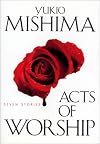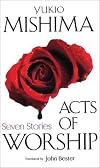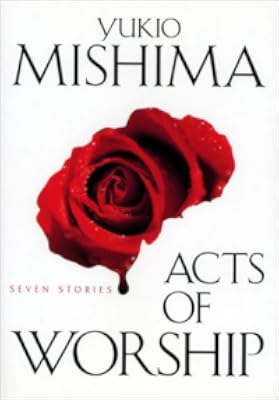
Acts of Worship: Seven Stories
by Yukio Mishima
On This Page
Description
Here are seven stories of psychological insight and eroticism from Japan's most famous writer. Other works by Yukio Mishima which are published by Kodansha include Sun and Steel'. When Mishima committed ritual suicide in November 1970, he was only forty-five. He had written over thirty novels, eighteen plays, and twenty volumes of short stories. During his lifetime, he was nominated for the Nobel Prize three times and had seen almost all of his major novels appear in English. While the show more flamboyance of his life and the apparent fanaticism of his death have dominated' show lessTags
Recommendations
















Member Recommendations
Member Reviews
One thing that struck me while reading this book is Mishima's unique ability to use words to sketch vivid images that will continue to stay etched in your memory long after you’ve finished the story. The seven stories in this collection spans a large part of Mishima's career as a writer. It was first published in 1965. The title, Acts of Worship, suggests that there is a kind of leitmotif to these stories – and it sure makes it more interesting to view this collection as a whole that way. The first two stories, Fountains in the Rain and Raisin Bread, were both written in 1963, and the protagonists here are frustrated young men. There is a hint of surrealism in both of these stories, especially the latter where Mishima also very show more cleverly paraphrases de Lautréamont’s Les Chants de Maldoror. Here, we are introduced to a group of restless westernized youth; the protagonist is called Jack, "with a past that included an attempted suicide", he is described as "twenty-two and made of a clear crystalline substance, [he] had as his sole aim to become quite invisible."
Sword (also 1963) is set in a college kendo club; the main protagonist being the club’s captain, Jiro. It is one of the most lengthy of these stories, and the one I liked the best. It’s easy to see Sword as one of the key stories among Mishima’s work. (Another is undoubtedly Patriotism, which was published in 1966.) Again Mishima’s evocative and poignant images are as important as the storyline:
"To be strong and true had been the most important task he had set himself since early childhood.
Once, as a boy, he had tried to outstare the sun. But before he could tell whether he had really looked at it or not, changes had occurred: the blazing red ball that had been there at first began to whirl, then suddenly dimmed, till it became a cold, bluish-black, flattened disk of iron. He felt he had seen the very essence of the sun....
For a while, wherever he looked he saw the sun's pale afterimage: in the undergrowth; in the shade beneath the trees; even, when he gazed up, in every part of the sky.
The truth was something too dazzling to be looked at directly. And yet, once it had come into one's field of vision, one saw patches of light in all kinds of places: the afterimages of virtue."
The next story, Sea and Sunset (1955), as well as the last in this collection, Act of Worship (1965), deals with more elderly people, and the whole tone is set in a lower, more melancholy pitch. The first of these is set in the thirteenth century; the main character is a reminiscing old Frenchman who had taken part in the Children’s Crusade, then being sold into slavery and eventually ending up as a handyman at a Buddhist temple after being freed by a Zen Master. Well, that's at least the 'skeleton' of the story, which isn't to say that this is what's the story is really about. Mishima is mostly more subtle than that. It is the only story in this collection that I didn’t care much for, while the last is among the best – with its distant echo of Thomas Mann: an aging eccentric professor of literature goes on a pilgrimage to three shrines in his birth district, bringing along his middle-aged house-keeper, both portrayed as unattractive in different ways – he with a walleye, dyed hair, soprano voice, vain... she with hollow cheeks, protruding teeth, "a face devoid of sexual appeal", self-effacing... Slowly the real reason for the pilgrimage comes to light. It rounds up this book perfectly, and it’s no coincidence that this entire collection of stories has gotten its title from this particular story.
In Cigarette (1946), which is a reminiscence of Mishima's school days - one of the first stories that won him attention in the literary world, and Martyrdom (1948), we return to youthful protagonists; both of these stories are succinctly rendered, and in the sublime cruelty depicted in Martyrdom there is a foreshadowing of his 1963 novel The Sailor Who Fell from Grace with the Sea. These two stories may not be among his best, but still fascinating reading - and on the whole, Mishima's portrayals of youth are in a class by itself.
This work is licensed under a Creative Commons Attribution-NonCommercial-ShareAlike 3.0 Unported License. show less
Sword (also 1963) is set in a college kendo club; the main protagonist being the club’s captain, Jiro. It is one of the most lengthy of these stories, and the one I liked the best. It’s easy to see Sword as one of the key stories among Mishima’s work. (Another is undoubtedly Patriotism, which was published in 1966.) Again Mishima’s evocative and poignant images are as important as the storyline:
"To be strong and true had been the most important task he had set himself since early childhood.
Once, as a boy, he had tried to outstare the sun. But before he could tell whether he had really looked at it or not, changes had occurred: the blazing red ball that had been there at first began to whirl, then suddenly dimmed, till it became a cold, bluish-black, flattened disk of iron. He felt he had seen the very essence of the sun....
For a while, wherever he looked he saw the sun's pale afterimage: in the undergrowth; in the shade beneath the trees; even, when he gazed up, in every part of the sky.
The truth was something too dazzling to be looked at directly. And yet, once it had come into one's field of vision, one saw patches of light in all kinds of places: the afterimages of virtue."
The next story, Sea and Sunset (1955), as well as the last in this collection, Act of Worship (1965), deals with more elderly people, and the whole tone is set in a lower, more melancholy pitch. The first of these is set in the thirteenth century; the main character is a reminiscing old Frenchman who had taken part in the Children’s Crusade, then being sold into slavery and eventually ending up as a handyman at a Buddhist temple after being freed by a Zen Master. Well, that's at least the 'skeleton' of the story, which isn't to say that this is what's the story is really about. Mishima is mostly more subtle than that. It is the only story in this collection that I didn’t care much for, while the last is among the best – with its distant echo of Thomas Mann: an aging eccentric professor of literature goes on a pilgrimage to three shrines in his birth district, bringing along his middle-aged house-keeper, both portrayed as unattractive in different ways – he with a walleye, dyed hair, soprano voice, vain... she with hollow cheeks, protruding teeth, "a face devoid of sexual appeal", self-effacing... Slowly the real reason for the pilgrimage comes to light. It rounds up this book perfectly, and it’s no coincidence that this entire collection of stories has gotten its title from this particular story.
In Cigarette (1946), which is a reminiscence of Mishima's school days - one of the first stories that won him attention in the literary world, and Martyrdom (1948), we return to youthful protagonists; both of these stories are succinctly rendered, and in the sublime cruelty depicted in Martyrdom there is a foreshadowing of his 1963 novel The Sailor Who Fell from Grace with the Sea. These two stories may not be among his best, but still fascinating reading - and on the whole, Mishima's portrayals of youth are in a class by itself.
This work is licensed under a Creative Commons Attribution-NonCommercial-ShareAlike 3.0 Unported License. show less
In Acts of Worship, Mishima captures the nihilistic despair and complex beauty of characters and settings much like in his longer work. While still containing the essence of his style, the short length of the stories do not allow room for a complete showcase of his talent. Some of the stories are only satisfactory, but others are excellent quality. 'Sword' and 'Act of Worship' stand out boldly among the rest. A worthwhile read for those already acquainted with Mishima's work.
Mishima began my love of Japanese literature, especially short stories. Japanese literature has a refreshing vein of naturalism and mysticism, and Mishima's stories are prime examples. I used some of his stories to teach themes to tenth graders (especially the rain one, with the rain outside, the water in the fountain, the tears on the girl's face, etc). He's a brilliant short story writer. I also enjoyed his other collection, Death in Midsummer.
Short stories that serve us up parts of Mishima. Includes many of the same themes found in his books.
Ratings
Members
- Recently Added By
Published Reviews
ThingScore 75
These complementary volumes of fiction and nonfiction only confirm his genius.
added by GYKM
Lists

Japanese Literature
230 works; 40 members
Author Information

269+ Works 27,182 Members
Yukio Mishima, the pseudonym for Hiraoka Kimitake, was born in Tokyo in 1925. His work covers many styles: poetry, essays, modern Kabuki ja Noh drama, and novels. Among his masterpieces are The Temple of the Golden Pavilion, and the four-volume novel Sea of Fertility, which outlines the Japanese experience in the 20th century. Each of the four show more volumes in this series has a distinct title--Spring Snow, Runaway Horses, The Temple of Dawn, and Five Signs of a God's Decay--and they were published over a six-year period, from 1965-1970. Mishima's plays include Tenth Day Chrysanthemum, and the Kabuki piece The Moon Like a Drawn Bow. Although Mishima was been nominated three times for the Nobel Prize for Literature, he never received it. Nevertheless, he is considered by many critics as one of the most important Japanese novelists of the 20th century. Yukio Mishima died by his own hand in 1970, committing seppuku (ritual disembowelment). (Bowker Author Biography) show less
Some Editions
Awards and Honors
Work Relationships
Common Knowledge
- Original title
- 三熊野詣
- Alternate titles
- Mikumano Moude
- Original publication date
- 1965 (original Japanese) (original Japanese); 1989 (English: Bester) (English: Bester)
- People/Characters
- Jiru Kobubu ("Sword")
- Last words
- (Click to show. Warning: May contain spoilers.)"Yes, I certainly will."
- Original language
- Japanese
- Disambiguation notice
- "Act of Worship" is a single story.
"Acts of Worship" is a collection of 7 stories - note the plural.
Please don't combine the two.
Classifications
- Genres
- Fiction and Literature, General Fiction
- DDC/MDS
- 895 — Literature & rhetoric Literatures of other languages Literatures of East and Southeast Asia
- LCC
- PL833 .I7 .A24 — Language and Literature Languages and literatures of Eastern Asia, Africa, Oceania Languages of Eastern Asia, Africa, Oceania Japanese language and literature Japanese literature Individual authors and works
- BISAC
Statistics
- Members
- 413
- Popularity
- 75,096
- Reviews
- 4
- Rating
- (3.70)
- Languages
- English, Italian, Portuguese
- Media
- Paper
- ISBNs
- 9
- ASINs
- 2