
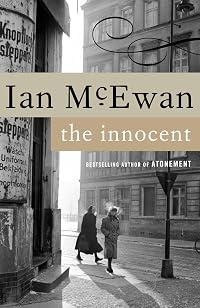
The Innocent
by Ian McEwan
On This Page
Description
Leonard Marnham is assigned to a British-American surveillance team in Cold War Berlin. His intelligence work--tunneling under a Russian communications center to tap the phone lines to Moscow--offers him a welcome opportunity to begin shedding his own unwanted innocence, even if he is only a bit player in a grim international comedy of errors. Leonard's relationship with Maria Eckdorf, an enigmatic and beautiful West Berliner, likewise promises to loosen the bonds of his ordinary life. But show more the promise turns to horror in the course of one terrible evening--a night when Leonard Marnham learns just how much of his innocence he's willing to shed. show lessTags
Recommendations




























Member Recommendations
Member Reviews
McEwan is a dense writer (I say this having read a grand total of two of his books, of course) so I feel as though I have to be in the right mood to get into one of his novels. Subtle buildup seems to be a theme of his. Which isn’t to say, of course, that he’s boring. I found both this novel and Atonement to be master works in demonstrating the power authors have to demonstrate tone through language and pacing. I get immense joy from reading how he can manipulate the to match the needs of the scene – from long, ponderous, lush phrasing to match when a character is ruminating; to fast, paranoid, rapid-fire phrasing when the situation is tense.
The story is of a young man, Leonard Marnham, working for the British secret service in show more Berlin following World War 2. He’s involved in the historical Operation Gold, an actual espionage attempt where the British and Americans cooperated to tap Soviet/East German phone lines. This was conducted by digging a tunnel under the border between Allied and Soviet sectors of the city (this predates the Wall). This isn’t, however, a spy novel in the customary sense. No gadgets, no novels, no state intrigue. The intrigue here is personal.
The tunnel imagery plays a key role in how the story unfolds. Marnham’s life is one of separation. By it’s nature, he has to keep his work life, technical assistance on Operation Gold, separate from his personal life, a budding relationship with a local Berliner. He, himself, even comments on how he feels like a different person when he’s working in the tunnel versus when he’s with Maria. The job, itself, is as if he’s gone through a tunnel and emerged into an entirely new life from what he knew in his youth in England. Segmentation, different sections of his life divided off that he travels to and from, emerging into each as a different person is a key theme to the novel. One that, as these things go, will not last when Leonard is forced to mix the parts of his life.
Given the title, the concept of innocence is explored and played with throughout the novel. Leonard is caught up in the machinations of the Allies versus the Soviets and even the Americans and the British, conflicts he doesn’t seem prepared to deal with. He’s also an innocent in love as his relationship with Maria shows. To use a cliche, she makes him a man. Finally, the two lovers are also innocent of the crime that they punish themselves for.
Finally, there’s the question of innocence of the people of Germany. While I don’t think the novel tries to brush over German civilian complicity in Nazi war crimes (which ended less than a decade prior to the start of the novel), it does look briefly at the nature of the city following the war and Berliner relations with the occupying Allied forces. The city is described as wrecked and ruined, areas of the city are described in terms of which of the Allied nations occupies it and how they treat the civilians, and Maria and her female friends are scarred by memories of the rapes committed by Soviet soldiers during the conquest. British and American characters act with a degree of overlordship over the city, and Maria is the only German character in the story, aside from a few minor characters. Even hapless Leonard marvels in his luxurious, massive apartment in a building occupied by other Allied national officials while Maria talks about the housing shortage for native Berliners and lives in an apartment threatened by squatters and with insufficient heat and no running water.
Genuinely, I enjoyed this book quite a bit. There is little I can say that I disliked. As mentioned above, it takes a little while to draw you in but that seems to be McEwan’s thing: novels that are a slow burn, but you’re engrossed before you realize it. Leonard was an absolutely charming character to be in the head of, if a little awkward and uncomfortable in some scenes. Maria was a mystery I enjoyed trying to piece together, especially given the novel’s espionage setting. The event that triggers the last third of the book and its attending chaos is made ever more delicious by the supporting cast: the various G-men and agents in the various organizations that Leonard works with. Berlin as a part-surreal no-man’s land and part-conquered paradise fits the story and its themes of innocence and compartmentalization well. It’s somewhat a shame that, according to McEwan, few people read the book. show less
The story is of a young man, Leonard Marnham, working for the British secret service in show more Berlin following World War 2. He’s involved in the historical Operation Gold, an actual espionage attempt where the British and Americans cooperated to tap Soviet/East German phone lines. This was conducted by digging a tunnel under the border between Allied and Soviet sectors of the city (this predates the Wall). This isn’t, however, a spy novel in the customary sense. No gadgets, no novels, no state intrigue. The intrigue here is personal.
The tunnel imagery plays a key role in how the story unfolds. Marnham’s life is one of separation. By it’s nature, he has to keep his work life, technical assistance on Operation Gold, separate from his personal life, a budding relationship with a local Berliner. He, himself, even comments on how he feels like a different person when he’s working in the tunnel versus when he’s with Maria. The job, itself, is as if he’s gone through a tunnel and emerged into an entirely new life from what he knew in his youth in England. Segmentation, different sections of his life divided off that he travels to and from, emerging into each as a different person is a key theme to the novel. One that, as these things go, will not last when Leonard is forced to mix the parts of his life.
Given the title, the concept of innocence is explored and played with throughout the novel. Leonard is caught up in the machinations of the Allies versus the Soviets and even the Americans and the British, conflicts he doesn’t seem prepared to deal with. He’s also an innocent in love as his relationship with Maria shows. To use a cliche, she makes him a man. Finally, the two lovers are also innocent of the crime that they punish themselves for.
Finally, there’s the question of innocence of the people of Germany. While I don’t think the novel tries to brush over German civilian complicity in Nazi war crimes (which ended less than a decade prior to the start of the novel), it does look briefly at the nature of the city following the war and Berliner relations with the occupying Allied forces. The city is described as wrecked and ruined, areas of the city are described in terms of which of the Allied nations occupies it and how they treat the civilians, and Maria and her female friends are scarred by memories of the rapes committed by Soviet soldiers during the conquest. British and American characters act with a degree of overlordship over the city, and Maria is the only German character in the story, aside from a few minor characters. Even hapless Leonard marvels in his luxurious, massive apartment in a building occupied by other Allied national officials while Maria talks about the housing shortage for native Berliners and lives in an apartment threatened by squatters and with insufficient heat and no running water.
Genuinely, I enjoyed this book quite a bit. There is little I can say that I disliked. As mentioned above, it takes a little while to draw you in but that seems to be McEwan’s thing: novels that are a slow burn, but you’re engrossed before you realize it. Leonard was an absolutely charming character to be in the head of, if a little awkward and uncomfortable in some scenes. Maria was a mystery I enjoyed trying to piece together, especially given the novel’s espionage setting. The event that triggers the last third of the book and its attending chaos is made ever more delicious by the supporting cast: the various G-men and agents in the various organizations that Leonard works with. Berlin as a part-surreal no-man’s land and part-conquered paradise fits the story and its themes of innocence and compartmentalization well. It’s somewhat a shame that, according to McEwan, few people read the book. show less
Read: May 2017
I am really beginning to love Ian McEwan's work. The Innocent is the fifth novel I have read by McEwan in recent years and while it is not quite up at the heady heights of Atonement and The Cement Garden in my opinion, it is a wonderful novel in its own right; incredibly well written, dark, atmospheric, funny in places and tragic in others.
The Innocent is based around the real events of Operation Gold; a joint task force of American and British intelligence in Berlin who dug tunnels to tap into Russian communications. The protagonist of The Innocent is Leonard, a British operative sent out to Berlin to participate in Operation Gold. He is the 'innocent' of the story as he gets caught up in a series of events that he soon show more loses control over.
The reason it's not a five star novel for me is that I found the story a little hard to get into at first and Leonard wasn't very likeable mostly because of his attempt to rape Maria , but as soon as I became invested in Leonard's character and the situation he got caught up in, I couldnt put this book down.
Rating: 4/5 stars show less
I am really beginning to love Ian McEwan's work. The Innocent is the fifth novel I have read by McEwan in recent years and while it is not quite up at the heady heights of Atonement and The Cement Garden in my opinion, it is a wonderful novel in its own right; incredibly well written, dark, atmospheric, funny in places and tragic in others.
The Innocent is based around the real events of Operation Gold; a joint task force of American and British intelligence in Berlin who dug tunnels to tap into Russian communications. The protagonist of The Innocent is Leonard, a British operative sent out to Berlin to participate in Operation Gold. He is the 'innocent' of the story as he gets caught up in a series of events that he soon show more loses control over.
The reason it's not a five star novel for me is that I found the story a little hard to get into at first and Leonard wasn't very likeable
Rating: 4/5 stars show less
If an extraterrestrial were to ask for a list of ten works to read in order to understand our strange species, I would be inclined to include this among them -- because it captures so well so much of what makes us human. I found it gripping, insightful, terrifying, funny, touching, and poignant. It also contains the most horrific two pages I've ever read anywhere; those with weak constitutions can skip them at no loss whatsoever. They show McEwan's macabre side, and I'm sure he enjoyed the idea of making his readers squirm
I've certainly liked some of Ian McEwan's other novels (Enduring Love and Atonement in particular). However, The Innocent is my favorite of his works -- I loved it!
I've certainly liked some of Ian McEwan's other novels (Enduring Love and Atonement in particular). However, The Innocent is my favorite of his works -- I loved it!
For such a slim novel I've been labouring over this book for weeks. I usually prefer McEwan's earlier work, finding it much more creative than his more recent books, but there was something very dense about the first half of this book and I kept putting it down after a couple of pages.
Set in 1950s Berlin, the book is set amidst the backdrop of heightening tensions between Russia and the US / UK. It's a fictional retelling of the true story of Operation Gold, a joint MI6 / CIA initiative to spy build the Berlin Tunnel to spy on the Russian army's telecommunications. The first half of the novel was centred very heavily on the tunnel and the British protagonist's role in the operation, but it bored me. There wasn't a hook that made me want show more to keep turning the pages.
In the second half of the book the story eventually got interesting (for me at least), when the protagonist's romance with a local Berlin woman becomes complex and his darker side is revealed. in the last quarter of the book the tension really mounts up, but again somehow the prose feels heavier and more laboursome than it needs to.
3.5 stars purely because the last quarter did reel me in, but definitely far from a McEwan favourite (if I counted up all the McEwan's I've read, I'd probably find that more than half don't agree with me, but somehow I still can't let him go. I think it's because when he's good, he's up there as one of the most inventive literary fiction writers there is). show less
Set in 1950s Berlin, the book is set amidst the backdrop of heightening tensions between Russia and the US / UK. It's a fictional retelling of the true story of Operation Gold, a joint MI6 / CIA initiative to spy build the Berlin Tunnel to spy on the Russian army's telecommunications. The first half of the novel was centred very heavily on the tunnel and the British protagonist's role in the operation, but it bored me. There wasn't a hook that made me want show more to keep turning the pages.
In the second half of the book the story eventually got interesting (for me at least), when the protagonist's romance with a local Berlin woman becomes complex and his darker side is revealed. in the last quarter of the book the tension really mounts up, but again somehow the prose feels heavier and more laboursome than it needs to.
3.5 stars purely because the last quarter did reel me in, but definitely far from a McEwan favourite (if I counted up all the McEwan's I've read, I'd probably find that more than half don't agree with me, but somehow I still can't let him go. I think it's because when he's good, he's up there as one of the most inventive literary fiction writers there is). show less
Even after reflecting on this book for a few days after finishing it, I'm still not sure if I actually enjoyed it. Like all of McEwan's novels that I've read it is very well written and highly engaging, but I am becoming less and less fond of his narrative style. In each of his books he presents us with relatively normal protagonists, living relatively normal lives. But then he makes them do horrible things because they "lose control" over their own actions (usually through an initial inaction or incapability of stepping back from making poor reactionary choices). I figured that maybe this novel would be different because it is set in Cold War-era Berlin, and the protagonist is a low-level government spy (more of a technician, but he show more gets drawn into more active espionage), but instead of writing outside his own narrative structure and focusing on the man's role in spying on the East Germans or his life in Berlin McEwan throws in an accidental murder and finishes with a mad-cap race to cover up the evidence. It made for some hair-raising moments while reading, but when compared to his other books (particularly the Cement Garden) this plot structure becomes quite passé. show less
In the 1990 “The Innocent”, Ian McEwan continued his trend of doling out a surprise wallop in the midst of a standard story – boy meets girl, misconceptions, shit hits the fan, boy separates from girl, and then many years later… maybe, finally.
It’s post WWII in Berlin. The Americans, English, Russians, mingle with the Germans in states of distrust, frenemy, multiple security clearance levels, and spying. Leonard Marnham, 25, is the billboard Englishman, outwardly kind, quiet, a certifiable nerd working in Berlin as a technician. His best friend in Berlin is Bob Glass, the loud stereotype American who is a military man and is one of Leonard’s main contact for the ‘secret project’ (which is real – “The Berlin show more Tunnel”, or Operation Gold from 1955 but most of the events in the story are fictional.). Maria Eckdorf, 30, is the divorced German lady Leonard meets one night in a night club; she’s unusually independent living on her own, but also with the baggage of a violent ex-husband, Otto.
The writing is very McEwan. The words and pages of the main story (boy-girl relationship) flowed effortlessly. Unfortunately, the technical details of the spy story were meh. They weren’t interesting and read more like time/page fillers until Leonard and Maria are off work and can continue with their story. The ‘wallop’ I mentioned was repulsive and excessive; that’s chapter 18 if you want to skim pass that. The gruesomeness may or may not be necessary to explain the decisions made, particularly by Leonard; personally, I don’t think it’s needed.
As mild mannered as Leonard is supposedly, I became very angry at him for a specific action that frightened Maria. While I understand the sequence of events, his base motivation is unacceptable. What is up with men’s need to dominate?!? I was also disappointed with Maria. It’s her baggage that she has now involved Leonard. In short, I disliked both protagonists! The key secondary character who has been nothing but truthful became my favorite character, Bob Glass.
Though I generally like McEwan’s works, I won’t recommend this one.
One quote:
On Sex – his first time:
“Of what followed he remembered only two things. The first was that it was rather like going to see a film that everybody else had been talk about: difficult to imagine in advance, but once there, installed, partly recognition, partly surprise. The encompassing slippery smoothness, for example, was much as he had hoped – even better, in fact – while nothing in his extensive reading had prepared him for the crinkly sensation of having another’s public hair pressed against his own. The second was awkward. He had read all about premature ejaculation and wondered if he would suffer, and now it seemed he might. It was not movement that threatened to bring him on. It was when he looked at her face. She was lying on her back, for they were what she had taught him to call auf Altdeutsch. Sweat had restyled her hair into snaky coils and her arms were thrown up behind her heads, with the palms spread, like a comic-book representation of surrender. At the same time she was looking up at him in a knowing, kindly way. It was just this combination of abandonment and loving attention that was too good to be looked at, too perfect for him, and he had to avert his eyes, or close them, and think of… of, yes, a circuit diagram, a particularly intricate and lovely one he had committed to memory during the fitting of signal activation units to the Ampex machines. show less
It’s post WWII in Berlin. The Americans, English, Russians, mingle with the Germans in states of distrust, frenemy, multiple security clearance levels, and spying. Leonard Marnham, 25, is the billboard Englishman, outwardly kind, quiet, a certifiable nerd working in Berlin as a technician. His best friend in Berlin is Bob Glass, the loud stereotype American who is a military man and is one of Leonard’s main contact for the ‘secret project’ (which is real – “The Berlin show more Tunnel”, or Operation Gold from 1955 but most of the events in the story are fictional.). Maria Eckdorf, 30, is the divorced German lady Leonard meets one night in a night club; she’s unusually independent living on her own, but also with the baggage of a violent ex-husband, Otto.
The writing is very McEwan. The words and pages of the main story (boy-girl relationship) flowed effortlessly. Unfortunately, the technical details of the spy story were meh. They weren’t interesting and read more like time/page fillers until Leonard and Maria are off work and can continue with their story. The ‘wallop’ I mentioned was repulsive and excessive; that’s chapter 18 if you want to skim pass that. The gruesomeness may or may not be necessary to explain the decisions made, particularly by Leonard; personally, I don’t think it’s needed.
As mild mannered as Leonard is supposedly, I became very angry at him for a specific action that frightened Maria. While I understand the sequence of events, his base motivation is unacceptable. What is up with men’s need to dominate?!? I was also disappointed with Maria. It’s her baggage that she has now involved Leonard. In short, I disliked both protagonists! The key secondary character who has been nothing but truthful became my favorite character, Bob Glass.
Though I generally like McEwan’s works, I won’t recommend this one.
One quote:
On Sex – his first time:
“Of what followed he remembered only two things. The first was that it was rather like going to see a film that everybody else had been talk about: difficult to imagine in advance, but once there, installed, partly recognition, partly surprise. The encompassing slippery smoothness, for example, was much as he had hoped – even better, in fact – while nothing in his extensive reading had prepared him for the crinkly sensation of having another’s public hair pressed against his own. The second was awkward. He had read all about premature ejaculation and wondered if he would suffer, and now it seemed he might. It was not movement that threatened to bring him on. It was when he looked at her face. She was lying on her back, for they were what she had taught him to call auf Altdeutsch. Sweat had restyled her hair into snaky coils and her arms were thrown up behind her heads, with the palms spread, like a comic-book representation of surrender. At the same time she was looking up at him in a knowing, kindly way. It was just this combination of abandonment and loving attention that was too good to be looked at, too perfect for him, and he had to avert his eyes, or close them, and think of… of, yes, a circuit diagram, a particularly intricate and lovely one he had committed to memory during the fitting of signal activation units to the Ampex machines. show less
It is hard to categorize Ian McEwan’s writing. This is probably the fifth book of his that I have read and each one has been quite a different style. This book is perhaps a historical romance but that is rather simplistic. At heart it is an exploration of how circumstances cause people to do unthinkable things.
Leonard Marnham is a twenty-five year old electronics technician who works for the Post Office which in Britain was responsible for the telephone system. So when Britain needs someone to provide technical expertise for a top-secret project in Berlin Leonard is sent. The project is a collaboration with the US and Leonard is seconded to the US group. Bob Glass, a security expert for the project, shows him the ropes. The project show more entails digging a tunnel over to the Russian sector and tapping into their phone lines which connect East Germany with the USSR headquarters. Bob also takes Leonard on a night out in East and West Berlin. In one of the nightclubs telephones and pneumatic tubes connect the patrons and Leonard receives a letter from a beautiful German woman. Maria is a divorced thirty-year-old and, when she learns that Leonard is a virgin, she takes on the task of initiating him sexually. Soon Leonard and Maria are spending every night together which causes Bob Glass some concern that Maria is a spy. Although she isn’t Maria does get Leonard involved in a situation that results in a security breach.
A word of warning for people with weak stomachs: there are a couple of chapters that will test you. I’m not sure why McEwan had to go into so much graphic detail; perhaps it was meant to underline the dichotomy between Leonard’s innocence and his criminality. Whatever the reason I think those chapters will haunt me for a long time and I won’t be recommending this book to anyone. show less
Leonard Marnham is a twenty-five year old electronics technician who works for the Post Office which in Britain was responsible for the telephone system. So when Britain needs someone to provide technical expertise for a top-secret project in Berlin Leonard is sent. The project is a collaboration with the US and Leonard is seconded to the US group. Bob Glass, a security expert for the project, shows him the ropes. The project show more entails digging a tunnel over to the Russian sector and tapping into their phone lines which connect East Germany with the USSR headquarters. Bob also takes Leonard on a night out in East and West Berlin. In one of the nightclubs telephones and pneumatic tubes connect the patrons and Leonard receives a letter from a beautiful German woman. Maria is a divorced thirty-year-old and, when she learns that Leonard is a virgin, she takes on the task of initiating him sexually. Soon Leonard and Maria are spending every night together which causes Bob Glass some concern that Maria is a spy. Although she isn’t Maria does get Leonard involved in a situation that results in a security breach.
A word of warning for people with weak stomachs: there are a couple of chapters that will test you. I’m not sure why McEwan had to go into so much graphic detail; perhaps it was meant to underline the dichotomy between Leonard’s innocence and his criminality. Whatever the reason I think those chapters will haunt me for a long time and I won’t be recommending this book to anyone. show less
Members
- Recently Added By
Published Reviews
ThingScore 50
Ian McEwan has concentrated too much of his artistic energy on the surface of his story, has burnished it to such a high finish that not only the eye but the mind slides over and, ultimately, off the page.
Despite all that, I have to say that The Innocent is marvelously entertaining, filled with dark irony, with horror and regret.
Despite all that, I have to say that The Innocent is marvelously entertaining, filled with dark irony, with horror and regret.
added by jburlinson
McEwan's latest—his best shot at a popular novel—is something of a departure from his previous work (The Child in Time, The Comfort of Strangers, etc.), but no less skillful in design or execution. Part romance, part murder mystery, and part spy intrigue, this cool tale of postwar Berlin relies on a number of historical and dramatic ironies for its punch.
McEwan's clinical account of show more dismemberment reminds us of the dark imagination displayed in his other work—it's also bound to turn off the wider audience who would otherwise enjoy this clean and clever fiction. show less
McEwan's clinical account of show more dismemberment reminds us of the dark imagination displayed in his other work—it's also bound to turn off the wider audience who would otherwise enjoy this clean and clever fiction. show less
added by Richardrobert
Lists

Best Spy Fiction
153 works; 102 members

Books Read in 2014
2,343 works; 89 members

Books set in Berlin
46 works; 4 members

Books Read in 2019
4,052 works; 110 members

Finished in 2024
19 works; 1 member

1001 Books You Must Read Before You Die
1,448 works; 1,133 members
Author Information

77+ Works 99,920 Members
Ian McEwan was born in Aldershot, England on June 21, 1948. He received a B.A. in English Literature from the University of Sussex and an M.A. in English Literature from the University of East Anglia. He writes novels, plays, and collections of short stories including In Between the Sheets, The Cement Garden, The Comfort of Strangers, The show more Innocent, Black Dogs, The Daydreamer, Enduring Love, Sweet Tooth, The Children Act and Nutshell. He has won numerous awards including the 1976 Somerset Maugham Award for First Love, Last Rites; the 1987 Whitbread Novel Award and the 1993 Prix Fémina Etranger for The Child in Time; the 1998 Booker Prize for Fiction for Amserdam; the 2002 W. H. Smith Literary Award, the 2003 National Book Critics' Circle Fiction Award, the 2003 Los Angeles Times Prize for Fiction, and the 2004 Santiago Prize for the European Novel for Atonement; and the 2006 James Tait Black Memorial Prize for Saturday. (Bowker Author Biography) show less
Some Editions
Series
Belongs to Publisher Series
Work Relationships
Is contained in
Common Knowledge
- Canonical title*
- Unschuldige
- Original title
- The Innocent
- Alternate titles
- The Special Relationship
- Original publication date
- 1990
- People/Characters
- Leonard Marnham; Maria Eckdorf; Bob Glass
- Important places
- Berlin, Germany; London, England, UK
- Important events
- Cold War
- Related movies
- The Innocent (1993 | IMDb)
- Dedication
- To Penny
- First words
- It was Lieutenant Lofting who dominated the meeting. "Look here, Marnham. You've only just arrived, so there's no reason why you should know the situation. It's not the Germans or the Russians who are the problem here. It isn... (show all)'t even the French. It's the Americans. They don't know a thing. What's worse, they won't learn, they won't be told. It's just how they are."
- Last words
- (Click to show. Warning: May contain spoilers.)They would visit the old places and be amused by the changes, and yes, they would go out to Potsdamer Platz one day and climb the wooden platform and take a good long look at the Wall together, before it was all torn down.
- Original language
- English
*Some information comes from Common Knowledge in other languages. Click "Edit" for more information.
Classifications
Statistics
- Members
- 2,652
- Popularity
- 7,026
- Reviews
- 49
- Rating
- (3.70)
- Languages
- 20 — Catalan, Chinese, Czech, Danish, Dutch, English, Finnish, French, German, Hebrew, Italian, Japanese, Latvian, Norwegian (Bokmål), Polish, Portuguese, Romanian, Spanish, Swedish, Turkish
- Media
- Paper, Audiobook, Ebook
- ISBNs
- 80
- ASINs
- 19