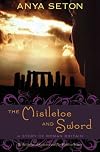
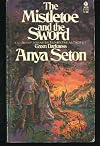
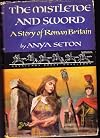
The Mistletoe and the Sword
by Anya Seton
On This Page
Description
Anya Seton, author of the bestselling Katherine and The Winthrop Woman, was at her peak when she penned those two novels in the mid-1950s. But during that same period, she also wrote a little-known shorter novel entitled The Mistletoe and Sword. Here she turned her peerless talents as a storyteller and researcher to the adventure and romance of Roman Britain circa A.D. 60. Quintus Tullius, the young standard bearer with the Ninth Roman Legion, has come to Britain as show more part of the empire's efforts to pacify the rebellious tribes there. But he is haunted by his quest for the bones of his grandfather, who died seventeen years before in "the place of the golden tree and the stony circle." As the druids who haunt Stonehenge lead him through the mythic land, he falls in love with the beautiful and mysterious Regan. But this girl is the foster daughter of Boadicea, the warrior queen of the Icenians and instigator of the historic, bloody rebellion of the British tribes against Rome. With its suspenseful battle scenes and its mysticism and romance, The Mistletoe and Sword is an absorbing tale that makes this obscure era of history excitingly contemporary. show lessTags
Recommendations





















Member Reviews
A young Roman and his fellow soldiers are sent to Britain in AD 60.
Events focus on Queen Boudicca’s rebellion and a mysterious druid from Stone Henge.
The characters are vivid, though I feel Boudicca/Boadicea is too melodramatic.
The plot is a good adventure yarn, with action, mystery, suspense, a little romance, and a hint of druid-style magic.
Events focus on Queen Boudicca’s rebellion and a mysterious druid from Stone Henge.
The characters are vivid, though I feel Boudicca/Boadicea is too melodramatic.
The plot is a good adventure yarn, with action, mystery, suspense, a little romance, and a hint of druid-style magic.
Interesting - it's very detailed, in some odd ways. Fascinating views of Roman Britain, early on - houses, climate, attitudes, clothes, and behavior of different groups (hopefully reasonably accurate - I didn't notice any outright errors, anyway). Our Hero is a snotty Roman "young gentleman" of a legionary - though he does display the (rare) ability to treat not-Romans as human beings almost from the beginning. Clash of honors and duties, on many levels. It's quite a rich story, though not a comfortable one - friends and enemies keep switching places, and nothing is quite predictable. Well...the overall story is, pretty much, but there's a lot of interesting twists along the way. Her foreword says that all these events happened, though show more the whys are often uncertain and she presented her own idea there - she mentions several of her sources, too. Fun, definitely worth reading and possibly worth rereading, and I'll be looking for more by her (though it's a pretty old book!). And unfortunately, despite a mention in the foreword, there's no "endpaper maps" in my paperback copy. show less
I picked this up for a song at the library discard shelf. "Written for the younger generation" as stated on the back cover, this was a story of Roman Britain in the days of Boadicea and her revolt. A young soldier, Quintus Tullius, standard bearer in the IX Hispania is sent to Britannia, not merely to fight for glory but with a personal mission--to find the bones of his grandfather near Stonehenge and to give them proper burial. In the course of the story, he meets a young British woman, Regan, granddaughter of the Arch Druid and foster daughter of Boadicea, with whom he falls in love--no, any romance is only a small part of the story and understated, at that. After Boadicea's mistreatment by the Romans, she begins her bloody uprising. show more Since the II Legion in the West has not joined the other legions, General Petillius sends the Celtic-speaking Quintus West disguised as a Silure, to find out what happened. He is guided by Regan and a native potter, then a servant of the Arch Druid. After his return a big battle is fought with Boadicea. Quintus doesn't succeed in his quest, but finds something far superior!
After a few pages I thought, "Gosh, this isn't the Seton I read years ago--her style is too unsophisticated." Then after reading the back cover I understood--a YA book before the terminology had come into vogue. So I didn't feel disappointed after accepting the book on its own terms. Characters were not terribly "deep", but endearing. I liked much the best what Quintus found at the II Legion fortress, his treatment there, and his meeting and befriending the two other messengers, Dio and Fabian, who had been sent before him. I loved their banter--comic relief? Imprisoned together in the fort, they rejoin the Roman army after their [too obvious and simple] escape and journey back. A light, easy read. I do fault the author for using modern place names instead of ones the Romans would have used; St. Alban's [Verulamium] especially sounded odd. Wales as an entity didn't exist until the Middle Ages. Both modern and Roman names were given on the end-papers, which had a cleverly drawn map of Roman Britain [although called "England"] and line drawings of items important to the story. show less
After a few pages I thought, "Gosh, this isn't the Seton I read years ago--her style is too unsophisticated." Then after reading the back cover I understood--a YA book before the terminology had come into vogue. So I didn't feel disappointed after accepting the book on its own terms. Characters were not terribly "deep", but endearing. I liked much the best what Quintus found at the II Legion fortress, his treatment there, and his meeting and befriending the two other messengers, Dio and Fabian, who had been sent before him. I loved their banter--comic relief? Imprisoned together in the fort, they rejoin the Roman army after their [too obvious and simple] escape and journey back. A light, easy read. I do fault the author for using modern place names instead of ones the Romans would have used; St. Alban's [Verulamium] especially sounded odd. Wales as an entity didn't exist until the Middle Ages. Both modern and Roman names were given on the end-papers, which had a cleverly drawn map of Roman Britain [although called "England"] and line drawings of items important to the story. show less
Anya Seton's The Mistletoe and the Sword tells the story of Roman officer Quintus Tullius's adventures in Britain at the time of Boudicea's uprising. Arriving in Britain to join the Ninth 'Hispana' Legion, Quintus is determined to find the bones of his grandfather, who had been killed by Druids a century before. Quintus' quest, however, soon takes a backseat to the war between the Romans and Boudicea, Queen of the Iceni and leader of the British tribes fighting against Roman rule. While not a bad book, at 250 pages I didn't feel it was long enough to truly enable the characters and storylines to be fully fleshed out. The story just felt too rushed, and not enough character development occurred for me to truly connect with any of the show more principal figures. Not a bad read, just not a great one. show less
Judging from the scanty size of this novel, I wasn't expecting a dense and involved historical novel that was capable of covering Rome's invasion of the British Isles. You can't do that in less than three hundred pages. However, I was expecting something more, especially in regards to Queen Boudicca's attack on Roman rule. I've always been pro-Boadicea, so to have her vilified for the sake of a silly little romance was not to my liking. Love her or hate her, you can't deny that Boadicea had serious cajones to take on the Roman army.
I give it points for originality and the research it must have taken to scratch out this silly little book. I feel I've been kind in giving it three stars.
I give it points for originality and the research it must have taken to scratch out this silly little book. I feel I've been kind in giving it three stars.
Quintus, a Roman soldier in Britain in 60AD, has two missions: to conquer Britain in the name of the emperor Nero, and to find the ancient remains of his great-grandfather, murdered by Druids during the invasion of Julius Caesar many years earlier. However, the Roman military doesn't count on warrior queen Boudicea uniting the Celtic tribes in revolt, and Quintus doesn't count on falling for Regan, a fetching young Briton woman.
This is a fairly light-hearted story, given the subject matter. I found it enjoyable, and consider it a decent jumping-off point for a reader new to Roman history in Britain.
This is a fairly light-hearted story, given the subject matter. I found it enjoyable, and consider it a decent jumping-off point for a reader new to Roman history in Britain.
I read more than half in one night - cannot put it down!
Having loved Latin Class in high school and college, I have always enjoyed stories about the Romans. This tale of Roman conquest in ancient Britain was even more engrossing than I would've imagined.
Once again, no matter the time period - Anya Seton is outstanding.
Having loved Latin Class in high school and college, I have always enjoyed stories about the Romans. This tale of Roman conquest in ancient Britain was even more engrossing than I would've imagined.
Once again, no matter the time period - Anya Seton is outstanding.
Members
- Recently Added By
Lists

Roman Britain
42 works; 12 members

Authors from the United States
245 works; 3 members

Books Read in 2016
4,666 works; 197 members
Talk Discussions
Past Discussions
Subjugate the British in Good Show Sir! — bad science fiction and fantasy covers (January 2025)
Author Information

25+ Works 8,954 Members
Some Editions
Series
Belongs to Publisher Series
Common Knowledge
- Canonical title
- The Mistletoe and the Sword
- Original publication date
- 1955
- People/Characters
- Quintus Tullius Pertinax; Regan; Conn Lear; Petillius Cerealis; Lucius Claudius Drusus; Boudica (show all 9); Flaccus; Decianus Catus; Navin
- Important places
- Britannia, Roman Empire; England, UK
- First words
- Quintus, standing in the prow of the Roman war galley, was eagerly peering through the swirling fog ahead, toward a glimpse of high white cliffs.
- Last words
- (Click to show. Warning: May contain spoilers.)The slanting sun filtered through the leaves and glinted on the girl's bright flowing hair and it glinted on the breastplate of the young Roman centurion, who had found in this land not the thing he had once searched for, but instead a new home, and love, and his destiny.
Classifications
Statistics
- Members
- 216
- Popularity
- 151,245
- Reviews
- 11
- Rating
- (3.28)
- Languages
- Dutch, English
- Media
- Paper
- ISBNs
- 8
- ASINs
- 5