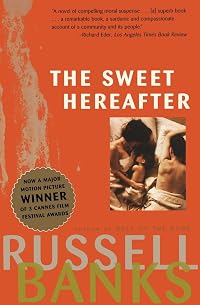
The Sweet Hereafter
by Russell Banks
On This Page
Description
In The Sweet Hereafter, Russell Banks tells a story that begins with a school bus accident. Using four different narrators, Banks creates a small-town morality play that addresses one of life's most agonizing questions: when the worst thing happens, who do you blame?Tags
Recommendations










Member Reviews
The day didn't begin with much snow, but Dolores Driscoll knew it would grow in strength as the morning wore on. She'd driven the children of Sam Dent to and from school for years, in both good and bad weather, so she understood the potential dangers of the snow. That day, something surprised her in the road, she veered off course and over a the drop into Jones Brook.
Told from the points of view of four different characters, "The Sweet Hereafter" examines a small town as it attempts to cope with the loss of so many lives and who to blame for such an act. Dolores Driscoll recounts the morning of the school bus accident; Billy Ansel was following the bus, watching his children as the contentedly rode to school; Mitchell Stephens, Esq., show more smells a lawsuit in the air and wants to be the one to gather the folks of Sam Dent into a army of victims; Nichole Burnell, a young girl now bound to a life in a wheelchair, is the one person upon whom the future of the town lies. It's remarkable storytelling, delving into the darker side of small-town life, with each of the characters surviving his or her own tragedies, separate from the accident, and yet they still find the strength to rise above something potentially even more devastating than the accident itself. A fantastic book. show less
Told from the points of view of four different characters, "The Sweet Hereafter" examines a small town as it attempts to cope with the loss of so many lives and who to blame for such an act. Dolores Driscoll recounts the morning of the school bus accident; Billy Ansel was following the bus, watching his children as the contentedly rode to school; Mitchell Stephens, Esq., show more smells a lawsuit in the air and wants to be the one to gather the folks of Sam Dent into a army of victims; Nichole Burnell, a young girl now bound to a life in a wheelchair, is the one person upon whom the future of the town lies. It's remarkable storytelling, delving into the darker side of small-town life, with each of the characters surviving his or her own tragedies, separate from the accident, and yet they still find the strength to rise above something potentially even more devastating than the accident itself. A fantastic book. show less
There’s before and there’s after that fateful moment when a school bus runs off the road during a snowstorm, killing fourteen children of a small Adirondack town. Someone must be to blame. Is it the state, or the town, or maybe the bus driver? Will the out-of-town lawyers destroy what remains of this community, or will the town find a path to healing?
The perspective alternates between four first-person narrators: Delores, the bus driver; Billy, a Vietnam veteran and widower whose children were on the school bus; Mitchell, the negligence lawyer; and Nichole, a teenage girl who survived the accident with a catastrophic injury. Each narrator reveals baggage they carried before the accident that shapes their response to the tragedy and show more evokes the reader’s empathy, without crossing the line to pity. This book gives more than it demands from readers. Warmly recommended. show less
The perspective alternates between four first-person narrators: Delores, the bus driver; Billy, a Vietnam veteran and widower whose children were on the school bus; Mitchell, the negligence lawyer; and Nichole, a teenage girl who survived the accident with a catastrophic injury. Each narrator reveals baggage they carried before the accident that shapes their response to the tragedy and show more evokes the reader’s empathy, without crossing the line to pity. This book gives more than it demands from readers. Warmly recommended. show less
To start off, a disclaimer: I do love genre fiction. As even a brief look through my reviews will show you, my reading spreads out very far afield indeed, and I enjoy pretty much every type of fiction as well as quite a lot of non-fiction. Still, the kind of fiction that I love the most, that is closest to my heart, is literary fiction; and there are reasons for that which go beyond personal preference. (And, another disclaimer, I’m of course well aware that there are exceptions, that there is genre fiction which is just as deep and ambitious and formally daring as the best of literary fiction. But those are just that: exceptions. (And, disclaimer inside a disclaimer, there is of course literary fiction that plain sucks, and this is show more not the exception at all. I’m not concerning myself with bad books here, however.)) What distinguishes good literary from most genre fiction is that the former has a layering of meaning, a surplus of significance which the majority of the latter lacks. You can trace this even in fairly conventional realistic fiction, if it is well made like, let’s say, Russell Banks’ comparatively slim novel The Sweet Hereafter.
So let’s take a look at it. After the disclaimers, a warning: It is impossible to make the point I want to make without mentioning details of the plot, so there will be spoilers.
The Sweet Hereafter takes place entirely in a small American town in Upstate New York. It is told in five parts by four different narrators, each of which has his or her own, very distinctive voice – something that Russell Banks handles very well here: The language that the narrators use does not only serves to tell them apart but also contributes to their characterization and to clarifying their relation to the novel’s central event, a school bus accident in which several children have died. The bus driver’s style is chatty as she attempts to distract herself from the terrible moment when she caused the bus to swerve off the road; the voice of the father who lost two children is detached and matter-of-fact as he is still under shock from which he will possibly never recover; the voice of the lawyer who persuades several of the bereft parents into a compensation lawsuit feels like a court address as he battles with the feelings of guilt nagging at him and attempts to justify himself; and the voice of the girl who survived the accident with her legs paralyzed is defiant as she not only copes with her disability but even tries to draw strength and confidence from it.
On its most obvious level, The Sweet Hereafter is a novel about greed and what it does to a community; it shows how an unscrupulous lawyer exploits the loss of grieving parents, and how those parents are only too willing to give in to his seduction (on this level, the lawyer does come across like something of a snake oil merchant and I think there may be reminiscences of Melville’s Confidence Man). The town community is close to breaking apart, and it is only when the parents and the lawyer are forced to relinquish the lawsuit that the town is finally healed. From this perspective, the novel tells a story of redemption and even is, in spite of the tragedy at its heart, quite uplifting in its overall effect.
That on its own would have made for a nice, if possibly somewhat forgettable novel, but there is more to The Sweet Hereafter than that. On another level – a level that is both more general and more individual – it is a novel about the way a single, unforeseen event can rupture apparently settled lives. The event itself – the bus accident – is never directly represented, it is a void, a lacuna that sharply divides everything into a Before and an After. It is probably from this level that the novel’s stems, insofar as the disruptive force of the event is such that even the survivors and the bereaved parents have been touched by death and passed into a different existence, have in some way died themselves. Of course, their hereafter is not particularly sweet, so the title is highly ironic, but even so the romanticisation it denotates marks one way to cope with the catastrophic event. And the novel traces many ways to deal with the disruption the event has caused, not only for its point of view characters but for the whole town; the lawsuit which was at the centre of the first layer becoming just one coping strategy among many on this level. And the ending, viewed from this perspective, is far more ambiguous – while some people do manage to cope with the desaster and its consequences, some are destroyed by it, and it is quite clear that everyone will be bearing its scars. Even Nichole (the surving school girl), who appears to have become a stronger person after surviving the accident has paid for this with the loss of use of her legs, while others sink ever deeper into lethargy and alcoholism.
The Sweet Hereafter, however, is still not done yet, and there is another layer of meaning to be unearthed if one digs just a little deeper, and this layer is mainly concerned with perception. Or more precisely, with the unreliability of perception which is a theme that runs through the whole novel from start to finish, starting with the bus accident itself, which was caused by the driver seeing something on the road which was not there – or maybe it was, we never really find out and remain as much in the dark about it as the bus driver herself. The bereaved father is unable to view the women he was having an affair with the same way as he did before, she has stopped being desirable for him. When the lawyer persuades the parents of the dead children to file a lawsuit he does so by shifting their perception, first by turning their tragedy into a source of possible profit, second by putting the blame for the accident on an instution that would be able to pay compensation. And Nicole has been sexually abused by her father for years, but none of the grown-ups has noticed, or wanted to notice. This thematic cluster culminates when Nicole places her deposition and lies about what she has seen – but although she lies about having actually seen the speed at which the bus was going, she may very well be right about it, as only the bus driver is contradicting her and she is not exactly reliable herself (and not even quite certain about what she has seen, either). So Nichole may be telling the truth even as she is lying, which of course is precisely what novels do – we might see a metafictional twist hidden there, if we were so inclined.
One could probably find more, if one kept looking hard enough for it, but I think I made my point. It is a bit like Zeno’s paradox, the one about Achilles and the turtle – just as Achilles is unable to catch up with the turtle even as their distance shrinks towards the infinitesimally small, there always remains a residue of unresolved significance in a work of literary fiction, a surplus of meaning which may grow smaller and smaller with each repeated reading but never disappears completely and always promises more things to discover. show less
So let’s take a look at it. After the disclaimers, a warning: It is impossible to make the point I want to make without mentioning details of the plot, so there will be spoilers.
The Sweet Hereafter takes place entirely in a small American town in Upstate New York. It is told in five parts by four different narrators, each of which has his or her own, very distinctive voice – something that Russell Banks handles very well here: The language that the narrators use does not only serves to tell them apart but also contributes to their characterization and to clarifying their relation to the novel’s central event, a school bus accident in which several children have died. The bus driver’s style is chatty as she attempts to distract herself from the terrible moment when she caused the bus to swerve off the road; the voice of the father who lost two children is detached and matter-of-fact as he is still under shock from which he will possibly never recover; the voice of the lawyer who persuades several of the bereft parents into a compensation lawsuit feels like a court address as he battles with the feelings of guilt nagging at him and attempts to justify himself; and the voice of the girl who survived the accident with her legs paralyzed is defiant as she not only copes with her disability but even tries to draw strength and confidence from it.
On its most obvious level, The Sweet Hereafter is a novel about greed and what it does to a community; it shows how an unscrupulous lawyer exploits the loss of grieving parents, and how those parents are only too willing to give in to his seduction (on this level, the lawyer does come across like something of a snake oil merchant and I think there may be reminiscences of Melville’s Confidence Man). The town community is close to breaking apart, and it is only when the parents and the lawyer are forced to relinquish the lawsuit that the town is finally healed. From this perspective, the novel tells a story of redemption and even is, in spite of the tragedy at its heart, quite uplifting in its overall effect.
That on its own would have made for a nice, if possibly somewhat forgettable novel, but there is more to The Sweet Hereafter than that. On another level – a level that is both more general and more individual – it is a novel about the way a single, unforeseen event can rupture apparently settled lives. The event itself – the bus accident – is never directly represented, it is a void, a lacuna that sharply divides everything into a Before and an After. It is probably from this level that the novel’s stems, insofar as the disruptive force of the event is such that even the survivors and the bereaved parents have been touched by death and passed into a different existence, have in some way died themselves. Of course, their hereafter is not particularly sweet, so the title is highly ironic, but even so the romanticisation it denotates marks one way to cope with the catastrophic event. And the novel traces many ways to deal with the disruption the event has caused, not only for its point of view characters but for the whole town; the lawsuit which was at the centre of the first layer becoming just one coping strategy among many on this level. And the ending, viewed from this perspective, is far more ambiguous – while some people do manage to cope with the desaster and its consequences, some are destroyed by it, and it is quite clear that everyone will be bearing its scars. Even Nichole (the surving school girl), who appears to have become a stronger person after surviving the accident has paid for this with the loss of use of her legs, while others sink ever deeper into lethargy and alcoholism.
The Sweet Hereafter, however, is still not done yet, and there is another layer of meaning to be unearthed if one digs just a little deeper, and this layer is mainly concerned with perception. Or more precisely, with the unreliability of perception which is a theme that runs through the whole novel from start to finish, starting with the bus accident itself, which was caused by the driver seeing something on the road which was not there – or maybe it was, we never really find out and remain as much in the dark about it as the bus driver herself. The bereaved father is unable to view the women he was having an affair with the same way as he did before, she has stopped being desirable for him. When the lawyer persuades the parents of the dead children to file a lawsuit he does so by shifting their perception, first by turning their tragedy into a source of possible profit, second by putting the blame for the accident on an instution that would be able to pay compensation. And Nicole has been sexually abused by her father for years, but none of the grown-ups has noticed, or wanted to notice. This thematic cluster culminates when Nicole places her deposition and lies about what she has seen – but although she lies about having actually seen the speed at which the bus was going, she may very well be right about it, as only the bus driver is contradicting her and she is not exactly reliable herself (and not even quite certain about what she has seen, either). So Nichole may be telling the truth even as she is lying, which of course is precisely what novels do – we might see a metafictional twist hidden there, if we were so inclined.
One could probably find more, if one kept looking hard enough for it, but I think I made my point. It is a bit like Zeno’s paradox, the one about Achilles and the turtle – just as Achilles is unable to catch up with the turtle even as their distance shrinks towards the infinitesimally small, there always remains a residue of unresolved significance in a work of literary fiction, a surplus of meaning which may grow smaller and smaller with each repeated reading but never disappears completely and always promises more things to discover. show less
A deeply imagined book takes a flinty-eyed examination of a town and characters involved in the aftermath of a tragedy. Banks maintains a nearlly intoxicating level of sadness, and uncovers the dignity, courage and humanity in even the most flawed characters. If there's a message here, it's that we all share in a tragedy that befalls our community. This was made into a good movie, but do yourself a favor and read the book first. A good cry can be redeeming.
A book that stops you in your tracks. Banks handles an amazing range of narrators with amazing deftness.
Nothing about grief is simple. For people, families, or communities. Banks writes it all here.
Nothing about grief is simple. For people, families, or communities. Banks writes it all here.
(I should say right up front that what I’ve just read is an “Advance Reading Copy” of The Sweet Hereafter and not whatever eventually made it into bookstores. Did I miss anything? I don’t know, even if the same HarperCollins-published edition is supposedly three pages longer here at Goodreads.)
“Nothing. Except that his tongue came out and licked dry lips. Then I recognized it: I’ve seen it a hundred times, but it still surprises and scares me. It’s the opaque black-glass look of a man who recently learned of the death of his child. It’s the face of a person who’s gone to the other side of life and is no longer even looking back at us. It always has the same history, that look: at the moment of the child’s dying, the show more man follows his child into darkness, like he’s making a last attempt to save it; then, in panic, to be sure that he himself has not died as well, the man turns momentarily back toward us, maybe he even laughs then or says something weird, for he sees only darkness there, too; and how he has returned to where his child first disappeared, fixing onto one of the bright apparitions that linger here. It’s not a pretty look; it’s downright spooky” (p. 102).
Out of context, this paragraph may not sound like much. In context, it can ruin your day … give you nightmares … take with it the last peaceful evening you’ve ever spent … if you’re now a parent.
If you’re not, I’m not sure. Maybe it wouldn’t mean much.
I haven’t read anything like The Sweet Hereafter since John Fowles’s The Collector, back in the sixties – which could well say more about me as a reader of current literature than about Russell Banks as a writer of the same. In any case, I’ll risk saying that this novel is sui generis. Four distinct voices; and all four, authentic (at least to this reader’s eyes and ears). Quite an accomplishment – and something very few writers (once again, in my limited experience) know how to do well.
Apart from a stylistic tour de force, Russell Banks accomplishes a psychological study par excellence. I have rarely read – then consequently seen, felt, smelled – four characters as sharply as I did the four in The Sweet Hereafter. You may not like some of these four. But believe me: you won’t forget any of them anytime soon.
And the story? Yes, the story is harrowing – but not told without a dollop of humor now and again. Without that occasional narrative lagniappe, I’m not sure I could’ve made it to the end.
But I did, and can now highly recommend this novel – my first of Russell Banks’s, but certainly not my last.
One additional citation – and this one from the bus driver:
“That done, though, I kept myself away from all town functions, church affairs, meetings, bake sales, and so forth, and more or less oriented myself west and south, faced our life towards Lake Placid, where I had to take Abbott twice a week for his physical therapy, anyhow. Naturally, I no longer drove the school bus – two weeks after the accident, the school board mailed me a certified letter saying my services were no longer required, but I had already made that decision for myself, thank you. And since Eden Schraft never called me, the way she usually did, about carrying the mail in the summer months, I gave that up, too; a bit more reluctantly, however, than I gave up the bus, for I had no terrible associations with that particular job. Now, whenever I saw one of those big yellow International school buses on the road, I simply had to look away or else concentrate on a single detail, like the sum of the numbers on the number plate or the poker hand the numbers made, until the thing was gone from view” (p. 223).
Welcome to America, the Land of Opportunity – where the roads are all paved in gold, and which “can be an interesting town (country) when you see it from a tourist’s perspective” (p. 223).
By way of conclusion, I’ll cite Banks’s own conclusion: a small-town demolition derby – an apt metaphor, I assume, for the larger story. I’ll risk a further assumption – namely, that ‘Boomer’ (the last car standing in the derby, and which formerly belonged to the ill-fated bus driver whose thoughts I cited above) might well signal a generation just a ‘derby’ or two away from posterity and the grave. If my assumption is correct, Banks’s inspired choice is a trope I’d like to quietly applaud.
RRB
05/30/14
Brooklyn, New York, U.S.A. show less
“Nothing. Except that his tongue came out and licked dry lips. Then I recognized it: I’ve seen it a hundred times, but it still surprises and scares me. It’s the opaque black-glass look of a man who recently learned of the death of his child. It’s the face of a person who’s gone to the other side of life and is no longer even looking back at us. It always has the same history, that look: at the moment of the child’s dying, the show more man follows his child into darkness, like he’s making a last attempt to save it; then, in panic, to be sure that he himself has not died as well, the man turns momentarily back toward us, maybe he even laughs then or says something weird, for he sees only darkness there, too; and how he has returned to where his child first disappeared, fixing onto one of the bright apparitions that linger here. It’s not a pretty look; it’s downright spooky” (p. 102).
Out of context, this paragraph may not sound like much. In context, it can ruin your day … give you nightmares … take with it the last peaceful evening you’ve ever spent … if you’re now a parent.
If you’re not, I’m not sure. Maybe it wouldn’t mean much.
I haven’t read anything like The Sweet Hereafter since John Fowles’s The Collector, back in the sixties – which could well say more about me as a reader of current literature than about Russell Banks as a writer of the same. In any case, I’ll risk saying that this novel is sui generis. Four distinct voices; and all four, authentic (at least to this reader’s eyes and ears). Quite an accomplishment – and something very few writers (once again, in my limited experience) know how to do well.
Apart from a stylistic tour de force, Russell Banks accomplishes a psychological study par excellence. I have rarely read – then consequently seen, felt, smelled – four characters as sharply as I did the four in The Sweet Hereafter. You may not like some of these four. But believe me: you won’t forget any of them anytime soon.
And the story? Yes, the story is harrowing – but not told without a dollop of humor now and again. Without that occasional narrative lagniappe, I’m not sure I could’ve made it to the end.
But I did, and can now highly recommend this novel – my first of Russell Banks’s, but certainly not my last.
One additional citation – and this one from the bus driver:
“That done, though, I kept myself away from all town functions, church affairs, meetings, bake sales, and so forth, and more or less oriented myself west and south, faced our life towards Lake Placid, where I had to take Abbott twice a week for his physical therapy, anyhow. Naturally, I no longer drove the school bus – two weeks after the accident, the school board mailed me a certified letter saying my services were no longer required, but I had already made that decision for myself, thank you. And since Eden Schraft never called me, the way she usually did, about carrying the mail in the summer months, I gave that up, too; a bit more reluctantly, however, than I gave up the bus, for I had no terrible associations with that particular job. Now, whenever I saw one of those big yellow International school buses on the road, I simply had to look away or else concentrate on a single detail, like the sum of the numbers on the number plate or the poker hand the numbers made, until the thing was gone from view” (p. 223).
Welcome to America, the Land of Opportunity – where the roads are all paved in gold, and which “can be an interesting town (country) when you see it from a tourist’s perspective” (p. 223).
By way of conclusion, I’ll cite Banks’s own conclusion: a small-town demolition derby – an apt metaphor, I assume, for the larger story. I’ll risk a further assumption – namely, that ‘Boomer’ (the last car standing in the derby, and which formerly belonged to the ill-fated bus driver whose thoughts I cited above) might well signal a generation just a ‘derby’ or two away from posterity and the grave. If my assumption is correct, Banks’s inspired choice is a trope I’d like to quietly applaud.
RRB
05/30/14
Brooklyn, New York, U.S.A. show less
Great example of how people's reactions to the same event can vary so widely, both from person to person and within one person over the course of time. A deeply sad novel with wonderfully rendered characters that makes you long for the heavy snow and deep hush of the Adirondacks, until the hush is proven to be made of muffled screams.
Members
- Recently Added By
Lists

Read the book and saw the movie
1,170 works; 195 members

1990s
309 works; 17 members

Books Set in New York State
65 works; 11 members

Books Featured on Readers' Review of the Diane Rehm Show
161 works; 8 members

Books Set in Small Towns and Villages
278 works; 16 members

Books Read in 2004
200 works; 7 members
Accidents in Fiction
22 works; 5 members

501 Must-Read Books
529 works; 71 members
Books Tagged Small Town
58 works; 1 member

Mustich's 1000 Books to Read Before You Die: A Life Changing List
1,001 works; 19 members

Gen X Library
245 works; 4 members
Author Information

38+ Works 11,886 Members
The oldest of four children, Russell Banks spent his childhood and adolescence in New Hampshire and Eastern Massachusetts. His blue collar, working class background is strongly reflected in his writing. The first in his family to attend college, Banks studied at Colgate University and later graduated Phi Beta Kappa from the University of North show more Carolina, at Chapel Hill. While he was establishing himself as a writer, Banks spent time as a plumber, shoe salesman, and a window dresser. Banks's titles include Searching for Survivors, Family Life, Hamilton Stark, The New World, The Book of Jamaica, Trailerpark, The Relation of My Imprisonment, Continental Drift, Success Stories, Affliction, The Sweet Hereafter and Dreaming Up America. Banks has also written numerous poems, stories, and essays. Banks is the recipient of several awards and prizes. Among his accolades are the St. Lawrence Award for Short Fiction, the John Dos Passos Award, and the Literature Award from the American Academy of Arts and Letters. In 1986, Continental Drift was a finalist for the Pulitzer Prize. (Bowker Author Biography) show less
Awards and Honors
Work Relationships
Is contained in
Has the adaptation
Is abridged in
Has as a student's study guide
Common Knowledge
- Canonical title
- The Sweet Hereafter
- Original publication date
- 1991
- People/Characters
- Mitchell Stevens; Zoe Stevens; Nicole Burnell; Sam Burnell; Dolores Discolt; Billy Ansel
- Important places
- New York, USA
- Related movies
- The Sweet Hereafter (1997 | IMDb)
- Epigraph
- By homely gift and hindered Words
The human heart is told
Of Nothing—
"Nothing" is the force
That renovates the World—
Emily Dickinson (#1563) - Dedication
- for Chase
- First words
- A dog—it was a dog I saw for certain.
- Last words
- (Click to show. Warning: May contain spoilers.)For a brief second, though, their eyes were pure white and flat, like dry, coldly glowing disks, and it was as if the animals had all come to the edge of the forest, and there by the side of the road they had waited and watched for me, until I had passed them by and the sage familiar darkness had returned.
- Blurbers
- West, Cornel; Ondaatje, Michael; Leonard, Elmore; Eder, Richard; Mosher, Howard Frank
- Original language
- English
- Canonical DDC/MDS
- 813.54
- Canonical LCC
- PS3552.A49
Classifications
Statistics
- Members
- 1,785
- Popularity
- 12,265
- Reviews
- 37
- Rating
- (3.99)
- Languages
- 8 — Dutch, English, French, German, Italian, Japanese, Portuguese, Spanish
- Media
- Paper, Audiobook, Ebook
- ISBNs
- 26
- UPCs
- 1
- ASINs
- 7