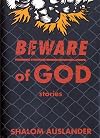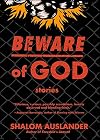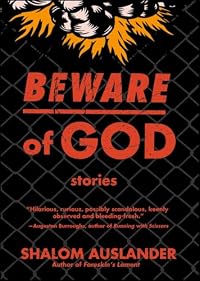
Beware of God: Stories
by Shalom Auslander
On This Page
Description
Violent rabbis, lovelorn wives, a busy Grim Reaper, shame-filled simians, and one seriously angry deity populate this humorous and disquieting collection.Shalom Auslander's stories in Beware of God have the mysterious punch of a dream. They are wide ranging and inventive: A young Jewish man's inexplicable transformation into a very large, blond, tattooed goy ends with a Talmudic argument over whether or not his father can beat his unclean son with a copy of the Talmud. A pious man having a show more near-death experience discovers that God is actually a chicken, and he's forced to reconsider his life — and his diet. At God's insistence, Leo Schwartzman searches Home Depot for supplies for an ark. And a young boy mistakes Holocaust Remembrance Day as emergency preparedness training for the future.
Auslander draws upon his upbringing in an Orthodox Jewish community in New York State to craft stories that are filled with shame, sex, God, and death, but also manage to be wickedly funny and poignant. show less
Tags
Recommendations



















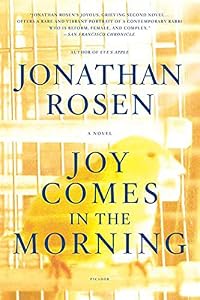

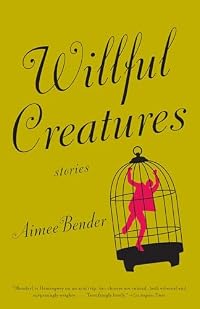



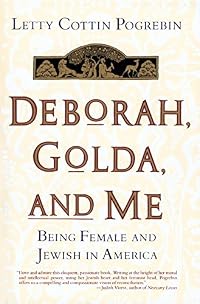
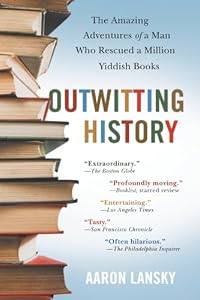
















Member Recommendations
Member Reviews
A collection of calculatedly outrageous short stories. Almost all of them target religion - often by satirising organised religion, personal faith (characters praying to something which is clearly not a god) or Talmudic debate (about issues which are clearly not religious or Biblical). Others imagine what would happen if the God of the Old Testament was literal truth in the twenty-first century ("The angels stood quietly at the back of His office, their eyes locked nervously on the place where their feet would have been" - from possibly the best one of the stories, "Somebody Up There Likes You"). They are pretty deadpan, and I read the first few stories shaking with laughter. But I would recommend against reading the whole book in one show more go, as I did - there were definitely diminishing returns, not only because of the similarities of style and subject matter, but because as you read on, the book felt increasingly angry and less and less funny. show less
Heinlein said in Stranger in a Strange Land that humor is based on what hurts. These stories are funny because Auslander's anger and hurt about the sorry state of the world and God's responsibility for it are so serious and real.
Hilarious, biting stories on religious angst and the theologically absurd. Here, God is a hitman, a huge Chicken, or an insecure and attention-seeking bully. Pet hamsters pray for the generosity of their Provider, and the Bible turns out to be ancient beach-reading fiction. Simply fabulous.
In this slender volume containing 14 wickedly satirical and possibly blasphemous short stories, the American journalist Shalom Auslander takes a knife to the pious veneer of modern-day religious Jewish life. They are probably best read all in one go and would take a couple of hours, if that.
To give you some examples of the book's tongue in cheek stance, in one story a religious man dies, goes to heaven and discovers God is a giant chicken. In another, a take on Kafka's "Metamorphosis", a Jewish man awakes to discover he has become a tattooed, blond, muscular "goy" (Yiddish for non-Jew) leading to a spiritual crisis for his family. One story even rejoices in the title "It Ain't Easy Being Supremey".
Whilst this makes the collection sound show more as if it would have limited appeal to non-Jews, essentially one can see the God that appears in these stories as a generic authority figure, and several stories have their protagonists getting themselves into sticky situations after unquestioningly following his instructions, such as the man who sets out for Home Depotto buy the materials to build an ark, or the man whose increasing piety strains his marriage to breaking point.
Despite the levity, some stories do have more serious cores, such as "Holocaust Tips for Kids", a young boy's garbled version of his observation of Yom Ha-Shoah (Holocaust Rememberance Day). show less
To give you some examples of the book's tongue in cheek stance, in one story a religious man dies, goes to heaven and discovers God is a giant chicken. In another, a take on Kafka's "Metamorphosis", a Jewish man awakes to discover he has become a tattooed, blond, muscular "goy" (Yiddish for non-Jew) leading to a spiritual crisis for his family. One story even rejoices in the title "It Ain't Easy Being Supremey".
Whilst this makes the collection sound show more as if it would have limited appeal to non-Jews, essentially one can see the God that appears in these stories as a generic authority figure, and several stories have their protagonists getting themselves into sticky situations after unquestioningly following his instructions, such as the man who sets out for Home Depotto buy the materials to build an ark, or the man whose increasing piety strains his marriage to breaking point.
Despite the levity, some stories do have more serious cores, such as "Holocaust Tips for Kids", a young boy's garbled version of his observation of Yom Ha-Shoah (Holocaust Rememberance Day). show less
It's one thing to believe the message. It's another to worship the creed. Here's a collection of short, stark and funny parables about the futility of trying to find a short cut to the bosom of Abraham.
These are characters trapped in cul de sacs of legalistic fretting, and the god protrayed here in the one that would have to exist to make all this theological manuvering something other than absurd and pointless -- a smug CEO, frustrated with his penny-ante creations and bound by his own legalistic mind.
It's a funny book, a ding on the vanities and motivations of hyperobservant followers everywhere. Not just Orthodox Jews.
These are characters trapped in cul de sacs of legalistic fretting, and the god protrayed here in the one that would have to exist to make all this theological manuvering something other than absurd and pointless -- a smug CEO, frustrated with his penny-ante creations and bound by his own legalistic mind.
It's a funny book, a ding on the vanities and motivations of hyperobservant followers everywhere. Not just Orthodox Jews.
This is a short, unusual, and pretty funny collection of short stories by Shalom Auslander, who was raised as an Orthodox Jew. From the titles alone, you can probably see that he's a little conflicted in his belief, titles like: Holocaust Tips for Kids, Startling Revelations from the Lost Book of Stan, Prophet's Dilemma, and It Ain't Easy Bein' Supremey.
There's a story where a woman goes through the spiritual mathematics of purposely causing her husband to sin: "Sin selection became critical: she had to make sure that nothing she was doing to cause him to sin was actually costing her more points than his resultant sin would end up costing him..."
There's one where an ape suddenly receives enlightenment and doesn't quite know what to do show more with it.
There's one where a man discovers some ancient tablets with the words of the Bible on them; it's just that there's this one paragraph that's missing on all the other ancient tablets...
There's one where a young Jewish man goes to sleep and wakes up as a large, blond, goy (more than a little Kafkaesque).
And several more. I don't know that Auslander is going to be struck down any time soon, but I did have a little trouble with God using the F-word. Still. It was a very interesting book, and reminded me of Chris Moore's Lamb in its questioning of certain expressions and requirements of organized religion.
I'd definitely recommend it for those not easily offended.
Some of my favorite quotes:
"Surely, Bloom reasoned, if God wanted to kill him, God could kill him. Then again, if God wanted him dead, why the Volvo? If death is predetermined, wouldn't automobile purchases be predetermined? Didn't the Volvo--the prudence, the zero percent financing--didn't they all collectively prove that someone up there liked Bloom?"
"The harsh reality was this: God was skewing old. And white. Of course, it was a difficult market. His numbers were through the mosque's roof in the East, but in the West, God was in the toilet. As chart A clearly showed, there had been a short spike in His awareness levels immediately following 9/11, but it had been a nearly continuous freefall ever since--and even back then, His awareness was skewing negative."
"'Yes, yes,' said Rabbi Teitelbaum. 'The Google knows many things.'" show less
There's a story where a woman goes through the spiritual mathematics of purposely causing her husband to sin: "Sin selection became critical: she had to make sure that nothing she was doing to cause him to sin was actually costing her more points than his resultant sin would end up costing him..."
There's one where an ape suddenly receives enlightenment and doesn't quite know what to do show more with it.
There's one where a man discovers some ancient tablets with the words of the Bible on them; it's just that there's this one paragraph that's missing on all the other ancient tablets...
There's one where a young Jewish man goes to sleep and wakes up as a large, blond, goy (more than a little Kafkaesque).
And several more. I don't know that Auslander is going to be struck down any time soon, but I did have a little trouble with God using the F-word. Still. It was a very interesting book, and reminded me of Chris Moore's Lamb in its questioning of certain expressions and requirements of organized religion.
I'd definitely recommend it for those not easily offended.
Some of my favorite quotes:
"Surely, Bloom reasoned, if God wanted to kill him, God could kill him. Then again, if God wanted him dead, why the Volvo? If death is predetermined, wouldn't automobile purchases be predetermined? Didn't the Volvo--the prudence, the zero percent financing--didn't they all collectively prove that someone up there liked Bloom?"
"The harsh reality was this: God was skewing old. And white. Of course, it was a difficult market. His numbers were through the mosque's roof in the East, but in the West, God was in the toilet. As chart A clearly showed, there had been a short spike in His awareness levels immediately following 9/11, but it had been a nearly continuous freefall ever since--and even back then, His awareness was skewing negative."
"'Yes, yes,' said Rabbi Teitelbaum. 'The Google knows many things.'" show less
A bunch of short stories about Orthodox Judaism, male angst over sex, male angst over the existence of God, etc., told in absurdist fashion (e.g., two hamsters debate the existence of God, who for them is the guy who puts the apples in their cage and takes out the crap; a devout teen wakes up, a la Gregor Samsa, as a goy). I wasn’t impressed, though there was a story that captured really well the experience, which I think is fairly common among preadolescent American Jews, of overdosing on information about the Holocaust: trying to make sense of this thing that happened that is essentially unimaginable and yet real. Trying to make sense of the fact that six million people were killed for being just like you; that the people who killed show more them would like to have killed you; that people in your family were killed; that most other people in the world who heard about it didn’t much care. Planning for what you’d do if it started to happen here; wondering which of the non-Jews you know would shelter you, or at least not betray you; meanwhile also doing homework and playing soccer and everything else that a preadolescent middle- or upper-class American kid does. It’s a weird mental state; why shouldn’t we be neurotic? show less
Members
- Recently Added By
Author Information

14+ Works 2,120 Members
Awards and Honors
Distinctions
Common Knowledge
- Canonical title*
- Beware of God
- Dedication
- For Orli
- Quotations
- The Mishnah says that it was our forefather Isaac who asked God to bring suffering to the world, since suffering is a great thing. God replied that it is indeed a wonderful idea and so He made Isaac blind. ["Holocaust T... (show all)ips for Kids," p. 73.]
He was overcome with the desire to build something with hammers and wood. [The Metamorphosis," p. 116]
Surly, bossy, paranoid, violent. God was a terrible influence. ["Prophet's Dilemma," p. 131]
Goldsmith didn't care much for God's apology. He wasn't angry about his mother's death; death happens. But he was angry about her suffering. He could well understand that there were things he could not understand, but the nee... (show all)d for suffering was something he never wanted to understand. He couldn't stomach the sight of God these days, but what was he going to do? ["They're All the Same," pp. 145-6]
*Some information comes from Common Knowledge in other languages. Click "Edit" for more information.
Classifications
Statistics
- Members
- 405
- Popularity
- 76,297
- Reviews
- 17
- Rating
- (3.81)
- Languages
- 7 — English, French, German, Hebrew, Hungarian, Italian, Portuguese
- Media
- Paper, Ebook
- ISBNs
- 16
- ASINs
- 4