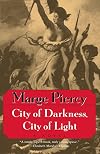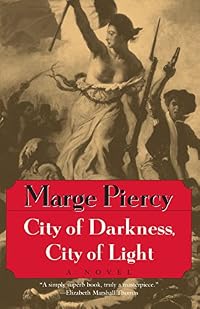
City of Darkness, City of Light
by Marge Piercy
On This Page
Description
"FAST-PACED . . . PIERCY BREATHES LIFE INTO THE ACTUAL HISTORICAL FIGURES WHO SHAPED THE REVOLUTION."--San Francisco Examiner & Chronicle
In her most splendid, thought-provoking novel yet, Marge Piercy brings to vibrant life three women who play prominent roles in the tumultuous, bloody French Revolution--as well as their more famous male counterparts.
Defiantly independent Claire Lacombe tests her theory: if men can make things happen, perhaps women can too. . . . Manon Philipon finds show more she has a talent for politics--albeit as the ghostwriter of her husband's speeches. . . . And Pauline Léon knows one thing for certain: the women must apply the pressure or their male colleagues will let them starve. While illuminating the lives of Robespierre, Danton, and Condorcet, Piercy also opens to us the minds and hearts of women who change their world, live their ideals--and are prepared to die for them.
"MASTERFUL . . . PIERCY BRINGS THE BLOOD AND GUTS, THE IDEAS AND PASSIONS, OF THE REVOLUTION TO LIFE."
--The Women's Review of Books
"PIERCY'S STORYTELLING POWERS CAPTURE THE TURBULENCE AND EXCITEMENT OF [THIS] LIBERATING ERA."
--The Boston Herald
From the Trade Paperback edition.
. show less
Tags
Recommendations




















Member Reviews
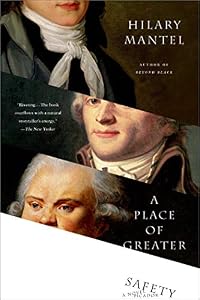
To be honest, I was initially certain that this novel couldn't equal the incandescently brilliant 'A Place of Greater Safety' by Hilary Mantel. This put it at rather a disadvantage, but nonetheless I ended up enjoying it nearly as much as Mantel's masterpiece. Piercy uses six different points of view to show how the French Revolution unfolded, of which three are women. This is where the two novels differed most importantly, in my view. In 'A Place of Greater Safely' I felt very close to Robespierre, Danton, and Camille Desmoulins; the latter was particularly sensitively portrayed. In 'City of Darkness, City of Light' I felt closer to the three women, Manon Roland, Pauline Léon, and Claire Lacombe. Their narratives were beautifully done show more and truly moving. I've previously read a non-fiction account of key women during the revolution, 'Liberty' by Lucy Moore, but found that much less engaging. (I should mention that 'A Place of Greater Safety' does give time to Théroigne de Méricourt, another fascinating revolutionary woman.)
In my mind, the latter of half of this novel really emerged from the shadow of Mantel's book (which was written some years later!). Piercy's writing style doesn't have the same utterly immersive quality as Mantel's, but neither do more than a handful of other novelists. Mantel is such a fantastic writer that practically anyone else suffers by comparison. 'City of Darkness, City of Light' is nonetheless compelling, very well-paced, and deeply sympathetic. The whirlwind of change unleashed by the revolution is beautifully conveyed. There are Americanisms to be found here and there in the text; Piercy explains her rationale for this the introductory Author's Note. I found them a little disconcerting at first, but they in no way detracted from my overall enjoyment of this novel. And it was deeply enjoyable, with a wonderful sense of momentum and feeling.
Moreover, rarely amongst novels and non-fiction about the French Revolution, it did not end with Robespierre's death. The final chapters, in which the surviving characters made a life amid the chaos of the Directory and the ascension of Napoleon, were particular favourites of mine. They allowed the characters to reflect on the changes of the revolution, without a sense of artificially astute historical perspective. I definitely wouldn't read this novel instead of 'A Place of Greater Safety', if some cruel torturer forced me to only read one French Revolution novel ever again, but both are brilliant. 'City of Darkness, City of Light' brings the period vividly to life, especially the lives of radical women at the time. I highly recommend it. show less
In my mind, the latter of half of this novel really emerged from the shadow of Mantel's book (which was written some years later!). Piercy's writing style doesn't have the same utterly immersive quality as Mantel's, but neither do more than a handful of other novelists. Mantel is such a fantastic writer that practically anyone else suffers by comparison. 'City of Darkness, City of Light' is nonetheless compelling, very well-paced, and deeply sympathetic. The whirlwind of change unleashed by the revolution is beautifully conveyed. There are Americanisms to be found here and there in the text; Piercy explains her rationale for this the introductory Author's Note. I found them a little disconcerting at first, but they in no way detracted from my overall enjoyment of this novel. And it was deeply enjoyable, with a wonderful sense of momentum and feeling.
Moreover, rarely amongst novels and non-fiction about the French Revolution, it did not end with Robespierre's death. The final chapters, in which the surviving characters made a life amid the chaos of the Directory and the ascension of Napoleon, were particular favourites of mine. They allowed the characters to reflect on the changes of the revolution, without a sense of artificially astute historical perspective. I definitely wouldn't read this novel instead of 'A Place of Greater Safety', if some cruel torturer forced me to only read one French Revolution novel ever again, but both are brilliant. 'City of Darkness, City of Light' brings the period vividly to life, especially the lives of radical women at the time. I highly recommend it. show less
Well written and very well researched novel about the French Revolution which refreshingly included a couple of characters who are not amoung the usual suspects when reading about the revolution. Besides the well known Danton and Robespeirre and the slightly lesser known Manon Roland and Nicolas Condorcet, we also follow Claire Lacombe and Pauline Leon who founded the first all women's political organisation (the Revolutionary Republican Women) so there's a nice mix of point of views from men and women, moderates and radicals, petty nobles, educated middle class and city poor.
I have wavered between giving this 4 or 5 stars for a couple of days but finally plumped for 4 as the book did have a couple of weaknesses including a slow start show more (took about 50 pages to get going but once it did it was very hard to put down), some minor but jarring use of modern language and an ending that felt a little tacked on and not entirely in keeping with the rest of the story. However, none of this was enough to seriously annoy and it was an otherwise great read.
This is a wonderfully detailed novel if you want to learn more about the French Revolution in an enjoyable way and while my favourite French Revolution novel is still Hilary Mantel's 'A Place of Greater Safety' this one comes in a pretty close second.
Thanks to my GR friend Kim for suggesting this book for our buddy read and French Revolution binge as otherwise I might never have read it :-). show less
I have wavered between giving this 4 or 5 stars for a couple of days but finally plumped for 4 as the book did have a couple of weaknesses including a slow start show more (took about 50 pages to get going but once it did it was very hard to put down), some minor but jarring use of modern language and an ending that felt a little tacked on and not entirely in keeping with the rest of the story. However, none of this was enough to seriously annoy and it was an otherwise great read.
This is a wonderfully detailed novel if you want to learn more about the French Revolution in an enjoyable way and while my favourite French Revolution novel is still Hilary Mantel's 'A Place of Greater Safety' this one comes in a pretty close second.
Thanks to my GR friend Kim for suggesting this book for our buddy read and French Revolution binge as otherwise I might never have read it :-). show less
My friend Jemidar and I decided to read this book together because after finishing Hilary Mantel's wonderful [b:A Place of Greater Safety|101921|A Place of Greater Safety|Hilary Mantel|http://photo.goodreads.com/books/1344312998s/101921.jpg|1168385], we missed its chief protagonists, that is, Camille Desmoulins, Georges-Jacques Danton and Maximilien Robespierre, and we wanted to further immerse ourselves in the events of the French Revolution. The novel tells the stories of Danton and Robespierre, along with those of three other players in the Revolution: actress Claire Lacombe and chocolate maker Pauline Léon (who between them founded and led the influential Society of Revolutionary Women), middle-class political activist Manon Roland show more and mathematician, philosopher and politician Nicolas Condorcet. Piercy explores events from 1789 to 1794 chapters which alternate the point of view of the six main characters.*
At first, reading the novel seemed like less than a good idea. Piercy's style is very different from that of Mantel. The narrative is much less dialogue driven than that of A Place of Greater Safety and much heavier on exposition. While a reader wanting to be told the facts may consider that an advantage, I missed the feeling that I was seeing events through the character's eyes and thinking their thoughts. Instead, I was often being told things by the author rather than shown things by the characters. However, as I continued to read, that aspect of the novel bothered me less and I was soon thoroughly engaged with the characters and the events through which they lived.
This was another fascinating excursion into the events of the French Revolution, something about which I previously had only the sketchiest of knowledge. Overall, I prefer A Place of Greater Safety, largely because I prefer Mantel's style, but also because I was disappointed that Piercy ended the novel with a speculative flight of fancy. But it's a close run thing. Piercy brings her characters to life and tells an interesting story in an engaging and accessible way. In addition, through the inclusion of Claire Lacombe and Pauline Léon as characters, Piercy provides a female and working class (sans culottes) perspective which is missing from A Place of Greater Safety. As far as ratings go, it's hovering at around the 4-1/2 star mark.
* Camille Demoulins, who is such a strong presence in Mantel's novel, is a more minor character in this one. show less
A very readable book, bringing to life a period in history and six lives from that time with humanity and humour. Piercy follows 'Max' Robespierre, Georges Danton, Nicolas Condorcet, Manon Roland and actress Claire Lacombe into the French Revolution, devoting a chapter to each character, and taking the reader through the Terror with each of them.
This is a fictionalised account of fact and common myth about famous names such as Robespierre and Danton, and Piercy translates these figures into sympathetic individuals with ease, but I wish she had left her soapbox at the author's note and not made the decision to break down anachronisms by using modern, American terminology. Her feminist viewpoint starts to get a little monotonous after a show more few chapters, as none of the women are allowed to speak or behave naturally - all are proclaimed as intellectual, independent beings, who would be on equal terms with the men if not for the pesky social conditions of the time. Indeed, Madame Roland was a very intelligent and industrious woman, but the reader is not allowed to learn this about her for themselves, as Piercy provides a disclaimer for each female character, presumably so that modern readers won't be put off by women who are also wives and mothers! And words and phrases like 'pal', 'guy', 'cookie-cutter', and 'no fair' do not sit well in a book about the eighteenth century; I know the author did this intentionally, but most of the book is written in plain and yet standard English, so the slang is really not necessary.
However, apart from the clash of centuries, I enjoyed this book, and learned a lot more about men and women like Robespierre and Madame Roland than I would have with a dry text book. Very enjoyable. show less
This is a fictionalised account of fact and common myth about famous names such as Robespierre and Danton, and Piercy translates these figures into sympathetic individuals with ease, but I wish she had left her soapbox at the author's note and not made the decision to break down anachronisms by using modern, American terminology. Her feminist viewpoint starts to get a little monotonous after a show more few chapters, as none of the women are allowed to speak or behave naturally - all are proclaimed as intellectual, independent beings, who would be on equal terms with the men if not for the pesky social conditions of the time. Indeed, Madame Roland was a very intelligent and industrious woman, but the reader is not allowed to learn this about her for themselves, as Piercy provides a disclaimer for each female character, presumably so that modern readers won't be put off by women who are also wives and mothers! And words and phrases like 'pal', 'guy', 'cookie-cutter', and 'no fair' do not sit well in a book about the eighteenth century; I know the author did this intentionally, but most of the book is written in plain and yet standard English, so the slang is really not necessary.
However, apart from the clash of centuries, I enjoyed this book, and learned a lot more about men and women like Robespierre and Madame Roland than I would have with a dry text book. Very enjoyable. show less
I am pretty particular about historical fiction because if I know anything about the era and an author gets it wrong (You wouldn't have wanted to be in the audience when I saw Elizabeth..I couldn't stop pointing out what was wrong and getting all huffy about it). Marge Piercy does an excellent job of creating her characters, both well known and unknown (and in between). Wonderful book for people who love historical fiction or the French Revolution. Others may enjoy it too.
This historical novel about the French Revolution, being reissued as an ebook, reminds us yet again about lessons to be learned from history. Piercy has carefully traced the origins and outcomes of the events in 18th century France through telling the stories of three men and three women, based on her research and surmisings. Even though we may remember the outcomes for these real people, the details of their lives make their times seem immediate and tragic, and we are immersed in their situations. For readers not too familiar with the personalities, the transitions between characters is sometimes confusing, and I wish I had known about the guide at the end of the book before I started; this is just not obvious in an e-reader. show more Particularly strong were the descriptions of friendships, for example between Camille and Georges, and Pauline and Claire. show less
This book was an enjoyable novelistic summary of the French Revolution: pre- , during, and post-, with an epilogue, [not called as such] of three characters meeting years later and discussing what had been accomplished during the Revolution years, even with the excesses. The story follows six main figures: Robespierre, Danton, Condorcet and three women [who seemed like platforms for Piercy's blatant feminism]. The first part of the novel: years 1780-1791 were much more interesting. 1792 dragged and the Marat murder in the bathtub by Charlotte Corday and the Reign of Terror were just skimmed over. Pacing wasn't that good. I liked both major and minor characters' biographies and their revealing their inmost thoughts and aspirations openly show more to the reader. The French Revolution has been well documented--with biographies, even an autobiography, so Piercy had much source material. The author's use of "guy" or "boyfriend" annoyed me. Her "Author's Note" is worth reading. show less
Members
- Recently Added By
Lists

Fiction Set During a Revolution
55 works; 24 members
Author Information

66+ Works 12,028 Members
Poet and novelist Marge Piercy was born in Detroit, Michigan on March 31, 1936. She received a B. A. from the University of Michigan and an M. A. from Northwestern. She is involved in the Jewish renewal and political work and was part of the civil rights movement. She won the Arthur C. Clarke award. Besides writing her own novels and collections show more of poetry, she has collaborated with her husband Ira Wood on a play, The Last White Class, and a novel, Storm Tide. In 1997, they founded a small literary publishing company called the Leapfrog Press. She currently lives in Cape Cod. (Bowker Author Biography) Marge Piercy is the author of 14 previous poetry collections and 14 novels. In 1990 her poetry won the Golden Rose, the oldest poetry award in the country. She lives on Cape Cod. (Publisher Provided) Marge Piercy is the author of 35 books of poetry & fiction, including the best sellers "Gone to Soldiers" & "The Longings of Women". (Publisher Provided) show less
Awards and Honors
Awards
Common Knowledge
- Canonical title
- City of Darkness, City of Light
- Original publication date
- 1996
- People/Characters
- Claire Lacombe; Maximilien de Robespierre; Madame Roland; Pauline Leon; Nicolas de Condorcet; Sophie de Condorcet (show all 9); Georges Danton; Lucile Desmoulins; Charlotte Robespierre
- Important places
- Paris, France
- Important events
- French Revolution (1789)
Classifications
Statistics
- Members
- 487
- Popularity
- 61,891
- Reviews
- 11
- Rating
- (3.95)
- Languages
- Danish, English
- Media
- Paper, Ebook
- ISBNs
- 12
- ASINs
- 3