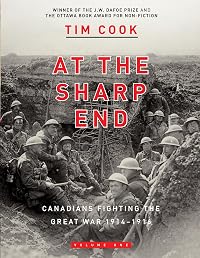
At the Sharp End Volume One: Canadians Fighting the Great War 1914-1916
by Tim Cook
Canadians Fighting the Great War (1)
On This Page
Description
At the Sharp End covers the harrowing early battles of World War One, when tens of thousands, then hundreds of thousands, died, before the generals and soldiers found ways to break the terrible stalemate of the front. It provides both an intimate look at the Canadian men in the trenches and an authoritative account of the slow evolution in tactics, weapons, and advancement. Featuring never-before-published photographs, letters, diaries, and maps, this recounting of the Great War through the show more soldiers' eyewitness accounts is moving and thoroughly engrossing. At The Sharp End is the first comprehensive history of Canadians in World War One in 40 years. It heralds a growing interest in World War One history with a CBC documentary currently under development. Acclaimed Canadian actor Paul Gross is starring in a $20-million feature film to be released in summer 2007. show lessTags
Recommendations














Member Recommendations
sushidog The micro view of Canadians in the First World War vs. what it all meant.

Member Reviews
As Cook makes clear in his introduction, it is not an exhaustive look at Canada during the war. It solely focuses on the Canadian Corps, the army faction that fought; there is nothing about the air corps, navy, home front, and aside from brief mentions of Sam Hughes (minister of militia until 1916), no political details. As the title states, it starts from the Canadian entry into the war alongside the UK in 1914, and ends with the conclusion of the Battle of the Somme in October 1916.
The writing is very clear and straight-forward, and makes great use of quotations from memoirs and letters from soldiers at the front. Cook does a good job to present the horrors that the soldiers had to face, making constant references to the conditions of show more the trenches, often noting the presence of decaying bodies and human remains scattered about. Naturally, the artillery that characterised the front is also detailed, sometimes preceding the mention of the dead and wounded.
The individual is a constant theme throughout the book. As Cook makes heavy use of soldier's writings, he focuses on them at times; for example, in several instances he will go to lengths detailing how various soldiers acted during a battle, giving the reader a close-up perspective on how it felt. This has a certain effect, amplified as some of these accounts are closed by the somber note that the soldier was later wounded or, quite often, killed later on. Though Cook focuses on the front-line soldiers, he also takes time to detail the officer corps, noting the political aspects that gripped the leadership of the Canadian military to some extent.
Though heavily focused on the battles the Canadians took part in (Second Ypres, St. Julien, Festubert, Somme, to name some), Cook also spends a good amount detailing the other aspects of the war. Chapters explaining the construction and maintenance of the trench system, the rotation of units, their training, and the medical system are just some of the topics covered, giving a more rounded and nuanced impression of life for the soldiers. show less
The writing is very clear and straight-forward, and makes great use of quotations from memoirs and letters from soldiers at the front. Cook does a good job to present the horrors that the soldiers had to face, making constant references to the conditions of show more the trenches, often noting the presence of decaying bodies and human remains scattered about. Naturally, the artillery that characterised the front is also detailed, sometimes preceding the mention of the dead and wounded.
The individual is a constant theme throughout the book. As Cook makes heavy use of soldier's writings, he focuses on them at times; for example, in several instances he will go to lengths detailing how various soldiers acted during a battle, giving the reader a close-up perspective on how it felt. This has a certain effect, amplified as some of these accounts are closed by the somber note that the soldier was later wounded or, quite often, killed later on. Though Cook focuses on the front-line soldiers, he also takes time to detail the officer corps, noting the political aspects that gripped the leadership of the Canadian military to some extent.
Though heavily focused on the battles the Canadians took part in (Second Ypres, St. Julien, Festubert, Somme, to name some), Cook also spends a good amount detailing the other aspects of the war. Chapters explaining the construction and maintenance of the trench system, the rotation of units, their training, and the medical system are just some of the topics covered, giving a more rounded and nuanced impression of life for the soldiers. show less
Like the only other review of this book I am reminded of Keegan’s Face of Battle. Keegan asks for a different approach than traditional war histories written from commanders viewpoints. Cook’s book is close to what Keegan was looking for.
At the Sharp End is a wonderfully balanced book. It gives credit to the fighting spirit of the Canadian Corps but stays clear of the jingoistic myths that many Canadians perpetuate. The Canadians did become an elite corps of the BEF but it took many hard lessons. Cook covers all aspects of the Canadians on the Western Front and we see that some of the oft repeated heroic tales (Canadians urinating in their handkerchiefs to fight a gas attack for example) were but a small part of the story. But many show more other writers have debunked myths, the facts alone can do that. Cook’s real triumph is attributed to his writing style and the balance he gives the content.
Cook tells the story in chronological order from the excited volunteers across Canada to the carnage of the Somme. But he also inserts chapters to describe, in detail, the daily grind and realities of life for the soldier, the layout of the trenches, the thoughts of high command. All of this is given life by carefully chosen first person accounts that give life to the narrative. Slowly as the book unfolds and a soldier after soldier’s quotation about the topic in question is followed by where the man was later killed. This understated presentation does just as much to relate the horror of the Great War as the casualty numbers. show less
At the Sharp End is a wonderfully balanced book. It gives credit to the fighting spirit of the Canadian Corps but stays clear of the jingoistic myths that many Canadians perpetuate. The Canadians did become an elite corps of the BEF but it took many hard lessons. Cook covers all aspects of the Canadians on the Western Front and we see that some of the oft repeated heroic tales (Canadians urinating in their handkerchiefs to fight a gas attack for example) were but a small part of the story. But many show more other writers have debunked myths, the facts alone can do that. Cook’s real triumph is attributed to his writing style and the balance he gives the content.
Cook tells the story in chronological order from the excited volunteers across Canada to the carnage of the Somme. But he also inserts chapters to describe, in detail, the daily grind and realities of life for the soldier, the layout of the trenches, the thoughts of high command. All of this is given life by carefully chosen first person accounts that give life to the narrative. Slowly as the book unfolds and a soldier after soldier’s quotation about the topic in question is followed by where the man was later killed. This understated presentation does just as much to relate the horror of the Great War as the casualty numbers. show less
At the risk of inviting comparisons that never can be fair, I found that reading this new history of Canada's infantry during the first part of WWI often made me remember John Keegan's "Face of Battle", which I hold as the measure for all similar books. Tim Cook does a wonderful job of mixing necessary background, but perhaps dry facts, with the voices of the soldiers and commanders. Through in vivid descriptions of the battlefields themselves and the conditions under which the troops lived and endured, and you could not help but be engaged by this book. At the risk of making another poor comparison, I found that in my imagination I visualized a kind of infinite layers of grey such as you see in Kubrick's "Paths of Glory" punctuated by show more reds, pinks, black, and white from broken bodies that were churned deep into the battlefield.
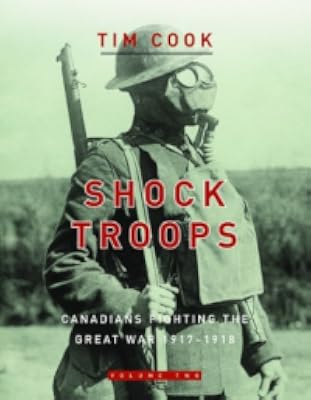
Cook's next book, "Shock Troops" is lined up and ready to go, and I'm quite looking forward to it. show less
Cook's next book, "Shock Troops" is lined up and ready to go, and I'm quite looking forward to it. show less
A good portrayal of the role Canadians played in the Great War. Illuminated by specific aspects of the war like weapons and medicine make it a pretty comprehensive look at this time.
Ratings
Members
- Recently Added By
Lists

r/AskHistorians' Recommended Books
1,068 works; 17 members
Author Information

19+ Works 1,010 Members
Tim Cook is a military historian at the Canadian War Museum. His books have won numerous awards, including the 2008 J.W. Dafoe Prize for At the Sharp End and the 2009 RBC Taylor Prize for Literary Non-Fiction for Shock Troops. In. 2013, he received the Pierre Berton Award for popularizing Canadian history and he is a member of the Order of Canada. show more He lives in Ottawa. show less
Awards and Honors
Series

Common Knowledge
- Original publication date
- 2007
- People/Characters
- Canadian Forces
- Important places
- Western Front in World War I; Somme, Hauts-de-France, France
- Dedication
- For Sarah, Chloe, and Emma
- First words
- Hurling through the air, artillery shells crash down on the enemy lines in a series of explosion that sends sandbags, clods of earth, and body parts in a geyser of solid eruptions.
- Last words
- (Click to show. Warning: May contain spoilers.)And this nightmare would continue to torment tens of millions of soldiers and civilians for another two years, cost millions of lives, and forever change world history.
Classifications
Statistics
- Members
- 157
- Popularity
- 208,482
- Reviews
- 5
- Rating
- (4.57)
- Languages
- English
- Media
- Paper, Ebook
- ISBNs
- 3
- ASINs
- 2