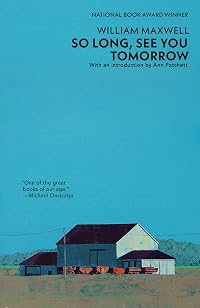
So Long, See You Tomorrow
by William Maxwell
On This Page
Description
[In this book, the author] explores the enigmatic gravity of the past, which compels us to keep explaining it even as it makes liars out of us every time we try. On a winter morning in the 1920s, a shot rings out on a farm in rural Illinois. A man named Lloyd Wilson has been killed. And the tenuous friendship between two lonely teenagers - one privileged yet neglected, the other a troubled farm boy - has been shattered. Fifty years later, one of those boys - now a grown man - tries to show more reconstruct the events that led up to the murder. In doing so, he is inevitably drawn back to his lost friend Cletus, who had the misfortune of being the son of Wilson's killer and who in the months before witnessed things that Maxwell's narrator can only guess at. Out of memory and imagination, the surmises of children and the destructive passions of their parents, [the author] creates a [story] of youth and loss.-Back cover. show lessTags
Recommendations












Member Recommendations
Member Reviews
Regret is a capricious instinct, like a devilish fairy sprinkling her dust where you’d least expect it, or want it. The big failings, the ones that would apparently change life’s course, are easy to spot, even at the moment of their unfolding. But the small ones, the routine and seemingly trivial, are the ones that reach out from the past with a haunting vengeance.
William Maxwell, in [So Long, See You Tomorrow] dives headlong into such a shameful memory, looking at it from fifty years gone. The seminal event is a murder. But the story doesn’t study the bloody, jealous act. Instead, the narrator excavates his guilt over how he treated the murderer’s son, Cletus, a year and a half later. He had moved with his family to the big show more city by that time, having forgotten befriending the awkward outsider. When he sees Cletus in the halls of his new big-city high school, he doesn’t speak to him, doesn’t mention that he knows what happened or that he won’t tell anyone about the scandal. Fifty years later, he is left to wonder what Cletus took from the snub. Did the boy assume he was marked with the guilt of what his father had done? Or that his burden was a dangerous contagion?
As these things are, it’s difficult to explain. And Maxwell puts the story into the proper context, exhuming all the baggage, not the least of which is the narrator’s own grief over the death of his mother at about the same time. The result is a tart slice of small-town Midwestern angst. Maxwell’s spare, elegiac tone is masterful.
First appearing in The New Yorker in two parts, the story was published in book form in 1980. Maxwell had long been the fiction editor for The New Yorker, working with the likes of J.D. Salinger, John O’Hara, and John Cheever. But he had also distinguished himself with his own short stories and novels. This final book was a finalist for the Pulitzer Prize in the year it was published, likely a recognition of Maxwell’s body of work as well as the power of the book itself
Bottom Line: Spare and elegiac; a tart slice of Midwestern angst.
5 bones!!!!! show less
William Maxwell, in [So Long, See You Tomorrow] dives headlong into such a shameful memory, looking at it from fifty years gone. The seminal event is a murder. But the story doesn’t study the bloody, jealous act. Instead, the narrator excavates his guilt over how he treated the murderer’s son, Cletus, a year and a half later. He had moved with his family to the big show more city by that time, having forgotten befriending the awkward outsider. When he sees Cletus in the halls of his new big-city high school, he doesn’t speak to him, doesn’t mention that he knows what happened or that he won’t tell anyone about the scandal. Fifty years later, he is left to wonder what Cletus took from the snub. Did the boy assume he was marked with the guilt of what his father had done? Or that his burden was a dangerous contagion?
As these things are, it’s difficult to explain. And Maxwell puts the story into the proper context, exhuming all the baggage, not the least of which is the narrator’s own grief over the death of his mother at about the same time. The result is a tart slice of small-town Midwestern angst. Maxwell’s spare, elegiac tone is masterful.
First appearing in The New Yorker in two parts, the story was published in book form in 1980. Maxwell had long been the fiction editor for The New Yorker, working with the likes of J.D. Salinger, John O’Hara, and John Cheever. But he had also distinguished himself with his own short stories and novels. This final book was a finalist for the Pulitzer Prize in the year it was published, likely a recognition of Maxwell’s body of work as well as the power of the book itself
Bottom Line: Spare and elegiac; a tart slice of Midwestern angst.
5 bones!!!!! show less
What a beautiful but sad book.
What we, or at any rate what I, refer to confidently as memory--meaning a moment, a scene, a fact that has been subjected to a fixative and thereby rescued from oblivion--is really a form of storytelling that goes on continually in the mind and often changes with the telling. Too many conflicting emotional interests are involved for life ever to be wholly acceptable, and possibly it is the work of the storyteller to rearrange things so that they conform to this end. In any case, in talking about the past we lie with every breath we draw.
So speaks out narrator as he sets out to recreate the end of his childhood. The last gasping breath of an unhappy lad's, I think innocence is too light-hearted a term for show more it, ignorance of the full measure of unhappiness that others can bear in addition to himself, even if he waits a half-century to get to the meat of the pain:
Whether they are part of a home or home is a part of them is not a question children are prepared to answer. Having taken away the dog, take away the kitchen–the smell of something good in the oven for dinner. Also the smell of washing day, of wool drying in the wooden rack. Of ashes. Of soup simmering on the stove. Take away the patient old horse waiting by the pasture fence. Take away the chores that kept him busy from the time he got home from school until they sat down to supper. Take away the early-morning mist, the sound of crows quarreling in the treetops.
His work clothes are still hanging on a nail beside the door of his room, but nobody puts them on or takes them off. Nobody sleeps in his bed. Or reads the broken-back copy of Tom Swift and His Flying Machine. Take that away too, while you are at it.
Take away the pitcher and bowl, both of them dry and dusty. Take away the cow barn where the cats, sitting all in a row, wait with their mouths wide open for somebody to squirt milk down their throats. Take away the horse barn too–the smell of hay and dust and horse piss and old sweat-stained leather, and the rain beating down on the plowed field beyond the door. Take all this away and what have you done to him? In the face of a deprivation so great, what is the use of asking him to go on being the boy he was. He might as well start life over again as some other boy instead.
"Cletus" brought to life as an Einsteinian thought experiment, a boy whose remembered existence is defined by a murder committed or a suicide perpetrated or both. Or neither?
But let me say this. My confusion about this issue is paralleled by the narrator's confusion about his own place, his very existence in the world of this little prairie farming town. His father isn't much for feelings, and he's a "sissy" and an artistic child...except for music, the art form his father loves and he knowingly resists learning as his only somewhat outward act of rebellion.
As he turned away I had the feeling he had washed his hands of me. Was I not the kind of little boy he wanted to have?
What strikes me as hilarious, in a not-funny-at-all way, is:
We were both creatures of the period. I doubt if the heavy-businessman-father-and-the-oversensitive-artistic-son syndrome exists anymore. Fathers have grown sensitive and kiss their grown sons when they feel like it, and who knows what oversensitive is, considering all there is to be sensitive to.
Well now, this novella having a publication date of 1980, all I can think is that Maxwell intended this as sly humor. Or else he was deaf and blind.
Sly humor it is.
And it's of a piece with the Maxwellian phrases that abound in this book. It's always so tempting to rush to the Goodreads quotes page and add...almost every line he writes. Retyping the entire book being, then, a real temptation, I add no quotes to the ones already found there. I rely on the mathematical certainty that all of us together are smarter than any one of us individually. Let the hive mind decide which of these sentences are crucial, which best illuminate Maxwell's writerly chops as well as his storyteller's acumen.
But the title of this review gives me away. I want to add something to the quotes page. I can't, though, because even I the "oh-so-what-about-spoilers" King-Emperor feel the last two pages of the story can't be excerpted without making the point of reading the book evaporate.
It is damned near heartbreaking, what those pages say and what it means. I was perfectly glad to read this book, and rate it close to four stars. Then the ending hit me with The Walking Dead's Negan's baseball bat.
Maxwell wrote a good little story and a perfect ending. That deserves recognition. Read it, please, it won't take long and it will give you something beautiful in return. show less
What we, or at any rate what I, refer to confidently as memory--meaning a moment, a scene, a fact that has been subjected to a fixative and thereby rescued from oblivion--is really a form of storytelling that goes on continually in the mind and often changes with the telling. Too many conflicting emotional interests are involved for life ever to be wholly acceptable, and possibly it is the work of the storyteller to rearrange things so that they conform to this end. In any case, in talking about the past we lie with every breath we draw.
So speaks out narrator as he sets out to recreate the end of his childhood. The last gasping breath of an unhappy lad's, I think innocence is too light-hearted a term for show more it, ignorance of the full measure of unhappiness that others can bear in addition to himself, even if he waits a half-century to get to the meat of the pain:
Whether they are part of a home or home is a part of them is not a question children are prepared to answer. Having taken away the dog, take away the kitchen–the smell of something good in the oven for dinner. Also the smell of washing day, of wool drying in the wooden rack. Of ashes. Of soup simmering on the stove. Take away the patient old horse waiting by the pasture fence. Take away the chores that kept him busy from the time he got home from school until they sat down to supper. Take away the early-morning mist, the sound of crows quarreling in the treetops.
His work clothes are still hanging on a nail beside the door of his room, but nobody puts them on or takes them off. Nobody sleeps in his bed. Or reads the broken-back copy of Tom Swift and His Flying Machine. Take that away too, while you are at it.
Take away the pitcher and bowl, both of them dry and dusty. Take away the cow barn where the cats, sitting all in a row, wait with their mouths wide open for somebody to squirt milk down their throats. Take away the horse barn too–the smell of hay and dust and horse piss and old sweat-stained leather, and the rain beating down on the plowed field beyond the door. Take all this away and what have you done to him? In the face of a deprivation so great, what is the use of asking him to go on being the boy he was. He might as well start life over again as some other boy instead.
"Cletus" brought to life as an Einsteinian thought experiment, a boy whose remembered existence is defined by a murder committed or a suicide perpetrated or both. Or neither?
But let me say this. My confusion about this issue is paralleled by the narrator's confusion about his own place, his very existence in the world of this little prairie farming town. His father isn't much for feelings, and he's a "sissy" and an artistic child...except for music, the art form his father loves and he knowingly resists learning as his only somewhat outward act of rebellion.
As he turned away I had the feeling he had washed his hands of me. Was I not the kind of little boy he wanted to have?
What strikes me as hilarious, in a not-funny-at-all way, is:
We were both creatures of the period. I doubt if the heavy-businessman-father-and-the-oversensitive-artistic-son syndrome exists anymore. Fathers have grown sensitive and kiss their grown sons when they feel like it, and who knows what oversensitive is, considering all there is to be sensitive to.
Well now, this novella having a publication date of 1980, all I can think is that Maxwell intended this as sly humor. Or else he was deaf and blind.
Sly humor it is.
And it's of a piece with the Maxwellian phrases that abound in this book. It's always so tempting to rush to the Goodreads quotes page and add...almost every line he writes. Retyping the entire book being, then, a real temptation, I add no quotes to the ones already found there. I rely on the mathematical certainty that all of us together are smarter than any one of us individually. Let the hive mind decide which of these sentences are crucial, which best illuminate Maxwell's writerly chops as well as his storyteller's acumen.
But the title of this review gives me away. I want to add something to the quotes page. I can't, though, because even I the "oh-so-what-about-spoilers" King-Emperor feel the last two pages of the story can't be excerpted without making the point of reading the book evaporate.
It is damned near heartbreaking, what those pages say and what it means. I was perfectly glad to read this book, and rate it close to four stars. Then the ending hit me with The Walking Dead's Negan's baseball bat.
Maxwell wrote a good little story and a perfect ending. That deserves recognition. Read it, please, it won't take long and it will give you something beautiful in return. show less
I wish every book I read was as moving and thoughtful as this one. Beyond it being a memoir (of sorts), it is told by one who has lived and observed and been immersed in words for a long time. (Maxwell was in his 70s when he wrote this.) From the first pages I felt at ease, being in well aged hands.
The structure is unique. Written part as memoir in first person about his own life; part, for lack of a better word, as investigation; and then a long switch to third person when Maxwell imagines the lives affected by this incident, including all the slow tragedies that led up to it. (Even Trixie, the dog, is effected and my heart ached for her.) Remarkably, this mishmash we are warned about in school, worked.
And the writing, oh the writing. show more I could live for the rest of my life on this kind of lyrical, dead-eye accurate, evocative writing. I wanted to find a few sentences to share the feeling here, but that wouldn't work. It is passages that flow, build, and then crescendo, ending with an intake of breath, "Oh yes. Life is like that," (to paraphrase a bit from poet Elizabeth Bishop).
This book has prompted a new bookshelf tag: to re-read. show less
The structure is unique. Written part as memoir in first person about his own life; part, for lack of a better word, as investigation; and then a long switch to third person when Maxwell imagines the lives affected by this incident, including all the slow tragedies that led up to it. (Even Trixie, the dog, is effected and my heart ached for her.) Remarkably, this mishmash we are warned about in school, worked.
And the writing, oh the writing. show more I could live for the rest of my life on this kind of lyrical, dead-eye accurate, evocative writing. I wanted to find a few sentences to share the feeling here, but that wouldn't work. It is passages that flow, build, and then crescendo, ending with an intake of breath, "Oh yes. Life is like that," (to paraphrase a bit from poet Elizabeth Bishop).
This book has prompted a new bookshelf tag: to re-read. show less
William Maxwell tells a modest yet devastating story using memory as both his subject and method. His subject is his aging narrator’s revisitation of a childhood memory of a friendship ruptured by the murder of a neighboring farmer by his friend’s father. The narrator’s adult attempt to reconstruct this shocking act of violence forces him to confront his own past and his younger self. Maxwell constructs a plot around these memories that slowly accumulate feelings of unspoken guilt and withheld kindness that persist into adulthood.
Maxwell’s prose is deceptively simple, yet it is emotionally charged. Scenes of rural life in the 20’s Midwest, parental absence, adolescent confusion and even the impact on a farm dog that doubles as show more a beloved pet are rendered with such gentleness that their sadness arrives quietly, often well after finishing the passages. The novel’s power lies in what it refuses to dramatize, trusting the reader to feel the full measure of loss and regret.
Some may view this simplicity as a shortcoming, wanting more narrative momentum or psychological depth in the characters. Moreover, the novel’s brevity can make others feel its impact as fleeting and underwhelming. Yet, Maxwell deliberately maintains the emotional stew on simmer. In doing so, he has created a quiet, controlled novel that achieves its emotional power not through plot or drama but through reflection, restraint, and the slow accumulation of feeling. show less
Maxwell’s prose is deceptively simple, yet it is emotionally charged. Scenes of rural life in the 20’s Midwest, parental absence, adolescent confusion and even the impact on a farm dog that doubles as show more a beloved pet are rendered with such gentleness that their sadness arrives quietly, often well after finishing the passages. The novel’s power lies in what it refuses to dramatize, trusting the reader to feel the full measure of loss and regret.
Some may view this simplicity as a shortcoming, wanting more narrative momentum or psychological depth in the characters. Moreover, the novel’s brevity can make others feel its impact as fleeting and underwhelming. Yet, Maxwell deliberately maintains the emotional stew on simmer. In doing so, he has created a quiet, controlled novel that achieves its emotional power not through plot or drama but through reflection, restraint, and the slow accumulation of feeling. show less
“What we, or at any rate what I, refer to confidently as memory—meaning a moment, a scene, a fact that has been subjected to a fixative and thereby rescued from oblivion—is really a form of storytelling that goes on continually and often changes with the telling. Too many conflicting emotional interests are involved for life ever to be wholly acceptable, and possibly it is the work of the storyteller to rearrange things so that they conform to this end. In any case, in talking about the past we lie with every breath we draw.”
This is my second reading of this novel. It’s incredible that I was still pulled into its understated prose despite knowing all of the details this time around. The narrator of the story reconstructs show more events of his childhood so as to get as close to what happened as he can.
He developed a friendship with Cletus Smith in that random but still valid and legitimate way children do, without knowing the details of each other’s lives, and they spent time playing together in a coordinated way where speech wasn’t essential, perfectly synchronized, and purely enjoying each other’s company. A string of tragic events draws them away from each other, and they both move from the small town of Lincoln to Chicago. The tragedy that marks Cletus Smith, even though he is wholly innocent of it, is the kind that would carry whispers around him from those who know him, and judiciously he is moved from the town and its school, while the narrator is forced to move after his father gets a better job position in the city, where they bump into each other and the narrator is forced into that impossible position where words cannot offer comfort and no action seems appropriate. A situation often too complex for adults and even more complex for the child the narrator was at the time. But this inaction as he didn’t acknowledge his friend marks him for life and fills the narrator with guilt so that even as an older man he recreates these incidents obsessively trying to get to that elusive point of understanding.
The past, inescapable, palpable in the present and always shaping the future. Does understanding things as accurately as possible—at least on the personal level—bring that final and conciliatory promise of closure? The narrator doesn’t seem quite sure in the end, even suggests it doesn’t, and I think I agree. There’s no going back to mend things, that chasm can never be breached. This is a beautifully written book, and hopefully one that I’ll return to again. show less
This is my second reading of this novel. It’s incredible that I was still pulled into its understated prose despite knowing all of the details this time around. The narrator of the story reconstructs show more events of his childhood so as to get as close to what happened as he can.
He developed a friendship with Cletus Smith in that random but still valid and legitimate way children do, without knowing the details of each other’s lives, and they spent time playing together in a coordinated way where speech wasn’t essential, perfectly synchronized, and purely enjoying each other’s company. A string of tragic events draws them away from each other, and they both move from the small town of Lincoln to Chicago. The tragedy that marks Cletus Smith, even though he is wholly innocent of it, is the kind that would carry whispers around him from those who know him, and judiciously he is moved from the town and its school, while the narrator is forced to move after his father gets a better job position in the city, where they bump into each other and the narrator is forced into that impossible position where words cannot offer comfort and no action seems appropriate. A situation often too complex for adults and even more complex for the child the narrator was at the time. But this inaction as he didn’t acknowledge his friend marks him for life and fills the narrator with guilt so that even as an older man he recreates these incidents obsessively trying to get to that elusive point of understanding.
The past, inescapable, palpable in the present and always shaping the future. Does understanding things as accurately as possible—at least on the personal level—bring that final and conciliatory promise of closure? The narrator doesn’t seem quite sure in the end, even suggests it doesn’t, and I think I agree. There’s no going back to mend things, that chasm can never be breached. This is a beautifully written book, and hopefully one that I’ll return to again. show less
A brief, childhood friendship which ends in a wordless, silent goodbye at the loud sound of a gunshot, So Long, See You Tomorrow is a semi-autobiographical novel about the ghosts of our past. They are the apparitions that linger at the back of remorseful minds. The ones that frighten and follow us throughout our lives. Engagingly narrated by its protagonist who recalls his friendship with another young boy, it also tells of a murder that disturbed the whole town. A murder which ripped families apart after the flames of betrayal and jealousy turn an adult friendship into ashes. And a lot of parallels between these two friendships cover the field of lasting guilt. But guilt doesn't fasten itself from what was done alone. It also leaks show more from what one has failed to do. So we see violence as a cause, yet see silence as another. As the tale about the murder further unfolds, various themes refer to problematic power dynamics in a marriage and the consequences of divorce. Maxwell gravely paints its misfortunes and the bubbling bitterness lethal and acidic. It's only a matter of time until people meet their demise. Meanwhile, the narrator dozes on and off on the bed of regret underneath the blanket of memories. There is a painful reminder that some relationships merely don't have closures. We cannot fault ourselves from not having had done enough younger. And we will eventually have to reconcile with the fact.
Some plot details found both here and in They Came Like Swallows pertain to the swift familial history of Maxwell's himself. How dearly he holds his mother in his heart, the altered life after her death is very tangible here as it is in They Came Like Swallows. show less
Some plot details found both here and in They Came Like Swallows pertain to the swift familial history of Maxwell's himself. How dearly he holds his mother in his heart, the altered life after her death is very tangible here as it is in They Came Like Swallows. show less
Take away the pitcher and the bowl, both of them dry and dusty. Take away the cow barn where the cats, sitting all in a row, wait with their mouths wide open for somebody to squirt milk down their throats. Take away the horse barn too -- the smell of hay and dust and horse piss and old sweat-stained leather, and the rain beating down on the plowed field beyond the open door. Take all this away and what have you done to him? In the face of a deprivation so great, what is the use of asking him to go on being the boy he was. He might as well start life over again as some other boy instead. (p. 113)
Life can change dramatically and irrevocably in a split second. This happened to Cletus Smith when his father, Clarence, a tenant farmer, shot show more and killed his friend and neighboring farmer, Lloyd Wilson. In imagining the impact of this event, William Maxwell goes well beyond the obvious (a man dead, a family in mourning), to understand how the murder came to happen in the first place, and how these factors would have affected Cletus.
The narrator of this story was Cletus' childhood friend only briefly, just before the murder. And children, as we know, are highly unreliable narrators. Many years later he gained access to newspaper accounts, and developed a more complete picture. And yet, he understands even this view is unreliable:
What we, or at any rate what I, refer to confidently as memory -- meaning a moment, a scene, a fact that has been subjected to a fixative and thereby rescued from oblivion -- is really a form of storytelling that goes on continually in the mind and often changes with the telling. Too many conflicting emotional interests are involved for life ever to be wholly acceptable, and possibly it is the work of the storyteller to rearrange things so that they conform to this end. In any case, in talking about the past we lie with every breath we draw. (p. 27)
Despite this acknowledged flaw, our narrator reconstructs the events that led to Lloyd Wilson's murder, and tells an emotional story of two families, a friendship, and marriages gone sour. Our narrator is also not immune to tragedy and its aftermath: he lost his mother at a young age, and saw the devastating impact on his father. Children are but observers of this drama, and are powerless to influence it.
Maxwell writes with such economy, packing surprising emotional depth into just a few sentences. Take, for example, the quote that opens this review: can't you just feel Cletus' entire world crumbling around him? A few pages later Maxwell describes the family dog's response as her world also changes forever, and instead of appearing silly or superfluous, it reinforced the weight of the tragedy that befell this family. And always, running through the story like a current, is the narrator's guilt over how he treated Cletus later on. He keeps trying to "rearrange things to conform to this end," and simply cannot. This is a powerful story; highly recommended. show less
Life can change dramatically and irrevocably in a split second. This happened to Cletus Smith when his father, Clarence, a tenant farmer, shot show more and killed his friend and neighboring farmer, Lloyd Wilson. In imagining the impact of this event, William Maxwell goes well beyond the obvious (a man dead, a family in mourning), to understand how the murder came to happen in the first place, and how these factors would have affected Cletus.
The narrator of this story was Cletus' childhood friend only briefly, just before the murder. And children, as we know, are highly unreliable narrators. Many years later he gained access to newspaper accounts, and developed a more complete picture. And yet, he understands even this view is unreliable:
What we, or at any rate what I, refer to confidently as memory -- meaning a moment, a scene, a fact that has been subjected to a fixative and thereby rescued from oblivion -- is really a form of storytelling that goes on continually in the mind and often changes with the telling. Too many conflicting emotional interests are involved for life ever to be wholly acceptable, and possibly it is the work of the storyteller to rearrange things so that they conform to this end. In any case, in talking about the past we lie with every breath we draw. (p. 27)
Despite this acknowledged flaw, our narrator reconstructs the events that led to Lloyd Wilson's murder, and tells an emotional story of two families, a friendship, and marriages gone sour. Our narrator is also not immune to tragedy and its aftermath: he lost his mother at a young age, and saw the devastating impact on his father. Children are but observers of this drama, and are powerless to influence it.
Maxwell writes with such economy, packing surprising emotional depth into just a few sentences. Take, for example, the quote that opens this review: can't you just feel Cletus' entire world crumbling around him? A few pages later Maxwell describes the family dog's response as her world also changes forever, and instead of appearing silly or superfluous, it reinforced the weight of the tragedy that befell this family. And always, running through the story like a current, is the narrator's guilt over how he treated Cletus later on. He keeps trying to "rearrange things to conform to this end," and simply cannot. This is a powerful story; highly recommended. show less
Members
- Recently Added By
Published Reviews
ThingScore 100
Told from the viewpoint of an old man who feels guilt about his broken connection to a high-school friend after the friend suffers a terrible trauma, the story is sad, primal, deeply American. The writing is as clear and sharp as grain alcohol.
added by Shortride
Lists

The Guardian's 1000 Novels Everyone Must Read
1,005 works; 552 members

Recommend the 20 best books you've read in the last five years
2,168 works; 609 members

The Top Ten: Writers Pick Their Favorite Books
240 works; 33 members

Favourite Books
1,820 works; 316 members

Top Five Books of 2020
982 works; 350 members

Backlisted
109 works; 9 members
BBC's 100 Novels That Shaped Our World
100 works; 22 members
National Book Award Finalists - Fiction
377 works; 12 members

Pulitzer Prize for Fiction - Finalists
88 works; 9 members

Top Five Books of 2015
811 works; 241 members

Five star books
1,767 works; 110 members

One Book, Many Authors
441 works; 40 members

Lithub: The 50 Best Contemporary Novels Under 200 Pages
50 works; 4 members
TML 200 Best Books 1950-1999
202 works; 10 members

A's favorite novels
100 works; 3 members

Books Read in 2017
4,249 works; 130 members

Books Read in 2022
5,226 works; 115 members

Books Read in 2016
4,666 works; 199 members

Books Read in 2020
4,379 works; 124 members

1980 great books
63 works; 1 member

Slightly Foxed 2
21 works; 1 member

A Novel Cure
742 works; 23 members

National Book Award winners
65 works; 11 members

Books Read in 2019
4,052 works; 108 members

Leah Eady's Book Mentions
18 works; 2 members
Backlisted Podcast
65 works; 3 members

The Modern Library (The Two Hundred Best Novels....
202 works; 1 member
Author Information

28+ Works 5,707 Members
Born in Lincoln, Illinois in 1908, William Maxwell is one of America's more prominent writers. He is the recipient of numerous awards including the National Book Critics Circle Award (1994), and the American Book Award (1982) for his novel "So Long, See You Tomorrow." Maxwell's fiction has been described as nostalgic. Most of his work takes place show more in simpler, gentler times in the small towns of the American Midwest. Two of Maxwell's novels, "They Came Like Swallows" (1937) and "So Long, See You Tomorrow" (1980), deal with characters who lose relatives in the influenza epidemic of 1918. Maxwell's own mother died in the epidemic when he was ten years old. Maxwell published his first novel, "Bright Center of Heaven," in 1934. He moved to New York City in 1936 and was hired by the New Yorker. His years as an editor there, 1936 to 1976, coincided with what many believe are the magazine's finest. This was the era that saw the publication of the works of many accomplished writers, such as J. D. Salinger, Eudora Welty, John Updike, and Mary McCarthy in the New Yorker's pages. Maxwell has published six novels, several collections of short stories, a family history, and numerous book reviews. He served as president of the National Institute of Arts and letters from 1969 to 1972. William Maxwell has been married for over 50 years to the former Emily Noyes. They met at the New Yorker when she applied for a job. The couple has two daughters. (Bowker Author Biography) show less
Some Editions
Awards and Honors
Awards
Notable Lists
Series
Belongs to Publisher Series
Work Relationships
Is contained in
Has as a student's study guide
Common Knowledge
- Canonical title
- So Long, See You Tomorrow
- Original title
- So Long, See You Tomorrow
- Original publication date
- 1979 (serialized) (serialized); 1980 (book) (book)
- People/Characters
- Lloyd Wilson; Clarence Smith; Cletus Smith; Fern Smith
- Important places
- Illinois, USA
- Dedication
- For Robert Fitzgerald
- First words
- The gravel pit was about a mile east of town, and the size of a small lake, and so deep that boys under sixteen were forbidden by their parents to swim there.
- Quotations
- What we, or at any rate what I, refer to confidently as memory - meaning a moment, a scene, a fact that has been subjected to a fixative and thereby rescued from oblivion - is really a form of storytelling that goes on contin... (show all)ually in the mind and often changes with the telling. Too many conflicting emotional interests are involved for life ever to be wholly acceptable, and possibly it is the work of the storyteller to rearrange things so that they conform to this end. In any case, in talking about the past we lie with every breath we draw.
"There is a limit, surely, to what one can demand of one’s adolescent self." - Last words
- (Click to show. Warning: May contain spoilers.)And whether the series of events that started with the murder of Lloyd Wilson - whether all that finally began to seem less real, more like something he dreamed, so that instead of being stuck there he could go on and by the grace of God lead his own life, undestroyed by what was not his doing.
- Blurbers
- Hazzard, Shirley; Updike, John; Steegmuller, Francis
- Original language
- English
Classifications
Statistics
- Members
- 2,082
- Popularity
- 9,997
- Reviews
- 82
- Rating
- (3.89)
- Languages
- 11 — Chinese, Dutch, English, French, German, Italian, Norwegian (Bokmål), Portuguese, Spanish, Swedish, Turkish
- Media
- Paper, Audiobook, Ebook
- ISBNs
- 33
- ASINs
- 13