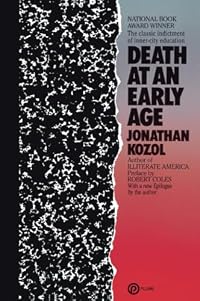
Death at an Early Age
by Jonathan Kozol
On This Page
Description
The story of the year the author spent teaching in a predominantly black school in Boston.Tags
Recommendations
















Member Reviews
It's hard to convey how powerful this book is.
The author, Jonathan Kozol, taught for a short time as a white teacher in a predominantly black Boston city school in the 1960s. He was ultimately fired for introducing his fourth grade students to a Langston Hughes poem called "Ballad of the Landlord" which he read in an attempt to spark his class interest in something, anything "
Kozol's first person narrative about his experience reads like Dickensian novel. The illegal but frequent beatings children received from teachers in the hidden bowels of the decaying school building. The complete lack of understanding or interest in the difficult home lives of many of these children. The psychological smashing of any spark of creativity or show more independence displayed by a child. And the repeated blaming of students for the shortcoming of their teachers. And these are just of the insidious ways blatant prejudice was administered on a daily basis in the city's public schools.
Living in the Boston area, I picked the book up after hearing an interview with the author on the 50th anniversary of the book's publication. I thought it would be an interesting look at the history of the Boston Schools. But it was MUCH more than I bargained for. It is a scathing indictment of an institution with deeply entrenched bigotry and cruelty and completely explains why court-ordered bussing was the only way to achieve educational parity. Beyond that it's a shameful portrait of our country during the early years of the civil rights movement. I think it should be mandatory reading in all US history classes in this country. show less
The author, Jonathan Kozol, taught for a short time as a white teacher in a predominantly black Boston city school in the 1960s. He was ultimately fired for introducing his fourth grade students to a Langston Hughes poem called "Ballad of the Landlord" which he read in an attempt to spark his class interest in something, anything "
Kozol's first person narrative about his experience reads like Dickensian novel. The illegal but frequent beatings children received from teachers in the hidden bowels of the decaying school building. The complete lack of understanding or interest in the difficult home lives of many of these children. The psychological smashing of any spark of creativity or show more independence displayed by a child. And the repeated blaming of students for the shortcoming of their teachers. And these are just of the insidious ways blatant prejudice was administered on a daily basis in the city's public schools.
Living in the Boston area, I picked the book up after hearing an interview with the author on the 50th anniversary of the book's publication. I thought it would be an interesting look at the history of the Boston Schools. But it was MUCH more than I bargained for. It is a scathing indictment of an institution with deeply entrenched bigotry and cruelty and completely explains why court-ordered bussing was the only way to achieve educational parity. Beyond that it's a shameful portrait of our country during the early years of the civil rights movement. I think it should be mandatory reading in all US history classes in this country. show less
It's hard to convey how powerful this book is.
The author, Jonathan Kozol, taught for a short time as a white teacher in a predominantly black Boston city school in the 1960s. He was ultimately fired for introducing his fourth grade students to a Langston Hughes poem called "Ballad of the Landlord" which he read in an attempt to spark his class interest in something, anything "
Kozol's first person narrative about his experience reads like Dickensian novel. The illegal but frequent beatings children received from teachers in the hidden bowels of the decaying school building. The complete lack of understanding or interest in the difficult home lives of many of these children. The psychological smashing of any spark of creativity or show more independence displayed by a child. And the repeated blaming of students for the shortcoming of their teachers. And these are just of the insidious ways blatant prejudice was administered on a daily basis in the city's public schools.
Living in the Boston area, I picked the book up after hearing an interview with the author on the 50th anniversary of the book's publication. I thought it would be an interesting look at the history of the Boston Schools. But it was MUCH more than I bargained for. It is a scathing indictment of an institution with deeply entrenched bigotry and cruelty and completely explains why court-ordered bussing was the only way to achieve educational parity. Beyond that it's a shameful portrait of our country during the early years of the civil rights movement. I think it should be mandatory reading in all US history classes in this country. show less
The author, Jonathan Kozol, taught for a short time as a white teacher in a predominantly black Boston city school in the 1960s. He was ultimately fired for introducing his fourth grade students to a Langston Hughes poem called "Ballad of the Landlord" which he read in an attempt to spark his class interest in something, anything "
Kozol's first person narrative about his experience reads like Dickensian novel. The illegal but frequent beatings children received from teachers in the hidden bowels of the decaying school building. The complete lack of understanding or interest in the difficult home lives of many of these children. The psychological smashing of any spark of creativity or show more independence displayed by a child. And the repeated blaming of students for the shortcoming of their teachers. And these are just of the insidious ways blatant prejudice was administered on a daily basis in the city's public schools.
Living in the Boston area, I picked the book up after hearing an interview with the author on the 50th anniversary of the book's publication. I thought it would be an interesting look at the history of the Boston Schools. But it was MUCH more than I bargained for. It is a scathing indictment of an institution with deeply entrenched bigotry and cruelty and completely explains why court-ordered bussing was the only way to achieve educational parity. Beyond that it's a shameful portrait of our country during the early years of the civil rights movement. I think it should be mandatory reading in all US history classes in this country. show less
I think the subtitle says it all; a nonfiction account of a first-time fourth grade teacher in a less than stellar school system in Roxbury, Massachusetts. "They had desks and a teacher, but they really did not have a class" (p 29). While Kozol is talking about a physical space (he had to share a large auditorium with three, sometimes four other activities (including drama and band practices), I really think he was also referring to the lack of togetherness as a group. There wasn't a sense of community. There wasn't a unified eagerness to learn. Nothing bound them to the reason they were there. This is to say nothing of the lack of support Kozol received as an educator from his peers and administration. He was constantly criticized for show more the amount of time, resources and energy he gave to "the Negro student." Death at an Early Age is a continuous report of the different instances of abuse and neglect the students endured, culminating with Kozol's unjustified dismissal after the inclusion of a Langston Hughes poem, "The Landlord." show less
This book is as much about people's ability to deceive themselves as it is about conditions in the Boston Public Schools for black children during the 1960s. I enjoyed the psychological profiles of the Reading Teacher and the school superintendent and members of the school committee.
The experiences of a young idealistic teacher in the Boston Public school system. This was one of the books that influenced my decision to become a teacher; it is powerfully written, sure in its assumptions, and often hits the nail on the head. It is a heartbreaking book to read in some ways, especially to see how the black students in the system were so subject to a policy of benign neglect designed to make them acceptive of their lot in life, or at least desirous of bettering themselves without rocking the boat.
A hero of education. Too bad we can't listen to him and his kind to get something going with regard to education in this country. When will we ever learn that improving the lives of the least fortunate through authentic education is the answer to most ofl
Members
- Recently Added By
Lists

New England Books
101 works; 10 members

A Boston Reading List
120 works; 10 members
Author Information

19+ Works 7,363 Members
Educator and author Jonathan Kozol was born in Boston. He graduated from Harvard University in 1958. Kozol has an concerns with topics such as illiteracy, children trying to learn in bad neighborhoods and homelessness. His books include Death at an Early Age, Illiterate American and Rachel and Her Children: Homeless Families in America. (Bowker show more Author Biography) show less
Some Editions
Awards and Honors
Distinctions
Notable Lists
Common Knowledge
- Original publication date
- 1967 (text) (text); 1985 (epilogue) (epilogue)
- Epigraph
- Some day, maybe, there will exist a well-informed, well-considered, and yet fervent public conviction that the most deadly of all possible sins is the mutilation of a child's spirit; for such mutilation undercuts the life pri... (show all)nciple of trust, without which every uman act, may it feel ever so good and seem ever so right, is prone to perversion by destructive forms of conscientiousness.
--Erik Erikson - Dedication
- This book is dedicated to Ellen Jackson
- First words
- Stephen is eight years old.
Preface: I hope some of those Congressmen who are now looking into the causes of riots will find time to read this honest and terrifying book by Jonathan Kozol, a young teacher fired from his job by the Boston school system f... (show all)or using a poem by Langston Hughes that was not on the prescribed list of "reading materials."
Foreword: During the academic year 1964-1965, I found myself teaching in a segregated classroom of the Boston Public Schools. - Last words
- (Click to show. Warning: May contain spoilers.)It is not difficult to understand why this would seem desirable, and it is very hard for someone who lives among the Negro people to argue against it,, much as he might consider it unwise.
- Blurbers
- Schrag, Peter
Classifications
- Genres
- Nonfiction, General Nonfiction
- DDC/MDS
- 306.4320974461 — Society, government, & culture Social sciences, sociology & anthropology Social Behavior - Dating, Marriage, Divorce Specific aspects of culture Education School and society
- LCC
- LC2803 .B7 .K6 — Education Special aspects of education Special aspects of education Education of special classes of persons Blacks. African Americans
- BISAC
Statistics
- Members
- 438
- Popularity
- 69,823
- Reviews
- 8
- Rating
- (4.18)
- Languages
- English
- Media
- Paper
- ISBNs
- 8
- ASINs
- 13