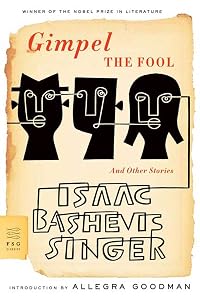
Gimpel the Fool and Other Stories
by Isaac Bashevis Singer
On This Page
Description
Isaac Bashevis Singer' s first collection of stories, "Gimpel the Fool," is a landmark work that has attracted international acclaim since it was first published in 1957. In Saul Bellow' s masterly translation, the title story follows the exploits of Gimpel, an ingenuous baker who is universally deceived but who declines to retaliate against his tormentors. Gimpel and the protagonists of the other stories in this volume all inhabit the distinctive pre- World War II ghettos of Poland and, show more beyond that, the larger world created by Singer' s unforgettable prose. show lessTags
Recommendations
























Member Reviews
“Gimpel the Fool and Other Stories” was originally published in 1953, and contains ten short stories rife with Singer’s unique fictional voice – full of meditations on mortality, good, and evil, Jewish mythology, and an ability to communicate truths in the folksy, simple yet extraordinarily sophisticated way that characterizes these parabolic stories. Singer’s protagonists live in the Old World in every sense - a world inhabited with dybbuks, qlippoth, and golem who are every bit as real as anyone else. They are not disembodied spirits in “the world beyond.” They quite literally live in your mirror (see “The Mirror”) and come to talk to you after they have died.
In the title story, and maybe one of the more endearing, show more Gimpel, a baker from Frampol, openly declares in the opening lines “I am Gimpel the Fool. I don’t think myself a fool. On the contrary. But that’s what folks call me.” His innocence and simplicity almost set him up for the reader to expect something more sinister, but his child-like nature abides. Despite marrying a woman who shamelessly cuckolds him time and time and time again, he seems to have a preternatural ability for forgiveness and acceptance. One night, a Spirit of Evil visits him in his sleep and tempts him to deceive the world in the same way that it continues to deceive him. He asks how, and the Spirit responds “you might accumulate a bucket of urine every day and at night pour it into the dough. Let the sages of Frampol eat filth,” and urges him not to believe in God. The spirit of his wife visits him and warns him that just because she was false to him doesn’t mean that everything he’s learned is false. Gimpel is a poignant figure, but one whose goodness consigns him to what others think is foolishness for his entire life.
Singer the parabolist is at his height “The Gentleman from Cracow” wherein a man descends upon Frampol seemingly able to solve many of the city’s problems with his tremendous generosity and wealth. The only man trying to brook his influence on the townspeople of Frampol is old Rabbi Ozer, who keeps warning that he is a satanic influence. With such a heavy-handed theme, Singer does the seemingly impossible here: telling a moralistic tale without taking a cudgel to the reader’s head in order to communicate his message. This might be one of my favorite stories in the collection because its tone has so much in common with many of the others. It is a clearly articulated, well-defined fable that leaves enough room for ambiguity to entice the intelligent reader to visit it more than once.
After this and a couple of other experiences with short stories this year, I think I could reconsider what I think of them. Both this and Angela Carter’s “The Bloody Chamber and Other Stories” are two of the best books I’ve read in the last year. I was in the bookstore the other day and bought “In My Father’s Court,” an autobiographical volume about Singer’s rebellious childhood. These stories more than anything else struck me as the stories of a rebel; the characters are overly credulous yet smart, and deeply religious but speculative and doubting. If it’s anything like these stories, I can’t wait. show less
In the title story, and maybe one of the more endearing, show more Gimpel, a baker from Frampol, openly declares in the opening lines “I am Gimpel the Fool. I don’t think myself a fool. On the contrary. But that’s what folks call me.” His innocence and simplicity almost set him up for the reader to expect something more sinister, but his child-like nature abides. Despite marrying a woman who shamelessly cuckolds him time and time and time again, he seems to have a preternatural ability for forgiveness and acceptance. One night, a Spirit of Evil visits him in his sleep and tempts him to deceive the world in the same way that it continues to deceive him. He asks how, and the Spirit responds “you might accumulate a bucket of urine every day and at night pour it into the dough. Let the sages of Frampol eat filth,” and urges him not to believe in God. The spirit of his wife visits him and warns him that just because she was false to him doesn’t mean that everything he’s learned is false. Gimpel is a poignant figure, but one whose goodness consigns him to what others think is foolishness for his entire life.
Singer the parabolist is at his height “The Gentleman from Cracow” wherein a man descends upon Frampol seemingly able to solve many of the city’s problems with his tremendous generosity and wealth. The only man trying to brook his influence on the townspeople of Frampol is old Rabbi Ozer, who keeps warning that he is a satanic influence. With such a heavy-handed theme, Singer does the seemingly impossible here: telling a moralistic tale without taking a cudgel to the reader’s head in order to communicate his message. This might be one of my favorite stories in the collection because its tone has so much in common with many of the others. It is a clearly articulated, well-defined fable that leaves enough room for ambiguity to entice the intelligent reader to visit it more than once.
After this and a couple of other experiences with short stories this year, I think I could reconsider what I think of them. Both this and Angela Carter’s “The Bloody Chamber and Other Stories” are two of the best books I’ve read in the last year. I was in the bookstore the other day and bought “In My Father’s Court,” an autobiographical volume about Singer’s rebellious childhood. These stories more than anything else struck me as the stories of a rebel; the characters are overly credulous yet smart, and deeply religious but speculative and doubting. If it’s anything like these stories, I can’t wait. show less
Gimpel the Fool, the collection, is not one of my favorite Singer works. That's why I am giving it the rating I am. In truth, I would choose it over many books I've rated higher. At some point though, a measure of objectivity should be allowed in. Right, Gimpel? Anyway, what follows is my current view in regard to the character of Gimpel. There is the potential below, of course, for spoilers to the story.
Why is Gimpel a fool?
Gimpel is "easy to take in." Gimpel is taken in, even, by statements he suspects to be false. A fool's response to hearing the news of his parents rising from the grave? "To tell the truth, I knew nothing of the sort had happened, but all the same, as folks were talking, I threw on my wool vest and went out." It's show more not hope that drives him out - he says as much. He knows his parents aren't there. He offers two reasons: 1) anything is possible, and 2) those who told him would be upset if he didn't pretend at least to believe them. I think Gimpel is holding something back. He may not realize it himself. Is it possible the primary reason for Gimpel acting the fool is that he does not want to acknowledge the cruelty that surrounds human existence? Is it a case, then, of opting for illusion rather than reality?
Well, anything is possible. Life goes on. Indignities mount. El Diablo appears. Not in a sulfuric cloud, but atop processed powdery foodstuff bags that are the heart of Gimpel's economic well-being is the temptation whispered. Gimpel? Gimpel goes along with everything. The apparition of his wife next appears. Gimpel is persuaded to undo that which the devil almost made him do. I mean, is the cup half-empty or half-full at this point? Gimpel please stop being rolled.
Gimpel the wanderer goes from town to town comforted in the knowledge "No doubt the world is entirely an imaginary world, but it is only once removed from the true world." What's that? I see him still running away from the problem; still acting on things he believes to be untrue; still reaching for the wool vest while undertaking his latest errand. Is there any reason why we should take Gimpel's word for anything?
So, is Gimpel a fool at story's end?
I keep thinking to Singer's Author's Note to The Penitent, written many years after this story, how it mentions the following: "If I were able to picket the Almighty, I would carry a sign with the slogan UNFAIR TO LIFE!" He wouldn't find Gimpel on that picket line. And that's why Gimpel, to this reader, remains the fool. show less
Why is Gimpel a fool?
Gimpel is "easy to take in." Gimpel is taken in, even, by statements he suspects to be false. A fool's response to hearing the news of his parents rising from the grave? "To tell the truth, I knew nothing of the sort had happened, but all the same, as folks were talking, I threw on my wool vest and went out." It's show more not hope that drives him out - he says as much. He knows his parents aren't there. He offers two reasons: 1) anything is possible, and 2) those who told him would be upset if he didn't pretend at least to believe them. I think Gimpel is holding something back. He may not realize it himself. Is it possible the primary reason for Gimpel acting the fool is that he does not want to acknowledge the cruelty that surrounds human existence? Is it a case, then, of opting for illusion rather than reality?
Well, anything is possible. Life goes on. Indignities mount. El Diablo appears. Not in a sulfuric cloud, but atop processed powdery foodstuff bags that are the heart of Gimpel's economic well-being is the temptation whispered. Gimpel? Gimpel goes along with everything. The apparition of his wife next appears. Gimpel is persuaded to undo that which the devil almost made him do. I mean, is the cup half-empty or half-full at this point? Gimpel please stop being rolled.
Gimpel the wanderer goes from town to town comforted in the knowledge "No doubt the world is entirely an imaginary world, but it is only once removed from the true world." What's that? I see him still running away from the problem; still acting on things he believes to be untrue; still reaching for the wool vest while undertaking his latest errand. Is there any reason why we should take Gimpel's word for anything?
So, is Gimpel a fool at story's end?
I keep thinking to Singer's Author's Note to The Penitent, written many years after this story, how it mentions the following: "If I were able to picket the Almighty, I would carry a sign with the slogan UNFAIR TO LIFE!" He wouldn't find Gimpel on that picket line. And that's why Gimpel, to this reader, remains the fool. show less
An early anthology of Singer's work, this volume is characteristically wonderful. There is truth to Singer's writing, and simplicity. His characters are real, even those as unreal as imps and dybbukim. There is true, unfettered joy in works like that that bears this name ("Joy," the seventh story of this volume). Even from the wreckage of war-torn villages, even from the clutches of Satan himself, Singer manages to snatch glimmerings of hope and peace and love.
My favorite from this collection is "The little shoemakers," a short saga of several generations of cobblers in a small Polish village. The story focuses its attention on the symbolically-named Abba, the last of the line to live out much of his life in Poland before emigrating to show more America. So vivid, the descriptions of his town, the portrait of his home. So real, his hands, his work, his world. So well do we feel we know poor Abba that we cry when his home is destroyed, his life uprooted, he and his small satchel of tools carried across the sea to begin a new life late in his appointed years. "Oh Lord, Judele!"
Absent from this collection were Singer's tales of mid-century New York, a fare that offers delicious variety in many of his other collections of short prose. This absence is perhaps the volume's only drawback. Otherwise, read, rejoice! show less
My favorite from this collection is "The little shoemakers," a short saga of several generations of cobblers in a small Polish village. The story focuses its attention on the symbolically-named Abba, the last of the line to live out much of his life in Poland before emigrating to show more America. So vivid, the descriptions of his town, the portrait of his home. So real, his hands, his work, his world. So well do we feel we know poor Abba that we cry when his home is destroyed, his life uprooted, he and his small satchel of tools carried across the sea to begin a new life late in his appointed years. "Oh Lord, Judele!"
Absent from this collection were Singer's tales of mid-century New York, a fare that offers delicious variety in many of his other collections of short prose. This absence is perhaps the volume's only drawback. Otherwise, read, rejoice! show less
Gimpel was a simple baker in a shetl and struggles with being the object of ridicule and deception. Gimpel has an unwavering faith in the goodness of people. Was he a fool?
Sólo había leído un libro de Isaac Bashevis Singer, [b:El Certificado|3205753|El Certificado|Isaac Bashevis Singer|https://images.gr-assets.com/books/1267857266s/3205753.jpg|2267466], y sigue siendo una de mis novelas favoritas de toda la vida. Por eso mismo, me llamaba mucho la atención la faceta de Singer como cuentista, y ahora que terminé "Gimpel the Fool", no puedo decir más que no me siento nada decepcionado. El polaco es un excelente cuentista, con la combinación perfecta de cuento folclórico y realista, siempre preocupado por el sexo, la espiritualidad, la muerte y el sufrimiento no sólo de un pueblo, sino del ser humano.
¡Por cierto! El buen Misael Maqueda y yo hicimos un capítulo de nuestro podcast "La antorcha al show more oído" sobre Singer. Si gustan pasar a escucharlo, pueden entrar desde acá:
https://soundcloud.com/user-744630066/capitulo-2-isaac-bashevis-singer-nuestra-p... show less
¡Por cierto! El buen Misael Maqueda y yo hicimos un capítulo de nuestro podcast "La antorcha al show more oído" sobre Singer. Si gustan pasar a escucharlo, pueden entrar desde acá:
https://soundcloud.com/user-744630066/capitulo-2-isaac-bashevis-singer-nuestra-p... show less
Isaac Bashevis Singer was born to a Hasidic rabbi and his wife in a small village near Warsaw in 1904, and he lived in poverty for most of his childhood and young adult life. He studied the Talmud formally, read literature and philosophy in his spare time, and worked as a proofreader, reviewer and short story writer in the mid-1920s, aided by his older brother Israel Joshua Singer, who became a noted journalist and novelist. He emigrated to New York in 1935, following his brother who had emigrated there three years previously. He continued to write short stories and novels, always in Yiddish initially, which were later revised and translated into English. He was awarded the Nobel Prize for Literature in 1978.
Gimpel the Fool: And Other show more Stories (1953) was the first collection of Singer's short stories published in English in the United States. It is one of four books included in the Library of America's Collected Stories: Gimpel the Fool to The Letter Writer.
The stories are set in shtetls. small towns with large Jewish populations, in late 19th century Poland. They are told as folk tales involving villagers, mainly of whom are led to sin by a variety of devils and demons, who take advantage of the characters' weaknesses and greed to lead them astray. The first story, "Gimpel the Fool", is the best in this collection, involving a simple man who is repeatedly tricked and tortured by his fellow villagers and wife, but ultimately has the last word, as he retains his belief in the God and the capacity of goodness in man. Other stories are similarly themed, in that those who follow a path of truth and good will ultimately be rewarded, whereas those consumed by greed or desired will be easily tricked by demons, who assume a variety of disguises, and will meet fates worse than death.
The stories are quite rich, humorous and witty without being overly moralistic, and the book was a most enjoyable read. show less
Gimpel the Fool: And Other show more Stories (1953) was the first collection of Singer's short stories published in English in the United States. It is one of four books included in the Library of America's Collected Stories: Gimpel the Fool to The Letter Writer.
The stories are set in shtetls. small towns with large Jewish populations, in late 19th century Poland. They are told as folk tales involving villagers, mainly of whom are led to sin by a variety of devils and demons, who take advantage of the characters' weaknesses and greed to lead them astray. The first story, "Gimpel the Fool", is the best in this collection, involving a simple man who is repeatedly tricked and tortured by his fellow villagers and wife, but ultimately has the last word, as he retains his belief in the God and the capacity of goodness in man. Other stories are similarly themed, in that those who follow a path of truth and good will ultimately be rewarded, whereas those consumed by greed or desired will be easily tricked by demons, who assume a variety of disguises, and will meet fates worse than death.
The stories are quite rich, humorous and witty without being overly moralistic, and the book was a most enjoyable read. show less
the story of Gimpel who longs for the land only
an interval a hearbeat removed from ours and where
even Gimpel will meet no deception or confusion,
is deeply resonant to me.
an interval a hearbeat removed from ours and where
even Gimpel will meet no deception or confusion,
is deeply resonant to me.
Members
- Recently Added By
Lists

Jewish Books
367 works; 24 members

Favourite Short Stories
22 works; 2 members

The 150 Greatest Novels of All Time
150 works; 6 members
Author Information

387+ Works 24,018 Members
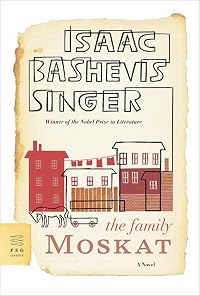
Isaac Bashevis Singer (1904-91) was the author of many novels, stories, children's books, and memoirs. He received the Nobel Prize in Literature in 1978. (Publisher Provided) Isaac Bashevis Singer was born in Radzymin, Poland on July 14, 1904. He received a traditional Jewish education, including training at the rabbinical seminary in Warsaw. He show more began writing in Hebrew while he worked for 10 years as a proofreader and translator in Warsaw. In 1935, he immigrated to New York, where he became a journalist for the Daily Forward, America's largest Yiddish newspaper. Most of his stories were originally published in this newspaper in serial form. His first novel, The Family Moskat, was published in 1950. His other works include The Magician of Lublin, The Spinoza of Market Street, The Slave, and A Friend of Kafka. A Day of Pleasure: Stories of a Boy Growing Up in Warsaw won the National Book Award for children's literature. He received numerous awards during his lifetime including the Nobel Prize for Literature in 1978 and the Gold Medal for Fiction in 1989. He died after suffering a series of strokes on July 24, 1991. (Bowker Author Biography) show less
Some Editions
Awards and Honors
Notable Lists
Series
Belongs to Publisher Series
Avon (SS7)
Work Relationships
Is contained in
Contains
Has as a student's study guide
Common Knowledge
- Canonical title
- Gimpel the Fool and Other Stories
- Original title
- Gimpel the Fool and Other Stories
- Original publication date
- 1953
- People/Characters
- Gimpel the Fool
- Dedication*
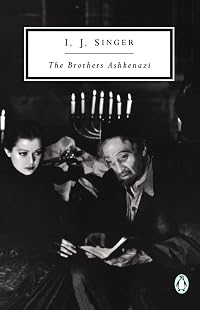
- Dedico queste pagine alla memoria di mio fratello, I.J. Singer, l'autore dei Fratelli Ashkenazi, Yoshe Kalb eccetera, che mi aiutò a entrare negli Stati Uniti e fu il mio maestro in letteratura. Sto ancora imparando da lui e... (show all) dalla sua opera. ISAAC BASHEVIS SINGER
- Original language*
- Yiddish
- Canonical DDC/MDS
- 839.09
- Disambiguation notice
- This is the collection of short stories. Contains
Gimpel the Fool,
The Gentleman from Cracow,
The Wife Killer,
By the Light of Memorial Candles,
The Mirror,
The Little Shoemakers,
Joy,
From the Diary... (show all) of One Not Born,
The Old Man,
Fire,
The Unseen.
Not to be combined with the single short story.
*Some information comes from Common Knowledge in other languages. Click "Edit" for more information.
Classifications
- Genres
- General Fiction, Fiction and Literature
- DDC/MDS
- 839.09 — Literature & rhetoric German & related literatures Other Germanic literatures - Yiddish
- LCC
- PJ5129 .S49 .G513 — Language and Literature Oriental languages and literatures Oriental philology and literature Hebrew Other languages used by Jews Yiddish
- BISAC
Statistics
- Members
- 657
- Popularity
- 44,037
- Reviews
- 11
- Rating
- (3.90)
- Languages
- 13 — Czech, Dutch, English, French, German, Italian, Japanese, Polish, Romanian, Spanish, Swedish, Thai, Yiddish
- Media
- Paper, Audiobook, Ebook
- ISBNs
- 30
- UPCs
- 2
- ASINs
- 25