On This Page
Description
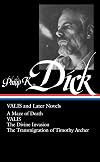
The third and final volume of an overview of the author's work features novels written during his later years, including "A Maze of Death" and "The Divine Invasion," when the themes of religious revelation became predominant.Tags
Recommendations













































Member Reviews
My continuing journey through the Philip K. Dick Library of America collections is nearing its end; the final one collects his "VALIS novels" from the 1980s... but despite the "later novels" subtitle, throws in also A Maze of Death, which was published in 1970 and thus chronologically goes back between Ubik (1969) and Flow My Tears, the Policeman Said (1974).
A Maze of Death
This novel comes from the very end of what I think of as Dick's early period (1955-70), when he publishing two or three novels most years. It also feels like one of those early period novels; it clearly predates the shift that came with Flow My Years and A Scanner Darkly (1977). It's about ordinary people on another planet; a discontented group of space colonists have show more all been resettled on the uninhabited planet of Delmak-O... only they don't know why, because the message that's supposed to tell them this is damaged. You can see how this comes out of the same sort of area as, say, Martian Time-Slip (1964), though it's the first of Dick's novels that I've read where interstellar travel is in the foreground, not just interplanetary. (Certainly interstellar travel is an element in many of his other novels, but this is the first I've read where the narrative predominantly takes place outside of Earth's solar system.)
So it's clearly early Dick... and it's clearly also weaker Dick. It starts promisingly enough, and there's a bit of a trippy twist... but then there's another and another, and it felt more like a formula than something disconcerting. Like, Dick knew what people liked about his books was reality being upended, and so dutifully wrote a book that did it, but didn't put the work into making the reader feel upended. None of those moments here land the way similar ones did in Martian Time-Slip, Do Androids Dream of Electric Sheep? (1968), or Ubik (1969). I don't know that I could tell you why without digging more deeply into A Maze of Death than I really feel motivated to do, but there it is.
What Dick did in his "VALIS novels," stylistically and thematically, is not really what he was doing in A Maze of Death at all. I guess they wanted the volume to be a bit longer, and A Maze of Death does have an attempt at creating an original religion in it. But honestly I wonder if a short volume omitting it would have been preferable; definitely weakest of the ten Dick novels I've read thus far.
VALIS / The Divine Invasion / The Transmigration of Timothy Archer
After eight months and thirteen novels, these three stories finally draw my Dick journey to a close. The so-called "VALIS trilogy" is more of a duology plus a third book with thematic links to the first two. VALIS (1981) and The Divine Invasion (1981) are both science fiction novels where people have encounters with pink laser beams that impart to them the existence of God, and where the existence of the movie-within-a-book, VALIS, is discussed. On the other hand, The Transmigration of Timothy Archer (1982) is a non-sf novel about an Episcopal bishop trying to find proof of the existence of God. But in terms of how the novels work, I think VALIS and Transmigration are closer together, and Divine Invasion is the outlier.
VALIS and Transmigration are both about the search for God and the search for meaning. VALIS begins with a story about the science fiction author Horselover Fat, but the first-person narrator quickly admits that Fat is him, it's just that these events are too painful to recount directly. But as you keep reading, it seems that the narrator must be a separate person from Fat because they have conversations, and then you realize that the first person narrator is Dick himself! But eventually all this is explained (well, as much as anything is explained in a Dick novel), and I really enjoyed the play with narration. I also just really enjoyed the story in general: Fat is someone with marriage issues, with drug issues, but most of all, with meaningfulness issues. He's chasing after meaning, and maybe he finds it in VALIS... but then there are aspects of VALIS that turn out to be disappointing. Like the best Dick novels, it balances trippiness with ordinariness, and it's definitely in the top tier of his work.
The Transmigration of Timothy Archer is very similar to VALIS in many ways: it's about our desperate search for religious truth and our disappointment when we think we've found it. It is also, like VALIS, told in the first person—maybe I am forgetting something, but I think these are the only two Dick novels to be? If so, it's a real shame, because it's highly effective here. The narrator here is Angel Archer, the daughter-in-law of Timothy Archer, a radical bishop who soon becomes involved in a sexual relationship, a discovery of the origins of Christianity that might disprove the divinity of Christ, and supposed communications from the spirits of dead loved ones. What do we chose to believe in, and what do we not? Angel is a great narrator, with the strong sense of personality and voice; the events of the novel are tragic but often kept at a remove, in a way that feels very emotionally honest. There are lots of great bits: I really liked a conversation between the bishop and a car enthusiast about making the link between cause and effect; I liked how Angel (who was an English major in college) continually reflected on the way that literature gave her something to believe in, how it served as a sort of substitute religion—but also how that substitute keeps her at a remove from reality. As an English major (and, now, English professor), I can empathize, and I find the critique interesting. The last bit of the novel is really great.
Dick believed himself to have experienced a divine revelation in reality, but you wouldn't know it from these two novels. They're both about the limitations of belief in a way that I found very interesting. VALIS is technically sf, but I felt you could probably read it as a realist novel if you wanted to; on the other hand, there is the possibility that something supernatural actually did happen in Transmigration. (Angel doesn't think so, though, and neither did I.) Though they grapple with similar themes to much of his early work, I had a real sense that Dick had "leveled up" as a writer.
The Divine Invasion is different from the other two, because instead of being about belief, it's about the things one might believe in. It's also more like Dick's earlier novels, being set in the future, about colonists on other planets. A space colonist has to marry a woman who's undergoing a virgin birth; the child is God apparently. The child undergoes an experience much like the Temptation of Christ, though Dick puts a nice little spin on it. This book had its moments. Probably my favorite is that much of the novel is a flashback that the colonist has while he's in cryogenic suspension, only a malfunction in the mechanism means that his tube is picking up a radio station broadcasting string versions of music from Fiddler on the Roof. So the whole time the story is unfolding, he keeps asking other characters if they can hear the music. Which means we never see how things "actually" went! (If you believe Dick's VALIS cosmology, though, I think everything happens all at once, so there is no difference between the actual events and the recalled events.)
I liked all the stuff about the colonist; it was solid, mid-tier Dick, about an ordinary guy trying to stay afloat, work through a bad marriage, and deal with extraordinary things happening to him. A lot like, say Martian Time-Slip (1964) or Now Wait for Last Year (1966), both favorite novels by Dick. On the other hand, the religious discussions between the kid and other characters were frequently dull. I prefer reading about someone searching for truth, I guess, to hearing what Dick's supposed truth actually was. VALIS and Transmigration are skeptical in a way that Divine Invasion is not. So a decent work, but clearly (to me anyway) the weakest of the three.
Dick died after he wrote Transmigration but before it was published. It's a real shame for any number of reasons, but particularly because you have the impression Dick was about to kick into a third phase of his literary career. After the early write-tons-of-novels-and-some-will-be-great-and-some-will-not phase (1955-70) and the drugs-have-slowed-me-down phase (1970-77), he was picking up the speed again, and also developing his technique and talent in ways he had not done before. Alas, the final phase consists only of these three novels. I would have loved more sf novels like VALIS and more realist novels like Transmigration.
I've really enjoyed this journey... but I also have the vague sense that even though Dick published some thirty-plus novels while he was alive (and several more were published posthumously), that in these thirteen I've read the best of what he has to offer, and I'd be better off not chasing down, say, Time Out of Joint (1959) or The Penultimate Truth (1964). But if anyone thinks there's some Dick novel I haven't read that I really ought to, let me know! On the other hand, I've never read any of his short fiction except "The Minority Report," and it's been collected in its totality in five volumes, so I will be going through it. show less
A Maze of Death
This novel comes from the very end of what I think of as Dick's early period (1955-70), when he publishing two or three novels most years. It also feels like one of those early period novels; it clearly predates the shift that came with Flow My Years and A Scanner Darkly (1977). It's about ordinary people on another planet; a discontented group of space colonists have show more all been resettled on the uninhabited planet of Delmak-O... only they don't know why, because the message that's supposed to tell them this is damaged. You can see how this comes out of the same sort of area as, say, Martian Time-Slip (1964), though it's the first of Dick's novels that I've read where interstellar travel is in the foreground, not just interplanetary. (Certainly interstellar travel is an element in many of his other novels, but this is the first I've read where the narrative predominantly takes place outside of Earth's solar system.)
So it's clearly early Dick... and it's clearly also weaker Dick. It starts promisingly enough, and there's a bit of a trippy twist... but then there's another and another, and it felt more like a formula than something disconcerting. Like, Dick knew what people liked about his books was reality being upended, and so dutifully wrote a book that did it, but didn't put the work into making the reader feel upended. None of those moments here land the way similar ones did in Martian Time-Slip, Do Androids Dream of Electric Sheep? (1968), or Ubik (1969). I don't know that I could tell you why without digging more deeply into A Maze of Death than I really feel motivated to do, but there it is.
What Dick did in his "VALIS novels," stylistically and thematically, is not really what he was doing in A Maze of Death at all. I guess they wanted the volume to be a bit longer, and A Maze of Death does have an attempt at creating an original religion in it. But honestly I wonder if a short volume omitting it would have been preferable; definitely weakest of the ten Dick novels I've read thus far.
VALIS / The Divine Invasion / The Transmigration of Timothy Archer
After eight months and thirteen novels, these three stories finally draw my Dick journey to a close. The so-called "VALIS trilogy" is more of a duology plus a third book with thematic links to the first two. VALIS (1981) and The Divine Invasion (1981) are both science fiction novels where people have encounters with pink laser beams that impart to them the existence of God, and where the existence of the movie-within-a-book, VALIS, is discussed. On the other hand, The Transmigration of Timothy Archer (1982) is a non-sf novel about an Episcopal bishop trying to find proof of the existence of God. But in terms of how the novels work, I think VALIS and Transmigration are closer together, and Divine Invasion is the outlier.
VALIS and Transmigration are both about the search for God and the search for meaning. VALIS begins with a story about the science fiction author Horselover Fat, but the first-person narrator quickly admits that Fat is him, it's just that these events are too painful to recount directly. But as you keep reading, it seems that the narrator must be a separate person from Fat because they have conversations, and then you realize that the first person narrator is Dick himself! But eventually all this is explained (well, as much as anything is explained in a Dick novel), and I really enjoyed the play with narration. I also just really enjoyed the story in general: Fat is someone with marriage issues, with drug issues, but most of all, with meaningfulness issues. He's chasing after meaning, and maybe he finds it in VALIS... but then there are aspects of VALIS that turn out to be disappointing. Like the best Dick novels, it balances trippiness with ordinariness, and it's definitely in the top tier of his work.
The Transmigration of Timothy Archer is very similar to VALIS in many ways: it's about our desperate search for religious truth and our disappointment when we think we've found it. It is also, like VALIS, told in the first person—maybe I am forgetting something, but I think these are the only two Dick novels to be? If so, it's a real shame, because it's highly effective here. The narrator here is Angel Archer, the daughter-in-law of Timothy Archer, a radical bishop who soon becomes involved in a sexual relationship, a discovery of the origins of Christianity that might disprove the divinity of Christ, and supposed communications from the spirits of dead loved ones. What do we chose to believe in, and what do we not? Angel is a great narrator, with the strong sense of personality and voice; the events of the novel are tragic but often kept at a remove, in a way that feels very emotionally honest. There are lots of great bits: I really liked a conversation between the bishop and a car enthusiast about making the link between cause and effect; I liked how Angel (who was an English major in college) continually reflected on the way that literature gave her something to believe in, how it served as a sort of substitute religion—but also how that substitute keeps her at a remove from reality. As an English major (and, now, English professor), I can empathize, and I find the critique interesting. The last bit of the novel is really great.
Dick believed himself to have experienced a divine revelation in reality, but you wouldn't know it from these two novels. They're both about the limitations of belief in a way that I found very interesting. VALIS is technically sf, but I felt you could probably read it as a realist novel if you wanted to; on the other hand, there is the possibility that something supernatural actually did happen in Transmigration. (Angel doesn't think so, though, and neither did I.) Though they grapple with similar themes to much of his early work, I had a real sense that Dick had "leveled up" as a writer.
The Divine Invasion is different from the other two, because instead of being about belief, it's about the things one might believe in. It's also more like Dick's earlier novels, being set in the future, about colonists on other planets. A space colonist has to marry a woman who's undergoing a virgin birth; the child is God apparently. The child undergoes an experience much like the Temptation of Christ, though Dick puts a nice little spin on it. This book had its moments. Probably my favorite is that much of the novel is a flashback that the colonist has while he's in cryogenic suspension, only a malfunction in the mechanism means that his tube is picking up a radio station broadcasting string versions of music from Fiddler on the Roof. So the whole time the story is unfolding, he keeps asking other characters if they can hear the music. Which means we never see how things "actually" went! (If you believe Dick's VALIS cosmology, though, I think everything happens all at once, so there is no difference between the actual events and the recalled events.)
I liked all the stuff about the colonist; it was solid, mid-tier Dick, about an ordinary guy trying to stay afloat, work through a bad marriage, and deal with extraordinary things happening to him. A lot like, say Martian Time-Slip (1964) or Now Wait for Last Year (1966), both favorite novels by Dick. On the other hand, the religious discussions between the kid and other characters were frequently dull. I prefer reading about someone searching for truth, I guess, to hearing what Dick's supposed truth actually was. VALIS and Transmigration are skeptical in a way that Divine Invasion is not. So a decent work, but clearly (to me anyway) the weakest of the three.
Dick died after he wrote Transmigration but before it was published. It's a real shame for any number of reasons, but particularly because you have the impression Dick was about to kick into a third phase of his literary career. After the early write-tons-of-novels-and-some-will-be-great-and-some-will-not phase (1955-70) and the drugs-have-slowed-me-down phase (1970-77), he was picking up the speed again, and also developing his technique and talent in ways he had not done before. Alas, the final phase consists only of these three novels. I would have loved more sf novels like VALIS and more realist novels like Transmigration.
I've really enjoyed this journey... but I also have the vague sense that even though Dick published some thirty-plus novels while he was alive (and several more were published posthumously), that in these thirteen I've read the best of what he has to offer, and I'd be better off not chasing down, say, Time Out of Joint (1959) or The Penultimate Truth (1964). But if anyone thinks there's some Dick novel I haven't read that I really ought to, let me know! On the other hand, I've never read any of his short fiction except "The Minority Report," and it's been collected in its totality in five volumes, so I will be going through it. show less
Phew, that's done! The reading part, that is. Now for the review. Give me a couple of days.
A Maze of Death: Different viewpoints.
VALIS: Babblings from a sober druggie. 1st half is boring, but then it picks up.
The Divine Invasion: Alternative VALIS universe.
The Transmigration of Timothy Archer: Mildly interesting from the start, but not science fiction!
Now for Lafcadio Hearn, which I think I will find a bit more enjoyable.
I do hope they don't publish another Dick volume. But, maybe his short stories (were there any?) might contain some science fiction.
A Maze of Death: Different viewpoints.
VALIS: Babblings from a sober druggie. 1st half is boring, but then it picks up.
The Divine Invasion: Alternative VALIS universe.
The Transmigration of Timothy Archer: Mildly interesting from the start, but not science fiction!
Now for Lafcadio Hearn, which I think I will find a bit more enjoyable.
I do hope they don't publish another Dick volume. But, maybe his short stories (were there any?) might contain some science fiction.
Hardcover
Ratings
Members
- Recently Added By
Published Reviews
ThingScore 75
What this volume ultimately tells us is that Dick was not a science fiction writer, but instead he was our writer. Some science fiction readers have chided him for valuing the fiction over the science, and he certainly did not write your typical space operas. But that seems to be the point here, and why in fact he transcends in so many ways, and to use his own concept, the "Black Iron Prison" show more of the genre. show less
added by Shortride
Author Information

670+ Works 146,745 Members
Phillip Kindred Dick was an American science fiction writer best known for his psychological portrayals of characters trapped in illusory environments. Born in Chicago, Illinois, on December 16, 1928, Dick worked in radio and studied briefly at the University of California at Berkeley before embarking on his writing career. His first novel, Solar show more Lottery, was published in 1955. In 1963, Dick won the Hugo Award for his novel, The Man in the High Castle. He also wrote a series of futuristic tales about artificial creatures on the loose; notable of these was Do Androids Dream of Electric Sheep?, which was later adapted into film as Blade Runner. Dick also published several collections of short stories. He died of a stroke in Santa Ana, California, in 1982. (Bowker Author Biography) show less
All Editions
Series

Belongs to Publisher Series
Work Relationships
Is contained in
Contains
Common Knowledge
- Canonical title
- VALIS and Later Novels
- Original publication date
- 2009-07-30; 1970 (A Maze of Death) (A Maze of Death); 1981 (VALIS) (VALIS); 1982 (The Divine Invasion) (The Divine Invasion); 1982 (The Transmigration of Timothy Archer) (The Transmigration of Timothy Archer)
Classifications
Statistics
- Members
- 482
- Popularity
- 62,895
- Reviews
- 3
- Rating
- (4.47)
- Languages
- English
- Media
- Paper
- ISBNs
- 1
- ASINs
- 2