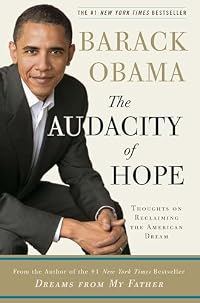
The Audacity of Hope: Thoughts on Reclaiming the American Dream
by Barack Obama
On This Page
Description
Senator Obama calls for a different brand of politics--a politics for those weary of bitter partisanship and alienated by the "endless clash of armies" we see in Congress and on the campaign trail; a politics rooted in the faith, inclusiveness, and nobility of spirit at the heart of our democracy. He explores those forces--from the fear of losing, to the perpetual need to raise money, to the power of the media--that can stifle even the best-intentioned politician. He examines the growing show more economic insecurity of American families, the racial and religious tensions within the body politic, and the transnational threats--from terrorism to pandemic--that gather beyond our shores. And he grapples with the role that faith plays in a democracy. Only by returning to the principles that gave birth to our Constitution, he says, can Americans repair a broken political process, and restore to working order a government dangerously out of touch with millions of ordinary Americans.--From publisher description. show lessTags
Recommendations






Member Recommendations

foof2you This is Obama's life story and how became the man he is today.

Member Reviews
This was a surprisingly interesting book. It was an odd combination of personal anecdotes and policy proposals. Odd, for me, because, when I read about politics, I am used to more abstract, academic fare. The anecdotes lend a certain weight to the proposals. You don't just learn what Obama's political positions are, but also why he holds those positions. It's also quite well written.
This adds a similar weight to his (better-known) speeches as well. For example, when Obama talks about bipartisanship, he really means it. Having read this book, I can see how they are those lines in his speeches are not just (for him) empty platitudes. He seems to really mean them, because in the book, he gives not just the position but an argument for the show more position and specific, concrete reasons for it, on both a policy level and a personal level. The time and effort he puts into his arguments here (and, in my opinion, their effectiveness) strongly suggest that he's completely sincere.
His sincerity (on the issue of bipartisanship) is further supported by a recent news story I read where he asked Congressional Democrats to make further compromises on a stimulus bill, in order to get more Republican votes, even though the Democrats already had enough votes to win. I get the impression that a lot of people have heard him speak, but few have yet taken what he's said seriously. Had Democrats on the Hill complaining bothered to read his book, they might not have been surprised.
I was struck by how often he used variations on the phrase 'a new consensus'. If you take his arguments seriously, then this would mean that, for Obama, compromise is not a means, it's an end. That is, he's not a centrist is the mold of Bill Clinton, willing to compromise in order to achieve and stay in power and maybe do some good in the meantime. Obama, on the other hand, presents compromise as a goal with value in itself.
Compromise is itself a virtue in two senses. First, more generally, compromise is what democracy is all about, the very process itself. To dismiss it as merely a means to an end is to dismiss democracy itself in the same way. Second, compromise is a virtue for the sake of progressive causes as well. Changes and improvements achieved by compromise--a compromise that takes the form of a 'new consensus'--have the capacity to have vastly more impact and staying power. Why simply change a law (when the next time the other guys are in power they'll just change it back), when you can change peoples minds (the common consensus) instead. This isn't just pie-in-the-sky naivete, but a political strategy for lasting, effective change. By way of precedent, FDR didn't just enact the reforms of the New Deal, he was able to forge a common consensus between Democrats and moderate Republicans that lasted (at least) 50 years. Johnson did the same thing with the Voting Rights Act. The point isn't that everyone has to agree and sing songs around the campfire, but only that enough people agree for long enough that the reform in question becomes a basic assumption for future political discourse.
It will be fascinating to see if he will be able to get it to work.
Anyone interested in American politics would benefit from this book. Whether you agree with his goals or not, this book goes a long way to explaining his strategies and motives. show less
This adds a similar weight to his (better-known) speeches as well. For example, when Obama talks about bipartisanship, he really means it. Having read this book, I can see how they are those lines in his speeches are not just (for him) empty platitudes. He seems to really mean them, because in the book, he gives not just the position but an argument for the show more position and specific, concrete reasons for it, on both a policy level and a personal level. The time and effort he puts into his arguments here (and, in my opinion, their effectiveness) strongly suggest that he's completely sincere.
His sincerity (on the issue of bipartisanship) is further supported by a recent news story I read where he asked Congressional Democrats to make further compromises on a stimulus bill, in order to get more Republican votes, even though the Democrats already had enough votes to win. I get the impression that a lot of people have heard him speak, but few have yet taken what he's said seriously. Had Democrats on the Hill complaining bothered to read his book, they might not have been surprised.
I was struck by how often he used variations on the phrase 'a new consensus'. If you take his arguments seriously, then this would mean that, for Obama, compromise is not a means, it's an end. That is, he's not a centrist is the mold of Bill Clinton, willing to compromise in order to achieve and stay in power and maybe do some good in the meantime. Obama, on the other hand, presents compromise as a goal with value in itself.
Compromise is itself a virtue in two senses. First, more generally, compromise is what democracy is all about, the very process itself. To dismiss it as merely a means to an end is to dismiss democracy itself in the same way. Second, compromise is a virtue for the sake of progressive causes as well. Changes and improvements achieved by compromise--a compromise that takes the form of a 'new consensus'--have the capacity to have vastly more impact and staying power. Why simply change a law (when the next time the other guys are in power they'll just change it back), when you can change peoples minds (the common consensus) instead. This isn't just pie-in-the-sky naivete, but a political strategy for lasting, effective change. By way of precedent, FDR didn't just enact the reforms of the New Deal, he was able to forge a common consensus between Democrats and moderate Republicans that lasted (at least) 50 years. Johnson did the same thing with the Voting Rights Act. The point isn't that everyone has to agree and sing songs around the campfire, but only that enough people agree for long enough that the reform in question becomes a basic assumption for future political discourse.
It will be fascinating to see if he will be able to get it to work.
Anyone interested in American politics would benefit from this book. Whether you agree with his goals or not, this book goes a long way to explaining his strategies and motives. show less
I had to. I just had to. After the horribly awful election last week, I had to listen to this book. I had bought it years ago but it had sat on my shelf. After the election, I grabbed the audiobook from my library's OverDrive site and sped through Oklahoma, Texas, and New Mexico listening to it.
My first reaction was incredible sadness that this man will no longer be our president in a few short months. His thoughts on government, politics, and America are uniquely intelligent, empathetic, measured, and reasonable. They make sense, and I dearly needed some sense this past week.
Ultimately, I also felt hope, because this man is and was my president, and had worked to make our country better -- not just for the rich and privileged, but show more for everybody. And I have hope because he showed that most people just want the same things, and that we can all find common ground. show less
My first reaction was incredible sadness that this man will no longer be our president in a few short months. His thoughts on government, politics, and America are uniquely intelligent, empathetic, measured, and reasonable. They make sense, and I dearly needed some sense this past week.
Ultimately, I also felt hope, because this man is and was my president, and had worked to make our country better -- not just for the rich and privileged, but show more for everybody. And I have hope because he showed that most people just want the same things, and that we can all find common ground. show less
Две реалности се преплитат в тази книга.
След първата половина - вижданията на Обама за политиката и икономиката - мислех да я захвърля и да й сложа една звездичка. Знатете какво е булшит - как някой се опитва да ви забълбуква, с красиви думички и дълги, увъртяни и красиво звучащи, но нищо конкретно не значещи изречения да прикрие какво наистина мисли, да се хареса на всички, да извика емоциите ви, вместо show more разума.
Обама много, ама много внимава думите му да не противоречат кардинално на ничие мнение, което прави на места жалък и смешен опитът му да удовлетвори и да се хареса на радикално противоположни типове избиратели. Защото за икономика и политика той пише като истински, закоравял политик - точно като тия, като които декларира, че никога няма да стане - гладко, мазно, фалшиво.
Втората половина от книгата обаче, е тотално различна. Там той говори за неща, които очевидно са фокусът на вниманието и работата му като политик - социална политика, здравеопазване, образование, религия. Логично, по тия въпроси, той се аргументира доста добре (освен за училищните ваучери - защо ги мрази така и не обясни) и не се страхува да изкаже твърдо мнението си, да опише визията си за това какво трябва да бъде и какво конкретно трябва да се направи. Макар да не съм съгласен с доста от идеите му, хареса ми енергията, с която говори за тях и разбирането в дълбочина на проблемите, които се опитва да пребори.
Общо взето (това личи във всяко изречение в книгата) Обама е типичен представител на Прогресивните Демократи в САЩ - това са идейните наследници на Рузвелт и Кейнс, които смятат, че хората просто не знаят какво искат и какво е добро за тях - и затова правителството е призвано да се грижи за всички аспекти от живота на гражданите си, да регулира и да се намесва с твърда ръка икономиката, да създава заетост, да обгрижва хората със щедри социални програми, да прибира големи данъци и всичко това - с помощта на армия бюрократи.
Един вид, лозунгът, познат твърде добре от близкото минало на България: "Дайте да дадем!" show less
След първата половина - вижданията на Обама за политиката и икономиката - мислех да я захвърля и да й сложа една звездичка. Знатете какво е булшит - как някой се опитва да ви забълбуква, с красиви думички и дълги, увъртяни и красиво звучащи, но нищо конкретно не значещи изречения да прикрие какво наистина мисли, да се хареса на всички, да извика емоциите ви, вместо show more разума.
Обама много, ама много внимава думите му да не противоречат кардинално на ничие мнение, което прави на места жалък и смешен опитът му да удовлетвори и да се хареса на радикално противоположни типове избиратели. Защото за икономика и политика той пише като истински, закоравял политик - точно като тия, като които декларира, че никога няма да стане - гладко, мазно, фалшиво.
Втората половина от книгата обаче, е тотално различна. Там той говори за неща, които очевидно са фокусът на вниманието и работата му като политик - социална политика, здравеопазване, образование, религия. Логично, по тия въпроси, той се аргументира доста добре (освен за училищните ваучери - защо ги мрази така и не обясни) и не се страхува да изкаже твърдо мнението си, да опише визията си за това какво трябва да бъде и какво конкретно трябва да се направи. Макар да не съм съгласен с доста от идеите му, хареса ми енергията, с която говори за тях и разбирането в дълбочина на проблемите, които се опитва да пребори.
Общо взето (това личи във всяко изречение в книгата) Обама е типичен представител на Прогресивните Демократи в САЩ - това са идейните наследници на Рузвелт и Кейнс, които смятат, че хората просто не знаят какво искат и какво е добро за тях - и затова правителството е призвано да се грижи за всички аспекти от живота на гражданите си, да регулира и да се намесва с твърда ръка икономиката, да създава заетост, да обгрижва хората със щедри социални програми, да прибира големи данъци и всичко това - с помощта на армия бюрократи.
Един вид, лозунгът, познат твърде добре от близкото минало на България: "Дайте да дадем!" show less
My general opinion of Barack Obama is quite favorable, and since I fully enjoyed his first book, Dreams from My Father, I expected I would also like his second and newest work, The Audacity of Hope (Crown, 2006). It had been sitting on my shelf waiting for me since November and I finally pulled it off this week and had a read. It was not a disappointment. Once again Obama's elegant writing style is on full display, as is his knack for turning a good phrase. While he does not turn the book into a policy handbook full of detailed proposals or concrete plans for change, he offers something that I would argue may be even more important: a different way of approaching politics and shaping political debate.
If I picked out every excerpt from show more this book which spoke to me (and which I have jotted down in my reading notes) I'd be typing all day (and would entirely ruin the book for you). But I think this two-paragraph selection sums Obama's message up fairly well (p. 22):
"It's not simply that a gap exists between our professed ideals as a nation and the reality we witness every day. In one form or another, that gap has existed since America's birth. Wars have been fought, laws passed, systems reformed, unions organized, and protests staged to bring promise and practice into alignment.
No, what's troubling is the gap between the magnitude of our challenges and the smallness of our politics - the ease with which we are distracted by the petty and trivial, our chronic avoidance of tough decisions, our seeming inability to build a working consensus to tackle any big problem."
Obama's desire to refocus American priorities is one of the most refreshing things about the man. While it may come across as overly idealistic to call for increased funding for eduction, sci/tech research and energy independence, all these things are areas in which we must do better as a nation. As he notes after commenting on the recent pork-filled highway bill, "what's missing is not money, but a national sense of urgency." Difficult to argue with that, somehow. His analysis of various policy areas (from immigration to foreign policy to health care) is instructive without being boring; hopeful without seeming laughable.
The Audacity of Hope goes far beyond Obama's policy chapters, as lucid and useful as they are. He also discusses, in a very personal way, the adjustment process to becoming a senator of some celebrity. The difficulties it created for his family life - this is a man with two young children - come through loud and clear, and as in his first memoir, it's apparent that this man still carefully thinks about his actions and the impact they will have on those around him.
Barack Obama's hopeful optimism, and his certainty that we can do better as a nation if we're able to rise above petty grievances and slights to achieve meaningful results is a message I think Americans are yearning for in these times of turmoil and partisan bickering. His exposition of those beliefs in The Audacity of Hope is a good one, and I recommend it without reservation.
http://philobiblos.blogspot.com/2007/01/book-review-audacity-of-hope.html show less
If I picked out every excerpt from show more this book which spoke to me (and which I have jotted down in my reading notes) I'd be typing all day (and would entirely ruin the book for you). But I think this two-paragraph selection sums Obama's message up fairly well (p. 22):
"It's not simply that a gap exists between our professed ideals as a nation and the reality we witness every day. In one form or another, that gap has existed since America's birth. Wars have been fought, laws passed, systems reformed, unions organized, and protests staged to bring promise and practice into alignment.
No, what's troubling is the gap between the magnitude of our challenges and the smallness of our politics - the ease with which we are distracted by the petty and trivial, our chronic avoidance of tough decisions, our seeming inability to build a working consensus to tackle any big problem."
Obama's desire to refocus American priorities is one of the most refreshing things about the man. While it may come across as overly idealistic to call for increased funding for eduction, sci/tech research and energy independence, all these things are areas in which we must do better as a nation. As he notes after commenting on the recent pork-filled highway bill, "what's missing is not money, but a national sense of urgency." Difficult to argue with that, somehow. His analysis of various policy areas (from immigration to foreign policy to health care) is instructive without being boring; hopeful without seeming laughable.
The Audacity of Hope goes far beyond Obama's policy chapters, as lucid and useful as they are. He also discusses, in a very personal way, the adjustment process to becoming a senator of some celebrity. The difficulties it created for his family life - this is a man with two young children - come through loud and clear, and as in his first memoir, it's apparent that this man still carefully thinks about his actions and the impact they will have on those around him.
Barack Obama's hopeful optimism, and his certainty that we can do better as a nation if we're able to rise above petty grievances and slights to achieve meaningful results is a message I think Americans are yearning for in these times of turmoil and partisan bickering. His exposition of those beliefs in The Audacity of Hope is a good one, and I recommend it without reservation.
http://philobiblos.blogspot.com/2007/01/book-review-audacity-of-hope.html show less
Listening to this audio book, two years into the Obama presidency, made me somewhat sad. Was Obama hopelessly naïve and unused to the ways of Washington when he spoke so reasonably of compromise and meeting Republicans in the middle? It certainly hasn’t worked out the way he hoped, has it? Has the country become so polarized that the middle road has no support? Is the art of compromise dead?
The book still has its virtues – it presents many issues relatively evenhandedly. Obama speaks charmingly of his personal life. Enjoyable anecdotes are interspersed. The issues of race, religion, and values are discussed in a way that politicians generally shy away from.
I couldn’t help wondering what Obama will write after his presidency. show more Will his ideals remain as high, his belief in the American system of government as passionate? show less
The book still has its virtues – it presents many issues relatively evenhandedly. Obama speaks charmingly of his personal life. Enjoyable anecdotes are interspersed. The issues of race, religion, and values are discussed in a way that politicians generally shy away from.
I couldn’t help wondering what Obama will write after his presidency. show more Will his ideals remain as high, his belief in the American system of government as passionate? show less
It's interesting reading The Audacity of Hope six years later, in the run-up to Obama's second presidential race. In hindsight, what stands out most is how much of the book is pure rhetoric, having little to do with his actual agenda. For instance, at the time he was outspokenly critical of the federal government's massive deficit spending under the Bush administration---but in his own first term in office, far from working to change that, he has doubled down on it.
He specifically criticizes, for instance, Bush's "hugely expensive prescription drug benefit" which he says "has only made the problem worse"---and yet, his own healthcare reform package has done the same, only even more so. (To be fair, the ideas he presents in that regard show more in this book are actually not as bad as Obamacare ended up being---it was made even worse by being more closely modeled on Romneycare!) He writes, "The market alone can't solve our health-care woes---in part because the market has proven incapable of creating large enough insurance pools to keep costs to individuals affordable," but this has nothing to do with the market and there is no reason why it couldn't, and everything to do with government regulation of the insurance market such as restrictions on purchasing insurance across state lines. He continues, "in part because health care is not like other products or services (when your child gets sick, you don't go shopping for the best bargain)." But this is an equivocation---he switches from shopping for *insurance* to shopping for the actual healthcare, and when you think about it for a second it's obvious that even the latter is not the outlandish idea that he tries to suggest it is and healthcare really is mostly just like other products and services in that regard.
While some of Obama's criticisms of the Bush administration were fair (but apparently insincere), others are just nonsense. He accuses Bush of deregulating and dismantling the New Deal, which is not even close to an honest assessment of what was wrong with Bush's "Ownership Society". For instance, the Bush administration actually tried to use the federal government to encourage "ownership" through regulations and programs subsidizing risky loans (through, e.g., Fannie Mae and Freddie Mac). Predictably, this did not work---and equally predictably, Obama attempts to blame the outcome on "the failure of the free market", which had nothing to do with it seeing as how the market wasn't even close to free (the sectors of the economy that have the biggest problems---banking, wall street, housing, healthcare, etc.---are not coincidentally those that are the *most* regulated and have the most government interference in them, and that was just as true under Bush when Obama wrote this as it is now).
But the worst part of the book, to me, was the chapter on "Faith", in which Obama describes the country's and his own "movement toward a deepening religious commitment," which is especially disturbing in light of subsequent revelations about his pastor Reverend Wright (from a sermon of whose Obama took the title of this book). Many Americans may be reassured when he writes, "I felt God's spirit beckoning to me. I submitted myself to His will..." But to me, this is frighteningly reminiscent of how President Bush "routinely remark[ed] on how Christ changed his heart." I would much prefer politicians to keep their faith to themselves and be guided instead by reason in the public sphere. Obama does offer some criticism of the conservative assault on the separation of church and state, but he is only too happy to, for example, expand Bush's "faith-based initiatives" and continue DOMA.
In short, this book was clearly written basically as a campaign puff piece, designed to make Obama appear more moderate than he really is, while at the same time still trying to make him out to be a bold reformer---but across the board, what Obama advocates is the expansion of the federal government, increasing its role in every aspect of our lives. His previous book, Dreams from My Father, was more honest and better. The better parts of this book are those that are similarly autobiographical rather than straight political rhetoric, and from those I even get the impression that he's a decent guy personally, a good husband and father, and I might kind of like him if he weren't president.
It's also interesting reading this after having read Mitt Romney's book, No Apology---and the other thing that stood out most to me is how similar the two actually are (which is perhaps the biggest criticism I can make of Obama, as I think Romney is even worse). There are large chunks of the books, on topics from healthcare and education to regulation, that are virtually indistinguishable.
There's only one candidate in this race who offers a real, honest alternative, and that is Gary Johnson. I recommend reading all three of their books, including Johnson's Seven Principles of Good Government, and see for yourself. show less
He specifically criticizes, for instance, Bush's "hugely expensive prescription drug benefit" which he says "has only made the problem worse"---and yet, his own healthcare reform package has done the same, only even more so. (To be fair, the ideas he presents in that regard show more in this book are actually not as bad as Obamacare ended up being---it was made even worse by being more closely modeled on Romneycare!) He writes, "The market alone can't solve our health-care woes---in part because the market has proven incapable of creating large enough insurance pools to keep costs to individuals affordable," but this has nothing to do with the market and there is no reason why it couldn't, and everything to do with government regulation of the insurance market such as restrictions on purchasing insurance across state lines. He continues, "in part because health care is not like other products or services (when your child gets sick, you don't go shopping for the best bargain)." But this is an equivocation---he switches from shopping for *insurance* to shopping for the actual healthcare, and when you think about it for a second it's obvious that even the latter is not the outlandish idea that he tries to suggest it is and healthcare really is mostly just like other products and services in that regard.
While some of Obama's criticisms of the Bush administration were fair (but apparently insincere), others are just nonsense. He accuses Bush of deregulating and dismantling the New Deal, which is not even close to an honest assessment of what was wrong with Bush's "Ownership Society". For instance, the Bush administration actually tried to use the federal government to encourage "ownership" through regulations and programs subsidizing risky loans (through, e.g., Fannie Mae and Freddie Mac). Predictably, this did not work---and equally predictably, Obama attempts to blame the outcome on "the failure of the free market", which had nothing to do with it seeing as how the market wasn't even close to free (the sectors of the economy that have the biggest problems---banking, wall street, housing, healthcare, etc.---are not coincidentally those that are the *most* regulated and have the most government interference in them, and that was just as true under Bush when Obama wrote this as it is now).
But the worst part of the book, to me, was the chapter on "Faith", in which Obama describes the country's and his own "movement toward a deepening religious commitment," which is especially disturbing in light of subsequent revelations about his pastor Reverend Wright (from a sermon of whose Obama took the title of this book). Many Americans may be reassured when he writes, "I felt God's spirit beckoning to me. I submitted myself to His will..." But to me, this is frighteningly reminiscent of how President Bush "routinely remark[ed] on how Christ changed his heart." I would much prefer politicians to keep their faith to themselves and be guided instead by reason in the public sphere. Obama does offer some criticism of the conservative assault on the separation of church and state, but he is only too happy to, for example, expand Bush's "faith-based initiatives" and continue DOMA.
In short, this book was clearly written basically as a campaign puff piece, designed to make Obama appear more moderate than he really is, while at the same time still trying to make him out to be a bold reformer---but across the board, what Obama advocates is the expansion of the federal government, increasing its role in every aspect of our lives. His previous book, Dreams from My Father, was more honest and better. The better parts of this book are those that are similarly autobiographical rather than straight political rhetoric, and from those I even get the impression that he's a decent guy personally, a good husband and father, and I might kind of like him if he weren't president.
It's also interesting reading this after having read Mitt Romney's book, No Apology---and the other thing that stood out most to me is how similar the two actually are (which is perhaps the biggest criticism I can make of Obama, as I think Romney is even worse). There are large chunks of the books, on topics from healthcare and education to regulation, that are virtually indistinguishable.
There's only one candidate in this race who offers a real, honest alternative, and that is Gary Johnson. I recommend reading all three of their books, including Johnson's Seven Principles of Good Government, and see for yourself. show less
Okay so I've always been a huge Obama fan. I went door-to-door for him in 2008 and 2012, I took my son to one of his rallies (my first political rally and his), but even after that I was totally blown away by this book. I swear I wanted to quote 90% of the lines in the book on FB.
He's a brilliant man and so it's bittersweet to be driving around in my car listening to him speak while knowing the current president speaks like a fifth-grader (sorry fifth graders).
I would definitely recommend this book to conservatives who might think it would be a book constantly bashing them. In the book he blasts both sides about equally. He talks about his opinions but also makes sure to talk about what he DOES agree with about the other side's show more argument. In fact, much of the books is devoted to trying to show how alike people are and how the answer is in rising above the hype and being able to see both "sides". show less
He's a brilliant man and so it's bittersweet to be driving around in my car listening to him speak while knowing the current president speaks like a fifth-grader (sorry fifth graders).
I would definitely recommend this book to conservatives who might think it would be a book constantly bashing them. In the book he blasts both sides about equally. He talks about his opinions but also makes sure to talk about what he DOES agree with about the other side's show more argument. In fact, much of the books is devoted to trying to show how alike people are and how the answer is in rising above the hype and being able to see both "sides". show less
Members
- Recently Added By
Published Reviews
ThingScore 75
Barack Obama, the junior senator from Illinois and the Democratic Party’s new rock star, is that rare politician who can actually write — and write movingly and genuinely about himself.
added by jlelliott
Lists

LT picks: Blue Books
197 works; 44 members

Wishlist
10 works; 1 member

Unread books
1,063 works; 86 members

2000s decade
85 works; 7 members

Presidential Autobiographies
37 works; 3 members

Mind Expanding Books by hackerkid
581 works; 8 members

You Couldn't Pay Me to Read That (Take 2)
203 works; 86 members
Author Information

President Barack Obama was born in Honolulu, Hawaii on August 4, 1961. He graduated with a degree in political science from Columbia University in 1983. Before moving to Chicago in 1985, he worked at Business International Corporation and then at the New York Public Interest Research Group. In Chicago, he worked as a community organizer with show more low-income residents. He entered Harvard Law School in 1988, was elected editor of the Harvard Law Review in 1990, and graduated in 1991. After graduating law school, he returned to Chicago and became a civil rights lawyer. He also taught at the University of Chicago Law School from 1992 to 2004. In 1997, he was elected to the Illinois State Senate and served until 2004. In 2000, he made an unsuccessful bid for a seat in the U.S. House of Representatives. In 2005, he was elected to the U.S. Senate. In 2007, he announced his candidacy for the 2008 Democratic presidential nomination. On November 4, 2008, Obama defeated John McCain in the general election and became the first African-American to be elected President of the United States. He wrote Dreams from My Father: A Story of Race and Inheritance in 1995 and The Audacity of Hope: Thoughts on Reclaiming the American Dream in 2006. He won Best Spoken Word Album Grammy Awards in 2006 and 2008 for abridged audiobook versions of both books. He won the Nobel Peace Prize in 2009. His book Of Thee I Sing came out in 2010. (Bowker Author Biography) show less
Some Editions
Awards and Honors
Awards
Distinctions
Work Relationships
Is contained in
Contains
Common Knowledge
- Canonical title
- The Audacity of Hope: Thoughts on Reclaiming the American Dream
- Original publication date
- 2006-10
- People/Characters
- Barack Obama; Harry Reid; George W. Bush; Bill Clinton; Thomas Jefferson; Abraham Lincoln (show all 12); Ronald Reagan; Franklin Delano Roosevelt; Rosa Parks; Michelle Obama; Malia Obama; Sasha Obama
- Important places
- Illinois, USA; Chicago, Illinois, USA; Washington, D.C., USA
- Dedication
- To the women who raised me - my maternal grandmother, Tutu, who's been a rock of stability throughout my life, and my mother, whose loving spirit sustains me still.
- First words
- On most days, I enter the Capitol through the basement.
It's been almost ten years since I first ran for political office. - Last words
- (Click to show. Warning: May contain spoilers.)As usual, my wife is right.
(Click to show. Warning: May contain spoilers.)My heart is filled with love for this country. (Epilogue) - Blurbers
- Kakutani, Michiko; Balzar, John; Kazin, Michael; Dorning, Mike
- Original language
- English
Classifications
- Genres
- General Nonfiction, Biography & Memoir, Nonfiction, Politics and Government, History
- DDC/MDS
- 973.04960730092 — History & geography History of North America United States United States Ethnic And National Groups Other Groups African Americans African Americans
- LCC
- E901.1 .O23 .A3 — History of the United States Twenty-first century
- BISAC
Statistics
- Members
- 10,221
- Popularity
- 951
- Reviews
- 176
- Rating
- (3.82)
- Languages
- 22 — Arabic, Bengali, Catalan, Chinese, Czech, Danish, Dutch, English, Finnish, French, German, Hungarian, Indonesian, Italian, Korean, Norwegian (Bokmål), Farsi/Persian, Portuguese, Croatian, Spanish, Swedish, Turkish
- Media
- Paper, Audiobook, Ebook
- ISBNs
- 76
- ASINs
- 40