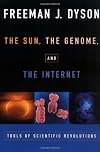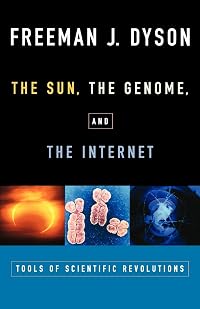
The Sun, The Genome, and The Internet: Tools of Scientific Revolution
by Freeman J. Dyson
New York Public Library Lectures in Humanities
On This Page
Description
In this visionary look into the future, Freeman Dyson argues that technological changes fundamentally alter our ethical and social arrangements and that three rapidly advancing new technologies--solar energy, genetic engineering, and world-wide communication--together have the potential to create a more equal distribution of the world's wealth. Dyson begins by rejecting the idea that scientific revolutions are primarily concept driven. He shows rather that new tools are more often the sparks show more that ignite scientific discovery. Such tool-driven revolutions have profound social consequences--the invention of the telescope turning the Medieval world view upside down, the widespread use of household appliances in the 1950s replacing servants, to cite just two examples. In looking ahead, Dyson suggests that solar energy, genetics, and the Internet will have similarly transformative effects, with the potential to produce a more just and equitable society. Solar power could bring electricity to even the poorest, most remote areas of third world nations, allowing everyone access to the vast stores of information on the Internet and effectively ending the cultural isolation of the poorest countries. Similarly, breakthroughs in genetics may well enable us to give our children healthier lives and grow more efficient crops, thus restoring the economic and human vitality of village cultures devalued and dislocated by the global market. Written with passionate conviction about the ethical uses of science, The Sun, the Genome, and the Internet is both a brilliant reinterpretation of the scientific process and a challenge to use new technologies to close, rather than widen, the gap between rich and poor. show lessTags
Recommendations




Member Reviews
Drawn from a series of public lectures, this is the mind of Freeman Dyson at its most fertile. The book bubbles with creative ideas even if my instinct throughout was to treat it as yet another item of that curious genre - speculative science faction.
He writes clearly and, very unusually amongst the top level of scientists let alone applied mathematicians, his genius is capable of understanding history and society. Indeed, I suspect that he would have made a very fine historian if he had taken a very different route in life.
However, a decade and a half on from the lectures, very little of what he has predicted (all of which I have no doubt is feasible) has come to pass. He seems to have been looking in the wrong direction more than show more once. His speculations are more than a little utopian.
This is a little odd because he has a highly intelligent approach to the effect of politics on technological investment. There are some very acute observations on failures to be cost-effective. One might have expected him to have been a little more cautious on that ground alone.
While mildly stimulated, I did not get a great deal out of the book because it was simply not grounded enough in the world I think that I am living in. He was persuasive, as a Kuhn-sceptic, on one thing though - that technique and tools drive science as much as concepts and models.
His argument for scientific development as a craft process with many incremental changes and cross-fertilisations, with investment by scientists themselves in the machinery that enables discovery, is well taken. It made me rethink how thought and application exist in close dialectic.
But there is so much material here, so much inventiveness, so much intellectual creativity and so many leaps that the book leaves one wondering precisely what one has learned that is useful. That may be unfair but one wanted not more ideas but clearer thread for those already offered.
Like contemporary science fiction, speculative science faction throws so much at the reader that the tale often spins away far from the credible and the useful - and the human. That so little of the implicit prediction appears to be materially present today seems to confirm a lack of groundedness.
Oh, we poor mortals - unable to deliver what our intellectual gods demand of us! show less
He writes clearly and, very unusually amongst the top level of scientists let alone applied mathematicians, his genius is capable of understanding history and society. Indeed, I suspect that he would have made a very fine historian if he had taken a very different route in life.
However, a decade and a half on from the lectures, very little of what he has predicted (all of which I have no doubt is feasible) has come to pass. He seems to have been looking in the wrong direction more than show more once. His speculations are more than a little utopian.
This is a little odd because he has a highly intelligent approach to the effect of politics on technological investment. There are some very acute observations on failures to be cost-effective. One might have expected him to have been a little more cautious on that ground alone.
While mildly stimulated, I did not get a great deal out of the book because it was simply not grounded enough in the world I think that I am living in. He was persuasive, as a Kuhn-sceptic, on one thing though - that technique and tools drive science as much as concepts and models.
His argument for scientific development as a craft process with many incremental changes and cross-fertilisations, with investment by scientists themselves in the machinery that enables discovery, is well taken. It made me rethink how thought and application exist in close dialectic.
But there is so much material here, so much inventiveness, so much intellectual creativity and so many leaps that the book leaves one wondering precisely what one has learned that is useful. That may be unfair but one wanted not more ideas but clearer thread for those already offered.
Like contemporary science fiction, speculative science faction throws so much at the reader that the tale often spins away far from the credible and the useful - and the human. That so little of the implicit prediction appears to be materially present today seems to confirm a lack of groundedness.
Oh, we poor mortals - unable to deliver what our intellectual gods demand of us! show less
I was surprised by this book. I thought it would just be all "wow, technology, cool." But it was actually about how to thoughtfully and ethically use technology to bring about social justice. Technology shouldn't just be about making new toys for the rich, but it should be about developing ways to level the playing field for everyone in the world. One thing I found that was very interesting was the accounts of how technological advances will often liberate one group of people while taking away the freedom of another group. One example given in the book was the rise of househould appliances in the early twentienth century. The servant class was done away with (in those days, middle class families might have multiple servants), but middle show more class women then lost much freedom when they had to return to household duties.
Dr. Dyson, a physicist, sees solar energy, genetic engineering, and the Internet as the tools to bring about this social revolution. I would be interested in seeing an updated version of this book because this was written over ten years ago, and a lot has changed since then. Internet access still isn't freely available everywhere, but it sure is better than it was in the late 90's. show less
Dr. Dyson, a physicist, sees solar energy, genetic engineering, and the Internet as the tools to bring about this social revolution. I would be interested in seeing an updated version of this book because this was written over ten years ago, and a lot has changed since then. Internet access still isn't freely available everywhere, but it sure is better than it was in the late 90's. show less
Ratings
Members
- Recently Added By
Published Reviews
ThingScore 75
"speculates on what technologies (currently in their infancy) have the potential to become world-transforming in the near future."
added by wademlee
Author Information

47+ Works 3,132 Members
Freeman Dyson, editor, professor emeritus at the Institute for Advanced Study in Princeton, has contributed to the fields of mathematics, physics, astronomy, and biology. He is the author of numerous books, including Weapons and Hope, which won the National Book Critics Circle Award in 1984.
Awards and Honors
Series

Common Knowledge
- Canonical title
- The Sun, The Genome, and The Internet: Tools of Scientific Revolution
Classifications
- Genres
- Science & Nature, Nonfiction, Technology, General Nonfiction, Philosophy, History
- DDC/MDS
- 303.483 — Society, government, & culture Social sciences, sociology & anthropology Social processes Social change Causes of change Development of science and technology
- LCC
- QC20 .D98 — Science Physics Physics General
- BISAC
Statistics
- Members
- 239
- Popularity
- 136,597
- Reviews
- 2
- Rating
- (3.47)
- Languages
- 7 — Chinese, English, French, German, Italian, Portuguese, Spanish
- Media
- Paper, Ebook
- ISBNs
- 10
- ASINs
- 2