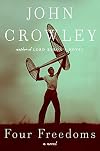
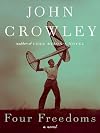
Four Freedoms
by John Crowley
On This Page
Description
In the early years of the 1940s, as the nation's young men ship off to war, the call goes out for builders of the machinery necessary to defeat the enemy. To this purpose, a city has sprung up seemingly overnight in the windswept fields of Oklahoma: the Van Damme airplane factory, a gargantuan complex dedicated to the construction of the B-30 Pax, the largest bomber ever built. Some men, but mostly women, many of whom have never operated a rivet gun or held a screwdriver, flock to this show more place eager to earn, to grow, to do their part. Many are away from home for the very first time, enticed by the opportunity to be something more than wife and homemaker. In the middle of nowhere they will live, work, and earn their own money, fearing for the safety of their absent fighting men as the world around them changes forever.--From publisher's description. show lessTags
Recommendations






Member Reviews
Heading into my read of an advance review copy of John Crowley's forthcoming Four Freedoms, I was unsure what to expect. The publisher's blurb told me that it was a book about "a disabled man...among a crowd of women" at "the height of World War II." It didn't seem obvious that this scenario would be a setting suited to the artful exploration of ideas I had enjoyed in the author's AEgypt cycle, a set of four novels that develop a complexly interwoven text about the human experience of magic and the magic of human experience. I needn't have worried.
The Four Freedoms of the title are the ones articulated in FDR's 1941 State of the Union speech: freedom of speech, freedom of worship, freedom from want, freedom from fear. The fact that the show more novel is divided into four parts suggests a correspondence, but there's no obvious one-to-one relationship between those parts and the freedoms. They seem more like the four movements of a symphony, and here is the key to the esoteric dimension of Four Freedoms: the Théorie des quatre mouvements et des destinees generales (1808) of Charles Fourier. Crowley is very coy about this element of the novel--unlike his free admission of the historical and scholarly grist for his mill in AEgypt--he never even mentions Fourier by name, either in the novel or in the afterword that discusses his research sources. Still, the unavoidable fact is that Four Freedoms character Pancho Notzing's "Bestopianism" is Fourierist though and through: a magical ur-socialism founded in "Passionate Series" generating "Harmony" through the satisfaction of dynamic and heterogeneous desires. Pancho himself is even a biographical cipher for Fourier. Where Fourier was the son of a prosperous cloth merchant and had a career as a traveling salesman, Pancho is retiring from a career as a traveling salesman of luxury cloths.
The Theory of Four Movements is Fourier's earliest and most bewildering exposition of his system. The mouvements themselves are enumerated only in a footnote and some brief glossary material, where they are given as social, human, animal, and organic--in descending order. The hierarchy of the Fourierist movements perhaps accounts for the sparing but curious use of the first-person plural in the frame of Four Freedoms. The "we" narrating the novel could be the collective identity of the quasi-phalanx of the Van Damme Aero manufacturing plant, a "Temporary Harmonious Zone"--cousin maybe to Hakim Bey's Temporary Autonomous Zone.
Both the little society of the Ponca City plant and the greater society of WWII America with its socialized command economy are especially worth readers' attention at a time when the US is confronted with a need to fundamentally reorganize its material and industrial bases. The historical setting of Four Freedoms is bracingly topical while we confront a "great recession" or even "greater depression" that seems bound to displace what "postwar" generations have been taught to consider the American "way of life." A gasoline ration of four gallons per week? That was a reality of the home front.
I cried once in the course of reading this book. If it has that effect on anyone else, I wouldn't necessarily expect it to be at the same place: there's a lot emotional power distributed through many personal stories over the course of the novel. As I have come to expect from Crowley, his narrative voice is sure--both efficient and beautiful--and his characters are compelling. The plot is largely subordinate to the characters, and tends to fan out from them in individual tributaries of memory, told to one another or simply recalled.
Crowley's AEgypt (especially as read backwards from the final realizations of Endless Things) can be considered a meditation on "neurodiversity": the idea that there are many necessarily partial and complementary ways of perceiving and understanding the world. Four Freedoms can be read as a corresponding exploration of physical diversity expressed through sex, age, disability, and race. But this is no moralizing, didactic exercise. I recently had a conversation with a literal fellow traveler on an airplane, regarding the importance of storytelling in the learning process. The stories in Four Freedoms can remind us of the kind of learning we all need to do, and that we will do whenever we remember our diverse radical passions. show less
The Four Freedoms of the title are the ones articulated in FDR's 1941 State of the Union speech: freedom of speech, freedom of worship, freedom from want, freedom from fear. The fact that the show more novel is divided into four parts suggests a correspondence, but there's no obvious one-to-one relationship between those parts and the freedoms. They seem more like the four movements of a symphony, and here is the key to the esoteric dimension of Four Freedoms: the Théorie des quatre mouvements et des destinees generales (1808) of Charles Fourier. Crowley is very coy about this element of the novel--unlike his free admission of the historical and scholarly grist for his mill in AEgypt--he never even mentions Fourier by name, either in the novel or in the afterword that discusses his research sources. Still, the unavoidable fact is that Four Freedoms character Pancho Notzing's "Bestopianism" is Fourierist though and through: a magical ur-socialism founded in "Passionate Series" generating "Harmony" through the satisfaction of dynamic and heterogeneous desires. Pancho himself is even a biographical cipher for Fourier. Where Fourier was the son of a prosperous cloth merchant and had a career as a traveling salesman, Pancho is retiring from a career as a traveling salesman of luxury cloths.
The Theory of Four Movements is Fourier's earliest and most bewildering exposition of his system. The mouvements themselves are enumerated only in a footnote and some brief glossary material, where they are given as social, human, animal, and organic--in descending order. The hierarchy of the Fourierist movements perhaps accounts for the sparing but curious use of the first-person plural in the frame of Four Freedoms. The "we" narrating the novel could be the collective identity of the quasi-phalanx of the Van Damme Aero manufacturing plant, a "Temporary Harmonious Zone"--cousin maybe to Hakim Bey's Temporary Autonomous Zone.
Both the little society of the Ponca City plant and the greater society of WWII America with its socialized command economy are especially worth readers' attention at a time when the US is confronted with a need to fundamentally reorganize its material and industrial bases. The historical setting of Four Freedoms is bracingly topical while we confront a "great recession" or even "greater depression" that seems bound to displace what "postwar" generations have been taught to consider the American "way of life." A gasoline ration of four gallons per week? That was a reality of the home front.
I cried once in the course of reading this book. If it has that effect on anyone else, I wouldn't necessarily expect it to be at the same place: there's a lot emotional power distributed through many personal stories over the course of the novel. As I have come to expect from Crowley, his narrative voice is sure--both efficient and beautiful--and his characters are compelling. The plot is largely subordinate to the characters, and tends to fan out from them in individual tributaries of memory, told to one another or simply recalled.
Crowley's AEgypt (especially as read backwards from the final realizations of Endless Things) can be considered a meditation on "neurodiversity": the idea that there are many necessarily partial and complementary ways of perceiving and understanding the world. Four Freedoms can be read as a corresponding exploration of physical diversity expressed through sex, age, disability, and race. But this is no moralizing, didactic exercise. I recently had a conversation with a literal fellow traveler on an airplane, regarding the importance of storytelling in the learning process. The stories in Four Freedoms can remind us of the kind of learning we all need to do, and that we will do whenever we remember our diverse radical passions. show less
 This review was written for LibraryThing Early Reviewers.
I bought this when it was first published, so it’s taken me nearly eight years to get around to reading it. And I’m a big fan of Crowley’s writing. Oops. Having said that, I’ve yet to read Endless Things, which I bought in 2007, chiefly because I want to reread Ægypt (AKA The Solitudes), Love & Sleep and Dæmonomania first… But: Four Freedoms, which is entirely unrelated and not even genre. The title refers to President Franklin D Roosevelt’s “four freedoms”: 1 freedom of speech, 2 freedom of worship, 3 freedom from want, and 4 freedom from fear. It is is set during WWII and chiefly concerns people who work at an aircraft factory in Ponca City, Oklahoma. The bomber these people are building is the B-30 Pax, but it’s show more clearly an analogue of the Convair B-36 Peacemaker, which did not see service during WWII (but from 1949 to 1959, to be precise) and was one of the great Cold War bombers of the US. Only 384 were built, but the novel claims 500 of its “B-30″s were built. Crowley mentions in an afterword that he didn’t intentionally model the B-30 on the B-36 and only later discovered the Pax / Peacemaker synchronicity and that the B-36 had been damaged by a cyclone at Fort Worth echoing events in his novel. I believe him – you don’t put “wow synchronicity!” notes in your afterword unless that’s what they were. The actual story of Four Freedoms is that of female and disabled members of the US workforce during WWII. The novel focuses on the factory which builds the B-30, but tells the story of several characters, introducing them and then telling their back-story through flashback. It’s a beautiful piece of writing – effortlessly readable, effortlessly convincing. I had forgotten how good Crowley is. I really ought to get started on my read of Endless Things… show less
John Crowley’s Four Freedom’s takes its title from FDR’s speech to Congress in January 1941 in which he says, “In the future days, which we seek to make secure, we look forward to a world founded upon four essential human freedoms:• “The first is freedom of speech and expression -- everywhere in the world.• “The second is freedom of every person to worship God in his own way....• “The third is freedom from want....• “The fourth is freedom from fear….”Crowley’s use of the term, however, doesn’t focus on a world made secure after winning the world war, but on specific segments of the US population for whom the war—and specifically the need to mobilize all available workers—brought access to freedoms show more they’d never known before: to women, to the handicapped, to minorities and to other marginalized citizens. The nameless narrator begins the story with his childhood memory of playing in a derelict airplane near the Ponca City, Oklahoma, airport. (That got my attention because I played in a deteriorating WWII plane while my father was taking his flying lessons. It was parked at our small town airport, and the instructor’s son, who had made it his playhouse, wasn’t above inviting a girl to join in.) The narrator, who never really intrudes into the story, seems to be a Ponca City native “documenting” his city’s role in the war effort. He infuses the story with a certain enthusiasm and love of place that’s attractive.Crowley creates a fictional aircraft plant—Van Damme Aero—building a fictional plane—the B30 Pax—outside Ponca City. The Van Damme brothers were early flying enthusiasts and Henry in particular had visions of building a “city of the hill” out of his factory, a self-sufficient town which came to be called Henryville where the workers who flocked to Ponca City for “war work” could live and work and be entertained. Everything was organized and ritualized, but Henry was no “big brother”, no profiteer bent on profiting from the government’s needs, but rather an aircraft enthusiast, interested in involving his employees in the great task entrusted to them.Crowley obviously researched the WWII homefront—particularly “war work”—in great detail, and yet the novel doesn’t read like an historical novel pieced together out of tidbits of history. That’s largely because of the compelling characters who march through the novel, with the focus falling on several characters in different situations, rather than focusing exclusively on one set of characters. It starts out with the Van Dammes but the bulk of the novel focuses on Al and Sal Maas who are midgets, on Vi Harbison, who left a deteriorating ranch and had her moment of fame at Van Damme Aero using her softball skills, on Pancho Notzring, an idealist always planning the perfection of human society, on Bunce, who left his wife up North to get “war work” that would keep him out of the war but then found another woman to keep him company in Henryville, and on Connie his wife, who felt her way to independence and competence—first getting a job in a plant at home and then when that firm folded, following Bunce to Ponca City where she finds her way on her own skills. If there is a “main character”, it’s Prosper Olander, whose spinal fusion operation as a kid left him completely unable to walk without braces and crutches. (The similarity of his disability—though not caused by polio—was extraordinarily like the President’s, though Crowley, rightly so, doesn’t push that.) Prosper’s father left when he was a child, partly because he couldn’t cope with a handicapped child, and his mother died while he was in the hospital. He’d been living a very restricted life with two aunts when the war brought possibilities for self sufficiency he’d never dreamed of. And possibilities for love (and sex) most people assumed he was incapable of. Damaged himself, he’s a healer for others, never sentimentalized though.Speaking of which, the real danger of a novel like this would be falling into sentimentality, but it never does. Crowley’s characters have individuality and dignity where a less skillful writer might have created “typical examples” out of tidbits of history. In the end they’re all out of jobs, but not out of life or love or loyalty.Finally, Crowley is an enormously talented writer, whose prose is dense and evocative with concrete details as well as ideas and concepts that widen the focus of even minor incidents and characters. Here’s one example that takes the reader right into the room with the big band:That amazing rolling thunder a big band could make when it started a song with the thudding of the bass drum all alone, like a fast train suddenly coming around a bend and into your ear: a kind of awed moan would take over the crowd when they did that, and then all the growling brass would stand and come in, like the same train picking up speed and rushing closer, and the couples would pour onto the floor, the drumming of their feet audible in the more bon ton nightclub downstairs, where the crooner raised his eyes to the trembling chandelier in delight or dismay. show less
One of Crowley's clearest and most compelling novels ever. Eschewing the multi-level baroque storylines of his more fantasy-oriented work, he tells the story of a bunch of misfits gathered in a midwestern company town to build a new bomber. The evocation of the privations and mood of WW2 America is beautiful, and the characters and story are simple and sad. If "Little, Big" is an intricate cloisonne, this is a sepia photograph.
This review was written for LibraryThing Early Reviewers.Summary: At the height of World War II, those Americans who aren’t fighting overseas are entering the work force back home. At the Van Damme airplane factory, four people converge: Prosper, a disabled man, Connie, a single mom, Vi, a softball pitcher, and Diane, a pregnant woman married to a pilot.
Review: One thing I can definitely say about Four Freedoms is that reading it feels like stepping into the 1940s. It’s the little details that really do it — the brand names, the small habits, things like that. Crowley is one writer who has done his research, and it makes reading his novel that much more enjoyable because it’s not flat, and it doesn’t read like a twenty-first century story superimposed on an old-fashioned show more narrative.
His characters are interesting, especially for being the people left behind in the war: that is, women and men who are unable to fight. In a lot of books about war, these characters are left out, so it was good to see them get explored. Prosper, Connie, Vi, and Diane are all short but poignant portraits of human lives and complexity. However, at times the ventures into their back stories made the four narratives feel disconnected and disjointed. Prosper was the one focal point where they all combined, so those moments without Prosper made it feel like I was reading four novellas centering around the same theme, instead of a single novel.
Four Freedoms really doesn’t feel like a novel. There is little plot or central concern outside of the meta-narrative. The language is also dense and the rhythm is heavy. Despite what it sounds like, I’m not trying to be critical. Crowley writes good stuff. I just mean that at the end of the day the structure and style are not really to my taste. But objectively, as well as in the subject matter and the exquisite details, I can recognize that here is real literature that deserves to be widely read.
Conclusion: A stylized, intelligent book about the experiences of the World War II American home front. The way the story was told didn't work for me, but I wouldn't hesitate to recommend it to others with different tastes. show less
Review: One thing I can definitely say about Four Freedoms is that reading it feels like stepping into the 1940s. It’s the little details that really do it — the brand names, the small habits, things like that. Crowley is one writer who has done his research, and it makes reading his novel that much more enjoyable because it’s not flat, and it doesn’t read like a twenty-first century story superimposed on an old-fashioned show more narrative.
His characters are interesting, especially for being the people left behind in the war: that is, women and men who are unable to fight. In a lot of books about war, these characters are left out, so it was good to see them get explored. Prosper, Connie, Vi, and Diane are all short but poignant portraits of human lives and complexity. However, at times the ventures into their back stories made the four narratives feel disconnected and disjointed. Prosper was the one focal point where they all combined, so those moments without Prosper made it feel like I was reading four novellas centering around the same theme, instead of a single novel.
Four Freedoms really doesn’t feel like a novel. There is little plot or central concern outside of the meta-narrative. The language is also dense and the rhythm is heavy. Despite what it sounds like, I’m not trying to be critical. Crowley writes good stuff. I just mean that at the end of the day the structure and style are not really to my taste. But objectively, as well as in the subject matter and the exquisite details, I can recognize that here is real literature that deserves to be widely read.
Conclusion: A stylized, intelligent book about the experiences of the World War II American home front. The way the story was told didn't work for me, but I wouldn't hesitate to recommend it to others with different tastes. show less
This review was written for LibraryThing Early Reviewers.Four Freedoms tells the story of people who work at an airplane factory in Oklamoha during WWII. Women, midgets, elderly, disabled, and other people who can't normally get jobs work at the factory and live in the factory town. The book weaves together the threads of their life stories as they meet at the factory.
Like many other Crowley novels, I found this to be utterly enchanting. Crowley's writing is sparse, but very evocative, and his characters are incredibly real. The characters and their stories were very absorbing. However, also like many other Crowley novels, I got the sense that there was some deeper esoteric meaning to the novel that I was missing. I don't mind - I thoroughly enjoyed reading the book.
Like many other Crowley novels, I found this to be utterly enchanting. Crowley's writing is sparse, but very evocative, and his characters are incredibly real. The characters and their stories were very absorbing. However, also like many other Crowley novels, I got the sense that there was some deeper esoteric meaning to the novel that I was missing. I don't mind - I thoroughly enjoyed reading the book.
A marvelous recreation of the American home front during World War II, the novel has a sneaky potency. Although the story may not initially seem tremendously eventful, the effects it produces will linger unexpectedly in the mind. Crowley has been at this game long enough that he can write seemingly plain and effortless prose that's nonetheless extremely writerly, so what may appear to be an exercise in straightforward nostalgia turns into a veiled comment on the current military and economic situation.
His ability to create solid characters also disguises slightly how unusual they really are. On reflection, there are a surprising number of disabled and radicalized figures whose perspectives on that era don't usually appear in fiction. show more The strangeness doesn't extend as far as it does in his earlier forays into fantasy and SF, but fans of his work in genre will be pleased that he's here found a natural and subtle way to include a brief mention or two of other spiritual realms. The book won't disappoint his followers, and it also offers a great deal to the reader seeking more escapist pleasures. show less
His ability to create solid characters also disguises slightly how unusual they really are. On reflection, there are a surprising number of disabled and radicalized figures whose perspectives on that era don't usually appear in fiction. show more The strangeness doesn't extend as far as it does in his earlier forays into fantasy and SF, but fans of his work in genre will be pleased that he's here found a natural and subtle way to include a brief mention or two of other spiritual realms. The book won't disappoint his followers, and it also offers a great deal to the reader seeking more escapist pleasures. show less
This review was written for LibraryThing Early Reviewers.Members
- Recently Added By
Published Reviews
ThingScore 75
Crowley sometimes has trouble with endings. The book goes on one episode too long and rambles through its conclusion. But it’s aglow with unforgettable characters like the bawdy boy who shares the young Prosper’s hospital ward and Prosper’s sad, germophobic mother. And it’s brilliantly stitched together by motifs of chrysalises and movies and by a joyous abundance of metaphor and simile.
added by Shortride
Lists

Top Five Books of 2013
1,562 works; 715 members

Books That Made Me Cry
199 works; 105 members

Books That Made Us Cry
278 works; 145 members

Books We Discovered On LibraryThing
530 works; 130 members
Author Information

46+ Works 12,780 Members
John Crowley was a recipient of the American Academy & Institute of Arts & Letters Award for Literature. He lives in the hills above the Connecticut River in northern Massachusetts with his wife & twin daughters. (Bowker Author Biography)
Awards and Honors
Awards
Work Relationships
Is contained in
Common Knowledge
- Canonical title
- Four Freedoms
- Original publication date
- 2009
- People/Characters
- Prosper Olander; Pancho Notzing; Connie Wrobleski; Diane Nunez; Vi Harbison
- Important places
- Ponca City, Oklahoma, USA
- Important events
- World War II
- Dedication
- For LSB, after all.
- First words
- In the fields that lie to the west of the Pona City municipal airport, there once could be seen a derelict Van Damme B-30 Pax bomber, one of the only five hundred turned out at the plant that Van Damme Aero built beyon... (show all)d the screen of oaks along Bois d'Arc Creek (Bodark the locals call it).
- Last words
- (Click to show. Warning: May contain spoilers.)There's a local club devoted to recovering the layout of it all, the dormitories, the clinics, teh shops and railroad tracks, and marking the faint street crossings, A to Z. But that's all.
Classifications
Statistics
- Members
- 189
- Popularity
- 173,105
- Reviews
- 19
- Rating
- (3.99)
- Languages
- English
- Media
- Paper, Ebook
- ISBNs
- 3
- ASINs
- 5