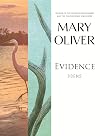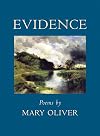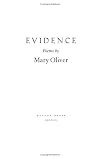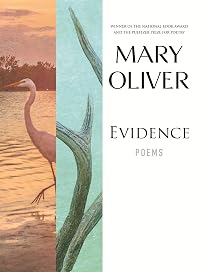
Evidence: Poems
by Mary Oliver
On This Page
Description
Overview: Never afraid to shed the pretense of academic poetry, never shy of letting the power of an image lie in unadorned language, Mary Oliver offers us poems of arresting beauty that reflect on the power of love and the great gifts of the natural world. Inspired by the familiar lines from William Wordsworth, "To me the meanest flower that blows can give / Thoughts that do often lie too deep for tears," she uncovers the evidence presented to us daily by nature, in rivers and stones, show more willows and field corn, the mockingbird's "embellishments," or the last hours of darkness. show lessTags
Recommendations






Member Recommendations
by wrmjr66
Member Reviews
Mary Oliver’s newest collection of poems entitled Evidence displays a pastoral quality not usually seen among her contemporaries. She deftly combines the styles of Frost and Williams, but gives a much harsher critique of the accelerating pace of modern day society. While there is an overt spirituality to the poems, it is not singular in focus, not identifiable with any one religion. For her, God is in the details, even if those details are plagues and wars. The book’s titular poem tries desperately to eschew science and capitalism, because science seeks to take the wonder out of Nature, but even this poem is surpassed by “To Begin With, The Sweet Grass” which read like a wonderful mixture between an extended haiku and a psalm.
 This review was written for LibraryThing Early Reviewers.
I am very grateful to Beacon Press and LibraryThing for the opportunity to review Mary Oliver’s latest book of poetry, Evidence, through LibraryThing’s Early Reviewers program. I’ve been reading Oliver’s poetry for the past few years, and have come to admire it a great deal. Evidence is a strong addition to this excellent body of work.
Much of Mary Oliver’s poetry is about the natural world, perhaps more so than any other living American poet. While the speed of life is faster than ever, and so many of us are overwhelmed with images, information, entertainment, and daily responsibilities, Oliver encourages readers to slow down, seek quiet, pay attention, and really notice the world around them. She is not a “nature poet,” show more but one who focuses on nature to better see what lies beyond it. As she writes in this book’s title poem, “Keep some room in your heart for the unimaginable.”
One of the poems is entitled, “There Are a Lot of Mockingbirds in This Book,” and it’s certainly true – and other kinds of birds as well. The book’s second poem is called “Swans,” and hints at love and loss, letting go, and faith. The poem’s speaker wonders that she could wish
that one of them might drop
a white feather
that I should have
something in my hand
to tell me
that they were real?
Of course
this was foolish.
What we love, shapely and pure,
is not to be held,
but to be believed in.
And then they vanished, into the unreachable distance.
In a poem entitled “I Am Standing,” the speaker is listening “to mockingbird again,” singing its song, and finally
my own unmusical self
begins humming:
thanks for the beauty of the world.
Thanks for my life.
Time and again, Oliver describes the beauty in nature, using words like “gifts” and “blessings,” and often seems to present these objects and occurrences as evidence of God. She writes in “It Was Early,” “Sometimes I need / only to stand / wherever I am / to be blessed.” But while there is a sense of spirituality in many of the poems, they are never preachy or heavy-handed. One of my favorites in this new book is the poem “At the River Clarion,” which begins, “I don’t know who God is exactly.” Some of the observations in this poem include:
If God exists he isn’t just butter and good luck.
He’s also the tick who killed my wonderful dog Luke.
And also:
If God exists He isn’t just churches and mathematics.
He’s the forest, He’s the desert.
He’s the ice caps, that are dying.
He’s the ghetto and the Museum of Fine Arts.
“At the River Clarion” meditates on God, and nature (the River Clarion) – I might also say nature as evidence of God – but also on death and grief. Oliver’s longtime partner passed away just a few years ago, so she knows grief all too well. She writes:
There was someone I loved who grew old and ill.
One by one I watched the fires go out.
There was nothing I could do
except to remember
that we receive
then we give back.
At the end of the poem, the speaker contrasts herself sitting “in a house filled with books, ideas, doubts, hesitations,” and the birds with “wings to uphold them,” and the river “on its / long journey, its pale, infallible voice / singing.”
My only disappointment with this volume is that a few of the poems are simply too short. The very first poem in the book, entitled “Yellow,” is only four lines. It paints an interesting image, and it’s thought-provoking, and quite good, but I want more of it. There are a couple more of three or four lines – well-done, but seemingly incomplete. They need not be VERY long; I like “Landscape in Winter,” which has two stanzas, a total of seven lines – just enough to have a sense of movement, one image to another. But, this minor disappointment probably says more about my taste in poetry – and my desire to read as many wonderful lines as I possibly can of Oliver’s work! – than about any real shortcomings in the book.
Whether listening to birds or rivers, watching the sky or the trees, or feeling grief or gladness, Mary Oliver expresses an amazement with the world around her, and with life itself, that is far too rare today. She writes, “Halleluiah, I’m sixty now, and even a little more, / and some days I feel I have wings.” Her poems take flight. They make me want to be more like her. show less
Much of Mary Oliver’s poetry is about the natural world, perhaps more so than any other living American poet. While the speed of life is faster than ever, and so many of us are overwhelmed with images, information, entertainment, and daily responsibilities, Oliver encourages readers to slow down, seek quiet, pay attention, and really notice the world around them. She is not a “nature poet,” show more but one who focuses on nature to better see what lies beyond it. As she writes in this book’s title poem, “Keep some room in your heart for the unimaginable.”
One of the poems is entitled, “There Are a Lot of Mockingbirds in This Book,” and it’s certainly true – and other kinds of birds as well. The book’s second poem is called “Swans,” and hints at love and loss, letting go, and faith. The poem’s speaker wonders that she could wish
that one of them might drop
a white feather
that I should have
something in my hand
to tell me
that they were real?
Of course
this was foolish.
What we love, shapely and pure,
is not to be held,
but to be believed in.
And then they vanished, into the unreachable distance.
In a poem entitled “I Am Standing,” the speaker is listening “to mockingbird again,” singing its song, and finally
my own unmusical self
begins humming:
thanks for the beauty of the world.
Thanks for my life.
Time and again, Oliver describes the beauty in nature, using words like “gifts” and “blessings,” and often seems to present these objects and occurrences as evidence of God. She writes in “It Was Early,” “Sometimes I need / only to stand / wherever I am / to be blessed.” But while there is a sense of spirituality in many of the poems, they are never preachy or heavy-handed. One of my favorites in this new book is the poem “At the River Clarion,” which begins, “I don’t know who God is exactly.” Some of the observations in this poem include:
If God exists he isn’t just butter and good luck.
He’s also the tick who killed my wonderful dog Luke.
And also:
If God exists He isn’t just churches and mathematics.
He’s the forest, He’s the desert.
He’s the ice caps, that are dying.
He’s the ghetto and the Museum of Fine Arts.
“At the River Clarion” meditates on God, and nature (the River Clarion) – I might also say nature as evidence of God – but also on death and grief. Oliver’s longtime partner passed away just a few years ago, so she knows grief all too well. She writes:
There was someone I loved who grew old and ill.
One by one I watched the fires go out.
There was nothing I could do
except to remember
that we receive
then we give back.
At the end of the poem, the speaker contrasts herself sitting “in a house filled with books, ideas, doubts, hesitations,” and the birds with “wings to uphold them,” and the river “on its / long journey, its pale, infallible voice / singing.”
My only disappointment with this volume is that a few of the poems are simply too short. The very first poem in the book, entitled “Yellow,” is only four lines. It paints an interesting image, and it’s thought-provoking, and quite good, but I want more of it. There are a couple more of three or four lines – well-done, but seemingly incomplete. They need not be VERY long; I like “Landscape in Winter,” which has two stanzas, a total of seven lines – just enough to have a sense of movement, one image to another. But, this minor disappointment probably says more about my taste in poetry – and my desire to read as many wonderful lines as I possibly can of Oliver’s work! – than about any real shortcomings in the book.
Whether listening to birds or rivers, watching the sky or the trees, or feeling grief or gladness, Mary Oliver expresses an amazement with the world around her, and with life itself, that is far too rare today. She writes, “Halleluiah, I’m sixty now, and even a little more, / and some days I feel I have wings.” Her poems take flight. They make me want to be more like her. show less
This review was written for LibraryThing Early Reviewers.Poetry has been a passion of mine all my life and I almost always have a volume of poetry as one of the books I am reading at any given time. Mary Oliver has become a very special poet in my life because with her work I feel I have developed an almost personal connection. I discovered Mary Oliver a few years ago when I picked up her book about poetry called Rules for the Dance. I was so impressed by that book that I started collecting her books of poems and she has become on of my favorite poets. I have found her later books, What Do We Know, Why I Wake Early, and Red Bird, to be especially meaningful to me. From her I have learned how to stop and appreciate the natural world around me and to take time to reflect on it as a way of show more calming myself and relaxing. I have learned to notice the small details as well and the grandeur in our beautiful planet. She has also shared wisdom that she has learned in her life’s journey that I have found inspiring and comforting.
Her newest volume, Evidence, continues in this tradition and takes us even further into her understanding of life and spirituality. Nothing is too insignificant for her to ignore nor too big for her to tackle. She epitomizes the idea that “the unexamined life is not worth living” and in examining her life she helps us to examine ours. In each of these later volumes of poetry I feel as if she has become more open and revealing of her inner feelings than she was in her earlier works. She shares not only her observations but her own reactions and feeling about these events. Although I will never know her personally, I somehow consider that she is a treasured and wise friend who helps and comforts me in my life’s journey. Just as I spend many hours with friends, I reread Mary Oliver’s books on a regular basis. She always has something “new’ to point out to me. The following poem gives a hint of the pleasures of this book.
Then the Bluebird Sang
Bluebird
slipped a little tremble
out of the triangle
of his mouth
and it hung in the air
until it reached my ear
like a froth or a frill
that Schumann
might have written in a dream.
Dear morning
you come
with so many angels of mercy
so wondrously disguised
in feathers, in leaves,
in the tongues of stones,
in the restless waters,
in the creep and the click
and the rustle
that greet me wherever I go
with their joyful cry; I’m still here, alive! show less
Her newest volume, Evidence, continues in this tradition and takes us even further into her understanding of life and spirituality. Nothing is too insignificant for her to ignore nor too big for her to tackle. She epitomizes the idea that “the unexamined life is not worth living” and in examining her life she helps us to examine ours. In each of these later volumes of poetry I feel as if she has become more open and revealing of her inner feelings than she was in her earlier works. She shares not only her observations but her own reactions and feeling about these events. Although I will never know her personally, I somehow consider that she is a treasured and wise friend who helps and comforts me in my life’s journey. Just as I spend many hours with friends, I reread Mary Oliver’s books on a regular basis. She always has something “new’ to point out to me. The following poem gives a hint of the pleasures of this book.
Then the Bluebird Sang
Bluebird
slipped a little tremble
out of the triangle
of his mouth
and it hung in the air
until it reached my ear
like a froth or a frill
that Schumann
might have written in a dream.
Dear morning
you come
with so many angels of mercy
so wondrously disguised
in feathers, in leaves,
in the tongues of stones,
in the restless waters,
in the creep and the click
and the rustle
that greet me wherever I go
with their joyful cry; I’m still here, alive! show less
This review was written for LibraryThing Early Reviewers.Although at first blush Mary Oliver writes the sort of many-birded-and-treed poetry one could send to one's great-grandmother, she in fact writes the sort of poetry one could study for good technique and still send to one's great-grandmother. This latest volume is no exception.
Oliver's themes include nature and its beauty as well as an exuberant, loving life. Perhaps because Oliver is in the transition from middle age into the age of the "young elderly" (she alludes to turning 60 during the writing of the book), she takes a philosophical bent in this book. She suggests that, for her, maturity is a time that is more expansive and less fragile than it may at first appear.
Mary Oliver is perhaps best known for her prosody manual "Rules for show more the Dance," and reading "Evidence" carefully you find that the simplicity of her style hides the fact that she controls the pacing and impact of her words. For example, in "Prince Buzzard" (page 5) the hurry of the lines "I took you, so high in the air, / for a narrow boat and two black sails" is promoted by the multiple feet and the inclusion of several anapests, so that when she reaches the lines "so slowly, / settling with hunched wings / and silent / as the grass itself" with their fewer, shorter, and more sibilant feet, by contrast they feel that they have landed into still, exhaling place.
The tension between more spare, essential lines and those that sprawl is set up throughout the book. Overall, she favors 3- and 4-line stanzas with 2-3 feet per line, experimenting also with 2-line stanzas and complex/emergent structures, but at all times she seems to be listening above all to the music she is writing. Although she is not much prone to direct wordplay, she does match up some lovely slants, such as frisky with risqué and motionless with carrion crows and good for us.
Although Mary Oliver is not one of my favorite poets (she has never, for example, made my heart race), she does solid work. An attentive reader will be well-rewarded by this book.
Highly recommended. show less
Oliver's themes include nature and its beauty as well as an exuberant, loving life. Perhaps because Oliver is in the transition from middle age into the age of the "young elderly" (she alludes to turning 60 during the writing of the book), she takes a philosophical bent in this book. She suggests that, for her, maturity is a time that is more expansive and less fragile than it may at first appear.
Mary Oliver is perhaps best known for her prosody manual "Rules for show more the Dance," and reading "Evidence" carefully you find that the simplicity of her style hides the fact that she controls the pacing and impact of her words. For example, in "Prince Buzzard" (page 5) the hurry of the lines "I took you, so high in the air, / for a narrow boat and two black sails" is promoted by the multiple feet and the inclusion of several anapests, so that when she reaches the lines "so slowly, / settling with hunched wings / and silent / as the grass itself" with their fewer, shorter, and more sibilant feet, by contrast they feel that they have landed into still, exhaling place.
The tension between more spare, essential lines and those that sprawl is set up throughout the book. Overall, she favors 3- and 4-line stanzas with 2-3 feet per line, experimenting also with 2-line stanzas and complex/emergent structures, but at all times she seems to be listening above all to the music she is writing. Although she is not much prone to direct wordplay, she does match up some lovely slants, such as frisky with risqué and motionless with carrion crows and good for us.
Although Mary Oliver is not one of my favorite poets (she has never, for example, made my heart race), she does solid work. An attentive reader will be well-rewarded by this book.
Highly recommended. show less
This review was written for LibraryThing Early Reviewers."Evidence" is a delightful book of poems that often gives one pause to reflect on what we have to gain by being still and observing the natural world, and what we have lost by not doing so. The poems offer evidence that nature gives us little remembrances of purpose and redemption, while not necessarily being redemptive itself--it just is, and is worthy to behold.
My favorite poem in the book is The Trees, which juxtaposes our "invention and advancement" with the holy work of trees in their seasonal ways. The last two lines have become a mantra as I travel among the juniper, pine, and manzanita of my own surroundings.
In her poem Prince Buzzard, I find a companion to Robinson Jeffers' poem Vulture (which also compares the bird's wings to show more sails). In Jeffers' poem he imagines the awe of "life after death" as carrion content in the bird's stomach, while Oliver nods to the "dark" and necessary work of such carrion feeders. Her poem "Li Po and the Moon" also seems to be a companion poem to Ezra Pound's Epitaph for Li Po. But, I thought Oliver's poem tried too hard to make her point about desperation, which fell flat after her account of Po's "drinking and dreaming and singing" rather than Pound's account of Po's attempt to "embrace a moon."
There are a lot of trees and birds in this book, a fact that made me chuckle when I reached the poem There Are a Lot of Mockingbirds in This Book. Indeed there are ( as well as swans, sparrows, buzzards), but none of them gratuitous.
The book's title poem ends with the prophetic proclamation that "The house of money is falling! The weeds are rising!" The readers who will enjoy this book are those who can rejoice in that proclamation and are willing to seriously listen to the river and hold the pine cone rather than commodify them.
The poet writes nature and nature writes the poet, and the reader is edified by this symbiotic relationship. This is a book best kept off the bookshelf, and in the back yard instead, or wherever else the evidence is to be found. show less
My favorite poem in the book is The Trees, which juxtaposes our "invention and advancement" with the holy work of trees in their seasonal ways. The last two lines have become a mantra as I travel among the juniper, pine, and manzanita of my own surroundings.
In her poem Prince Buzzard, I find a companion to Robinson Jeffers' poem Vulture (which also compares the bird's wings to show more sails). In Jeffers' poem he imagines the awe of "life after death" as carrion content in the bird's stomach, while Oliver nods to the "dark" and necessary work of such carrion feeders. Her poem "Li Po and the Moon" also seems to be a companion poem to Ezra Pound's Epitaph for Li Po. But, I thought Oliver's poem tried too hard to make her point about desperation, which fell flat after her account of Po's "drinking and dreaming and singing" rather than Pound's account of Po's attempt to "embrace a moon."
There are a lot of trees and birds in this book, a fact that made me chuckle when I reached the poem There Are a Lot of Mockingbirds in This Book. Indeed there are ( as well as swans, sparrows, buzzards), but none of them gratuitous.
The book's title poem ends with the prophetic proclamation that "The house of money is falling! The weeds are rising!" The readers who will enjoy this book are those who can rejoice in that proclamation and are willing to seriously listen to the river and hold the pine cone rather than commodify them.
The poet writes nature and nature writes the poet, and the reader is edified by this symbiotic relationship. This is a book best kept off the bookshelf, and in the back yard instead, or wherever else the evidence is to be found. show less
This review was written for LibraryThing Early Reviewers.I surprise myself by connecting so readily with the works of Mary Oliver: I, who spent an entire college course on the Romantics digging myself out from under ruined cottages and Aeolian harps. Yet, by and large, I do connect. Oliver is a "nature poet" in the sense that she places great value on details of the physical world, on taking the time to notice and prize elements of existence often considered small or insignificant. She argues with great passion that these details are actually of great importance, that in them dwell the complex raw material of life, in all its messy joy. I think it's the combination of nuance and deceptively simple language that really gets me about Oliver, and saves her from coming off as saccharine. She is show more capable of holding within herself two seemingly opposed facts, and presenting them calmly and beautifully, united in a single image. One of my favorite examples of this in Evidence is "Prince Buzzard":
Prince Buzzard,
I took you, so high in the air,
for a narrow boat and two black sails.
You were drifting
in the depths of the air
wherever you wanted to go,
and when you came down
with your spoony mouth
and your red head
and your creaking wings
to the lamb
dead, dead, dead
in the field of spring
I knew it was hunger
that brought you --
yet you went about it
so slowly,
settling with hunched wings
and silent
as the grass itself
over the lamb's white body --
it seemed
a ceremony,
a pause
as though something
in the quick of your own body
had come out
to give thanks
for the dark work
that was yours,
which wasn't to be done easily or quickly,
but thoroughly --
and indeed by the time summer
opened its green harbors
the field was nothing but flowers, flowers, flowers,
from shore to shore
Here Oliver observes, not just the relatively facile truth that life leads into death leads into life, but that the work of death is worthy of care, thoroughness, and thanks. Or maybe the issue is not so much one of worth, but simply of being: the work of death is done with a slow, careful completeness, and the speaker is a witness to that. Oliver is alive to the spirit of the natural world, yet she walks that Romantic line between perceiving and half-creating the world around her: the buzzard pauses, she writes, "as though something / in the quick of your own body / had come out..." Does the buzzard's seeming thankfulness dwell within the buzzard, or within the speaker? Or perhaps a little of each, or in the nexus of the two? Oliver's poems insist on a genuine, bone-deep connection with nature, but they also describe a necessary distance between the human speaker and the world observed. A lyric depicting time the speaker spent with a river otter is titled "Almost a Conversation"; another poem describes a mockingbird's indifference to any human listeners who might overhear his song. In "Moon and Water," Oliver portrays a deep, quiet connection with a natural entity, but also the limits of that connection:
I wake and spend
the last hours
of darkness
with no one
but the moon.
She listens
to my complaints
like the good
companion she is
and comforts me surely
with her light.
But she, like everyone,
has her own life.
So finally I understand
that she has turned away,
is no longer listening.
She wants me
to refold myself
into my own life.
And, bending close,
as we all dream of doing,
she rows with her white arms
through the dark water
which she adores
I love the image, here, of "refolding" oneself into one's own life after a period apart, and I love Oliver's perception of the moon as an entity helpful but aloof, with her own need, in the end, to return to the things which nourish her, "which she adores."
Oliver's language is hard to resist: it's accessible and even conversational, but distilled into a gorgeous precision. Occasionally there is a phrase reminiscent, to me, of a Sappho fragment:
"year after honey-rich year"
"summer / opened its harbors"
"one of those sweet, abrasive blades."
I can almost taste such lines; they fall onto the tongue like, as the poets themselves might say, drops of nectar. Savoring them, I find myself slowing down and lingering over their cadences, luxuriating in the stillness they leave in their wake. Oliver's habit of ending her poems without periods, letting them settle gradually and quietly in the reader's mind, like ripples on water, adds to this effect.
Occasionally Oliver does get a bit dances-with-the-daffodils for my taste. Evidence's "Violets," in particular, crosses some kind of a hippie-Romantic line for me, eulogizing about the lost flowers of childhood, long since bulldozed to make way for development. I also have trouble connecting with the poems in Evidence which use overtly religious language: "More Honey Locust," for example, perceives in the blossom "a prayer for us all"; there are poems called "Hallelujah" and "Prayer," and one that plays with the existence of angels. It's not that I think this kind of language is inappropriate or in any way irrelevant, but being a very secular person myself, I find it distracting. I can deduce from context, intellectually, what sort of a God concept Oliver herself might have, and I must say that it seems thoughtful and hard-won. But as I have none myself, I find that I am jerked out of the visceral experience of the poem whenever religious language makes an appearance.
But these are personal quibbles. Evidence is a masterful collection of poems, and one that only gets more lovely and thought-provoking the more I pore through it. show less
Prince Buzzard,
I took you, so high in the air,
for a narrow boat and two black sails.
You were drifting
in the depths of the air
wherever you wanted to go,
and when you came down
with your spoony mouth
and your red head
and your creaking wings
to the lamb
dead, dead, dead
in the field of spring
I knew it was hunger
that brought you --
yet you went about it
so slowly,
settling with hunched wings
and silent
as the grass itself
over the lamb's white body --
it seemed
a ceremony,
a pause
as though something
in the quick of your own body
had come out
to give thanks
for the dark work
that was yours,
which wasn't to be done easily or quickly,
but thoroughly --
and indeed by the time summer
opened its green harbors
the field was nothing but flowers, flowers, flowers,
from shore to shore
Here Oliver observes, not just the relatively facile truth that life leads into death leads into life, but that the work of death is worthy of care, thoroughness, and thanks. Or maybe the issue is not so much one of worth, but simply of being: the work of death is done with a slow, careful completeness, and the speaker is a witness to that. Oliver is alive to the spirit of the natural world, yet she walks that Romantic line between perceiving and half-creating the world around her: the buzzard pauses, she writes, "as though something / in the quick of your own body / had come out..." Does the buzzard's seeming thankfulness dwell within the buzzard, or within the speaker? Or perhaps a little of each, or in the nexus of the two? Oliver's poems insist on a genuine, bone-deep connection with nature, but they also describe a necessary distance between the human speaker and the world observed. A lyric depicting time the speaker spent with a river otter is titled "Almost a Conversation"; another poem describes a mockingbird's indifference to any human listeners who might overhear his song. In "Moon and Water," Oliver portrays a deep, quiet connection with a natural entity, but also the limits of that connection:
I wake and spend
the last hours
of darkness
with no one
but the moon.
She listens
to my complaints
like the good
companion she is
and comforts me surely
with her light.
But she, like everyone,
has her own life.
So finally I understand
that she has turned away,
is no longer listening.
She wants me
to refold myself
into my own life.
And, bending close,
as we all dream of doing,
she rows with her white arms
through the dark water
which she adores
I love the image, here, of "refolding" oneself into one's own life after a period apart, and I love Oliver's perception of the moon as an entity helpful but aloof, with her own need, in the end, to return to the things which nourish her, "which she adores."
Oliver's language is hard to resist: it's accessible and even conversational, but distilled into a gorgeous precision. Occasionally there is a phrase reminiscent, to me, of a Sappho fragment:
"year after honey-rich year"
"summer / opened its harbors"
"one of those sweet, abrasive blades."
I can almost taste such lines; they fall onto the tongue like, as the poets themselves might say, drops of nectar. Savoring them, I find myself slowing down and lingering over their cadences, luxuriating in the stillness they leave in their wake. Oliver's habit of ending her poems without periods, letting them settle gradually and quietly in the reader's mind, like ripples on water, adds to this effect.
Occasionally Oliver does get a bit dances-with-the-daffodils for my taste. Evidence's "Violets," in particular, crosses some kind of a hippie-Romantic line for me, eulogizing about the lost flowers of childhood, long since bulldozed to make way for development. I also have trouble connecting with the poems in Evidence which use overtly religious language: "More Honey Locust," for example, perceives in the blossom "a prayer for us all"; there are poems called "Hallelujah" and "Prayer," and one that plays with the existence of angels. It's not that I think this kind of language is inappropriate or in any way irrelevant, but being a very secular person myself, I find it distracting. I can deduce from context, intellectually, what sort of a God concept Oliver herself might have, and I must say that it seems thoughtful and hard-won. But as I have none myself, I find that I am jerked out of the visceral experience of the poem whenever religious language makes an appearance.
But these are personal quibbles. Evidence is a masterful collection of poems, and one that only gets more lovely and thought-provoking the more I pore through it. show less
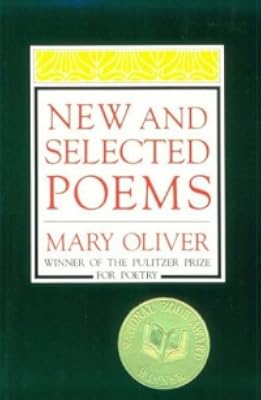
This review was written for LibraryThing Early Reviewers.Evidence is the latest book from Pulitzer Prize winning poet, Mary Oliver. If you have enjoyed her work in the past, put this volume down, walk away, and forget it exists. One is always sad when a master loses her stuff; and you don't want to be sad, do you? Pick up New and Selected Poems instead. There, you will discover poems reveling in the complexities of the natural world. There you will find a writer examining each facet of the gemstone, turning it slowly, reflecting upon cuts that gleam in sunlight, as well as those which remain in shadow. She seems to joy in each, equally.
Evidence, however, displays none of this probing; and the virtuosity usually obscured by her simple execution has now become mere simplicity. Most of the show more pieces are one dimensional statements of naive exuberance without any acute observations. The only questions asked are answered with the awkward interjections of glee one would expect from a very immature poet, and her images are inordinately weak.
(Writing this review was a painful task - probably why it's so short. Her earlier work is mandatory for the bookshelf. I hope this volume is an anomaly.) show less
Evidence, however, displays none of this probing; and the virtuosity usually obscured by her simple execution has now become mere simplicity. Most of the show more pieces are one dimensional statements of naive exuberance without any acute observations. The only questions asked are answered with the awkward interjections of glee one would expect from a very immature poet, and her images are inordinately weak.
(Writing this review was a painful task - probably why it's so short. Her earlier work is mandatory for the bookshelf. I hope this volume is an anomaly.) show less
This review was written for LibraryThing Early Reviewers.Members
- Recently Added By
Lists

Tonikat reading completed on Librarything journals
329 works; 2 members
Author Information

54+ Works 21,173 Members
Mary Oliver was born in Cleveland, Ohio on September 10, 1935. She attended Ohio State University and Vassar College, but did not receive a degree. Her first collection of poems, No Voyage and Other Poems, was published in 1963. She wrote more than 20 volumes of poetry including The River Styx, Ohio; The Leaf and the Cloud; Evidence; Blue Horses; show more and Felicity. She received several awards including the Pulitzer Prize for American Primitive, the Christopher Award and the L. L. Winship/PEN New England Award for House of Light, and the National Book Award for New and Selected Poems. Her books of prose include A Poetry Handbook, Rules for the Dance: A Handbook for Writing and Reading Metrical Verse, and Long Life: Essays and Other Writings. She held the Catharine Osgood Foster Chair for Distinguished Teaching at Bennington College from 1995 to 2001. She died on January 17, 2019 at the age of 83. (Bowker Author Biography) show less
Awards and Honors
Awards
Common Knowledge
- Canonical title
- Evidence: Poems
- Original publication date
- 2009
- Epigraph
- We create ourselves by our choices.
-- Kierkegaard - Dedication
- For Anne Taylor
- First words
- There is the heaven we enter
through institutional grace
and there are the yellow finches bathing and singing
in the lowly puddle. - Last words
- (Click to show. Warning: May contain spoilers.)I'm just going to put on
my jacket, my boots,
I'm just going to go out
to sleep
all this night
in some unnamed, flowered corner
of the pasture. - Blurbers
- Doyle, Brian; Hollander, Katherine
Classifications
Statistics
- Members
- 333
- Popularity
- 95,423
- Reviews
- 23
- Rating
- (4.21)
- Languages
- English
- Media
- Paper, Ebook
- ISBNs
- 4
- ASINs
- 1