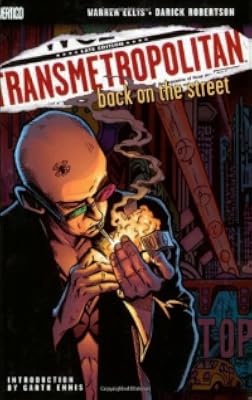
Transmetropolitan Vol. 01: Back on the Street
by Warren Ellis (Author), Darick Robertson (Illustrator)
Transmetropolitan (First Edition TPBs [1998-2004] — TPB 1 (1998 ed): Issues #1-3)
On This Page
Description
In the third year of the seminal series, no-holds-barred investigative reporter Spider Jerusalem delves into the City's police corruption. Despite drugs, drinking, and paranoia, Spider and his filthy assistants are hot on the trail of the truth behind the newly elected president's campaign. This volume includes the stories "Lonely City" and "Gouge Away," plus standalone stories such as "Nobody Loves Me," featuring guest artists Lea Hernandez, Kieron Dwyer, Bryan Hitch, Frank Quitely, and show more Eduardo Risso. Also collects a story from Vertigo: Winter's Edge #3. show lessTags
Recommendations

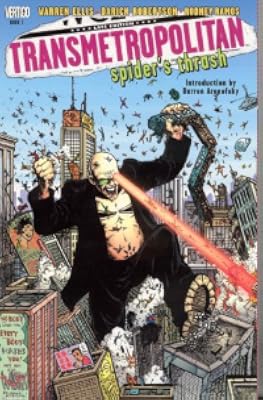
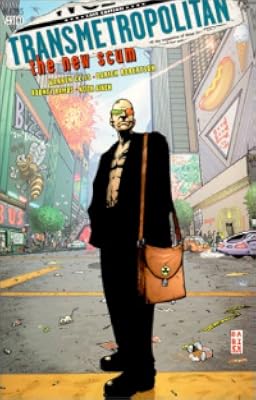


Member Recommendations
Member Reviews
Spider Jerusalem is the cyberpunk homage to gonzo journalist Hunter S. Thompson. You can see it in his appearance, demeanor, personality, and politics. And he's always smoking. Like HST, he savagely attacks what he perceives as a corrupt system filled with politicians, aristocrats, and cult leaders on the take with the use of his trusty computer. He's an anti-hero sticking it to--and sometimes kicking--the man. But he's also flawed. In Spider's case, it's manifold: booze and drugs, loyal to no one but himself, sloth, paranoia, and delusions of grandeur that manifest in the form of a self-righteous arbiter of morality attacking the powerful. He's judge, jury, and punisher (he doesn't execute anyone) who takes too much delight in carrying show more out his sentences.
Forced out of retirement due to bankruptcy and a publishing contract, Spider returns to the city he loves and loathes. He feeds off that loathing to craft his column for one of the local newspapers. His editor rewards Spider with a generous stipend and improved lodging (and later an assistant), which feeds Spider's ego and gives him all the justification he needs to continue his crusade.
Volume 1 collects the first six issues. The first three issues see Spider's return to the city from his mountain retreat. We learn about this world of his as he gets re-acquainted with it, noting what has changed, what hasn't. Along the way we discover that there are transients, humans who are re-writing their DNA to become aliens. Spider decides to make their story the subject of his first column.
The next three issues are one-offs where Spider meets his assistant (Channon, who deserves hazard pay for putting up with Spider's eccentricities) and runs into the President in a public bathroom, spends an afternoon watching TV (watch out for the ad bombs!), and visits a religious cult convention.
Darick Robertson's artwork is spot on. He perfectly captures the commercial chaos of the city, filled with the circus sideshow of humanity with all of its quirks, cultures, fashions and fetishes. I love scrutinizing the wide shot panels, combing through the debris of this world to catch a glimpse of the detritus and details that offer clues into what this world is all about: Ebola Cola, Necro Porn and Playgray magazines, Sin Gin, Dead Boyz cigarettes.
On a personal note, I just finished this volume before attending a corporate Christmas party. When I wasn't engaged in polite conversations with people who would soon forget I existed, Spider Jerusalem's commentary was there, running through my head with acerbic opinions about the occasion and its attendees. Having a character stick with you like that is a good sign that the author did his homework.
Given the current political climate, Transmetropolitan seems more relevant now than when it debuted 20 years ago. One major difference: the caricatures of people in the comic have now come to life. show less
Forced out of retirement due to bankruptcy and a publishing contract, Spider returns to the city he loves and loathes. He feeds off that loathing to craft his column for one of the local newspapers. His editor rewards Spider with a generous stipend and improved lodging (and later an assistant), which feeds Spider's ego and gives him all the justification he needs to continue his crusade.
Volume 1 collects the first six issues. The first three issues see Spider's return to the city from his mountain retreat. We learn about this world of his as he gets re-acquainted with it, noting what has changed, what hasn't. Along the way we discover that there are transients, humans who are re-writing their DNA to become aliens. Spider decides to make their story the subject of his first column.
The next three issues are one-offs where Spider meets his assistant (Channon, who deserves hazard pay for putting up with Spider's eccentricities) and runs into the President in a public bathroom, spends an afternoon watching TV (watch out for the ad bombs!), and visits a religious cult convention.
Darick Robertson's artwork is spot on. He perfectly captures the commercial chaos of the city, filled with the circus sideshow of humanity with all of its quirks, cultures, fashions and fetishes. I love scrutinizing the wide shot panels, combing through the debris of this world to catch a glimpse of the detritus and details that offer clues into what this world is all about: Ebola Cola, Necro Porn and Playgray magazines, Sin Gin, Dead Boyz cigarettes.
On a personal note, I just finished this volume before attending a corporate Christmas party. When I wasn't engaged in polite conversations with people who would soon forget I existed, Spider Jerusalem's commentary was there, running through my head with acerbic opinions about the occasion and its attendees. Having a character stick with you like that is a good sign that the author did his homework.
Given the current political climate, Transmetropolitan seems more relevant now than when it debuted 20 years ago. One major difference: the caricatures of people in the comic have now come to life. show less
A wonderful start to a series. Transmetropolitan is the story of Spider Jerusalem, a journalist in a future full of biotechnical and biochemical advancements and modifications in the human body and psyche. Living in a fucked up city, full of corruption, human body modifications (including trans-species genetic modifications), and hyper-mediated communication, Jerusalem's investigative reporting is unorthodox and leads to some intriguing narratives. I found the introduction interesting not only for the narrative, but also how the comic seems to raise serious questions that plague us now: government corruption, media ethics, the line between human and animal/object/technology/nature. Plus, the technology in the story is pretty rad.
So fucking awesome! If awesomeness could be condensed into six books, then this would be it!
Warren Ellis makes some eye-opening observations through Spider Jerusalem. The one that struck me most was this:
There's one hole in every revolution, large or small. And it's one word long -- people. No matter how big the idea they all stand under, people are small and weak and cheap and frightened. It's people that kill every revolution. (Issue 3)
He also captures the essence of journalism in a brief but astute conversation:
"The point is, the only real tools we have are our eyes and our heads. It's not the act of seeing with our own eyes alone; it's correctly comprehending what we see."
"Treating life as an autopsy."
"Got it. Laying open the guts show more of the world and sniffing the entrails, that's what we do." (Issue 4)
I've never been so amazed by a comic series. Transmetropolitan is off to a good start! show less
Warren Ellis makes some eye-opening observations through Spider Jerusalem. The one that struck me most was this:
There's one hole in every revolution, large or small. And it's one word long -- people. No matter how big the idea they all stand under, people are small and weak and cheap and frightened. It's people that kill every revolution. (Issue 3)
He also captures the essence of journalism in a brief but astute conversation:
"The point is, the only real tools we have are our eyes and our heads. It's not the act of seeing with our own eyes alone; it's correctly comprehending what we see."
"Treating life as an autopsy."
"Got it. Laying open the guts show more of the world and sniffing the entrails, that's what we do." (Issue 4)
I've never been so amazed by a comic series. Transmetropolitan is off to a good start! show less
Spider Jerusalem is a gonzo journalist in the mold of Hunter S. Thompson. Five years ago, he was popular enough to make a decent bundle and moved to the mountains to get away from the City and the fans. And now an old contract is due and he has to get a job again— and return to the chaos of the City.
Ellis depicts a frenetic, high-tech future that looks all too believable: sex, drugs, rock’n’roll, and society fragmenting into subculture after subculture. Spider’s return to the City sets the stage for exposition of this crazed world, and while Spider is a mad bastard whom I wouldn’t want to go near, he is ultimately redeemed by his love for the Truth.
This volume gives us the scene for Spider’s first column after he returns to show more the City, indicting the authorities at Civic Center for a crackdown on a particular subculture. Mao’s aphorism was that power comes from the barrel of a gun, but in a highly connected age, the more powerful barrel holds a camera lens. show less
Ellis depicts a frenetic, high-tech future that looks all too believable: sex, drugs, rock’n’roll, and society fragmenting into subculture after subculture. Spider’s return to the City sets the stage for exposition of this crazed world, and while Spider is a mad bastard whom I wouldn’t want to go near, he is ultimately redeemed by his love for the Truth.
This volume gives us the scene for Spider’s first column after he returns to show more the City, indicting the authorities at Civic Center for a crackdown on a particular subculture. Mao’s aphorism was that power comes from the barrel of a gun, but in a highly connected age, the more powerful barrel holds a camera lens. show less
If Hunter Thompson lived in a crazy, future dystopia, became such a popular journalist that he gained worldwide acclaim and wrote three books on a five-book contract, then disappeared into the mountains and became a militaristic Alan Moore; even then you'd only be scratching the surface of Spider Jerusalem.
Here we have the first story of Spider's return to a society he despises, all because his publisher is calling due on the other two books in his contract. In order to do so, he has to write, and to write he has to be in the city. Upon arriving he finds the city on the verge of a race riot by a bunch of weird hybrids called "Transients." These are humans who have willingly decided to turn themselves into aliens through genetic show more modification and have suddenly decided they deserve the rights currently being denied them due to their in-between status. Spider lives and writes like he doesn't have a care in the world, and he probably doesn't.
I've read this book probably five times now, should probably pick up the next few in the series soon, huh? HIGHLY recommend. show less
Here we have the first story of Spider's return to a society he despises, all because his publisher is calling due on the other two books in his contract. In order to do so, he has to write, and to write he has to be in the city. Upon arriving he finds the city on the verge of a race riot by a bunch of weird hybrids called "Transients." These are humans who have willingly decided to turn themselves into aliens through genetic show more modification and have suddenly decided they deserve the rights currently being denied them due to their in-between status. Spider lives and writes like he doesn't have a care in the world, and he probably doesn't.
I've read this book probably five times now, should probably pick up the next few in the series soon, huh? HIGHLY recommend. show less
While reading the "Transmetropolitian" series, one might get the slightest notion, really just an itch in the back of the mind, that the whole thing might have been created with the calculated notion of becoming a cult success. Futuristic dystopia that satirizes the prevalent negative trends in modern society? Check. Impossibly cool looking gun totting protagonist with an almost comical 8th-grade chic name (whose speech patterns and look were inspired by Hunter S. Thompson no less? Check. But aside from the nagging itch of calculation, the story of a near future rebel journalist navigating a twisted society he despises is so beautifully entertaining that it brushes away all doubts. Collecting the first three books in the series (and a show more introducing us to Spider Jerusalem, a character still in his birthing stages here, but becoming more interesting with every panel) and the first full story arc, this is a opening salvo of some primo comic book literature.
(This review originally appeared on zombieunderground.net) show less
(This review originally appeared on zombieunderground.net) show less
Transmet (as its loving fans refer to it) was published as a monthly series from 1997 (that's pre-Matrix) to 2002. In 2002, The Speed of Dark won the Nebula and Arthur C. Clarke award. Transmet won no Nebulas, no Clarkes, no Hugos. It was by carefully analyzing these two facts that I confirmed that power does not only corrupt, but stupefy.
Transmet is the best piece of Sci-Fi in recent memory, grasping the dangling wires from the post-cyberpunk machine and jamming them into sockets, willy-nilly, until the whole thing lights up like a god-forsaken, fission-powered Christmas Tree.
The only caveat that I can offer is that the technology levels are sometimes a bit wonky. It isn't Star Trek's transporters compared to their inability to say, show more overcome aging or fix a spine, but it is still sometimes a bit annoying to the fan of Speculative Fiction.
I recall quite vividly after reading Snowcrash that I wished that more books could feel like that (especially Stephenson's own). Alas; it seems that such an enjoyable masterwork comes only once to a medium. So, read Snowcrash, play Fallout II, watch the Matrix, and for the state of your puny, mortal soul, find yourself a copy of Transmet. show less
Transmet is the best piece of Sci-Fi in recent memory, grasping the dangling wires from the post-cyberpunk machine and jamming them into sockets, willy-nilly, until the whole thing lights up like a god-forsaken, fission-powered Christmas Tree.
The only caveat that I can offer is that the technology levels are sometimes a bit wonky. It isn't Star Trek's transporters compared to their inability to say, show more overcome aging or fix a spine, but it is still sometimes a bit annoying to the fan of Speculative Fiction.
I recall quite vividly after reading Snowcrash that I wished that more books could feel like that (especially Stephenson's own). Alas; it seems that such an enjoyable masterwork comes only once to a medium. So, read Snowcrash, play Fallout II, watch the Matrix, and for the state of your puny, mortal soul, find yourself a copy of Transmet. show less
Members
- Recently Added By
Lists

Recommended Comics / Graphic Novels
595 works; 122 members

Books Read in 2016
4,666 works; 199 members
Author Information


Some Editions
Awards and Honors
Series

Belongs to Publisher Series
Work Relationships
Common Knowledge
- Canonical title
- Transmetropolitan Vol. 01: Back on the Street
- Original publication date
- 1998
- People/Characters
- Spider Jerusalem; Mitchell Royce; Fred Christ; Channon Yarrow
- Important places
- The City
- Disambiguation notice
- Note: This is the old edition which includes issues #1-3. Newer editions contain #1-6 and should not be combined.
Classifications
- Genre
- Graphic Novels & Comics
- DDC/MDS
- 741.5973 — Arts & recreation Drawing & decorative arts Drawing Comic books, graphic novels, fotonovelas, cartoons, caricatures, comic strips History, geographic treatment, biography North American United States (General)
- LCC
- PN6728 .T68 .E43 — Language and Literature Literature (General) Literature (General) Collections of general literature Comic books, strips, etc.
Statistics
- Members
- 1,882
- Popularity
- 11,422
- Reviews
- 41
- Rating
- (4.13)
- Languages
- 7 — Czech, English, French, German, Italian, Spanish, Portuguese (Brazil)
- Media
- Paper, Ebook
- ISBNs
- 21
- ASINs
- 2