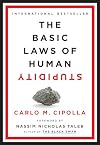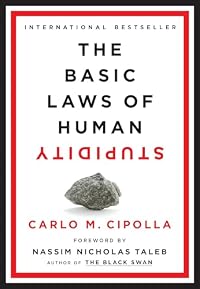
The Basic Laws of Human Stupidity
by Carlo M. Cipolla
On This Page
Description
"An economist explores the five laws that confirm our worst fears: stupid people can and do rule the world"--Tags
Recommendations












Member Reviews
Tan brillante como incómodo. Una lúcida reflexión con un análisis claro y conciso de la gravedad de subestimar la aparición de la estupidez en la sociedad, en conjunto con la malicia, la inteligencia y la falta de cautela.
Me quedo con el final debido a la gravedad de los acontecimientos actuales:
Me quedo con el final debido a la gravedad de los acontecimientos actuales:
En un país en decadencia, el porcentaje de individuos estúpidos sigue siendo igual a la cuota de personas estúpidas en el seno de una población; sin embargo, en el resto de la población se observa, sobre todo entre los individuos que están en el poder, una alarmante proliferación de malvados con un elevado porcentaje de estupidez y, entre los que no están en el poder, un igualmente alarmante crecimiento del número de los incautos.show more
Tal cambio en la composición de la población de los no estúpidos refuerza, inevitablemente, el poder destructivo de la fracción de los estúpidos, y conduce al país a la ruina.show less
The Merriam-Webster dictionary defines stupid as “given to unintelligent decisions or acts,” or alternatively as “acting in an unintelligent or careless manner.” Stupid people cause both intentional and unintentional harm or loss to others, even while deriving no gains (or even suffering losses) themselves. While stupid individuals are not necessarily malevolent, they nevertheless cause damage and represent a threat to society.
Both a study of human history and reflection on one’s own personal experiences confirm that stupidity is not exactly in short supply—but does stupidity’s prevalence across time and space indicate that it operates according to basic universal laws? According to Italian economic historian and professor show more Carlo M. Cipolla, the answer is yes.
In The Basic Laws of Human Stupidity, Cipolla condenses years of related research into five iron laws of stupidity, which he claims are universal and independent of time and place. All five laws ultimately lead to Cipolla’s primary, disheartening conclusion: Regardless of who you associate with, you will always encounter the same proportion of stupid individuals in every group.
Let’s work through the five laws to see if this is a reasonable conclusion.
Law #1: The number of stupid individuals in circulation is always underestimated
The first law simply states that you will always underestimate the number of stupid individuals in which you must deal with. Since Cipolla does not present a numerical measure or estimate at this point in the book, the reader more or less has to take his word for it. I’m sure, however, that you can recall numerous instances of dealing with stupid individuals, and further, that you can recall examples of stupidity coming from unexpected places or from those once judged to be rational or intelligent.
If the amount of stupidity in your life has ever surprised you, then you have experienced the first law directly.
Law #2: Stupidity is independent of any other personal or professional characteristic
The second law states that stupidity is independent of race, class, gender, nationality, or education, and that the same proportion of stupid individuals is found in both blue-collar and white collar professions, whether in a group of janitors or in a group of Nobel laureates. Cipolla writes:
“Whether I considered a large university or a small college, a famous institution or an obscure one, I found that the same fraction of the professors were stupid. So bewildered was I by the results that I made a special point to extend my research to a specially selected group, to a real elite, the Nobel laureates. The result confirmed Nature’s supreme powers: [the same] fraction of the Nobel laureates were stupid.”
The problem for Cipolla is that, at this point in the book, “stupid” has not even been defined, let alone demonstrated. So when Cipolla states that a fraction of Nobel laureates are “stupid,” we don’t really know what he means, and further, we don’t know how his research methods were able to distinguish between “stupid Nobel laureates” versus “non-stupid Nobel laureates.” The reader is simply left guessing.
Later in the book, Cipolla will define a stupid person as one who creates losses for others while deriving no gains themselves, but if this is the case, the reader can ask the following question: Wouldn’t a Nobel laureate presumably be creating value for others through their work, or at least deriving personal gains, thus directly refuting Cipolla’s argument based on his own definiton of stupidity? This is something to think about as you move on to the third law.
Cipolla also makes references to experiments and research that confirm the idea that the proportion of stupid individuals is constant in every group, but we’re never made aware of what those studies are. It seems as if we’re just supposed to take his word for it, which makes for a rather weak, if not intuitively appealing, argument.
The second law, like the first, seems to hold intuitively, but we’re not given any empirical reasons to accept the claim, beyond vague references to “studies” conducted by the author that are never shared or elaborated on. So while I’m certain that Cipolla is correct in his assertion that stupidity is independent of race, gender, and nationality, his assertion that stupidity is genetic and uninfluenced by education is far more questionable.
Law #3: Stupid people cause losses for others while deriving no gains themselves
The following table outlines the four personality types to which you may, on average, belong:
Gains (You) Losses (You)
Gains (Others) Intelligent Helpless
Losses (Others) Bandit Stupid
According to the table, if your actions provide gains for yourself and for others, you are an intelligent and contributing member to society; if your actions provide gains to yourself and losses to others, you’re a bandit; if your actions provide losses to yourself and gains to others, you’re helpless (or altruistic); and if your actions produce losses to both yourself and others, you’re stupid.
We can all think of personal examples of individuals who go out of their way to cause us unnecessary difficulties, embarrassment, or harm, all while gaining nothing for themselves (other than perhaps psychological satisfaction). This person’s behavior is typically irrational and unpredictable, and can only be fairly described as stupid.
I see no problem in conceding to the truth of this law, but this does not in itself confirm the truth of the first or second laws, which ultimately make unsupported empirical claims, or, if they are supported, the reader is never told how.
Law #4: Non-stupid people always underestimate the damaging power of stupid individuals
The fourth law states that non-stupid people consistently underestimate the damage stupid people can cause and falsely assume that stupid people will only harm themselves (like the helpless person in the table above). However, unlike the helpless person, the stupid person will create harm and losses for others, in addition to themselves, through unpredictable and irrational behavior. It is best, therefore, to deal with stupid people with caution, if at all.
Once again, history is replete with examples of stupid individuals creating incalculable harm, and one’s personal life is filled with similar examples of unexpected harm caused by sheer stupidity. We can safely conclude, therefore, that this law probably holds.
Law #5: A stupid person is the most dangerous type of person
The final law states that the stupid person is the most dangerous type of person, even more dangerous than the bandit. Recall that the bandit derives gains from the losses of others, which results in a transfer of wealth but not in an overall loss to society. Further, the bandits actions are rational (even if reprehensible), and therefore predictable. We can defend against the actions of bandits.
The stupid person, however, due to the unpredictability of their actions, is harder to defend against. Further, because they are creating losses for themselves and for others, the stupid person’s actions impoversh society as a whole.
The reader may question the legitimacy of this law. One need only think about the totalitarian dictators of twentieth-century history. By Cipolla’s own definition, these individuals are not stupid, they’re bandits. They orchestrated obscene levels of harm and destruction to benefit themselves by accumulating power, resources, and land. Of course, whether one defines someone as stupid or as a bandit is a matter of definition, so it could be said that the dictator who creates disproportional harm to others, compared to what they receive in personal gains, is therefore stupid. With this more inclusive definition, we can agree to the legitimacy of the fifth law.
Is stupidity genetically determined?
It’s admittedly very difficult to determine how seriously to take this book. Are we simply dealing with a tongue-in-cheek polemic, or a serious academic essay? The fact that the laws are based on Cipolla’s own academic research and the research of others suggests that it should be taken seriously. Additionally, the laws have an intuitive appeal and seem to match personal experience.
On the other hand, not one specific study is referenced. No examples are provided. And, most importantly, no explanation is offered as to how groups were formally analyzed to differentiate “stupid” from “non-stupid” people.
This is specifically a problem for the first two laws, and for Cipolla’s assertion that the fraction of stupid people will always remain constant, as this is genetically determined. In other words, if you’re born stupid, Cipolla is telling you that there is no amount of education that can ever change that fact.
I think this is almost certainly false. It’s highly unlikely that no one has ever gone from stupid (creating losses for others without any corresponding personal gains) to non-stupid through the pursuit of higher education or other morally-formative experiences. I’m sure you can think of personal examples yourself, fairly easily.
It’s disappointing to see Cipolla fall for the false dichotomy that is the nature/nurture debate. One’s beliefs and actions result from a complex mixture of genetics, environment, culture, and learning, and therefore any statement that places the blame for one’s actions or personality on either nature or nurture exclusively is almost certainly wrong.
Overall, Cipolla makes a strong intuitive case for the prevalence of stupidity and for the fact that stupid people are often dangerous and underestimated, and that a certain proportion of individuals are predisposed to stupidity. But the idea that education and culture have no role whatsoever to play in reforming stupidity on a person-by-person basis is far less persuasive. show less
Both a study of human history and reflection on one’s own personal experiences confirm that stupidity is not exactly in short supply—but does stupidity’s prevalence across time and space indicate that it operates according to basic universal laws? According to Italian economic historian and professor show more Carlo M. Cipolla, the answer is yes.
In The Basic Laws of Human Stupidity, Cipolla condenses years of related research into five iron laws of stupidity, which he claims are universal and independent of time and place. All five laws ultimately lead to Cipolla’s primary, disheartening conclusion: Regardless of who you associate with, you will always encounter the same proportion of stupid individuals in every group.
Let’s work through the five laws to see if this is a reasonable conclusion.
Law #1: The number of stupid individuals in circulation is always underestimated
The first law simply states that you will always underestimate the number of stupid individuals in which you must deal with. Since Cipolla does not present a numerical measure or estimate at this point in the book, the reader more or less has to take his word for it. I’m sure, however, that you can recall numerous instances of dealing with stupid individuals, and further, that you can recall examples of stupidity coming from unexpected places or from those once judged to be rational or intelligent.
If the amount of stupidity in your life has ever surprised you, then you have experienced the first law directly.
Law #2: Stupidity is independent of any other personal or professional characteristic
The second law states that stupidity is independent of race, class, gender, nationality, or education, and that the same proportion of stupid individuals is found in both blue-collar and white collar professions, whether in a group of janitors or in a group of Nobel laureates. Cipolla writes:
“Whether I considered a large university or a small college, a famous institution or an obscure one, I found that the same fraction of the professors were stupid. So bewildered was I by the results that I made a special point to extend my research to a specially selected group, to a real elite, the Nobel laureates. The result confirmed Nature’s supreme powers: [the same] fraction of the Nobel laureates were stupid.”
The problem for Cipolla is that, at this point in the book, “stupid” has not even been defined, let alone demonstrated. So when Cipolla states that a fraction of Nobel laureates are “stupid,” we don’t really know what he means, and further, we don’t know how his research methods were able to distinguish between “stupid Nobel laureates” versus “non-stupid Nobel laureates.” The reader is simply left guessing.
Later in the book, Cipolla will define a stupid person as one who creates losses for others while deriving no gains themselves, but if this is the case, the reader can ask the following question: Wouldn’t a Nobel laureate presumably be creating value for others through their work, or at least deriving personal gains, thus directly refuting Cipolla’s argument based on his own definiton of stupidity? This is something to think about as you move on to the third law.
Cipolla also makes references to experiments and research that confirm the idea that the proportion of stupid individuals is constant in every group, but we’re never made aware of what those studies are. It seems as if we’re just supposed to take his word for it, which makes for a rather weak, if not intuitively appealing, argument.
The second law, like the first, seems to hold intuitively, but we’re not given any empirical reasons to accept the claim, beyond vague references to “studies” conducted by the author that are never shared or elaborated on. So while I’m certain that Cipolla is correct in his assertion that stupidity is independent of race, gender, and nationality, his assertion that stupidity is genetic and uninfluenced by education is far more questionable.
Law #3: Stupid people cause losses for others while deriving no gains themselves
The following table outlines the four personality types to which you may, on average, belong:
Gains (You) Losses (You)
Gains (Others) Intelligent Helpless
Losses (Others) Bandit Stupid
According to the table, if your actions provide gains for yourself and for others, you are an intelligent and contributing member to society; if your actions provide gains to yourself and losses to others, you’re a bandit; if your actions provide losses to yourself and gains to others, you’re helpless (or altruistic); and if your actions produce losses to both yourself and others, you’re stupid.
We can all think of personal examples of individuals who go out of their way to cause us unnecessary difficulties, embarrassment, or harm, all while gaining nothing for themselves (other than perhaps psychological satisfaction). This person’s behavior is typically irrational and unpredictable, and can only be fairly described as stupid.
I see no problem in conceding to the truth of this law, but this does not in itself confirm the truth of the first or second laws, which ultimately make unsupported empirical claims, or, if they are supported, the reader is never told how.
Law #4: Non-stupid people always underestimate the damaging power of stupid individuals
The fourth law states that non-stupid people consistently underestimate the damage stupid people can cause and falsely assume that stupid people will only harm themselves (like the helpless person in the table above). However, unlike the helpless person, the stupid person will create harm and losses for others, in addition to themselves, through unpredictable and irrational behavior. It is best, therefore, to deal with stupid people with caution, if at all.
Once again, history is replete with examples of stupid individuals creating incalculable harm, and one’s personal life is filled with similar examples of unexpected harm caused by sheer stupidity. We can safely conclude, therefore, that this law probably holds.
Law #5: A stupid person is the most dangerous type of person
The final law states that the stupid person is the most dangerous type of person, even more dangerous than the bandit. Recall that the bandit derives gains from the losses of others, which results in a transfer of wealth but not in an overall loss to society. Further, the bandits actions are rational (even if reprehensible), and therefore predictable. We can defend against the actions of bandits.
The stupid person, however, due to the unpredictability of their actions, is harder to defend against. Further, because they are creating losses for themselves and for others, the stupid person’s actions impoversh society as a whole.
The reader may question the legitimacy of this law. One need only think about the totalitarian dictators of twentieth-century history. By Cipolla’s own definition, these individuals are not stupid, they’re bandits. They orchestrated obscene levels of harm and destruction to benefit themselves by accumulating power, resources, and land. Of course, whether one defines someone as stupid or as a bandit is a matter of definition, so it could be said that the dictator who creates disproportional harm to others, compared to what they receive in personal gains, is therefore stupid. With this more inclusive definition, we can agree to the legitimacy of the fifth law.
Is stupidity genetically determined?
It’s admittedly very difficult to determine how seriously to take this book. Are we simply dealing with a tongue-in-cheek polemic, or a serious academic essay? The fact that the laws are based on Cipolla’s own academic research and the research of others suggests that it should be taken seriously. Additionally, the laws have an intuitive appeal and seem to match personal experience.
On the other hand, not one specific study is referenced. No examples are provided. And, most importantly, no explanation is offered as to how groups were formally analyzed to differentiate “stupid” from “non-stupid” people.
This is specifically a problem for the first two laws, and for Cipolla’s assertion that the fraction of stupid people will always remain constant, as this is genetically determined. In other words, if you’re born stupid, Cipolla is telling you that there is no amount of education that can ever change that fact.
I think this is almost certainly false. It’s highly unlikely that no one has ever gone from stupid (creating losses for others without any corresponding personal gains) to non-stupid through the pursuit of higher education or other morally-formative experiences. I’m sure you can think of personal examples yourself, fairly easily.
It’s disappointing to see Cipolla fall for the false dichotomy that is the nature/nurture debate. One’s beliefs and actions result from a complex mixture of genetics, environment, culture, and learning, and therefore any statement that places the blame for one’s actions or personality on either nature or nurture exclusively is almost certainly wrong.
Overall, Cipolla makes a strong intuitive case for the prevalence of stupidity and for the fact that stupid people are often dangerous and underestimated, and that a certain proportion of individuals are predisposed to stupidity. But the idea that education and culture have no role whatsoever to play in reforming stupidity on a person-by-person basis is far less persuasive. show less
Fascinating and salient points, especially today in the wake of the lasting damage that has been done by a stupid person allowed to hold the highest, most powerful office in the United States. It’d be interesting to read Cipolla’s reflections on society today.
I disagree with several of his assertions, such as the number of stupid people being relatively constant as well as rooted in nature, rather than nurturing. It’s also not totally clear what he views as a gain or a loss, other than obvious examples. He also completely misses the mark in saying that “in the modern industrial world, class and caste are banished, both as words and as concepts, and religion is fading away.” I’d like to think he’d retract that statement if show more he were alive today. Every word of what he said there was wrong.
That said, laws 3-5 hit deeply during this time of visceral responses without any true thought of interaction. This is a fascinating and quick read that will make one think about how they interact with people in daily life. Actually, it’ll just make one think. show less
I disagree with several of his assertions, such as the number of stupid people being relatively constant as well as rooted in nature, rather than nurturing. It’s also not totally clear what he views as a gain or a loss, other than obvious examples. He also completely misses the mark in saying that “in the modern industrial world, class and caste are banished, both as words and as concepts, and religion is fading away.” I’d like to think he’d retract that statement if show more he were alive today. Every word of what he said there was wrong.
That said, laws 3-5 hit deeply during this time of visceral responses without any true thought of interaction. This is a fascinating and quick read that will make one think about how they interact with people in daily life. Actually, it’ll just make one think. show less
A quick read that will get you thinking and give you a chuckle. Seeing a formal graph dedicated to plotting the varying impact of stupidity on mankind was interesting.
I've successfully avoided stupid people throughout my life only to now have my country run by one...you know where I live. Funny, short book which makes some good points.
You can find our full review here:
https://thebeerthrillers.com/2023/11/20/book-review-the-basic-laws-of-human-stup....
An excerpt from the review:
1. Everyone underestimates the number of stupid individuals among us.
2. The probability that a certain person is stupid is independent of any other characteristic of that person.
3. A stupid person is a person who causes losses to another person while deriving no gain and even possibly incurring losses themselves.
4. Non-stupid people always underestimate the damaging power of stupid individuals.
5. A stupid person is the most dangerous type of person.
The first is exceptionally true. We all underestimate the number of stupid individuals among us. They are everywhere. Its like shape shifters, alien show more lizard people, like the Skrulls from Marvel, they are hiding in plan sight. They might even be someone you know – your best friend, your mum, your girlfriend even, who knows? Thats how insidious this “disease” [stupidity] is.
The book is pretty blunt in its language and phrasing. Theres no real political correctness, but there is no real political [in]correctness either. It just is. For example, rule number two is pretty straight forward – the stupid person is stupid because he’s not stupid; not because of any other defining characteristic. His race, his ethics, his nationality, his location, his place of birth, the way he looks, his gender, the skin color, etc, doesn’t matter. He is stupid — simply because — he is stupid.
George Carlin pretty much best sums it all up:
“Consider that the average person is stupid. Now, consider that most people are below average.”
George Carlin
I would have to look up the date for Carlin’s quote in question to see if he was inspired by Cipolla or vice versa; but they are basically cribbing off each other on this one.
Whereas Carlin is looking at things kind of more on an anecdotal, sociological side of things, more for the purposes of just humor with a bit of provocation of thought – Cipolla is doing it on kind of a philosophical, sociological, and academically / scholarly side. The economics and finance background of Cipolla lends him some credibility with the probability, the statistics, and the scholarly worldview. Whereas Carlin is making the statement and moving on with his monologue, Cipolla has science to back himself up and gives it to us.........................
Read the full review here: https://thebeerthrillers.com/2023/11/20/book-review-the-basic-laws-of-human-stup.... show less
https://thebeerthrillers.com/2023/11/20/book-review-the-basic-laws-of-human-stup....
An excerpt from the review:
1. Everyone underestimates the number of stupid individuals among us.
2. The probability that a certain person is stupid is independent of any other characteristic of that person.
3. A stupid person is a person who causes losses to another person while deriving no gain and even possibly incurring losses themselves.
4. Non-stupid people always underestimate the damaging power of stupid individuals.
5. A stupid person is the most dangerous type of person.
The first is exceptionally true. We all underestimate the number of stupid individuals among us. They are everywhere. Its like shape shifters, alien show more lizard people, like the Skrulls from Marvel, they are hiding in plan sight. They might even be someone you know – your best friend, your mum, your girlfriend even, who knows? Thats how insidious this “disease” [stupidity] is.
The book is pretty blunt in its language and phrasing. Theres no real political correctness, but there is no real political [in]correctness either. It just is. For example, rule number two is pretty straight forward – the stupid person is stupid because he’s not stupid; not because of any other defining characteristic. His race, his ethics, his nationality, his location, his place of birth, the way he looks, his gender, the skin color, etc, doesn’t matter. He is stupid — simply because — he is stupid.
George Carlin pretty much best sums it all up:
“Consider that the average person is stupid. Now, consider that most people are below average.”
George Carlin
I would have to look up the date for Carlin’s quote in question to see if he was inspired by Cipolla or vice versa; but they are basically cribbing off each other on this one.
Whereas Carlin is looking at things kind of more on an anecdotal, sociological side of things, more for the purposes of just humor with a bit of provocation of thought – Cipolla is doing it on kind of a philosophical, sociological, and academically / scholarly side. The economics and finance background of Cipolla lends him some credibility with the probability, the statistics, and the scholarly worldview. Whereas Carlin is making the statement and moving on with his monologue, Cipolla has science to back himself up and gives it to us.........................
Read the full review here: https://thebeerthrillers.com/2023/11/20/book-review-the-basic-laws-of-human-stup.... show less
Equal parts amusing and depressing. The author doesn't provide any actual scientific data to back up his theory, but his overall argument certainly feels plausible.
Members
- Recently Added By
Published Reviews
Neste breve ensaio, o historiador da economía Carlo M. Cipolla desenvolve unha visión das persoas estúpidas, que debuxa como un grupo máis poderoso ca a Mafia, o complexo industrial-militar ou a Internacional Comunista, e que actúa coordinadamente sen precisar de regulamentos, líderes nin manifestos, movido só pola súa propia estupidez.
As leis fudamentais da estupidez humana non é o show more traballo máis serio nin o que lle proporciounou máis prestixio académico ao autor, pero sen dúbida pode servir de utilidade ao lector precavido e contribuír dese xeito ao progreso do conxunto da sociedade.
Carlo Maria Cipolla (1922-2000) foi un historiador da economía italiano. Nacido en Pavía, e graduado na Universidade desa mesma cidade, aos 27 anos deu comezo a unha longa carreira académica en Italia que o levaría ao posto de catedrático na Universidade de California en Berkeley, e a ser admitido en varias academias de prestixio (Royal Historical Society, American Academy of Arts and Sciences, Accademia dei Lincei).
Cipolla foi unha autoridade recoñecida na historia económica, e traballou tamén na historia da tecnoloxía, a alfabetización e os sistemas sanitarios. Porén, un dos seus traballos máis divulgados é a breve análise económica, demográfica e histórica da estupidez humana que se recolle neste libro. show less
As leis fudamentais da estupidez humana non é o show more traballo máis serio nin o que lle proporciounou máis prestixio académico ao autor, pero sen dúbida pode servir de utilidade ao lector precavido e contribuír dese xeito ao progreso do conxunto da sociedade.
Carlo Maria Cipolla (1922-2000) foi un historiador da economía italiano. Nacido en Pavía, e graduado na Universidade desa mesma cidade, aos 27 anos deu comezo a unha longa carreira académica en Italia que o levaría ao posto de catedrático na Universidade de California en Berkeley, e a ser admitido en varias academias de prestixio (Royal Historical Society, American Academy of Arts and Sciences, Accademia dei Lincei).
Cipolla foi unha autoridade recoñecida na historia económica, e traballou tamén na historia da tecnoloxía, a alfabetización e os sistemas sanitarios. Porén, un dos seus traballos máis divulgados é a breve análise económica, demográfica e histórica da estupidez humana que se recolle neste libro. show less
added by pacocillero
Author Information

72+ Works 2,991 Members
Carlo M. Cipolla was a professor of economic history at the University of California, Berkeley. He died in 2000
Some Editions
Awards and Honors
Notable Lists
Work Relationships
Is contained in
Common Knowledge
- Canonical title
- The Basic Laws of Human Stupidity
- Original title
- Allegro ma non troppo
- Original publication date
- 1988; 1976 (limited edition) (limited edition)
- Original language
- Italian
Classifications
Statistics
- Members
- 474
- Popularity
- 63,879
- Reviews
- 19
- Rating
- (3.56)
- Languages
- 10 — Dutch, English, Finnish, French, German, Greek, Italian, Portuguese (Portugal), Romanian, Spanish
- Media
- Paper, Audiobook, Ebook
- ISBNs
- 28
- ASINs
- 6