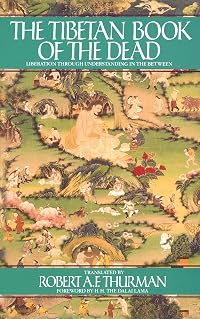
The Tibetan Book of the Dead: Liberation Through Understanding in the Between
by Robert A. F. Thurman (Translator), Dalai Lama (Foreword)
On This Page
Description
Tibetan Book of the Dead' provides the guidelines on preparing for death and achieving enlightenment by escaping the cycle of birth, suffering, and death. According to the author, monks can utilize meditation to explore the approximation of the life that exists beyond death and help gain knowledge on the preparation of souls for the afterlife experiences.Tags
Recommendations






Member Reviews
The so-called Tibetan Book of the Dead is my true Penelope. Thurman's translation is my least favorite of the translations of the Bardo Thodol (except for the W. Y. Evans-Wentz/Lama Kazi Dawa-Samdup version, which I don't even count as a translation) because of his experimental coinages which, to my mind, make it difficult to follow the terminology outward from this text to other works, including but not limited to Shi Tro practice.
All that means is that I don't think the coinages work. Otherwise, as usual, Khenpo Thurman is fantastic and deliriously wonderful. (He doesn't actually have the Khenpo degree, but I'll explain why I call him that if you're curious). And the pictures are lovely.
If you're interested in the Tibetan Book of the show more Dead, I suggest reading multiple translations. Include this among them. Oh oh, mixed messages!
This review applies to the Robert Thurman translation of the Bardo Thodol. show less
All that means is that I don't think the coinages work. Otherwise, as usual, Khenpo Thurman is fantastic and deliriously wonderful. (He doesn't actually have the Khenpo degree, but I'll explain why I call him that if you're curious). And the pictures are lovely.
If you're interested in the Tibetan Book of the show more Dead, I suggest reading multiple translations. Include this among them. Oh oh, mixed messages!
This review applies to the Robert Thurman translation of the Bardo Thodol. show less
The most prominent expert on Tibetan Buddhism in the West offers a translation of this essential book of Tibetan philosophy that captures the true spirit and poetry of the original work--a profound book that reveals the nature of the mind and its manifestations and offers pure enlightenment.
Amazing. I have read it through twice now and will read it through again many times. I find spirituality impossible to rate so know that my rating means simply that if you are a seeker of enlightenment, this is a stone you must turn over many times to look under.
Just flipping through it, powerful spiritual energy. Wouldn't dive in unless you dive in deep, deep, deep...
One of the treasures of human literature - the book; And one of the treasures of American (world) intellectuals - Robert Thurman.
Indeholder "Foreword by His Holiness the Dalai Lama", "Preface", "Part one - Preparations for the Journey", " Chapter 1 - Background", " An Outline of Tibetan History", " Tibet: A Spiritual Civilization", " Tibet's Present Plight", " Buddhism in Summary", " Tibetan Ideas About Death", " Chapter 2 - The Tibetan Science of DeatH", " What Is Death?", " The Six Realms", " The Three Buddha Bodies", " The Body-Mind Complex", " Stages of Death", " The Reality of Liberation", " Chapter 3 - The Tibetan Art of Dying", " Introduction", " Ordinary Preparations for Death", " Extraordinary Preparations", " The Preliminary Stage", " Mentor and Initiation", " The Creation Stage", " The Perfection Stage", " Chapter 4 - The Natural Liberation show more Literature", " The History of the Texts", " The Sections of the Book", "Part Two - The Guidebook For the Journey", " The Great Book of Natural Liberation Through Understanding in the Between", " Chapter 5 - The Between Prayers", " The Prayer of the Three Body Mentor Yoga", " The Prayer for Help from the Buddhas and Bodhisattvas", " The Prayer for Deliverance from the Straits of the Between", " The Prayer for Refuge from All Terrors of the Between", " The Root Verses of the Six Betweens", " Chapter 6 - The Guidebook to the Betweens", " The Prayer of the Reality Between", " Preliminaries", " Using The Book of Natural Liberation", " Recognition of the Clear Light in the Death-point Between", " The Central Channel Reality Clear Light", " The Out-of-Body Reality Clear Light", " The Mild Deity Reality Between", " The First Day", " The Second Day", " The Third Day", " The Fourth Day", " The Fifth Day", " The Sixth Day", " The Seventh Day", " The Fierce Deity Reality Between", " The Eighth Day", " The Ninth Day", " The Tenth Day", " The Eleventh Day", " The Twelfth Day", " Orientation to the Existence Between", " Basic Introduction", " Powers and Problems of a Between-Being", " Encountering the Lord of Death", " Detachment from the Previous Life", " Avoiding the Dull Lights to Block Rebirth", " Blocking the Door of the Womb", " Choosing a Good Womb", " Taking Refuge in the Three Jewels", "Part Three - Supplementary Translations", " Chapter 7 - The Dharma Practice, Natural Liberation of the Instincts", " The Ten Branches of Accumulating Merit", " Enlightening, Protecting, and Purifying", " Vajrasattva Purification", " The Actual Visualization", " Self-Creation", " The Mild Deity Interior Mandala", " The Scientist Deity Interior Mandala", " The Fierce Deity Interior Mandala", " Chapter 8 - The Natural Liberation through Naked Vision, Identifying the Intelligence", " The Quintessence", " The Need for This Identification", " The Detailed Identification", " The Three-Point Entrance", " The Forceful Method", " The Four Inerrancies and Four Nails", " The Oneness of Times", " Views, Meditations, Ethics, Fruitions", " This Knowing", " Mind Is All", "Glossary", "Essential Bibliography".
??? show less
??? show less
Sep 9, 2018 (Edited)Danish
Ratings
Members
- Recently Added By
Lists

Buddhism, books there in
23 works; 4 members

Pagan E-O-L doula
15 works; 1 member
Author Information

Robert Thurman is the cofounder of Tibet House US and the Jey Tsong Khapa Professor of Buddhist Studies at Columbia University.

The exiled 14th Dalai Lama was born on July 6, 1935 to a peasant family living in a former Tibetan village. He was recognized as the reincarnation of the previous spiritual leader of his nation at the age of two and enthroned on February 22, 1940. In 1959 he and 100,000 followers fled the country following a failed revolt against the Communist show more Chinese forces that had occupied Tibet for almost a decade. Since that time, the Dalai Lama has met with numerous world leaders and U. N. officials in a tireless effort to free his country and preserve the traditional Tibetan way of life. He received the Nobel Peace Prize in 1989 and has been awarded honorary citizenships by many international cities and countries, as well as multiple honorary degrees and human rights awards. In 2007 the Dalai Lama received the United States Congressional Gold Medal. He has written many books and lectures around the world. His book, My Spiritual Journey, made the iBooks bestseller list in 2016. He is the author of the best seller, The Book of Joy: Lasting Happiness in a Changing World, with the Desmond Tutu and Douglas Carlton Abrams. (Bowker Author Biography) show less
Series
Belongs to Publisher Series
Work Relationships
Has as a commentary on the text
Common Knowledge
- Canonical title
- The Tibetan Book of the Dead: Liberation Through Understanding in the Between
- Original title
- བར་དོ་ཐོས་གྲོལ; The Great Book of Natural Liberation Through Understanding in the Between; Bardo Thodol
- Original language
- Tibetan
- Disambiguation notice
- Although nominally the same as "The Tibetan Book of the Dead" edited by Evans-Wentz, this (abridged) edition from Thurman contains different source material and very different editorial content. It is also not the same as the... (show all) first complete English translation, issued later by Penguin Classics and other publishers. Please do NOT combine with either unless you are willing to separate and re-combine them properly again. There are well over a thousand copies.
Classifications
- Genres
- Religion & Spirituality, Nonfiction, General Nonfiction, Philosophy
- DDC/MDS
- 294.3423 — Religion Other religions Buddhism/Hinduism Buddhism Buddhism - practice Practice and tantra Death and rebirth
- LCC
- BQ4490 .K3713 — Philosophy, Psychology and Religion Buddhism Buddhism Doctrinal and systematic Buddhism Special doctrines
- BISAC
Statistics
- Members
- 1,119
- Popularity
- 22,640
- Reviews
- 6
- Rating
- (3.98)
- Languages
- 5 — Dutch, English, French, German, Tibetan
- Media
- Paper, Audiobook, Ebook
- ISBNs
- 17
- ASINs
- 18