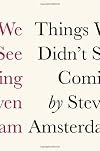
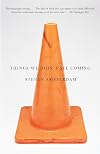
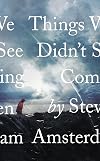
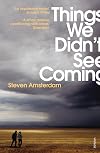
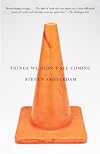
Things We Didn't See Coming
by Steven Amsterdam
On This Page
Description
"Nine connected stories set in a not-too-distant dystopian future in a landscape at once utterly fantastic and disturbingly familiar. The stories follow the narrator over three decades as he tries to survive in a world that is becoming increasingly savage as cataclysmic events unfold one after another"--Jacket.Tags
Recommendations















Member Reviews
Things We Didn’t See Coming is the story of one young boy, 9 years old on the eve of the millennium, and his subsequent journey through a world irrevocably changed by Y2K. As the world falls slowly apart and suffers through drought, flood, fire and disease, he teeters on the fence of petty crime and respectable government employment and experiences all facets of the evolution of human civilization.
The writing is beautifully stark, poetic and chilling, and the story twists and turns along with his fortunes and falls. This is not a book for the faint-hearted; there are few redeeming moments and little happiness in his journey through his teenage years and adulthood. The characters are flawed, but fit completely in the story – show more alliances are easily broken and every person is focused on their own and their families survival.
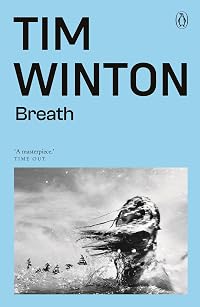
I enjoyed Things We Didn’t See Coming immensely – Mr. Amsterdam’s writing reminded me of Tim Winton or Ian McEwan and I was more than surprised to learn Things We Didn’t See Coming is his debut novel. I look forward to reading more of his work in the very near future. show less
The writing is beautifully stark, poetic and chilling, and the story twists and turns along with his fortunes and falls. This is not a book for the faint-hearted; there are few redeeming moments and little happiness in his journey through his teenage years and adulthood. The characters are flawed, but fit completely in the story – show more alliances are easily broken and every person is focused on their own and their families survival.
I enjoyed Things We Didn’t See Coming immensely – Mr. Amsterdam’s writing reminded me of Tim Winton or Ian McEwan and I was more than surprised to learn Things We Didn’t See Coming is his debut novel. I look forward to reading more of his work in the very near future. show less
I don't have a particularly good relationship with post-apocalyptic fiction, tending to find it either too far-fetched or, if not far-fetched, too depressing to want to immerse myself in for very long. I was spoiled early by having to read Robert Swindells's relentlessly bleak postnuclear misery-fest Brother in the Land for a school English class, after which I spent much of the next few years lying awake at night worrying that the noise of jumbo jets coming over Gatwick's flight path might in fact be the noise of a nuclear wind rushing towards our house. Thanks Miss Cutler.
Of course it's useful (necessary, even) to be scared by these ideas once or twice – but once you've got to grips with the basic principles, I'm not always sure the show more lessons learned are worth the emotional trauma involved. Which is what these books try and put you through, because despite the tone of some of my reviews I'm actually not a very critical reader – I tend to be pretty wide-eyed and immersive when it comes to fiction.
More generally, though, I think the genre suffers disproportionately from the prevailing fallacy that tragedy is somehow ‘truer’ than comedy. (Which some critics genuinely believe, not without reason, but which I don't.) This is why for example I am in no great hurry to read The Road, because although I often love Cormac McCarthy's writing style, I think his general philosophy depends on wilfully ignoring huge vistas of human experience and interaction – which is creatively interesting, but when it comes right down to it, no less selective a vision than that of someone like Terry Pratchett.
All of this is my way of saying that I liked Things We Didn't See Coming a lot more than I expected to when a cute sales assistant in a Melbourne branch of Readers flirted me into buying it ‘because the author's a local’. Actually Steven Amsterdam is originally from New York, but Melbourne has been his home for years now: the landscape of this book feels vaguely American, but the language includes some telltale non-US elements (like ‘Mum’). It begins on the eve of the millennium, and disappears off into an alternative present / near-future where society and the environment have broken down.
The book is constructed as a novel-in-short-stories, a format I like anyway and one which works especially well here. In nine standalone chapters, we see our unnamed narrator at different stages in his life, from a ten-year-old boy to a semi-invalid, prematurely-aged wasteland survivor. There is a lot of enjoyable speculation to be had over what must have happened in the long years between chapters, as secondary characters come and go, and as the world around us changes: we see at various times endless rain, urban looting, rural survivalism, drought, plague, even momentary periods of political stability with a decadent ruling class. The prose is sparse, uncomplicated and effective, and a lot of the key developments are unexplained and off-stage.
I like that the geopolitical/environmental speculation is not the main point here. What Amsterdam is really interested in is how interpersonal relationships work, how trust breaks down and whether it can ever be properly built up under extreme circumstances, and how to work out what really matters and strip down your life to just that. There is a nice strain of dark humour running through the book, and although it takes a steady look at the worst aspects of human nature, it doesn't forget the other aspects.
Only one of the stories felt underdeveloped to me; all of them completely held my attention and left me with lots to think about. Recommended for late-night reading under Gatwick flight path. show less
Of course it's useful (necessary, even) to be scared by these ideas once or twice – but once you've got to grips with the basic principles, I'm not always sure the show more lessons learned are worth the emotional trauma involved. Which is what these books try and put you through, because despite the tone of some of my reviews I'm actually not a very critical reader – I tend to be pretty wide-eyed and immersive when it comes to fiction.
More generally, though, I think the genre suffers disproportionately from the prevailing fallacy that tragedy is somehow ‘truer’ than comedy. (Which some critics genuinely believe, not without reason, but which I don't.) This is why for example I am in no great hurry to read The Road, because although I often love Cormac McCarthy's writing style, I think his general philosophy depends on wilfully ignoring huge vistas of human experience and interaction – which is creatively interesting, but when it comes right down to it, no less selective a vision than that of someone like Terry Pratchett.
All of this is my way of saying that I liked Things We Didn't See Coming a lot more than I expected to when a cute sales assistant in a Melbourne branch of Readers flirted me into buying it ‘because the author's a local’. Actually Steven Amsterdam is originally from New York, but Melbourne has been his home for years now: the landscape of this book feels vaguely American, but the language includes some telltale non-US elements (like ‘Mum’). It begins on the eve of the millennium, and disappears off into an alternative present / near-future where society and the environment have broken down.
The book is constructed as a novel-in-short-stories, a format I like anyway and one which works especially well here. In nine standalone chapters, we see our unnamed narrator at different stages in his life, from a ten-year-old boy to a semi-invalid, prematurely-aged wasteland survivor. There is a lot of enjoyable speculation to be had over what must have happened in the long years between chapters, as secondary characters come and go, and as the world around us changes: we see at various times endless rain, urban looting, rural survivalism, drought, plague, even momentary periods of political stability with a decadent ruling class. The prose is sparse, uncomplicated and effective, and a lot of the key developments are unexplained and off-stage.
I like that the geopolitical/environmental speculation is not the main point here. What Amsterdam is really interested in is how interpersonal relationships work, how trust breaks down and whether it can ever be properly built up under extreme circumstances, and how to work out what really matters and strip down your life to just that. There is a nice strain of dark humour running through the book, and although it takes a steady look at the worst aspects of human nature, it doesn't forget the other aspects.
Only one of the stories felt underdeveloped to me; all of them completely held my attention and left me with lots to think about. Recommended for late-night reading under Gatwick flight path. show less
Ten years later, the fears surrounding Y2K have faded mercifully into the recesses of our collective subconscious. The millennium bug never bit — computers didn’t fail, economies didn’t crumble, governments didn’t fall. But Steven Amsterdam’s imaginative first novel, Things We Didn’t See Coming, posits a reality in which the worst predictions came to pass. Told through a sequence of short stories chronicling the life of an unnamed narrator, the book opens on New Year’s Eve, 1999. At midnight of that momentous night, the electrical grid shuts down. Amsterdam’s child protagonist and his father stand in the cold.
Chaos and decay have infiltrated civilization. The structure of the government in Amsterdam’s unnamed country changes from story to story; physical, psychological, and moral breakdowns infest all aspects of society; starvation, plague, and corruption run rampant. To survive, the narrator ekes out an existence as a thief and government worker and, not surprisingly, sometimes both. Companionship and love comes fraught with danger:
The story moves into some surprising social and moral gray areas. Amsterdam tackles such weighty topics as polyamory, euthanasia, suicide, drugs, aging, and anarchy with insight and sensitivity. Employing a breezy, conversational style, Amsterdam blazes through his bleak tale of hope — the true heart of any good dystopia — but culminates in a too-abrupt ending that leaves the reader confused and unsatisfied. Even with this misstep, Things We Didn’t See Coming offers thought-provoking entertainment, and successfully introduces an important new writer.
This review originally appeared in the San Antonio Current, April 7, 2010. show less
This whole thing is symbolic, symbolic of a system that’s hopelessly shortsighted, a system that twenty, thirtyshow more
years ago couldn’t imagine a time when we might be starting a new century. That’s how limited an animal we are. Do you get it? A whole species that didn’t think to set its clocks the right way. We are arrogant, stupid, we lack humility in the face of centuries and centuries of time before us. What we call knowledge, what you learn in school about fossils and dinosaurs, it’s all hunches. What we know now is that we didn’t think enough. We know we aren’t careful enough and that’s about all we know. That’s what I’m trying to protect us from.”
I say, “OK,” because he’s getting more upset as he talks.
“What else haven’t we been paying attention to? I worry about your life, what’s going to happen to you. We can’t think our way out of every problem. We’re not smart enough.”
“Don’t worry so much.”
This only makes him mad. “What’s the right amount of worry? In our time, in your time, there’ll be breakdowns that can’t be fixed. There will be more diseases that can’t be fixed. Water will be as valuable as oil. And you’ll be stuck taking care of a fat generation of useless parents.
Chaos and decay have infiltrated civilization. The structure of the government in Amsterdam’s unnamed country changes from story to story; physical, psychological, and moral breakdowns infest all aspects of society; starvation, plague, and corruption run rampant. To survive, the narrator ekes out an existence as a thief and government worker and, not surprisingly, sometimes both. Companionship and love comes fraught with danger:
If it were just me, I could run off now with whatever I could carry. But it’s not, and how would she find me? Besides, he’d notice if I started packing up and, even if I was able to keep him back, he’d stay and claim whatever I left behind and be here when Margo comes back and infect her in a second. So I’m guarding our spot until she decides to wander home.
Staying awake up here is not what’s tough, but staying quietly balanced is. I’ve managed to hook my legs around one branch and my arms around another and it lets me stay reasonably still while being vigilant — watching, breathing softly through my face mask, waiting for him to die.
The story moves into some surprising social and moral gray areas. Amsterdam tackles such weighty topics as polyamory, euthanasia, suicide, drugs, aging, and anarchy with insight and sensitivity. Employing a breezy, conversational style, Amsterdam blazes through his bleak tale of hope — the true heart of any good dystopia — but culminates in a too-abrupt ending that leaves the reader confused and unsatisfied. Even with this misstep, Things We Didn’t See Coming offers thought-provoking entertainment, and successfully introduces an important new writer.
This review originally appeared in the San Antonio Current, April 7, 2010. show less
This collection of short stories was released in February and is definitely going to get some big press. The author, Steven Amsterdam, is a native New Yorker who moved to Australia in 2003. He is youngish and it comes through in the feel of these stories: one unlike any others I can remember. I’ve read many collections before, but often it seems they are told by an older ‘voice’, usually an introspective older man or woman. In the case of my beloved Tim Winton short stories, the voice changes throughout to different people and different age ranges. These however have a snarky young voice, a male narrator, and it spins things around quite a bit as the topics are different as well. The pace is fast and the humor is biting. Amsterdam show more makes visual pictures of a future Australia that are brutal and painful and heartbreaking.
In “The Theft That Got Me Here”, a young man who lives with his grandparents, one of whom is suffering from Alzheimer’s, is greeted with a surprise:
…Grandma opens the door and she’s fine. She’s standing on her own, not holding the walls, nothing. She’s been off the map for six years and now she’s looking at me like a professor. Not speedy and scared, like she was on the last treatment, but simply there, her old self. And this isn’t me on drugs. It’s her on drugs.
In “Dry Land”, Australia goes through a rain cycle that doesn’t end. For years. All that dry, dusty outback becomes a series of lakes, and the rain never stops. People are forced to evacuate, and while they try to hold off, leaving becomes inevitable. The narrator observes that “Despite all the feelings we think we’ve got for our loved ones and our attachments, when push comes to shove most people figure out how to travel light.”
The author blurb on the back states that Amsterdam is a psychiatric nurse as well as an author. I’m certain that his experience in health care has made him more aware of the more subtle layers of fear and anger, those that he exposes so well in this collection. It’s not in the big details that he reveals them, but in the little details, the little inflections and asides. An unusual collection that is a fun read from someone we’re going to hear good things about! show less
In “The Theft That Got Me Here”, a young man who lives with his grandparents, one of whom is suffering from Alzheimer’s, is greeted with a surprise:
…Grandma opens the door and she’s fine. She’s standing on her own, not holding the walls, nothing. She’s been off the map for six years and now she’s looking at me like a professor. Not speedy and scared, like she was on the last treatment, but simply there, her old self. And this isn’t me on drugs. It’s her on drugs.
In “Dry Land”, Australia goes through a rain cycle that doesn’t end. For years. All that dry, dusty outback becomes a series of lakes, and the rain never stops. People are forced to evacuate, and while they try to hold off, leaving becomes inevitable. The narrator observes that “Despite all the feelings we think we’ve got for our loved ones and our attachments, when push comes to shove most people figure out how to travel light.”
The author blurb on the back states that Amsterdam is a psychiatric nurse as well as an author. I’m certain that his experience in health care has made him more aware of the more subtle layers of fear and anger, those that he exposes so well in this collection. It’s not in the big details that he reveals them, but in the little details, the little inflections and asides. An unusual collection that is a fun read from someone we’re going to hear good things about! show less
“Not with a bang, but with a whimper”. Most likely, the apocalypse will be a slow, gradual turn for the worse, rather than a sudden destruction. This is what Amsterdam’s bleak but very human debut explores. We follow a single character over thirty years, from camping out with his dad to survive the Y2K bug (remember?) over the rain years, the pandemia, the enclaves and the attempts at rebuilding.
It’s an extremely clever setup for a post-apocalyptic dystopia, and I can’t belive I haven’t seen it before. Because with the scope, not only do we get an idea of the downfall of the world as we know it. We also get to follow the moral compass of our nameless narrator change, we see his shifts in optimism, sense of community and show more egoism, living inside and outside society in it’s different incarnations.
We never get the full story, but rather make touchdowns in time and place, looking at key events in our narrator’s life. The sense of world is eluding. The perspective is local – pandemia is not daring to return to your tent, flood is never being able to drown your clothes, dropping nativity is having to pamper the compound’s only spoiled, bratty teen. It’s not a pretty picture Amsterdam paints, but there’s humor in there too.
The local perspective keeps this book human, but is perhaps also what makes it stay a good read for me, rather than a great one. At times, I feel I don’t get quite enough from it, and the gaps and questions become something lacking rather than something sparking my imagination. But with that said, this is a clever, moving and original post-apocalypse, which I really recommend checking out. show less
It’s an extremely clever setup for a post-apocalyptic dystopia, and I can’t belive I haven’t seen it before. Because with the scope, not only do we get an idea of the downfall of the world as we know it. We also get to follow the moral compass of our nameless narrator change, we see his shifts in optimism, sense of community and show more egoism, living inside and outside society in it’s different incarnations.
We never get the full story, but rather make touchdowns in time and place, looking at key events in our narrator’s life. The sense of world is eluding. The perspective is local – pandemia is not daring to return to your tent, flood is never being able to drown your clothes, dropping nativity is having to pamper the compound’s only spoiled, bratty teen. It’s not a pretty picture Amsterdam paints, but there’s humor in there too.
The local perspective keeps this book human, but is perhaps also what makes it stay a good read for me, rather than a great one. At times, I feel I don’t get quite enough from it, and the gaps and questions become something lacking rather than something sparking my imagination. But with that said, this is a clever, moving and original post-apocalypse, which I really recommend checking out. show less
A slim book, I raced through it pretty quickly. I guess I'd call this an alternate history/post-apocalyptic/dystopia... The alternate history part is what would've happened if Y2K actually resulted in everything going haywire. This is written as a series of connected short stories - the connection being the narrator who we follow starting as a kid, when the Y2K incident occurs, through a variety of situations he goes through as an adult. There is time between the stories where you don't know exactly what has happened, exactly where he is in the US, and what the situation is. You don't get a lot of detail of exactly what happened during Y2K or why people are living the way they are, how the government has organized things after the show more crisis. I eat up apocalyptic/post-apocalyptic books and love the detail - I still really enjoyed this even without knowing actually what was going on and why. I recommend this. show less
A wonderful book of a post apocalyptic future, redemption, and growth. It follows the story of a young boy on New Years Eve in the year 2000. In short story form, you see this boy as a rebellious teenager as the world starts to fall. As he grows up, he survives in a world that is slowly going crazy. This follows his life from bearer of bad news to those being flooded out from never-ending rains, to his life with a state senator, than as he redeems himself.
The gaps between the stories are not filled in, for example, his love Margo drops from his life with no explanation. This allows a reader a bit more leeway in understanding this character (did Margo leave or did he, Was it fights over infertility, did Margo pass away) You see the show more narrator grow up, become more mature, but also more weighed down. And, the last two stories of the book, show society and the world on the mend. show less
The gaps between the stories are not filled in, for example, his love Margo drops from his life with no explanation. This allows a reader a bit more leeway in understanding this character (did Margo leave or did he, Was it fights over infertility, did Margo pass away) You see the show more narrator grow up, become more mature, but also more weighed down. And, the last two stories of the book, show society and the world on the mend. show less
Members
- Recently Added By
Published Reviews
ThingScore 75
Dystopia. Breakdown. We are always imagining it because it seems impossible that the world can keep going along through bigger, faster vectors. We are blindsided even as we rush forward to meet it, like the characters in these linked stories, with open arms.
added by Shortride
Lists

Short Story Collections and Anthologies
261 works; 42 members

Booktopia's 50 Must Read Australian Novels
50 works; 5 members
Author Information

3+ Works 449 Members
Steven Amsterdam was born on January 31, 1966 in Manhattan, New York. He has edited travel guides and designed book jackets. He is the author of What the Family Needed. His book, Things We Didn't See Coming, won The Age Book of the Year Award, among other honors. He is also a nurse, specializing in psychiatric and palliative care.
Awards and Honors
Series
Belongs to Publisher Series
Gallimard, Folio SF (436)
Common Knowledge
- Canonical title
- Things We Didn't See Coming
- Original publication date
- 2009
- First words
- For the first time, Dad is letting me help pack the car, but only because it's getting to be kind of an emergency.
- Last words
- (Click to show. Warning: May contain spoilers.)Slowly, he lowers his fingertips nearer my skin till I can feel their heat on my cheeks and then, without a sound, without the slightest incantation, he closes my eyes.
- Blurbers
- Indiana, Gary; Hutchinson, Andrew; Maguire, Emily
Classifications
Statistics
- Members
- 278
- Popularity
- 115,769
- Reviews
- 19
- Rating
- (3.55)
- Languages
- Dutch, English, French
- Media
- Paper, Ebook
- ISBNs
- 15
- ASINs
- 4