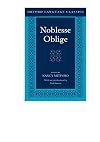
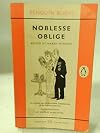
Noblesse Oblige: An Enquiry into the Identifiable Characteristics of the English Aristocracy
by Nancy Mitford (Editor)
On This Page
Description
The Great U and Non-U DebateUntil Nancy Mitford wrote 'The English Aristocracy' in 1955, England was blissfully unconscious of U-Usage and its lethal implications. The phenomenon of 'Upper-Class English Usage' had, it is true, already been remarked upon by Professor Alan Ross who, in an academic paper printed in Helsinki ayear earlier, claimed that the upper classes now distinguished solely by their use of language, but it was the Honourable Mrs. Peter Rodd (as she was addressed by U-speaker show more Evelyn Waugh, Esq.) who first let the cat out of the bag. Her article sparked off a public debate joined vigorously by EvelynWaugh, 'Strix', and Christopher Sykes, whose counterblasts are collected here. Osbert Lancaster, caricaturist of English manners, takes the debate into the visual dimension, and John Betjeman poeticizes on the theme with characteristic charm:Phone for the fish-knives NormanAs Cook is a little unnerved;You kiddies have crumpled the serviettes And I must have things daintily served. A new introduction by Ned Sherrin reveals more of the articles and correspondences that were generated by the debate, in his inimitably entertaining fashion. show lessTags
Recommendations





















Member Reviews
Nancy Mitford's Noblesse Oblige is one of the most peculiar books I've ever read.
Although it was a cause célèbre in Britain when it was first published in 1956, I wouldn't have expected it to get much traction here in Australia. There are class differences here, but why would a collection of essays about the Identifiable Characteristics of the English Aristocracy, be of any interest? Be that as it may, there was a battered copy of it in a local Little Library, and I couldn't resist taking it home to check it out.
The collection begins with 'U and Non-U, an Essay in Sociological Linguistics' by a professor of Linguistics called Alan S C Ross. He published it in a Finnish academic journal in 1954, and a storm of controversy erupted over show more his analysis of signifiers of class. (U meaning Upper Class, and Non-U, meaning the aspirational middle class.) He covers forms of address, writing styles and pronunciation, but it was the way he codified vocabulary as U or Non-U that caused the ruckus. The aspirational middle class trawled through the article, (and Nancy Mitford's summary of it) to find out if they were betraying their class status with an imperfect grasp of the unspoken rules. Yes, this small book has a list of speech habits and behaviours that could instantly consign the unwary to the hapless middle class!
For example —
LOL I think Mrs Sheedy who taught me in Grade Six must have been non-U, because she taught us never to use nice except about food.
I'd heard my parents cracking ironic jokes using its U and non-U terminology —
Nancy Mitford on page 38 tells me that my mother was thus betraying the U-habit of silence:
Whatever would Nancy make of the informality of email and SMS?
To read the rest of my review please visit https://anzlitlovers.com/2025/03/31/noblesse-oblige-1956-edited-by-nancy-mitford... show less
Although it was a cause célèbre in Britain when it was first published in 1956, I wouldn't have expected it to get much traction here in Australia. There are class differences here, but why would a collection of essays about the Identifiable Characteristics of the English Aristocracy, be of any interest? Be that as it may, there was a battered copy of it in a local Little Library, and I couldn't resist taking it home to check it out.
The collection begins with 'U and Non-U, an Essay in Sociological Linguistics' by a professor of Linguistics called Alan S C Ross. He published it in a Finnish academic journal in 1954, and a storm of controversy erupted over show more his analysis of signifiers of class. (U meaning Upper Class, and Non-U, meaning the aspirational middle class.) He covers forms of address, writing styles and pronunciation, but it was the way he codified vocabulary as U or Non-U that caused the ruckus. The aspirational middle class trawled through the article, (and Nancy Mitford's summary of it) to find out if they were betraying their class status with an imperfect grasp of the unspoken rules. Yes, this small book has a list of speech habits and behaviours that could instantly consign the unwary to the hapless middle class!
For example —
Dinner: U-speakers eat luncheon in the middle of the day and dinner in the evening. Non-U speakers (also U-children and U-dogs) have their dinner in the middle of the day.
Greens is non-U for vegetables.
Home: non-U — they have a lovely home'; U — 'they've a very nice house.'
LOL I think Mrs Sheedy who taught me in Grade Six must have been non-U, because she taught us never to use nice except about food.
I'd heard my parents cracking ironic jokes using its U and non-U terminology —
Is this tie U or non-U? my father might say, and my mother might respond with: I have no idea but it is surely non-U to care about whether it is or it isn't.
Nancy Mitford on page 38 tells me that my mother was thus betraying the U-habit of silence:
Silence is the only possible U-response to many embarrassing modern situations: the ejaculation of 'cheers' before drinking, for example, of 'it was so nice seeing you,' after saying good-bye. In silence, too, one must endure the use of the Christian name by comparative strangers and the horror of being introduced by Christian and surname without any prefix. This unspeakable usage sometimes occurs in letters — Dear XX — which, in silence, are quickly torn up, by me. (p.38-9)
Whatever would Nancy make of the informality of email and SMS?
To read the rest of my review please visit https://anzlitlovers.com/2025/03/31/noblesse-oblige-1956-edited-by-nancy-mitford... show less
Squashed between fat books of grammar I found [book: Noblesse Oblige], a set of essays on English colloquialisms and class in the twentieth century. The Hon. Mrs. Peter Rodd (aka Nancy Mitford)'s sharp little essay on "the identifiable characteristics of the English aristocracy" caused a flurry of letters and debate, some of which is published in this volume. Mitford set down a by-no-means comprehensive list of grammar, vocabulary, and modes of thought as Upper-Class or Not Upper-Class. In the 1950s, at least, members of the English nobility avoided euphemism, abbreviations and acronyms, while simultaneously using phrases that only had meaning if you already knew the people or place involved. She is followed by Alan S.C. Ross's turgid show more essay on "sociological inguistics," which was not worth slogging though, as it basically is just a list of how to pronounce vowels. There is a footnote per sentence, which makes it hard going. Evelyn Waugh apparently felt the need to stick his pointed little nose into the debate, and wrote a thirty-six page letter telling Mitford in the most patronizing language possible that she was a jumped-up pretender and not very smart, to boot. Since Mitford has facts and figures from Burke's and the College of Heralds, whereas Waugh has pithy anecdotes, I can't trust him much. Anyone who refers to a published author repeatedly as "a cutie" or "endearing" for daring to examine the society in which she lives, or who spends AN ENTIRE PAGE reminding his readers that "Nancy"'s father only succeeded to the peerage when she was 12, thus negating all her points because she's so very new to the peerage, is just not someone I can bear.
Luckily, Waugh's would-be razor wit is followed by "Strix"'s essay on colloquialisms, slang, and how language shifts over generations and geography. I think zie brings up the best points of all--that gentlemen have "a relish for incongruity": they love to sprinkle their speech with ironic snips of lower-class slang, they call a battle "a party" but a dull party "a disaster," and they play with understatements vs. overstatements. Actual events or people are talked about in an understated way, whereas feelings (petrified, nauseated, firghtful) are overstated. "Strix" also ends with a fantastic paragraph: "All tradition is bequeathed, however distrustfully, to the young. The upper-class young have not been dragooned about the use of words in the way their parents were; and they have ingested a richer, more variegated slice of the marzipan of English usage than reached, in the ordinary way of business, the gizzards of their elders. If they are sensible and civic, they will try to iron out these pregnant but elusive nuances and strive for a clear, classless medium of communication in which all say 'Pardon?' and none say 'What?,' every ball is a dance and every man's wife is 'the' wife. I shall be surprised, and disappointed, if they make the slightest endeavour to impoverish our extraordinary national life by doing anything of the sort." show less
Luckily, Waugh's would-be razor wit is followed by "Strix"'s essay on colloquialisms, slang, and how language shifts over generations and geography. I think zie brings up the best points of all--that gentlemen have "a relish for incongruity": they love to sprinkle their speech with ironic snips of lower-class slang, they call a battle "a party" but a dull party "a disaster," and they play with understatements vs. overstatements. Actual events or people are talked about in an understated way, whereas feelings (petrified, nauseated, firghtful) are overstated. "Strix" also ends with a fantastic paragraph: "All tradition is bequeathed, however distrustfully, to the young. The upper-class young have not been dragooned about the use of words in the way their parents were; and they have ingested a richer, more variegated slice of the marzipan of English usage than reached, in the ordinary way of business, the gizzards of their elders. If they are sensible and civic, they will try to iron out these pregnant but elusive nuances and strive for a clear, classless medium of communication in which all say 'Pardon?' and none say 'What?,' every ball is a dance and every man's wife is 'the' wife. I shall be surprised, and disappointed, if they make the slightest endeavour to impoverish our extraordinary national life by doing anything of the sort." show less
This collection ranges from the serious to the tongue-in-cheek to the ridiculous, as upper-class figures debate what constitutes upper-class-ness. For the non-English reader, it is difficult to always catch when one of the contributors is being entirely serious, when exaggerating, and when entirely sarcastic.
The best contributions are those of Mitford and Waugh, both of which are quite amusing. One sees a little of Auberon Waugh's arch upper-class satire he employed in his Private Eye diary in his father's earlier essay here.
The best contributions are those of Mitford and Waugh, both of which are quite amusing. One sees a little of Auberon Waugh's arch upper-class satire he employed in his Private Eye diary in his father's earlier essay here.
This novel is a collection of essays exploring the distinctions between the "U" (Upper Class) and The "non U". At times I found the "U"'s the be rather self deprecating and in on the joke of their culture and then at other times I thought those interviewed didn't quite get it. It all added to the tongue in cheek humor while imparting a wealth of information and history into English social customs.
Originally published in 1956, Noblesse Oblige is a classic (which sparked, out of a teasing and just ever so slightly tongue-in-cheek essay by Nancy Mitford, the original Upperclass/Non-Upperclass usage controversy) is still worth a reread today.
Although Nancy Mitford is often cited as the author, the book is actually a collection of essays, poetry and some satire by several different contributors. All aspire on some level to simultaneously illuminate and poke fun at the propensity of humans in general and the British in particular to divide into cliques, classes and every sort of Better Thans.
Although Nancy Mitford is often cited as the author, the book is actually a collection of essays, poetry and some satire by several different contributors. All aspire on some level to simultaneously illuminate and poke fun at the propensity of humans in general and the British in particular to divide into cliques, classes and every sort of Better Thans.
Ratings
Members
- Recently Added By
Author Information

All Editions
Awards and Honors
Distinctions
Series
Belongs to Publisher Series
Common Knowledge
- Canonical title
- Noblesse Oblige: An Enquiry into the Identifiable Characteristics of the English Aristocracy
- Original publication date
- 1956
Classifications
Statistics
- Members
- 455
- Popularity
- 66,749
- Reviews
- 5
- Rating
- (3.59)
- Languages
- English, French, German
- Media
- Paper
- ISBNs
- 12
- ASINs
- 30