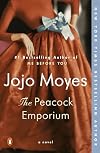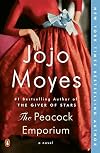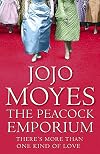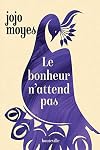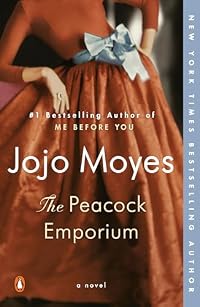
The Peacock Emporium
by Jojo Moyes
On This Page
Description
In the sixties, Athene Forster was the most glamorous girl of her generation. Nicknamed the Last Deb, she was also beautiful, spoiled, and out of control. When she agreed to marry the gorgeous young heir Douglas Fairley-Hulme, her parents breathed a sigh of relief. But within two years, rumors had begun to circulate about Athene's affair with a young salesman. Thirty-five years later, Suzanna Peacock is struggling with her notorious mother's legacy. The only place Suzanna finds comfort is in show more The Peacock Emporium, the beautiful coffee bar and shop she opens that soon enchants her little town. There she makes perhaps the first real friends of her life, including Alejandro, a male midwife, escaping his own ghosts in Argentina. The specter of her mother still haunts Suzanna. But only by confronting both her family and her innermost self will she finally reckon with the past--and discover that the key to her history, and her happiness, may have been in front of her all along. show lessTags
Recommendations



Member Reviews
Like the other books I’ve read by JoJo Moyes, this has an interesting and unpredictable plot and a cast of distinctive characters, in both primary and supporting roles. Dialog and relationships are original, complex, and believable. All good! I like this author. My main criticism with this one is the book’s structure.
At the beginning, Moyes introduces a bunch of characters in sequential, stand-alone chapters. No connection between them. This is a technique I’ve found several authors using lately — so it must be in vogue. The issue, for me, is that I then need to remember multiple story lines, without yet knowing how they will ultimately intersect. So just as I’m just getting to know one character, the chapter ends and that show more character is then set aside for some chunk of the book. And whatever emotional attachment I might have is set aside as well.
Obviously, the storylines do eventually link up and the central part of the novel follows a more linear plot line, focusing on Suzannah. She is a child of privilege from a family where she feels like an outsider and she has just returned to live in the small English town where she grew up, near that family. She is unsettled in her 10 year marriage to Neal and ambivalent about having children. Somewhat whimsically she decides she will find her true purpose by opening up a new shop (aka The Peacock Emporium).
As an entrepreneur, Suzannah (and we) gets to know a bunch of locals. A lonely old women who comes regularly to pass judgement on everything and everyone and to exercise her relentless self-involvement. A sunny young mother who becomes the cornerstone of establishing a welcoming atmosphere at the shop. A foreign-born male midwife whose darker skin makes it difficult to find acceptance in this small town. Plus, a few nearby shop owners.
Then, as we approach the end of the novel, the author employs the same writing technique as she did at the start — ending with a number of chapters that seem unconnected, where Moyes initially, intentionally obscures which character is being discussed. I’m not sure what this adds.
To be honest, I simply find this technique annoying. To me, an author should create something that so immerses the reader that they get lost inside the novel. Instead, what Moyes has done in this one is use such a heavy-handed structure that it interferes in that total immersion. Form over content. Not my preferred approach to fiction. show less
At the beginning, Moyes introduces a bunch of characters in sequential, stand-alone chapters. No connection between them. This is a technique I’ve found several authors using lately — so it must be in vogue. The issue, for me, is that I then need to remember multiple story lines, without yet knowing how they will ultimately intersect. So just as I’m just getting to know one character, the chapter ends and that show more character is then set aside for some chunk of the book. And whatever emotional attachment I might have is set aside as well.
Obviously, the storylines do eventually link up and the central part of the novel follows a more linear plot line, focusing on Suzannah. She is a child of privilege from a family where she feels like an outsider and she has just returned to live in the small English town where she grew up, near that family. She is unsettled in her 10 year marriage to Neal and ambivalent about having children. Somewhat whimsically she decides she will find her true purpose by opening up a new shop (aka The Peacock Emporium).
As an entrepreneur, Suzannah (and we) gets to know a bunch of locals. A lonely old women who comes regularly to pass judgement on everything and everyone and to exercise her relentless self-involvement. A sunny young mother who becomes the cornerstone of establishing a welcoming atmosphere at the shop. A foreign-born male midwife whose darker skin makes it difficult to find acceptance in this small town. Plus, a few nearby shop owners.
Then, as we approach the end of the novel, the author employs the same writing technique as she did at the start — ending with a number of chapters that seem unconnected, where Moyes initially, intentionally obscures which character is being discussed. I’m not sure what this adds.
To be honest, I simply find this technique annoying. To me, an author should create something that so immerses the reader that they get lost inside the novel. Instead, what Moyes has done in this one is use such a heavy-handed structure that it interferes in that total immersion. Form over content. Not my preferred approach to fiction. show less
Like the other books I’ve read by JoJo Moyes, this has an interesting and unpredictable plot and a cast of distinctive characters, in both primary and supporting roles. Dialog and relationships are original, complex, and believable. All good! I like this author. My main criticism with this one is the book’s structure.
At the beginning, Moyes introduces a bunch of characters in sequential, stand-alone chapters. No connection between them. This is a technique I’ve found several authors using lately — so it must be in vogue. The issue, for me, is that I then need to remember multiple story lines, without yet knowing how they will ultimately intersect. So just as I’m just getting to know one character, the chapter ends and that show more character is then set aside for some chunk of the book. And whatever emotional attachment I might have is set aside as well.
Obviously, the storylines do eventually link up and the central part of the novel follows a more linear plot line, focusing on Suzannah. She is a child of privilege from a family where she feels like an outsider and she has just returned to live in the small English town where she grew up, near that family. She is unsettled in her 10 year marriage to Neal and ambivalent about having children. Somewhat whimsically she decides she will find her true purpose by opening up a new shop (aka The Peacock Emporium).
As an entrepreneur, Suzannah (and we) gets to know a bunch of locals. A lonely old women who comes regularly to pass judgement on everything and everyone and to exercise her relentless self-involvement. A sunny young mother who becomes the cornerstone of establishing a welcoming atmosphere at the shop. A foreign-born male midwife whose darker skin makes it difficult to find acceptance in this small town. Plus, a few nearby shop owners.
Then, as we approach the end of the novel, the author employs the same writing technique as she did at the start — ending with a number of chapters that seem unconnected, where Moyes initially, intentionally obscures which character is being discussed. I’m not sure what this adds.
To be honest, I simply find this technique annoying. To me, an author should create something that so immerses the reader that they get lost inside the novel. Instead, what Moyes has done in this one is use such a heavy-handed structure that it interferes in that total immersion. Form over content. Not my preferred approach to fiction. show less
At the beginning, Moyes introduces a bunch of characters in sequential, stand-alone chapters. No connection between them. This is a technique I’ve found several authors using lately — so it must be in vogue. The issue, for me, is that I then need to remember multiple story lines, without yet knowing how they will ultimately intersect. So just as I’m just getting to know one character, the chapter ends and that show more character is then set aside for some chunk of the book. And whatever emotional attachment I might have is set aside as well.
Obviously, the storylines do eventually link up and the central part of the novel follows a more linear plot line, focusing on Suzannah. She is a child of privilege from a family where she feels like an outsider and she has just returned to live in the small English town where she grew up, near that family. She is unsettled in her 10 year marriage to Neal and ambivalent about having children. Somewhat whimsically she decides she will find her true purpose by opening up a new shop (aka The Peacock Emporium).
As an entrepreneur, Suzannah (and we) gets to know a bunch of locals. A lonely old women who comes regularly to pass judgement on everything and everyone and to exercise her relentless self-involvement. A sunny young mother who becomes the cornerstone of establishing a welcoming atmosphere at the shop. A foreign-born male midwife whose darker skin makes it difficult to find acceptance in this small town. Plus, a few nearby shop owners.
Then, as we approach the end of the novel, the author employs the same writing technique as she did at the start — ending with a number of chapters that seem unconnected, where Moyes initially, intentionally obscures which character is being discussed. I’m not sure what this adds.
To be honest, I simply find this technique annoying. To me, an author should create something that so immerses the reader that they get lost inside the novel. Instead, what Moyes has done in this one is use such a heavy-handed structure that it interferes in that total immersion. Form over content. Not my preferred approach to fiction. show less
I've loved almost all of Jojo Moyes' books, but this one wasn't quite as good. It starts off slowly, but some parts are excellent. She creatively crafted the tale about different generations and sometimes it's not clear which character is narrating the chapter for a page or two. I liked that, but I don't mind figuring things out. As usual for Moyes, I could identify with the characters or I know someone similar. I'll still recommend this one, but not at enthusiastically as her other novels.
This book from Moyes' backlist seems a bit different than other books by this author; it is darker in ways, and fewer of the characters are likable. On the other hand, they are portrayed in such a realistic way that one can’t help but develop - for most of them - an understanding of, and sympathy for, both their good and bad aspects.
The focus of the book is on the family of the Fairley-Hulmes and the people with whom their lives have intersected over the past 50 years or so. (The novel moves back and forth in time.) In particular, the story centers around Suzanna, one of the Fairley-Hulme daughters, now 35 and married to Neil Peacock. Her life seems boring and passionless to her, and she thinks perhaps a shop will help make her feel show more fulfilled. Thus she opens The Peacock Emporium, a little boutique for “found” objects with a coffee bar.
One of Suzanna’s first customers, Jessie Carter, offers to help in the shop. Because Jessie is genial and friendly in contrast to Suzanna, Suzanna realizes Jessie can help bring in customers. In time, surly Suzanna succumbs to Jessie’s charm as well, and in spite of their nine-year age difference (Suzanna is 35 and Jessie is 26), they become the best of friends.
Through the influence of Jessie, Suzanna gets to know the other shopkeepers and customers in the neighborhood, and the store’s business grows, as does Suzanna’s happiness. One male customer in particular seems to drop by more and more frequently. But Suzanna is married, and Jessie has a long-time boyfriend. They’re not sure what it means.
Changes are also occurring in her parents’ lives, but Suzanna, pre-occupied with herself, is largely oblivious to it. Then disaster strikes, and everyone has to re-evaluate who they are and what they want out of their lives.
Discussion: It takes longer than usual for Moyes to set up the background for the story and the ways in which its threads are tied together, but once the scaffolding is laid the pace is much improved. The story is cleverly bookended by the author, which adds to one's appreciation at the end.
While Moyes doesn't make it easy for us to like the characters, she adds the right amount of subtlety to convince us there is more to her protagonists than first meets the eye. In addition, the characters lives are quite interesting, and Moyes has you wishing you were there in the shop, having an espresso, and watching the story unfold.
Evaluation: I enjoy all of Moyes books. Her writing is quite good and her talent for realistic dialogue is outstanding. show less
The focus of the book is on the family of the Fairley-Hulmes and the people with whom their lives have intersected over the past 50 years or so. (The novel moves back and forth in time.) In particular, the story centers around Suzanna, one of the Fairley-Hulme daughters, now 35 and married to Neil Peacock. Her life seems boring and passionless to her, and she thinks perhaps a shop will help make her feel show more fulfilled. Thus she opens The Peacock Emporium, a little boutique for “found” objects with a coffee bar.
One of Suzanna’s first customers, Jessie Carter, offers to help in the shop. Because Jessie is genial and friendly in contrast to Suzanna, Suzanna realizes Jessie can help bring in customers. In time, surly Suzanna succumbs to Jessie’s charm as well, and in spite of their nine-year age difference (Suzanna is 35 and Jessie is 26), they become the best of friends.
Through the influence of Jessie, Suzanna gets to know the other shopkeepers and customers in the neighborhood, and the store’s business grows, as does Suzanna’s happiness. One male customer in particular seems to drop by more and more frequently. But Suzanna is married, and Jessie has a long-time boyfriend. They’re not sure what it means.
Changes are also occurring in her parents’ lives, but Suzanna, pre-occupied with herself, is largely oblivious to it. Then disaster strikes, and everyone has to re-evaluate who they are and what they want out of their lives.
Discussion: It takes longer than usual for Moyes to set up the background for the story and the ways in which its threads are tied together, but once the scaffolding is laid the pace is much improved. The story is cleverly bookended by the author, which adds to one's appreciation at the end.
While Moyes doesn't make it easy for us to like the characters, she adds the right amount of subtlety to convince us there is more to her protagonists than first meets the eye. In addition, the characters lives are quite interesting, and Moyes has you wishing you were there in the shop, having an espresso, and watching the story unfold.
Evaluation: I enjoy all of Moyes books. Her writing is quite good and her talent for realistic dialogue is outstanding. show less
The book opens in 2001 with a midwife in Buenos Aires involved in a delivery which leaves a bittersweet taste. The next chapter takes us back almost forty years, when Vivi is going to a dance with her friend Douglas. That story continues for a few chapters, as we get to know Douglas and his family rather better... then suddenly we're back to 2001, and a young woman called Suzanna Peacock who is feeling frustrated in life in general, and plans to open a shop - the Peacock Emporium of the book's title.
Reading just a chapter or two at night, I found myself totally confused at first, wondering how on earth these diverse threads would meld together. But gradually I found myself drawn more and more into the story, which is full of show more believable, and mostly likeable people, along with a few caricatures.
I wasn't sure I was going to like it at all, but by the end could barely put it down. The writing is crisp and very readable; the story cleverly bound together, even if the viewpoint and decade switches are sometimes a little confusing. Recommended. show less
Reading just a chapter or two at night, I found myself totally confused at first, wondering how on earth these diverse threads would meld together. But gradually I found myself drawn more and more into the story, which is full of show more believable, and mostly likeable people, along with a few caricatures.
I wasn't sure I was going to like it at all, but by the end could barely put it down. The writing is crisp and very readable; the story cleverly bound together, even if the viewpoint and decade switches are sometimes a little confusing. Recommended. show less
Contrary to Moyes usual likeable heroines , the main character is as deliberately unlikeable* as possible . I suspect Moyes was trying to write a successful romance with an unlikeable heroine since romance heroines are always so perfect. Unfortunately , I did not find the theme of the book romantic and didn't like the heroine enough to wish her a HEA. As always Moyes writing style and language are lovely and it was a well laid plot. I read till the end but I hope she returns to her intensely likeable characters.
Edit: Mystery solved, apparently this is actually an early book from her released in the U.K. in 2004 but just recently released in the U.S.
*I found her childish, selfish, and dishonest.
Edit: Mystery solved, apparently this is actually an early book from her released in the U.K. in 2004 but just recently released in the U.S.
*I found her childish, selfish, and dishonest.
Exquisite character work. Moyes has a gift of juggling many complex characters and making all their actions/words make perfect sense for them. I thoroughly enjoyed diving into them all through their stories.
Members
- Recently Added By
Author Information

37+ Works 42,356 Members
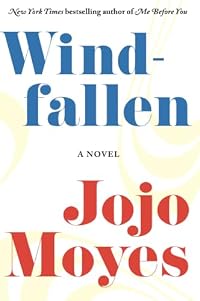
Jojo Moyes was born in London, England on August 4, 1969. She studied at Royal Holloway, University of London and Bedford New College, London University. In 1992, she won a bursary financed by The Independent newspaper to attend the postgraduate newspaper journalism course at City University, London. She subsequently worked for The Independent for show more the next 10 years in various roles including assistant news editor and arts and media correspondent. Her first book, Sheltering Rain, was published in 2002. Her other works include Me Before You, One Plus One, The Girl You Left Behind, Silver Bay, The Ship of Brides, Honeymoon in Paris, After You, Windfallen, Paris for One and Other Stories, and The Horse Dancer. She won the Romantic Novelists' Association's Romantic Novel of the Year Award in 2004 for Foreign Fruit and in 2011 for The Last Letter from Your Lover. (Bowker Author Biography) show less
Awards and Honors
Series
Belongs to Publisher Series
Common Knowledge
- Canonical title
- The Peacock Emporium
- Original title
- The Peacock Emporium; The peacock emporium
- Alternate titles*
- Ein ganz besonderer Ort
- Original publication date
- 2004-04
- People/Characters
- Suzanna Peacock; Athene Forster; Douglas Fairley-Hulme; Veronica 'Vivi' Newton; Neil Peacock; Jessie Carter (show all 7); Alejandro 'Ale' de Marenas
- Important places
- London, England, UK
- Dedication
- To my mother and father, Lizzie Sanders and Jim Moyes. With love and thanks.
- First words*
- Die Klimaanlage im Hospital de Clinicas hatte den Geist aufgegeben, schon zum dritten Mal in dieser Woche.
- Quotations
- It was less a garden than, as one visitor had noted, a kind of horticultural concentration camp.
- Last words
- (Click to show. Warning: May contain spoilers.)She will be loved.
- Original language*
- Englisch
*Some information comes from Common Knowledge in other languages. Click "Edit" for more information.
Classifications
Statistics
- Members
- 684
- Popularity
- 41,703
- Reviews
- 20
- Rating
- (3.27)
- Languages
- 10 — Dutch, English, Finnish, French, German, Italian, Polish, Portuguese (Portugal), Russian, Spanish
- Media
- Paper, Audiobook, Ebook
- ISBNs
- 39
- ASINs
- 11