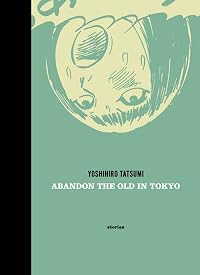
Abandon the Old in Tokyo
by Yoshihiro Tatsumi
On This Page
Description
Delves into the urban underbelly of 1960s Tokyo, exposing not only the seedy dealings of the Japanese everyman but Yoshihiro Tatsumi's maturation as a storyteller. Many of the stories deal with the economic hardships of the time and the strained relationships between men and women, but do so by means of dark allegorical twists and turns.Tags
Recommendations






















Member Recommendations

Member Reviews
This is a different world from the one I have been used to seeing in manga. In this, the second volume in Drawn and Quarterly's collection of Yoshihiro Tatsumi's work, someone vomits in virtually every story. Sometime it is pregnancy, sometime drunkenness, sometimes self-disgust, sometimes fear, but this is a world of retching and churning.
Tatsumi himself was the first to declare the difference between his fictional-realist world and the performance of dignity that often takes precedence in Japan's self-conception through manga. In 1957 he coined a new term to set his work and other alternative comics traditions in Japan in opposition to manga: gekiga. These were comics for adults, distributed differently (through lending libraries) show more than manga, dealing with uncomfortable subjects - brutal sexuality and violent alienation.
Indeed this is a world permeated by sexual anxiety, and unmediated by dream or fantasy. It is a world in which secrets are stripped bare: in one story a window washer witnesses his daughter's affair with her boss through a newly clean window and reacts (naturally!) by ripping her clothes off when she comes home and shoving her into a shower to be scrubbed down. In another, a comics artist can only find inspiration from the bawdy graffiti scrawled in a public bathroom (whose design - a flowing canal over which the user squats - seems more metaphorically direct about the scatological quality of artistic creation than the toilets we are accustomed to would be), and is caught sketching there by a total stranger. These are lives of tangled claustrophobia, filled to painfulness with other people and yet utterly lonely. The only people who ever reach out to the isolated everymen who fill Tatsumi's pages turn out to be whores.
As you can probably tell from these brief descriptions, there is often something contrived about the plots of these stories, which make up for their obviousness in abundant unpleasantness. The great strain seems to be in creating these harsh plot-lines, in violating the taboo, rather than in making the violation intricate. Drawn and Quarterly has laid out a project that involves publishing, each year, a collection of comics from one year of Tatsumi's career. The first was The Pushman and Other Stories (1969, publ. in English by D&Q in 2005), and this book represents 1970. I hold out hope for future years, for a boldness already present, matched with an intricacy sadly missed.
[Originally posted at http://sycoraxpine.blogspot.com/2007/09/abandon-old-in-tokyo-1970.html ] show less
Tatsumi himself was the first to declare the difference between his fictional-realist world and the performance of dignity that often takes precedence in Japan's self-conception through manga. In 1957 he coined a new term to set his work and other alternative comics traditions in Japan in opposition to manga: gekiga. These were comics for adults, distributed differently (through lending libraries) show more than manga, dealing with uncomfortable subjects - brutal sexuality and violent alienation.
Indeed this is a world permeated by sexual anxiety, and unmediated by dream or fantasy. It is a world in which secrets are stripped bare: in one story a window washer witnesses his daughter's affair with her boss through a newly clean window and reacts (naturally!) by ripping her clothes off when she comes home and shoving her into a shower to be scrubbed down. In another, a comics artist can only find inspiration from the bawdy graffiti scrawled in a public bathroom (whose design - a flowing canal over which the user squats - seems more metaphorically direct about the scatological quality of artistic creation than the toilets we are accustomed to would be), and is caught sketching there by a total stranger. These are lives of tangled claustrophobia, filled to painfulness with other people and yet utterly lonely. The only people who ever reach out to the isolated everymen who fill Tatsumi's pages turn out to be whores.
As you can probably tell from these brief descriptions, there is often something contrived about the plots of these stories, which make up for their obviousness in abundant unpleasantness. The great strain seems to be in creating these harsh plot-lines, in violating the taboo, rather than in making the violation intricate. Drawn and Quarterly has laid out a project that involves publishing, each year, a collection of comics from one year of Tatsumi's career. The first was The Pushman and Other Stories (1969, publ. in English by D&Q in 2005), and this book represents 1970. I hold out hope for future years, for a boldness already present, matched with an intricacy sadly missed.
[Originally posted at http://sycoraxpine.blogspot.com/2007/09/abandon-old-in-tokyo-1970.html ] show less
I've been a fan of Tatsumi's GNs that take a bleak and hard look at Japanese society. In this series of short stories, he tells us tales of men and women who feel trapped in bleak lives because of family obligations, hidden desires, thirst for revenge and social expectations. He exposes the repression his characters live under. If you want Disney-type GNs, this is not for you. If you want to look under the glossy surface of a culture, dive in.
The eight graphic short stories collected here were originally published in Japan in 1970. Tatsumi is the originator of the gekiga style of manga, which uses a cinematic style and involves adult themes. Both are in evidence here. Tatsumi’s focus is often on underclass protagonists who are barely eking out a living. Sometimes they are so set upon by burdens or responsibilities, or just unending back luck, that they despair. And in despair their lives slip across the border of the human. To describe these stories as bleak would be an understatement.
Since the stories were originally published for differing audiences (some for young people, and some aimed solely at the underground adult market), there is a significant variety in tone. show more Humour is typically a component of the stories, but in some the humour is exceedingly dark.
Recommended, with caution, to anyone interested in the growth of alternative manga in Japan. show less
Since the stories were originally published for differing audiences (some for young people, and some aimed solely at the underground adult market), there is a significant variety in tone. show more Humour is typically a component of the stories, but in some the humour is exceedingly dark.
Recommended, with caution, to anyone interested in the growth of alternative manga in Japan. show less
Soft and yet gritty drawings of everyday life in Japan during the 70's. The sordid reality of the characters is very tangible in Tatsumi's work; however, it is balanced with light humor. This graphic medium has succeeded in bringing together the Japanese of today and yesterday, as well as bringing in the readers to experience their reality. Tatsumi's perspective is spot on, and his eye serves as a perfect record of humanity's destruction, as well as occasional glimpses of beauty, as shown in this series of oftentimes-strange stories. He never leaves anything out; the buildings and the walls pop out at you, and they are also characters in the stories. Delving into the deeper characters of people and how they cope, no matter how strange show more or repulsive, at the end of the day, it shows that it is man's survival that is important. And though the characters may seem to be defeated and weak, the stories' importance lies on the fact that the characters have indeed survived, even if they still live in their "one room castles." For they still recognize freedom and they continue, and this is just enough to save them. show less
Bleak stories about despairing, lonely people trapped by society. There are no happy endings in this book of short stories. Despair is the keyword. Artwork is excellent and moody, and the stories are haunting. One is actually a horror story. There is an interesting interview with the author by Adrian Tomine at the back.
Collection of short stories, focusing on the individual's adaptation to the modernization of Japan in the 1970's. Tatsumi's writing career began in the 1950's (I believe) but it is only in the past few years that a conscious effort is being made to translate his work into English. The annoyance I have felt at not being able to just binge on a manga creator's work once I fall in love, because not everything had been translated into English, has helped me to understand why so many manga fans study Japanese. Of course, I think many fetishize Japanese culture, but if much of the work of a favorite creator is inaccessible due to the language barrier, I can see that being a strong motivating factor.
Koji Suzuki wrote the introduction and if I show more had just picked the book up not knowing anything about it, that fact alone would be enough for me to buy it. I don't want to say the stories are depressing, but the characters are deeply flawed and the tone is frequently dark (which, if you're familiar with Suzuki's work, you would have already guessed).
Tatsumi was the Mangaka who is credited with coining the term "gekiga." When I first started reading comics, I scorned manga. If someone had told me it wasn't all Sailor Moon and yaoi, if they had pointed me towards this stuff, I never would have been so disdainful and I regret my earlier prejudice. show less
Koji Suzuki wrote the introduction and if I show more had just picked the book up not knowing anything about it, that fact alone would be enough for me to buy it. I don't want to say the stories are depressing, but the characters are deeply flawed and the tone is frequently dark (which, if you're familiar with Suzuki's work, you would have already guessed).
Tatsumi was the Mangaka who is credited with coining the term "gekiga." When I first started reading comics, I scorned manga. If someone had told me it wasn't all Sailor Moon and yaoi, if they had pointed me towards this stuff, I never would have been so disdainful and I regret my earlier prejudice. show less
A most beautiful edition of short stories by Tatsumi (dating from 1970). Most stories are (a bit) weird and unsettling. Using manga style (or a mixture of manga and other, more western styles?), but telling alternative, literary stories. I'd certainly like to read more by Tatsumi and/or other alternative Japanese graphic novelists.
Members
- Recently Added By
Author Information

32+ Works 2,114 Members
Awards and Honors
Notable Lists
Series
Belongs to Publisher Series
Common Knowledge
- Canonical title
- Abandon the Old in Tokyo
- Original publication date
- 1970
Classifications
- Genre
- Graphic Novels & Comics
- DDC/MDS
- 741.5952 — Arts & recreation Drawing & decorative arts Drawing Comic books, graphic novels, fotonovelas, cartoons, caricatures, comic strips History, geographic treatment, biography Asian Japanese
- LCC
- PN6790 .J33 .T38 — Language and Literature Literature (General) Literature (General) Collections of general literature Comic books, strips, etc.
- BISAC
Statistics
- Members
- 407
- Popularity
- 76,227
- Reviews
- 14
- Rating
- (3.82)
- Languages
- English
- Media
- Paper
- ISBNs
- 2
- ASINs
- 1