On This Page
Description
A novel in three parts, beginning in the 1920s and ending in the 1950s, that follows the lives of two friends from the prewar years in Germany through an apocalyptic period and its startling aftermathTags
Recommendations
















Member Recommendations
by aprille
Member Reviews
Woof!
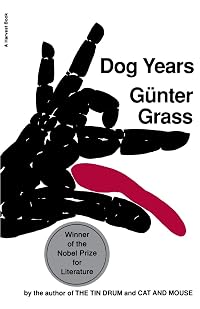
Grass's second big novel, from 1963. Calling it the third book in the "Danziger Trilogie" seems to be just a marketing thing - the story overlaps in time and space with the story of Blechtrommel, and there are a couple of brief mentions of people and incidents from the earlier novel, but what links the books is really the same thing that links all the rest of Grass's fiction and non-fiction: German history as he experienced it in his own life.
There's less uncontrolled rage here than in Blechtrommel. He still hits hard when he needs to, but the general mood is rather more ambiguous. Matern, the "antifascist" protagonist, finds that the war criminals he is hunting down are all good and decent people who turn out to have had perfectly show more plausible reasons for doing what they did; he himself has a dark secret in his past that he isn't prepared to face - something that becomes extra poignant now that Grass has revealed in his memoirs the corresponding dark secret in his own war experience. There's a clear warning that it's all too easy to deceive ourselves about our own faults, but that judging other people is equally hazardous, especially if we weren't there.
Grass is never less than entertaining, of course, even when he's lecturing you or going off into an abstruse discussion of the finer points of German shepherd dogs, technicalities of classical ballet, or the different qualities of cereal crops. There are some very plain, sober bits of writing, and some incredibly flashy passages, like the famous account of the closing days of the battle for Berlin as a search for a lost dog, written in language that's a clever cross between the style of Heidegger and that of military communiqués. Occasionally it all seems a bit too clever, but there mostly turns out to have been a good reason for it.
Grass is very conscious of the power of stories, and he makes a lot of use of story-telling tricks - repetition, looping narrative, interruption, verbal tags (Leitmotifs, really) linked to particular characters or ideas. A lot of well-known stories from literature, mythology and folklore come up, implicitly or explicitly. Walter and Eddie are sometimes Faust and Mephistopheles, sometimes Narziß and Goldmund, sometimes Siegfried and Loge. The book opens with a treasure being thrown into a river; it closes with a fire and a tour of the underworld.
As well as the big stuff, there's also a lot of wonderful detail. We get a few more deliciously repulsive entries in the Grass cookbook of meals you really wouldn't like to share: raw jellyfish, boiled animal entrails, soup made from replete leaches... Nothing quite as nightmarish as the eels in Blechtrommel, but it's a close run thing. show less
Grass's second big novel, from 1963. Calling it the third book in the "Danziger Trilogie" seems to be just a marketing thing - the story overlaps in time and space with the story of Blechtrommel, and there are a couple of brief mentions of people and incidents from the earlier novel, but what links the books is really the same thing that links all the rest of Grass's fiction and non-fiction: German history as he experienced it in his own life.
There's less uncontrolled rage here than in Blechtrommel. He still hits hard when he needs to, but the general mood is rather more ambiguous. Matern, the "antifascist" protagonist, finds that the war criminals he is hunting down are all good and decent people who turn out to have had perfectly show more plausible reasons for doing what they did; he himself has a dark secret in his past that he isn't prepared to face - something that becomes extra poignant now that Grass has revealed in his memoirs the corresponding dark secret in his own war experience. There's a clear warning that it's all too easy to deceive ourselves about our own faults, but that judging other people is equally hazardous, especially if we weren't there.
Grass is never less than entertaining, of course, even when he's lecturing you or going off into an abstruse discussion of the finer points of German shepherd dogs, technicalities of classical ballet, or the different qualities of cereal crops. There are some very plain, sober bits of writing, and some incredibly flashy passages, like the famous account of the closing days of the battle for Berlin as a search for a lost dog, written in language that's a clever cross between the style of Heidegger and that of military communiqués. Occasionally it all seems a bit too clever, but there mostly turns out to have been a good reason for it.
Grass is very conscious of the power of stories, and he makes a lot of use of story-telling tricks - repetition, looping narrative, interruption, verbal tags (Leitmotifs, really) linked to particular characters or ideas. A lot of well-known stories from literature, mythology and folklore come up, implicitly or explicitly. Walter and Eddie are sometimes Faust and Mephistopheles, sometimes Narziß and Goldmund, sometimes Siegfried and Loge. The book opens with a treasure being thrown into a river; it closes with a fire and a tour of the underworld.
As well as the big stuff, there's also a lot of wonderful detail. We get a few more deliciously repulsive entries in the Grass cookbook of meals you really wouldn't like to share: raw jellyfish, boiled animal entrails, soup made from replete leaches... Nothing quite as nightmarish as the eels in Blechtrommel, but it's a close run thing. show less
Although I found this difficult to get into it paid off in trademark Gunter style. He's a visionary, slipping through the cracks in the floorboards of history, introducing himself to the dustballs & skeletons (or in this case scarecrows & canines). Metaphysical magic realism with a tangible icy humour.
The Title is an echo of the common cliché "I was just following orders." Dog's lives being, to humans, little more than that anyway. So, it is an extended metaphor. And it is a very good example of that kind of thing. It is about the relationship between two boys who both manage to survive WWII. But, at one point, Matern, who had originally been asked to join Hitler's S.A. in order to get uniforms for Amstel's artistic work, which is building scarecrows. Matern however, is forced to denounce Amstel as a Jew, and personally brutalizes him. But, after that, he is materially involved in making sure his friend survives the war. later, they meet and resume a more mature? or is it uneasy? friendship.
My reading of Dog Years haunts me. It was a crossroads time and the absorbtion is steeped in a peculiar melancholy, about the moves about to undertaken. I'm sure a great measure of this projection, some psychic empathy with the protagonist. Neurological jury-rigging is inevitable; it does help to recognize the patterns and the places of origin. One is no less haunted, I'm afraid.
Another intricate novel of Grass's. The family line of a dog, leading to Hitler's favorite dog, Prinz. Part of the Danzig trilogy, shared with Cat and Mouse and his watermark Tin Drum.
Cat and mouse is smaller in scale than the first novel (Tin Drum), and Dog Years is much more on the same scale as Tin Drum.
Cat and mouse is smaller in scale than the first novel (Tin Drum), and Dog Years is much more on the same scale as Tin Drum.
Anni di cani è un libro di straordinaria densità, nulla è semplice. La cultura tedesca fa i conti con se stessa, con il suo passato, con le contraddizioni di un popolo attraverso un viaggio intenso nella storia recente di una nazione che ha voluto rompere i ponti con l’umanità. Ma il punto di vista di Grass va ben oltre le banali miopi visioni di colpe collettive, inquadrando tutto con la lente degli individui, dei singoli individui, due cani, padre e figlio, Harmas, cane del falegname, e Prinz, il pastore tedesco di Hitler, sopravvissuto al crepuscolo e poi divenuto Pluto nell’inquietante Germania della ricostruzione. Tre atti per un libro fondamentale della letteratura del secolo scorso, dove le tecniche letterarie si show more sovrappongono, fantastica la composizione del processo ad uno dei protagonisti ispirata ai cori delle tragedie greche, con una proposta polifona delle voci. Ed il passaggio dalla repubblica di Weimar al nazismo, e poi all’antinazismo, con gli individui che salgono e scendono dai camion dei vincitori, pronti ad additare chi non accettando l’omologazione rifiuta anche l’etichetta di anti, è il filo conduttore di questo lavoro. E’ un libro difficile, la lettura è davvero ostica, ci vuole impegno, dedizione, ma ne vale la pena Quando lo finisci senti che questi anni di cani ti sono rimasti dentro, davvero. show less
Nov 12, 2013 (Edited)Italian
Members
- Recently Added By
Lists

German Literature
518 works; 55 members

Books About World War II
102 works; 27 members

1960s, Best books published therein
254 works; 22 members
Amanda's Guaranteed Books
110 works; 5 members

Books Read in 2022
5,166 works; 112 members

My TBR
371 works; 3 members
Author Information

211+ Works 22,842 Members
Günter Wilhelm Grass was born on October 16, 1927 in the Free City of Danzig, which is now Gdansk, Poland. He was a member of the Hitler Youth and at the age of 17, he was drafted into the German army. Near the end of the war, he served as a tank gunner in the 10th SS Panzer Division. He was captured by the Americans and forced to visit the newly show more liberated Dachau concentration camp. After his release from a POW camp in 1946, he worked in a potash mine and as a stonemason's apprentice and studied painting and sculpture in Düsseldorf. His first novel, The Tin Drum, was published in 1959. It was adapted into a film and won the Academy Award for Best Foreign Film in 1979. His other works included Cat and Mouse, Dog Years, From the Diary of a Snail, The Flounder, The Rat, and Crabwalk. He also wrote a memoir entitled Peeling the Onion. He received the Nobel Prize for Literature in 1999. He was also a political activist and liberal provocateur. He advocated for environmental conservation, debt relief for poor countries, and generous policies regarding political asylum. He died on April 13, 2015 at the age of 87. (Bowker Author Biography) show less
Some Editions
Awards and Honors
Awards
Distinctions
Series

Belongs to Publisher Series
Work Relationships
Is contained in
Common Knowledge
- Canonical title
- Dog Years
- Original title
- Hundejahre
- Original publication date
- 1963
- People/Characters*
- Meneer Brauxel; Walter Matern; Eduard Amsel; Harry Liebenau
- Important places
- Danzig; Danzig, Prussia; Danzig, Prussia, German Empire; Danzig (Free City); Gdańsk, Pomeranian Voivodeship, Poland
- Dedication
- Walter Henn in memoriam
- First words
- Erzähl du.
You tell. - Last words
- (Click to show. Warning: May contain spoilers.)Each of us bathes by himself.
- Blurbers
- Veen, Adriaan van der; Steiner, George; Hogan, William; Kluger, Richard
- Original language
- German
*Some information comes from Common Knowledge in other languages. Click "Edit" for more information.
Classifications
Statistics
- Members
- 1,266
- Popularity
- 19,328
- Reviews
- 10
- Rating
- (3.81)
- Languages
- 15 — Danish, Dutch, English, Finnish, French, German, Italian, Lithuanian, Norwegian (Bokmål), Polish, Portuguese, Russian, Serbian, Spanish, Swedish
- Media
- Paper, Audiobook, Ebook
- ISBNs
- 53
- ASINs
- 32