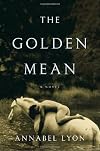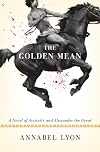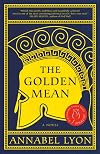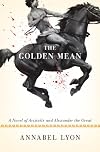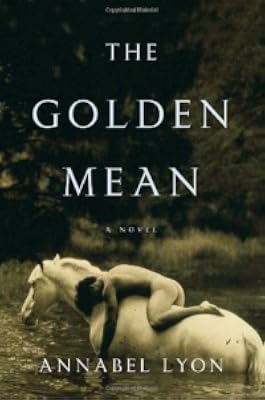
The Golden Mean
by Annabel Lyon
On This Page
Description
A startlingly original first novel that reimagines one of history’s most intriguing relationships: between legendary philosopher Aristotle and his most famous pupil, the young Alexander the Great342 BC: Aristotle is reluctant to set aside his own ambitions in order to tutor Alexander, the rebellious son of his boyhood friend Philip of Macedon. But the philosopher soon comes to realize that teaching this charming, surprising, sometimes horrifying teenager—heir to the Macedonian throne, show more forced onto the battlefield before his time—is a necessity amid the ever more sinister intrigues of Philip’s court.
Told in the brilliantly rendered voice of Aristotle—keenly intelligent, often darkly funny—The Golden Mean brings ancient Greece to vivid life via the story of this remarkable friendship between two towering figures, innovator and conqueror, whose views of the world still resonate today. Historical Fiction. Literature. Fiction. show less
Tags
Recommendations
























Member Recommendations

Member Reviews
Rating: 3.75* of five
The Publisher Says: On the orders of his boyhood friend, now King Philip of Macedon, Aristotle postpones his dreams of succeeding Plato as leader of the Academy in Athens and reluctantly arrives in the Macedonian capital of Pella to tutor the king’s adolescent sons. An early illness has left one son with the intellect of a child; the other is destined for greatness but struggles between a keen mind that craves instruction and the pressures of a society that demands his prowess as a soldier.
Initially Aristotle hopes for a short stay in what he considers the brutal backwater of his childhood. But, as a man of relentless curiosity and reason, Aristotle warms to the challenge of instructing his young charges, show more particularly Alexander, in whom he recognizes a kindred spirit, an engaged, questioning mind coupled with a unique sense of position and destiny.
Aristotle struggles to match his ideas against the warrior culture that is Alexander’s birthright. He feels that teaching this startling, charming, sometimes horrifying boy is a desperate necessity. And that what the boy – thrown before his time onto his father’s battlefields – needs most is to learn the golden mean, that elusive balance between extremes that Aristotle hopes will mitigate the boy’s will to conquer.
Aristotle struggles to inspire balance in Alexander, and he finds he must also play a cat-and-mouse game of power and influence with Philip in order to manage his own ambitions.
As Alexander’s position as Philip’s heir strengthens and his victories on the battlefield mount, Aristotle’s attempts to instruct him are honored, but increasingly unheeded. And despite several troubling incidents on the field of battle, Alexander remains steadfast in his desire to further the reach of his empire to all known and unknown corners of the world, rendering the intellectual pursuits Aristotle offers increasingly irrelevant.
Exploring this fabled time and place, Annabel Lyon tells her story in the earthy, frank, and perceptive voice of Aristotle himself. With sensual and muscular prose, she explores how Aristotle’s genius touched the boy who would conquer the known world. And she reveals how we still live with the ghosts of both men.
My Review: I think this is up there in ambition of storytelling with The Song of Achilles, the five-star imaginative tour de force by Madeline Miller. Aristotle as narrator of his time spent in Pella? A good idea! Tutoring Alexander means getting to the heart of the legend that surrounds Alexander and vivifying him, dusting off the fustian and falderol accreted to his tale.
Here's Alexander speaking to Aristotle:
Nice. Not a teenaged person speaking, and no I'm not retroactively applying 21st-century standards to Alexander, I'm fully aware that he was a powerful king's heir and a man before he was 17. But that's not my inner ear's problem with the passage.
It sounds like speechifying. It's not faux archaic, it's not arch or overwrought. It's just...speechy. Like a modern presidential speech to the jus' folks at a Town Hall. Aristotle, a man of immense intellect and unbounded curiosity, attempts to instill those qualities in Alexander's still-forming mind:
Aristotle uses some pretty vulgar (in all senses of the word) subjects to pique the youth's questing intelligence's appetite for information. (If Alexander was alive now, he'd be a Google employee assigned to counter-hacking.)
In the end, the historical Alexander and the historical Aristotle are brighter figures for Lyon's spit-polish of their statues. It's a good book, and I won't read it again. I feel it's delivered its payload of meaning and philosophical pondering to me. Alexander sums up the experience of The Golden Mean quite well:
I can't begin to tell you how tough it was for me to finish this five-star idea and rate it under four stars. I can't honestly push it higher, for the reasons I've given. It might seem to others a perfect five, which rating I can't give but can see how a reader with a more accepting nature would.
Watch this writer. This is a debut novel, following a story collection and a novella collection as well as some YA work. There is nothing in this book, either structural or aesthetic, that suggests to me a career of mediocre ~meh~ness. Fine, imaginitive writing will come forth from her pen. I haven't read the follow-on to this book, The Sweet Girl, about Aristotle's daughter. Happen that I will, with a deal of hope for excellence.
This work is licensed under a Creative Commons Attribution-NonCommercial-ShareAlike 3.0 Unported License. show less
The Publisher Says: On the orders of his boyhood friend, now King Philip of Macedon, Aristotle postpones his dreams of succeeding Plato as leader of the Academy in Athens and reluctantly arrives in the Macedonian capital of Pella to tutor the king’s adolescent sons. An early illness has left one son with the intellect of a child; the other is destined for greatness but struggles between a keen mind that craves instruction and the pressures of a society that demands his prowess as a soldier.
Initially Aristotle hopes for a short stay in what he considers the brutal backwater of his childhood. But, as a man of relentless curiosity and reason, Aristotle warms to the challenge of instructing his young charges, show more particularly Alexander, in whom he recognizes a kindred spirit, an engaged, questioning mind coupled with a unique sense of position and destiny.
Aristotle struggles to match his ideas against the warrior culture that is Alexander’s birthright. He feels that teaching this startling, charming, sometimes horrifying boy is a desperate necessity. And that what the boy – thrown before his time onto his father’s battlefields – needs most is to learn the golden mean, that elusive balance between extremes that Aristotle hopes will mitigate the boy’s will to conquer.
Aristotle struggles to inspire balance in Alexander, and he finds he must also play a cat-and-mouse game of power and influence with Philip in order to manage his own ambitions.
As Alexander’s position as Philip’s heir strengthens and his victories on the battlefield mount, Aristotle’s attempts to instruct him are honored, but increasingly unheeded. And despite several troubling incidents on the field of battle, Alexander remains steadfast in his desire to further the reach of his empire to all known and unknown corners of the world, rendering the intellectual pursuits Aristotle offers increasingly irrelevant.
Exploring this fabled time and place, Annabel Lyon tells her story in the earthy, frank, and perceptive voice of Aristotle himself. With sensual and muscular prose, she explores how Aristotle’s genius touched the boy who would conquer the known world. And she reveals how we still live with the ghosts of both men.
My Review: I think this is up there in ambition of storytelling with The Song of Achilles, the five-star imaginative tour de force by Madeline Miller. Aristotle as narrator of his time spent in Pella? A good idea! Tutoring Alexander means getting to the heart of the legend that surrounds Alexander and vivifying him, dusting off the fustian and falderol accreted to his tale.
Here's Alexander speaking to Aristotle:
You who understand what a human mind can be, how can you bear it? I don't have the hundredth part of your mind and there are days when I think I'll go mad. I can feel it. Or hear it. It's more like hearing something creeping along the walls, just behind my head, getting closer and closer. A big insect, maybe a scorpion. A dry skittering, that's what madness sounds like to me.
Nice. Not a teenaged person speaking, and no I'm not retroactively applying 21st-century standards to Alexander, I'm fully aware that he was a powerful king's heir and a man before he was 17. But that's not my inner ear's problem with the passage.
It sounds like speechifying. It's not faux archaic, it's not arch or overwrought. It's just...speechy. Like a modern presidential speech to the jus' folks at a Town Hall. Aristotle, a man of immense intellect and unbounded curiosity, attempts to instill those qualities in Alexander's still-forming mind:
You must look for the mean between extremes, the point of balance. The point will differ from man to man. There is not a universal standard of virtue to cover all situations at all times. Context must be taken into account, specificity, what is best at a particular place and time.
Aristotle uses some pretty vulgar (in all senses of the word) subjects to pique the youth's questing intelligence's appetite for information. (If Alexander was alive now, he'd be a Google employee assigned to counter-hacking.)
My father explained to me once that human male sperm was a potent distillation of all the fluids in the body, and that when those fluids became warm and agitated they produced foam, just as in cooking or sea water. The fluid or foam passes from the brain into the spine, and from there through the veins along the kidneys, then via the testicles into the penis. In the womb, the secretion of the man and the secretion of the woman are mixed together, though the man experiences the pleasure in the process and the woman does not. Even so, it is healthy for a woman to have regular intercourse, to keep the womb moist, and to warm the blood.
In the end, the historical Alexander and the historical Aristotle are brighter figures for Lyon's spit-polish of their statues. It's a good book, and I won't read it again. I feel it's delivered its payload of meaning and philosophical pondering to me. Alexander sums up the experience of The Golden Mean quite well:
You and I can appreciate the glory of things. We walk to the very edge of things as everyone else knows and understands and experiences them, and then we walk the next step. We go places no one has ever been. That's who we are. That's who you've taught me to be.
I can't begin to tell you how tough it was for me to finish this five-star idea and rate it under four stars. I can't honestly push it higher, for the reasons I've given. It might seem to others a perfect five, which rating I can't give but can see how a reader with a more accepting nature would.
Watch this writer. This is a debut novel, following a story collection and a novella collection as well as some YA work. There is nothing in this book, either structural or aesthetic, that suggests to me a career of mediocre ~meh~ness. Fine, imaginitive writing will come forth from her pen. I haven't read the follow-on to this book, The Sweet Girl, about Aristotle's daughter. Happen that I will, with a deal of hope for excellence.
This work is licensed under a Creative Commons Attribution-NonCommercial-ShareAlike 3.0 Unported License. show less
This book had so much promise! Written from the point of view of Aristotle, dealing with war, intrigue and philosophy, and a cast of characters including Alexander the Great, how can you possibly go wrong? And yet...
I was carried along by the story to about the halfway point when I started trying to put my finger on why I was not enjoying it more. Finally, it came to me. Annabel Lyon pulls off what seems to be impossible: she makes the lives of Aristotle and Alexander the Great dull. The little bits of Aristotle's thought we are given are dull. The battles we see, the history they are supposedly living, all are dull. Lyon lacks imagination or the skill to deal with the material. I have ordered the trilogy dealing with Alexander the show more Great written by Mary Renault. Those, I am sure, will be the antidote to this most disappointing book. show less
I was carried along by the story to about the halfway point when I started trying to put my finger on why I was not enjoying it more. Finally, it came to me. Annabel Lyon pulls off what seems to be impossible: she makes the lives of Aristotle and Alexander the Great dull. The little bits of Aristotle's thought we are given are dull. The battles we see, the history they are supposedly living, all are dull. Lyon lacks imagination or the skill to deal with the material. I have ordered the trilogy dealing with Alexander the show more Great written by Mary Renault. Those, I am sure, will be the antidote to this most disappointing book. show less
A book which really grew on me while reading, this tells the story of Aristotle's time at the court of his childhood friend Philip of Macedon at Pella. Initially employed to treat the king's elder, brain-damaged son, Aristotle is increasingly fascinated by Philip's younger boy: the smart, inscrutable and fragile Alexander. When Philip extends his job description to include tutoring Alexander, Aristotle finds himself set against a mind as thirsty for knowledge as his own, and as ruthless - but shaped of very different clay. By turns inspiring, poetic and strikingly vulgar, this is an odd book but one that really makes its mark.
Please see the full review on my blog here:
show more target="_top">http://theidlewoman.blogspot.co.uk/2014/05/the-golden-mean-annabel-lyon.html show less
Please see the full review on my blog here:
show more target="_top">http://theidlewoman.blogspot.co.uk/2014/05/the-golden-mean-annabel-lyon.html show less
Annabel Lyon takes us back to ancient times with this tale of Aristotle and Alexander. As I was reading this book I kept thinking of Mary Renault's book, Fire from Heaven. Sure enough, in the acknowledgments section, Fire from Heaven is mentioned. However, this is a more cerebral treatment plus it is told from Aristotle's point of view.
Aristotle is presented as suffering from an unnamed mental condition that sounds like bipolar disorder. Lyon isn't the first person to speculate this but it does give an interesting perspective to the foundations of Western philosophy.
I thought the writing was wonderful:
p. 264
Go still at sundown and you can hear the earth itself humming. The ground stays warm long into the night; strange-familiar faces show more smile up at us from the fields; the stars are a splash of silver liquid across the sky, a spill pattern as familiar as the stains on my mother's kitchen table.
I would recommend this book to anyone who wants to think about what they read. If you're looking for a less philosophical treatment of the same time period, try out Mary Renault. show less
Aristotle is presented as suffering from an unnamed mental condition that sounds like bipolar disorder. Lyon isn't the first person to speculate this but it does give an interesting perspective to the foundations of Western philosophy.
I thought the writing was wonderful:
p. 264
Go still at sundown and you can hear the earth itself humming. The ground stays warm long into the night; strange-familiar faces show more smile up at us from the fields; the stars are a splash of silver liquid across the sky, a spill pattern as familiar as the stains on my mother's kitchen table.
I would recommend this book to anyone who wants to think about what they read. If you're looking for a less philosophical treatment of the same time period, try out Mary Renault. show less
Annabel Lyon's The Golden Mean is an audacious novel about Aristotle's tutoring of the hot-blooded young warrior Alexander the Great in the years before he becomes king of Macedon at age twenty. Aristotle's quirky, scientific view of life unfolds in language that is startlingly contemporary, both in the sense of modern and of rooted in 4th century BC. Lyon's prose jumps with life, takes risks, defies gravity. We know we are in for a remarkable read when, early in the novel, we eavesdrop on Aristotle's thinking as he coolly examines his naked wife Pythias. A walking encyclopaedia who will write 200 books, we learn that Aristotle is prone to dramatic breakdowns that may reveal a tragic flaw. When young Alexander walks on stage holding a show more bloody severed head, the curtain of history is drawn back, the stage lights up, and we grip the edge of our seats.
The Golden Mean is a bravura performance by one of Canada's finest fiction writers. It was shortlisted for the Scotiabank Giller and the Governor-General's Award, and won the Writers' Trust Fiction Prize for 2009. Lyon has a fascinating blog on historical subjects at http://annabellyon.blogspot.com
from http://www.marynovik.com show less
The Golden Mean is a bravura performance by one of Canada's finest fiction writers. It was shortlisted for the Scotiabank Giller and the Governor-General's Award, and won the Writers' Trust Fiction Prize for 2009. Lyon has a fascinating blog on historical subjects at http://annabellyon.blogspot.com
from http://www.marynovik.com show less
Summary: A fictional retelling of the years Aristotle spent tutoring Alexander the Great, told from the point of view of Aristotle himself. Although he is disappointed at leaving Athens for what he perceives as backwards Macedon, he forges a complicated relationship with his brilliant new pupil.
Review: This is the fifth book in my goal to read the entire 2009 Giller shortlist. With this book, I am done. Yay! I saved this book for last because the subject interested me the most. I like Greek philosophy, I like Alexander the Great, and I like stories about pedagogy. So I went into The Golden Mean expecting nothing but good stuff all around.
For the most part, I got what I wanted. Lyon’s writing is described in the synopsis as tender but show more muscular, and that’s a better way of describing it than I ever could. Lyon alternates between a gritty depiction of life in the ancient Mediterranean and Aristotle’s lofty philosophical musings. I like that Aristotle is both a brilliant man and a human one; Lyon shows his interactions with his wife, with his household, with his own uncertainties. He is not a distant, inaccessible narrator, which is the one thing I was worried about going into the novel.
There are a lot of nice touches in The Golden Mean, a lot of strikingly strong writing. I think my favourite part was when Aristotle observes Alexander's "pink, sweet" euphemism for sex with women and what that says about him. Ha! However, my one complaint is that the novel feels a bit disjointed. Time passes strangely. A lot of the story is Aristotle moving to Macedon and getting to know the court, and then suddenly boom, it’s years later and women who were barely pregnant a few scenes ago are suddenly raising children. This made it hard to get a sense of Aristotle’s teaching of Alexander as a whole. The novel jumps around too much with its passage of time. I felt like I was reading bits and pieces of scenes rather than a unified whole. The scenes were great, but I wish they felt more connected.
Conclusion: A well-written novel, even if it does feel more episodic than a whole. show less
Review: This is the fifth book in my goal to read the entire 2009 Giller shortlist. With this book, I am done. Yay! I saved this book for last because the subject interested me the most. I like Greek philosophy, I like Alexander the Great, and I like stories about pedagogy. So I went into The Golden Mean expecting nothing but good stuff all around.
For the most part, I got what I wanted. Lyon’s writing is described in the synopsis as tender but show more muscular, and that’s a better way of describing it than I ever could. Lyon alternates between a gritty depiction of life in the ancient Mediterranean and Aristotle’s lofty philosophical musings. I like that Aristotle is both a brilliant man and a human one; Lyon shows his interactions with his wife, with his household, with his own uncertainties. He is not a distant, inaccessible narrator, which is the one thing I was worried about going into the novel.
There are a lot of nice touches in The Golden Mean, a lot of strikingly strong writing. I think my favourite part was when Aristotle observes Alexander's "pink, sweet" euphemism for sex with women and what that says about him. Ha! However, my one complaint is that the novel feels a bit disjointed. Time passes strangely. A lot of the story is Aristotle moving to Macedon and getting to know the court, and then suddenly boom, it’s years later and women who were barely pregnant a few scenes ago are suddenly raising children. This made it hard to get a sense of Aristotle’s teaching of Alexander as a whole. The novel jumps around too much with its passage of time. I felt like I was reading bits and pieces of scenes rather than a unified whole. The scenes were great, but I wish they felt more connected.
Conclusion: A well-written novel, even if it does feel more episodic than a whole. show less
In many professions today, there's a lot of talk about striving for "work-life balance." Although focused on a balance between our work and personal lives, the ultimate goal is to improve and broaden the quality of life. Yet more than 2,000 years ago Aristotle recognized that balance was the key to living the best life we could. His concept of the so-called "golden mean" was that we achieve happiness, both for ourselves and society, by finding a proper mix between the extremes of excess and deficiency.
That concept not only gives rise to the title of Annabel Lyon's first novel, The Golden Mean: A Novel of Aristotle and Alexander the Great, it is one of several Aristotelean ideas the book facilely explores. In fact, Lyon's work is almost show more deceptive in the way its provides the reader an entertaining entree to many of Aristotle's ideas without the reader necessarily knowing they are exploring them.
Although historical fiction, The Golden Mean provides not only a highly readable compendium of Aristotelean thought but, with the exception of one series of events created out whole cloth, also Aristotle's life. As the title suggests, the book is set during the period Aristotle served as the tutor to the teenage boy who would become Alexander the Great. Yet the reader is not limited to Aristotle's discussions with Alexander. In fact, as Aristotle narrates the story, many of the ideas and insight come from his interactions with others and his memories. It also shows what Aristotle the polymath Aristotle, a man as interested and versed in empirical research in biology as abstract ideas in philosophy and ethics.
The idea of extremes is replete in the work. On the one hand, there is Alexander, ambitious and intelligent. On the other hand, there is his half-brother, Arrhidaeus, mildly retarded or brain damaged and whom Aristotle also seeks to teach. On the one hand, Alexander chomps at the bit to become a military leader. On the other hand, post-battle he seems to suffer symptoms akin to what we call post-traumatic stress disorder. On the one hand, Alexander seeks to and will wield power to expand the Macedonian empire. On the other hand, he asks Aristotle at one point, "To make the unknown known, isn’t that the greatest virtue, the greatest happiness?"
Aristotle himself is an example of searching for the mean between extremes. Although he ponders deep philosophical issues in a world that worships a pantheon of gods, he finds divinity in the natural world and science, whether biological or mathematical. Moreover, in several passages Aristotle recounts how he struggles with swings from "black melancholy to golden joy." In fact, Aristotle's descriptions suggest he suffers a form of bipolar disorder.
Is all this historically accurate and plausible? Certainly not. But since when does learning about philosophy and history require complete and total adherence to what might be a sparse historical record? In fact, fiction provides an opportunity unlike any other to explore thoughts, concepts and ideas through different eyes and perspective. That the characters actually existed doesn't negate that value. To the contrary, it may bring us to a better understanding. The key is achieving balance between fact and invention. The Golden Mean is an admirable example of finding the mean between excess and deficiency in historical fiction.
(Originally posted at A Progressive on the Prairie.) show less
That concept not only gives rise to the title of Annabel Lyon's first novel, The Golden Mean: A Novel of Aristotle and Alexander the Great, it is one of several Aristotelean ideas the book facilely explores. In fact, Lyon's work is almost show more deceptive in the way its provides the reader an entertaining entree to many of Aristotle's ideas without the reader necessarily knowing they are exploring them.
Although historical fiction, The Golden Mean provides not only a highly readable compendium of Aristotelean thought but, with the exception of one series of events created out whole cloth, also Aristotle's life. As the title suggests, the book is set during the period Aristotle served as the tutor to the teenage boy who would become Alexander the Great. Yet the reader is not limited to Aristotle's discussions with Alexander. In fact, as Aristotle narrates the story, many of the ideas and insight come from his interactions with others and his memories. It also shows what Aristotle the polymath Aristotle, a man as interested and versed in empirical research in biology as abstract ideas in philosophy and ethics.
The idea of extremes is replete in the work. On the one hand, there is Alexander, ambitious and intelligent. On the other hand, there is his half-brother, Arrhidaeus, mildly retarded or brain damaged and whom Aristotle also seeks to teach. On the one hand, Alexander chomps at the bit to become a military leader. On the other hand, post-battle he seems to suffer symptoms akin to what we call post-traumatic stress disorder. On the one hand, Alexander seeks to and will wield power to expand the Macedonian empire. On the other hand, he asks Aristotle at one point, "To make the unknown known, isn’t that the greatest virtue, the greatest happiness?"
Aristotle himself is an example of searching for the mean between extremes. Although he ponders deep philosophical issues in a world that worships a pantheon of gods, he finds divinity in the natural world and science, whether biological or mathematical. Moreover, in several passages Aristotle recounts how he struggles with swings from "black melancholy to golden joy." In fact, Aristotle's descriptions suggest he suffers a form of bipolar disorder.
Is all this historically accurate and plausible? Certainly not. But since when does learning about philosophy and history require complete and total adherence to what might be a sparse historical record? In fact, fiction provides an opportunity unlike any other to explore thoughts, concepts and ideas through different eyes and perspective. That the characters actually existed doesn't negate that value. To the contrary, it may bring us to a better understanding. The key is achieving balance between fact and invention. The Golden Mean is an admirable example of finding the mean between excess and deficiency in historical fiction.
(Originally posted at A Progressive on the Prairie.) show less
Members
- Recently Added By
Published Reviews
ThingScore 100
The novel is deep and rich in thought and accomplishment, yet it reads with the calming ease and influence of a cool summer breeze.
added by Shortride
Lists

CBC Books - Canada's 100 (+ bonus 10): Which have you read?
110 works; 23 members

ALA The Reading List
490 works; 28 members
Author Information

13+ Works 1,102 Members
Awards and Honors
Awards
Distinctions
Notable Lists
Work Relationships
Has the (non-series) sequel
Common Knowledge
- Canonical title
- The Golden Mean
- Original title
- The Golden Mean
- Original publication date
- 2009
- People/Characters
- Alexander the Great; Aristotle, 384-322; Philip II of Macedon; Plato, ca. 428-347 BC; Hephaestion; Antipater (show all 7); Demosthenes
- Important places
- Macedonia; Ancient Greece
- Epigraph
- It must be borne in mind that my design is not to write histories, but lives. And the most glorious exploits do not always furnish us with the clearest discoveries of virtue or vice in men; sometimes a matter of less moment,... (show all) an expression or a jest, informs us better of their characters and inclinations, than the most famous sieges, the greatest armaments, or the bloodiest battles whatsoever.
Plutarch, Alexander
translated by John Dryden - Dedication
- For my parents,
my children,
and Bryant. - First words
- The rain falls in black cords, lashing my animals, my men, and my Wife, Pythias, who last night lay with her legs spread while I took notes on the mouth of her sex, who weeps silent tears of exhaustion now, on this tenth day ... (show all)of our journey.
- Last words
- (Click to show. Warning: May contain spoilers.)Never be afraid to enter an argument you can't immediately see your way out of. Can anyone tell me what a tragedy is ?
- Blurbers
- Banks, Russell; Boyne, John; Mason, Zachary; Phillips, Marie
Classifications
Statistics
- Members
- 678
- Popularity
- 42,424
- Reviews
- 25
- Rating
- (3.54)
- Languages
- 5 — Dutch, English, Finnish, French, Portuguese
- Media
- Paper, Audiobook, Ebook
- ISBNs
- 29
- ASINs
- 8