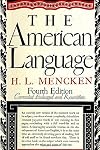
The American Language: An Inquiry into the Development of English in the United States
by H. L. Mencken
The American Language (1)
On This Page
Description
The American Language, first published in 1919, is H. L. Mencken's book about the English language as spoken in the United States. Mencken was inspired by "the argot of the colored waiters" in Washington, as well as one of his favorite authors, Mark Twain, and his experiences on the streets of Baltimore. In 1902, Mencken remarked on the "queer words which go into the making of 'United States.'" The book was preceded by several columns in The Evening Sun. Mencken eventually asked "Why show more doesn't some painstaking pundit attempt a grammar of the American language... English, that is, as spoken by the great masses of the plain people of this fair land?" It would appear that he answered his own question. In the tradition of Noah Webster, who wrote the first American dictionary, Mencken wanted to defend "Americanisms" against a steady stream of English critics, who usually isolated Americanisms as borderline barbarous perversions of the mother tongue. Mencken assaulted the prescriptive grammar of these critics and American "schoolmarms", arguing, like Samuel Johnson in the preface to his dictionary, that language evolves independently of textbooks. The book discusses the beginnings of "American" variations from "English", the spread of these variations, American names and slang over the course of its 374 pages. According to Mencken, American English was more colorful, vivid, and creative than its British counterpart. show lessTags
Recommendations























Member Reviews
I've wanted to read this for awhile, and eventually decided to pick it up during my recent [b:Dresden Files|47212|Storm Front (The Dresden Files, #1)|Jim Butcher|http://d202m5krfqbpi5.cloudfront.net/books/1345556917s/47212.jpg|1137060] sprint, to cleanse the palate between Harry Dresden's various lengthy and often amusing beat-downs. It took me awhile to finish, but honestly not as long as I thought it would, which is perhaps a testament to Mencken's ability to compellingly weave a tale about something as simultaneously ordinary and urbane as the everyday language in which we speak.
The main body of the book can be split into roughly three parts. The first five chapters covers the history of American as a language. Chapters V through show more VIII provide various grammatical explanations of "standard" American language, as it existed in Mencken's day. Chapters IX through XI focus on vulgar American language. After a short chapter with Mencken's predictions on the future of the language (XII), there's a long Appendix exploring more than two dozen languages that exist in various parts of the U.S., primarily in immigrant communities.
By and large, the most interesting part of the book for me was those first few chapters exploring the history of the language. Mencken very effectively shows how there mere fact of arriving in America forced explorers and settlers to begin developing their own language to describe the new plants, animals, landscapes and peoples they encountered. One of my favorite anecdotes is Mencken's description of the evolution of the word "raccoon" as people attempted to transcribe it from its original Native American pronunciation:
Thus, in [a:Captain John Smith|7098152|Captain John Smith|http://www.goodreads.com/assets/nophoto/nophoto-U-50x66-251a730d696018971ef4a443cdeaae05.jpg]'s "True Relation," published in 1608, one finds mention of a strange beast described variously as a rahaugcum and a raugroughcum. Four years later, in [a:William Strachey|853271|William Strachey|http://www.goodreads.com/assets/nophoto/nophoto-U-50x66-251a730d696018971ef4a443cdeaae05.jpg]'s "[b:Historie of Trevaile Into Virginia Britannia]" it became an aracoune, "much like a badger," and by 1624 Smith had made it a rarowcun in his "Virginia." It was not until 1672 that it emerged as the raccoon we know today.
Mencken doesn't only focus how new words come into the language. He also shows how America's separation from England prevented developments in the parent tongue from replicating in American. For example, while [a:Shakespeare|947|William Shakespeare|http://d202m5krfqbpi5.cloudfront.net/authors/1360741702p2/947.jpg] was busily coining words and phrases in Elizabethan England, the American language had little opportunity, initially anyway, to benefit directly from his inventiveness. Such differences due to separation weren't limited to new vocabulary. Existing words also changed their meaning, including which words were acceptable to speakers of "standard" English. Mencken points to a number of cases in which perfectly legitimate English terminology and phraseology survived in America but became disused in England, and then later became known as Americanisms, although they could more accurately be called archaisms that had simply fallen out of vogue.
Mencken also spends a lot of time showing how American language absorbed the language of other cultures. Many more words than "raccoon" have their roots in Native American language. Likewise, contact with the various explorers, settlers and later immigrants brought new words and phrases into the language. Most interestingly, however, Mencken notes the propensity of Americans to simply create new words to accommodate ideas as they are needed. Some of these stick around, though many tend, eventually, to fall by the wayside. And it's hard to predict which will remain ahead of time.
Mencken is also quite fond of word lists. At one point, he lists a stunningly large number of supposedly offensive words that I could only laugh, both at its size and the relative mildness of its members, before wondering whether he had a private list of more uncivil terms — and how I might get my hands on it. However, as might be expected, at times such lists are a little tedious. Part of why I like the earlier chapters so much is that they tell a story, weaving words and word groups together with their historical context and how they both affected and were affected by the people who used them. In the last few chapters, Mencken tends to ditch narrative and undertake the role of cataloger. I would be lying if I didn't admit to glossing over some portions of the last several chapters. Likewise for the Appendix.
That said, overall Mencken does an excellent job of balancing scholarship with storytelling. For anyone who has even the slightest interest in American as a language, there are a lot of treasures to uncover, and undoubtedly you will come away with ideas and inquiries to pursue further. This was the last edition Mencken produced, and it still remains a compelling read today. Although there have been other books written about the American language (or aspects of it) since 1936, I suspect it would be difficult to find any that are more enjoyable.
An expanded version of this review is available at CurtisWeyant.com show less
The main body of the book can be split into roughly three parts. The first five chapters covers the history of American as a language. Chapters V through show more VIII provide various grammatical explanations of "standard" American language, as it existed in Mencken's day. Chapters IX through XI focus on vulgar American language. After a short chapter with Mencken's predictions on the future of the language (XII), there's a long Appendix exploring more than two dozen languages that exist in various parts of the U.S., primarily in immigrant communities.
By and large, the most interesting part of the book for me was those first few chapters exploring the history of the language. Mencken very effectively shows how there mere fact of arriving in America forced explorers and settlers to begin developing their own language to describe the new plants, animals, landscapes and peoples they encountered. One of my favorite anecdotes is Mencken's description of the evolution of the word "raccoon" as people attempted to transcribe it from its original Native American pronunciation:
Thus, in [a:Captain John Smith|7098152|Captain John Smith|http://www.goodreads.com/assets/nophoto/nophoto-U-50x66-251a730d696018971ef4a443cdeaae05.jpg]'s "True Relation," published in 1608, one finds mention of a strange beast described variously as a rahaugcum and a raugroughcum. Four years later, in [a:William Strachey|853271|William Strachey|http://www.goodreads.com/assets/nophoto/nophoto-U-50x66-251a730d696018971ef4a443cdeaae05.jpg]'s "[b:Historie of Trevaile Into Virginia Britannia]" it became an aracoune, "much like a badger," and by 1624 Smith had made it a rarowcun in his "Virginia." It was not until 1672 that it emerged as the raccoon we know today.
Mencken doesn't only focus how new words come into the language. He also shows how America's separation from England prevented developments in the parent tongue from replicating in American. For example, while [a:Shakespeare|947|William Shakespeare|http://d202m5krfqbpi5.cloudfront.net/authors/1360741702p2/947.jpg] was busily coining words and phrases in Elizabethan England, the American language had little opportunity, initially anyway, to benefit directly from his inventiveness. Such differences due to separation weren't limited to new vocabulary. Existing words also changed their meaning, including which words were acceptable to speakers of "standard" English. Mencken points to a number of cases in which perfectly legitimate English terminology and phraseology survived in America but became disused in England, and then later became known as Americanisms, although they could more accurately be called archaisms that had simply fallen out of vogue.
Mencken also spends a lot of time showing how American language absorbed the language of other cultures. Many more words than "raccoon" have their roots in Native American language. Likewise, contact with the various explorers, settlers and later immigrants brought new words and phrases into the language. Most interestingly, however, Mencken notes the propensity of Americans to simply create new words to accommodate ideas as they are needed. Some of these stick around, though many tend, eventually, to fall by the wayside. And it's hard to predict which will remain ahead of time.
Mencken is also quite fond of word lists. At one point, he lists a stunningly large number of supposedly offensive words that I could only laugh, both at its size and the relative mildness of its members, before wondering whether he had a private list of more uncivil terms — and how I might get my hands on it. However, as might be expected, at times such lists are a little tedious. Part of why I like the earlier chapters so much is that they tell a story, weaving words and word groups together with their historical context and how they both affected and were affected by the people who used them. In the last few chapters, Mencken tends to ditch narrative and undertake the role of cataloger. I would be lying if I didn't admit to glossing over some portions of the last several chapters. Likewise for the Appendix.
That said, overall Mencken does an excellent job of balancing scholarship with storytelling. For anyone who has even the slightest interest in American as a language, there are a lot of treasures to uncover, and undoubtedly you will come away with ideas and inquiries to pursue further. This was the last edition Mencken produced, and it still remains a compelling read today. Although there have been other books written about the American language (or aspects of it) since 1936, I suspect it would be difficult to find any that are more enjoyable.
An expanded version of this review is available at CurtisWeyant.com show less
Word-Nerds come find your fodder.: We all knew Mencken was a master of wit, but little did we know that his mastery of words could also be introspective to the language itself. As a linguistics major, I found this tome extremely interesting. If you want meticulous detail on the historyu and the divergence from the British English, snap this book up. If you're still not satisfied, hunt around for the appedices he wrote later in his life.
Still indispensable introduction to American English.
Ratings
Members
- Recently Added By
Lists

Good Books for Word Geeks
16 works; 6 members

Modern Library 100 Best Nonfiction Books
100 works; 8 members

Trinity College Booklist (1951): Class Ten, English Literature
358 works; 5 members

Best 20th Century Books as of 1924
100 works; 6 members
Author Information

184+ Works 7,471 Members
H. L. Mencken 1880-1956 H. L. (Henry Louis) Mencken was born in Baltimore, Maryland, on September 12, 1880. He considered Maryland to be his home despite his many years in New York. As a child he attended Professor Friedrich Knapp's Institute, a private school for children of German descent. He completed his secondary education at Baltimore show more Polytechnic Institute, from which he graduated at the age of 16. Mencken wanted to be a writer but was obligated to work in his father's cigar factory. When his father died suddenly in 1899, Mencken immediately sought a job at the Baltimore Herald. Through he began with no experience in journalism, he quickly learned every job at the newspaper and at age 25 became its editor. Mencken went on to build himself a reputation as one of America's most brilliant writers and literary critics. His basic approach was to question everything and to accept no limits on personal freedom. He attacked organized religion, American cultural and literary standards, and every aspect of American life that he found shallow, ignorant, or false - which was almost everything. From the 1920's until his death, Mencken's sharp wit and penetrating social commentary made him one of the most highly regarded - and fiercely hated - of American social critics. He was later memorialized in the dramatic portrait of the cynical journalist in the play and film Inherit the Wind. Shortly after World War I, Mencken began a project that was to fascinate him for the rest of his life: a study of American language and how it had evolved from British English. In 1919 he published The American Language: A Preliminary Inquiry into the Development of English in the United States. To this and his publisher's surprise, the book sold out quickly; its wit and nonscholarly approach attracted many readers who would not normally buy a book on such a subject. In 1936, a revised and enlarged edition was published, and in 1945 and 1948, supplements were added. The work shows not only how American English differs from British English but how the 300 year American experience shaped American dialect. Thus the book, still considered a classic in its field, is both a linguistic and social history of the United States. Mencken died in his sleep on January 29, 1956. He was interred in Baltimore's Loudon Park Cemetery. (Bowker Author Biography) show less
Some Editions
Awards and Honors
Series

Work Relationships
Is contained in
Is an expanded version of
Has as a supplement
Has as a student's study guide
Common Knowledge
- Canonical title
- The American Language: An Inquiry into the Development of English in the United States
- Original publication date
- 1936
- Important places
- USA
- First words
- The first American colonists had perforce to invent Americanisms, if only to describe the unfamiliar landscape and weather, flora and fauna confronting them.
- Last words
- (Click to show. Warning: May contain spoilers.)Most of them are now located in large cities, where the women practise fortune-telling and the men work at ordinary trades.
- Original language
- English
- Canonical DDC/MDS
- 427.973
Classifications
- Genres
- Nonfiction, General Nonfiction, History
- DDC/MDS
- 427.973 — Language English & Old English languages Historical and geographic variations, modern nongeographic variations of English Geographic variations Geographic variations in North America United States
- LCC
- PE2808 .M4 — Language and Literature English language English Dialects. Provincialisms, etc.
- BISAC
Statistics
- Members
- 762
- Popularity
- 36,815
- Reviews
- 3
- Rating
- (4.33)
- Languages
- English
- Media
- Paper, Audiobook, Ebook
- ISBNs
- 12
- ASINs
- 45