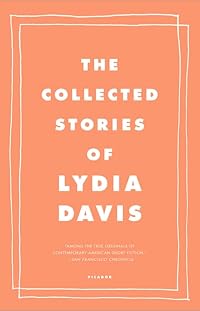
The Collected Stories of Lydia Davis
by Lydia Davis
On This Page
Description
A NEW YORK TIMES BOOK REVIEW EDITORS' CHOICE A LOS ANGELES TIMES FICTION FAVORITE FOR 2009 A SAN FRANCISCO CHRONICLE BEST BOOK OF 2009 Lydia Davis is one of our most original and influential writers, a storyteller celebrated for her emotional acuity, her formal inventiveness, and her ability to capture the mind in overdrive. She has been called " an American virtuoso of the short story form" ( S ) and " one of the quiet giants . . . of American fiction" ( Los Angeles Times Book Review ). show more This volume contains all her stories to date, from the acclaimed Break It Down (1986) to the 2007 National Book Award nominee Varieties of Disturbance . show lessTags
Recommendations







Member Recommendations
JuliaMaria Lydia Davis war die erste Ehefrau von Paul Auster. In seinen Memoiren beschreibt er auch die Zeit mit ihr, wenn er auch ihren Namen nicht explizit nennt.
Member Reviews
So now I have read all four of the individual books collected in the big orange volume. Several of these last stories were a bit different from the others--more of them were more like exercises in sociological inquiry or "studies" of human behaviour, interesting but . . . are they stories? Well, who cares, why not! What came into my mind was a study of Shakespeare's wife written by Germaine Greer -- the information about who she "really" was has to be gleaned from skimpy records of, say people with licenses to brew beer (she did), who inherited the "best bed" (she didn't) -- a picture does emerge but it is built as much on one's own ideas as the facts presented. The point, in other words! When Davis is at her best she is like a terrier show more pulling the squeaker out of a toy, intent and thorough, she'll take a behaviour apart until you cry uncle -- the best in this collection for me was the piece on what she learned from the baby. I do think even a non-short story reader might find Davis rewarding although I might be mad to think so. One of her stories has inspired me to take my mother's letters (I've kept about fifty) to read through and catalogue aspects of -- as a way to see what emerges, what might come through the whole and reveal more about who she was. I think Davis is extraordinary, original, funny, wise and humble. ***** show less
It's not often that I "review" books that seem popular and already have thousands of ratings and hundreds of reviews. But this is one of those lovely books that practically gives you a mindgasm when you pick it up because it's like an enormous box of fine chocolates, and you're obviously going to find some pieces in there to like, as well as some that don't really turn you on and which you're happy enough to hand (after biting) to your partner who doesn't mind so much the ones you find slightly weird tasting, simply insipid, or rather gross; but there's enough variety in this 733 page micro-brick that, were I the kind of person who puts droll reading material into the WC for self, partners, or guests (which I am not, and don't because show more who the F sits long enough on the pot to read or concentrate on reading), this is one book I would choose alongside, perhaps, something like Finnegans Wake -- because it's a delightful collection of variegated flavors, an infinitely deep well-spring of delights, and I'm certainly not the kind of person who would put in my john your typical lurid "john" reader full of humor-in-questionable-taste and amusing anecdotes short enough to last about one poop or similar rest period while providing no nutritional value. Certainly, I have not read cover to cover this immense, luscious tome, so you should not by any means take my word for anything. But I've had it sitting constantly beside me like a warm, purring feline companion and have been dipping my eyeballs into its warm currents daily, in random locations, for over a week now. My plan is to continue doing so, with pleasure and goosebumps, but I am unlikely to get revved up enough to sit with it exclusively until finished, as one might do with a shorter book containing less variety of prose, hence I will now lie to the web browser about having finished it so I can get on to reviewing it, but assure you it will remain physically on my desk for quite a while. Also, to be fair, at the time I purchased this book (moderately used and with one sadly water-warped page) for three dollars, I had never heard of the author, ever, because I'm not a literary person who travels in those circles; I just liked what I saw on the shelf of this short, thick volume; and the bits that I skimmed while standing--and what man on Earth with a classical mind could resist a Lydia, honestly?--and the book felt pleasant enough to carry away in my thoughts and then return to the bookstore for the express purpose of buying it some hours later, even with its little sad-puppy floppy-eared water stain. That is how highly I recommend it: half an hour, out of one's way, on foot, in the rain. show less
This small rather large chunk of a book is filled with stories that intrigue and make you wonder at what you just read. The humanity, humor, and relentless inventiveness on every page opens new vistas in what story-telling is all about. What does it mean to be an author, a writer, someone who puts words on paper - permanent, yet distilling the evanescent thoughts that might otherwise have been forgotten? Every time I open the book and read I end up setting it down so I can laugh or cry or more often sit and wonder at what just happened.
Jorge Luis Borges wrote summary abstracts of novels that don't exist. Samuel Beckett wrote novel-abstracts that do. Lydia Davis writes abstracts of an abstract's abstract. Some push ten to fifteen pages, and can be good, like "Thyroid Diary". Anybody who's ever had thyroid issues will particularly enjoy it. If only the bulk of her stories were that long and that good. But most average one to two pages, and are not very good, if occasionally clever and mildly amusing they be -- the way Bob Saget hosting America's Funniest Home Videos was clever and mildly amusing. "Mown Lawn" is moderately amusing and linguistically clever, but it's an exception to the rule in her collected stories. Many of her "stories" are paragraphs. Quite a few are show more single sentences, single lines. Lydia Davis is a molecular scientist of a writer conducting experiments at the sub-atomic level of prose. She's too minimal to be a minimalist, and too miniscule to be a miniaturist.
These are the facts about the fish in the Nile:
The above italicized ten words and colon are one such story-experiment, "Certain Knowledge from Herodotus," quoted in its entirety. Naturally I'd of preferred quoting only an excerpt from her story rather than the whole thing, but how?
No matter what the erudite tastemakers of contemporary literary fiction have to gush about Lydia Davis, even awarding her recently the Man Booker International Prize (one on the Booker panel, in fact, beamed about her "texts" and "apophthegms" without a smidgeon of irony), I'd rather read whatever "certain knowledge from Herodotus" I could glean myself straight from The Histories, rather than another text or apophthegm by this overly lauded, alleged genius of the short form.
These are the facts about the fishy abstracts in The Collected Stories of Lydia Davis. show less
These are the facts about the fish in the Nile:
The above italicized ten words and colon are one such story-experiment, "Certain Knowledge from Herodotus," quoted in its entirety. Naturally I'd of preferred quoting only an excerpt from her story rather than the whole thing, but how?
No matter what the erudite tastemakers of contemporary literary fiction have to gush about Lydia Davis, even awarding her recently the Man Booker International Prize (one on the Booker panel, in fact, beamed about her "texts" and "apophthegms" without a smidgeon of irony), I'd rather read whatever "certain knowledge from Herodotus" I could glean myself straight from The Histories, rather than another text or apophthegm by this overly lauded, alleged genius of the short form.
These are the facts about the fishy abstracts in The Collected Stories of Lydia Davis. show less
This is a really unusual collection of short stories. Lydia Davis plays with structure in a manner I have not seen before. I saw her speak as part of the Rochester Arts & Lecture Series 2010-2011, and was powerfully struck by her intellect and very dry wit. These qualities come through in her stories. She is a master of minutiae, able to make a pwerful statement in as little as 2-3 sentences. This is a great collection to pick up and put down in order to savor the material over time.
This is a lot of Lydia Davis. If you choose to read this volume (at 700 pages), rather than starting with one of her individual story collections, I'd advise taking it in small bits, while mixing in some other reading. Lydia Davis has been praised for her innovation in redefining what a 'story' can be. To say her stories are nontraditional would be stating the obvious. They range in length from one sentence to a more usual 10-15 pages. However, those latter are rare. I'd say the average is 2-3 pages. Many consist of a single paragraph. Some read like journal entries, while others read like clinical observations of domestic life. Certain ones appear to be the sort of notes you jot down in your writer's notebook, like half-formed ideas or show more short bursts of inspiration. Over time Davis's voice emerges and you settle in for the long haul. Her humor is subtle yet clever. It often appears out of nowhere. One story, 'Kafka Cooks Dinner', made me smile and chuckle the whole way through; however, this kind of humor would probably be lost or at least tempered on someone who hasn't read Kafka's writing at more than a cursory level. A lot of Davis's material reads like it's been mined straight from her own life, but this could merely be due to the straightforwardness of her prose. What I find interesting is that there is clear evidence in here that Davis is capable of quite deftly spinning a traditional narrative when she chooses to, although it's when she's toying with structure that she seems most in her element. Recommended for fans of Amy Hempel and other Gordon Lish mentees, as well as anyone else interested in having their understanding of the short story form shattered to bits. show less
A mixed bag of little gems, some flawed and cracked, others brilliant, all of them interesting. Davis is fiercely intellectual but never pedantic; within the stictly delimited space of her very short stories she can flit between erudite French wordplay and poignant commentary about being human. She can say more and do more in six paragraphs than most writers can achieve in a thick novel. Her sense of humor is sly and infectious. This book made me want to write fiction again, if you can call Davis's work fiction.
Members
- Recently Added By
Published Reviews
ThingScore 100
Davis approaches the short-story form with jazzy experimentation, tinkering with lists, circumlocutions, even interviews where the questions have been creepily edited out. You don’t work your way across this mesa-sized collection so much as pogo-stick about, plunging in wherever the springs meet the page.
added by Shortride
With the publication of this big book... Davis might well receive the kind of notice she's long been due. She is the funniest writer I know; the unique pleasure of her wit resides in its being both mordant and beautifully sorrowful
added by Shortride
Lists

50 Tough Books for Extreme Readers
71 works; 40 members

Dishonourable Mentions of 2013
189 works; 62 members

Most difficult novels
68 works; 27 members

thinking of reading in 2016
99 works; 1 member

NYT 100 best books of 21st C
100 works; 31 members

Books recommended by Calgary Public Library staff
1,588 works; 4 members

.
184 works; 1 member

Books Read in 2025
4,091 works; 97 members
Author Information

Lydia Davis is the author of several works of fiction. She is also a noted translator. She teaches at Bard College and lives in Port Ewen, New York. (Publisher Provided) Lydia Davis is a writer and translator. She is a professor of creative writing at the University at Albany, SUNY, and was a Lillian Vernon Distinguished Writer-in-Residence at New show more York University in 2012. Davis has published six collections of short stories, including The Thirteenth Woman and Other Stories (1976) and Break It Down (1986), a Finalist for the PEN/Hemingway Award. Her most recent collection was Varieties of Disturbance, published by Farrar, Straus and Giroux in 2007 and a Finalist for the National Book Award. Davis' stories are acclaimed for their brevity and humor. Many are only one or two sentences. Her book Can't and Won't made the New York Times Bestseller List in 2014. She has also translated Proust, Flaubert, Blanchot, Foucault, Michel Leiris, Pierre Jean Jouve and other French writers, as well as the Dutch writer A.L. Snijders. In October 2003 Davis received a MacArthur Fellowship. She was elected a Fellow of the American Academy of Arts and Sciences in 2005. Davis was announced as the winner of the 2013 Man Booker International Prize on 22 May 2013. Davis won £60,000 as part of the biennial award. (Bowker Author Biography) show less
Some Editions
Awards and Honors
Distinctions
Work Relationships
Common Knowledge
- Original title
- The collected stories of Lydia Davis
- Original publication date
- 2009
- First words
- I get home from work and there is a message from him: that he is not coming, that he is busy. He will call again. I wait to hear from him, then at nine o'clock I got to where he lives, find her car, but he's not home. I knock... (show all) at his apartment door and that at all the garage doors, not knowing which garage door is his - no answer. I write a note, read it over, write a new note, and stick it in his door. At home I am restless, and all I can do, though I have a lot to do, since I'm going on a trip in the morning, is play the piano. -Story
- Quotations
- I kept tripping on the street and walking into walls. Everything I said made me want to laugh. But near the end of the hour I was also telling him how face-to-face with another person I couldn't speak. There was always a wall... (show all). "Is there a wall between you and me now?" he would ask. No, there was no wall there anymore.
- Blurbers
- Franzen, Jonathan; Eggers, Dave; Oates, Joyce Carol; Moody, Rick; Smith, Ali
- Canonical DDC/MDS
- 813.54
- Canonical LCC
- PS3554.A9356
Classifications
Statistics
- Members
- 1,408
- Popularity
- 16,792
- Reviews
- 26
- Rating
- (4.22)
- Languages
- Dutch, English, Portuguese, Spanish
- Media
- Paper, Audiobook, Ebook
- ISBNs
- 35
- ASINs
- 4