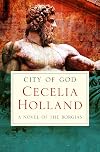
City of God
by Cecelia Holland
On This Page
Description
A self-serving political player in sixteenth-century Rome is caught up in the ruthless and powerful Borgia family's deadly intrigues of murder and betrayal It is known as the City of God--but Rome at the dawn of the sixteenth century is an unholy place where opulence, poverty, and decadence cohabitate sinfully under the ruthless rule of Rodrigo Borgia, the debauched Pope Alexander VI. Englishman Nicholas Dawson is secretary to the ineffectual ambassador of Florence and, as such, finds show more himself linked to Borgias' murderous machinations, specifically the brutal power plays of the warlord Cesare, the pope's bastard son. A skilled liar, conspirator, spy, and manipulator--a man drawn to power and the pleasures of excess--Dawson coolly plays his part in Rome's draconian political dramas with an eye to personal gain and no true allegiance to any side or player. But his attraction to a beautiful and very dangerous young man soon threatens to bring Dawson's secret enterprises crashing down around him, dooming him to a brutal and ignoble fate. The great Cecelia Holland is acclaimed as one of America's premier creators of historical fiction. With City of God she brings a remarkable epoch and a legendary family of scoundrels and murderers to breathtaking life--the corrupt patriarch pope; the suspiciously widowed and incestuous daughter, Lucrezia; Cesare, the bloodthirsty conqueror; and the tragically imprisoned and damned Caterina Sforza. Holland has written a stunning tale of betrayal, deception, and blood. show lessTags
Recommendations




















Member Reviews
Nicholas Dawson is the secretary to the Florentine ambassador in 16th century Rome. Having lived there for twenty years now, he is far removed from Florence, but continues thanklessly protecting the ambassador from his own indecision. However, this is the Rome of the Borgias, with Alexander VI in power and Cesare Borgia terrorising the Romagne with his army of condotierres. Nicholas is suborned as a spy by Cesare, and though his pride is rankled, he is also enamoured by the proximity of power, and proceeds to make some pertinent pieces of tactical advice. The Borgias, however, are pretty much utter monsters, self-serving, fickle and incredibly dangerous.
Unromantic, unsentimental, polished and sleek, this is a novel about power and show more corruption. Typical Holland, it is a man's world full of men plotting and killing and maneuvering. There are women in this: Lucrezia Borgia and two of her cousins and a brief, tragic appearance by Catherine Sforza. There isn't even a female love interest as Nicholas is gay, and his disreputable lover may doom him or ultimately redeem him, but neither of them are particularly fond of women at all. There's probably a Phd there for someone to explore how one woman can write so thoroughly and subversively about men in different periods of history but I'll just remark that this may be my favourite Holland yet and move on. show less
Unromantic, unsentimental, polished and sleek, this is a novel about power and show more corruption. Typical Holland, it is a man's world full of men plotting and killing and maneuvering. There are women in this: Lucrezia Borgia and two of her cousins and a brief, tragic appearance by Catherine Sforza. There isn't even a female love interest as Nicholas is gay, and his disreputable lover may doom him or ultimately redeem him, but neither of them are particularly fond of women at all. There's probably a Phd there for someone to explore how one woman can write so thoroughly and subversively about men in different periods of history but I'll just remark that this may be my favourite Holland yet and move on. show less
This is subtitled "A Novel of the Borgias" which, when I read it in 1979, I took to mean was about the Borgias. It was more subtle than that. A book published thirty years ago, amid the Carter Malaise years, about the roiling changes and upheavals of the late fifteenth/early sixteenth century, didn't have far to go to make its political statements. The Borgias, strong and ruthless, stood against the world astride a colossal machine of churchstate that seemed invincible.
Anyone remember a little old German named "Luther?" An English King called Henry? They weren't far in the future from the novel's setting in 1501-1503.
So the parallels to the US sense of itself in that time were obvious to a fairly bright new father. What I didn't see show more then, unsurprisingly, is that the then-middle-aged novelist had a different sense of the US, and was using the Florentine Signory (a nugatory and paralyzed non-system of non-governance) to make a deeper point about the direction she saw the country heading.
All of which is, really, speculative and irrelevant to the real purpose of a novel: Storytelling. Which this novel does quite well. I was hugely relieved that I liked the book as much, possibly more, at fifty than at twenty. It would have felt slightly upsetting to have found this book, one I esteemed so highly, wasn't up to the mark for adult me.
Nicholas Dawson, Englishman born in Navarre to exiled parents, is our POV character. He is slight, middle-aged, and queer. He is the secretary to the aforementioned nugatory Signory's legate to the Papal Court, and he is dangerously overqualified for the job...so much so that he rewrites his boss's dispatches home and makes them make sense, instead of being full of windy twaddle about the stars portending and the planets foretelling.
The day dawns, as in all underutilized workers's lives it must, when a better offer comes along: Cesare Borgia, Pope's son and all-around bastard, begins a long, slow seduction of Nicholas into Borgia service while remaining Florence's man in Rome.
Nicholas has fallen in love, a thing not in itself surprising, with a beautiful younger man who is from the wrong branch of a noble family and therefore has no place in the hierarchies of the time. Stefano and Nicholas are presented with startling clarity of vision. The reasons each loves the other are clear, as are the reasons their relationship has rocky patches and separations in it.
This treatment is uncommon in fiction written for a general audience, and was even more uncommon 30 years ago. I thought that quality alone made the book great, back then, and I see little reason not to laud Holland for her work today. She presents a real relationship between real men in an honest, warts-and-all kindness that I'd love to see other heterosexual writers work to emulate.
Our Nicholas, though, is playing both ends against the middle, and that is never, ever safe. He loses Stefano to Cesare Borgia's wily and cruel (non-sexual) seduction, and ultimately loses Stefano entirely to a cruel death.
It's then that the novel stopped making sense to me in 1979. Nicholas gets braver, and Holland puts him in place as the prime instigator of Cesare's poisoning of his father and himself at a party. Then, I could see no reason why he'd do such a nutty thing; now, it makes perfect sense. He has nothing left to lose. Kill me, don't kill me, it's all the same to me; acting in that frame of mind makes decisions very pure and very simple. I never considered that it would really be possible to sincerely be that way in 1979. In 2009, I know *exactly* where Holland has Nicholas coming from.
Bravely wrought, Miss Holland. This is a delightful book, well re-read, and worth your time and effort to find and read. show less
Anyone remember a little old German named "Luther?" An English King called Henry? They weren't far in the future from the novel's setting in 1501-1503.
So the parallels to the US sense of itself in that time were obvious to a fairly bright new father. What I didn't see show more then, unsurprisingly, is that the then-middle-aged novelist had a different sense of the US, and was using the Florentine Signory (a nugatory and paralyzed non-system of non-governance) to make a deeper point about the direction she saw the country heading.
All of which is, really, speculative and irrelevant to the real purpose of a novel: Storytelling. Which this novel does quite well. I was hugely relieved that I liked the book as much, possibly more, at fifty than at twenty. It would have felt slightly upsetting to have found this book, one I esteemed so highly, wasn't up to the mark for adult me.
Nicholas Dawson, Englishman born in Navarre to exiled parents, is our POV character. He is slight, middle-aged, and queer. He is the secretary to the aforementioned nugatory Signory's legate to the Papal Court, and he is dangerously overqualified for the job...so much so that he rewrites his boss's dispatches home and makes them make sense, instead of being full of windy twaddle about the stars portending and the planets foretelling.
The day dawns, as in all underutilized workers's lives it must, when a better offer comes along: Cesare Borgia, Pope's son and all-around bastard, begins a long, slow seduction of Nicholas into Borgia service while remaining Florence's man in Rome.
Nicholas has fallen in love, a thing not in itself surprising, with a beautiful younger man who is from the wrong branch of a noble family and therefore has no place in the hierarchies of the time. Stefano and Nicholas are presented with startling clarity of vision. The reasons each loves the other are clear, as are the reasons their relationship has rocky patches and separations in it.
This treatment is uncommon in fiction written for a general audience, and was even more uncommon 30 years ago. I thought that quality alone made the book great, back then, and I see little reason not to laud Holland for her work today. She presents a real relationship between real men in an honest, warts-and-all kindness that I'd love to see other heterosexual writers work to emulate.
Our Nicholas, though, is playing both ends against the middle, and that is never, ever safe. He loses Stefano to Cesare Borgia's wily and cruel (non-sexual) seduction, and ultimately loses Stefano entirely to a cruel death.
It's then that the novel stopped making sense to me in 1979. Nicholas gets braver, and Holland puts him in place as the prime instigator of Cesare's poisoning of his father and himself at a party. Then, I could see no reason why he'd do such a nutty thing; now, it makes perfect sense. He has nothing left to lose. Kill me, don't kill me, it's all the same to me; acting in that frame of mind makes decisions very pure and very simple. I never considered that it would really be possible to sincerely be that way in 1979. In 2009, I know *exactly* where Holland has Nicholas coming from.
Bravely wrought, Miss Holland. This is a delightful book, well re-read, and worth your time and effort to find and read. show less
I'm on a bit of a Borgia kick at the moment. Having just finished Sarah Dunant's new book In the Name of the Family, I moved on to Cecelia Holland's vision of 16th-century Rome. The Borgias are at the apex of their power, with Alexander VI on the Papal throne, his daughter Lucrezia being offered in marriage to the d'Este in Ferrara, and his son Cesare driving the fear of God into the Romagna at the point of a sword. As Italy shifts under the weight of their dominance, a sharp-eyed envoy at the Florentine embassy begins to wonder whether he can use the Borgias as a stepping stone to his own fortune. As a roistering story of the Roman underbelly, full of dark alleyways, abductions and subterfuge, this should have been an absolute show more stunner... and yet it's oddly stilted and unsatisfying...
For the full review, please see my blog (to be published on 6 Feb):
https://theidlewoman.net/2017/02/06/city-of-god-cecelia-holland/ show less
For the full review, please see my blog (to be published on 6 Feb):
https://theidlewoman.net/2017/02/06/city-of-god-cecelia-holland/ show less
I find the Borgias fascinating. I also like historical fiction. I really wanted to like this book more, but something held me back. I guess it was that I never lost myself in the story as I do with the best books. I was always aware I was sitting there reading it, and hoping it would get just a little better. I am not sure exactly what the problem was.
The story is set in Rome in the 16th century during the reign of Pope Alexander the head of the Borgia family. Perhaps its that they were merely minor characters in the book. Rodrigo, Cesare, Lucrezia are the suns around which the characters and the events move, but other than Cesare they are only glimpsed briefly. Cesare does appear more often, but is not fleshed out or developed as show more character.
The POV character, Nicholas Dawson, is a strange bird. An English, Spanish, Florentine. He is the secretary to the Ambassador of Florence to the Papal Court in Rome. He has had the job for 20 years and he has a weak and stupid boss, Ercole Brunni, who believes in the power of astrology to rule the affairs of men.
It is the job of Nicholas to be everywhere, know everyone and everything, explain it to his politically tone-deaf boss, and then rewrite or forge the dispatches the ambassador sends to the Signory in Florence. Nicholas must walk a fine line. His versions must seem to come from Brunni, must be accurate, give them the way to act, and the cover needed if they decide not to act. The Signory prefers to dither and if they have to act to blame the messenger if the act goes wrong. The government falls and new people are elected in every few months. Its like a game of hot potato and the object is not to be holding the potato when the music stops.
Nicholas is a sneak and it seems he goes out of his way to be nasty to those under him. He always has a reason or an excuse, but he never tries another option. Dawson betrays the people he works for on a regular basis, sometimes double or triple crossing. He often has no choice, but he is not really bothered by it. Just the cost of doing business.
Nicholas is gay and has to keep it secret. It is not acceptable and is a blackmail point. He buys quick sex with anonymous boys who hang around outside taverns. He also has relations with a 'straight' man, a violent thief, he pays for sex. They develop a prickly emotional and sexual relationship. If one begins to care, the other doesn't, and vice versa. There is also violence and theft in their relationship.
Dawson is just not a very nice character, and he isn't interesting enough to overcome that deficit. Perhaps that is why I didn't care for the book more. I don't have to like a character, but then s/he needs to be interesting or I lose interest. I am easily bored.
The story, besides Dawson's work and personal relationships is about the politics of conflict. Italy is a group of independent and feuding city states. The Borgias are trying to annex as much as possible, and the rest are picking sides and changing sides. The French and the Spanish are also moving troops around the countryside as everyone tries to win and outmaneuver the others.
The writing was smooth but odd in spots. It was as though words were missing from sentences, so it made no sense. The characters and dialog were good for the time period. I didn't feel jarred into the modern world. The settings were done really well in terms of period feel.
The ending is also not satisfying, it just starts a new round of sneaking and politic-ing. show less
The story is set in Rome in the 16th century during the reign of Pope Alexander the head of the Borgia family. Perhaps its that they were merely minor characters in the book. Rodrigo, Cesare, Lucrezia are the suns around which the characters and the events move, but other than Cesare they are only glimpsed briefly. Cesare does appear more often, but is not fleshed out or developed as show more character.
The POV character, Nicholas Dawson, is a strange bird. An English, Spanish, Florentine. He is the secretary to the Ambassador of Florence to the Papal Court in Rome. He has had the job for 20 years and he has a weak and stupid boss, Ercole Brunni, who believes in the power of astrology to rule the affairs of men.
It is the job of Nicholas to be everywhere, know everyone and everything, explain it to his politically tone-deaf boss, and then rewrite or forge the dispatches the ambassador sends to the Signory in Florence. Nicholas must walk a fine line. His versions must seem to come from Brunni, must be accurate, give them the way to act, and the cover needed if they decide not to act. The Signory prefers to dither and if they have to act to blame the messenger if the act goes wrong. The government falls and new people are elected in every few months. Its like a game of hot potato and the object is not to be holding the potato when the music stops.
Nicholas is a sneak and it seems he goes out of his way to be nasty to those under him. He always has a reason or an excuse, but he never tries another option. Dawson betrays the people he works for on a regular basis, sometimes double or triple crossing. He often has no choice, but he is not really bothered by it. Just the cost of doing business.
Nicholas is gay and has to keep it secret. It is not acceptable and is a blackmail point. He buys quick sex with anonymous boys who hang around outside taverns. He also has relations with a 'straight' man, a violent thief, he pays for sex. They develop a prickly emotional and sexual relationship. If one begins to care, the other doesn't, and vice versa. There is also violence and theft in their relationship.
Dawson is just not a very nice character, and he isn't interesting enough to overcome that deficit. Perhaps that is why I didn't care for the book more. I don't have to like a character, but then s/he needs to be interesting or I lose interest. I am easily bored.
The story, besides Dawson's work and personal relationships is about the politics of conflict. Italy is a group of independent and feuding city states. The Borgias are trying to annex as much as possible, and the rest are picking sides and changing sides. The French and the Spanish are also moving troops around the countryside as everyone tries to win and outmaneuver the others.
The writing was smooth but odd in spots. It was as though words were missing from sentences, so it made no sense. The characters and dialog were good for the time period. I didn't feel jarred into the modern world. The settings were done really well in terms of period feel.
The ending is also not satisfying, it just starts a new round of sneaking and politic-ing. show less
Read all my reviews on http://urlphantomhive.booklikes.com
I do not know too much about the Borgia family, who for a while ruled over large parts of Italy but had wider desires still. Much of what I know I got from watching Horrible Histories and playing Assassin's Creed (the one set in Rome being my favorite). City of God takes you along the path of the English Nicholas, as he tries to sneak his way in the Borgias good graces.
It is entirely my own fault that it stood on my shelves for so long, however, when I started reading I suddenly remembered why. There was an error in my e-copy, making that there wasn't a single pagebreak in the entire book. All text was pasted together, making me guess as to when the scenes had changed show more (considering this is a book filled with conspiracy and backstabbing, imagine my initial surprises when I missed a change of scene and thought someone present at the actual meeting where they discuss his murder). While annoying, the book was still more than readable.
While I enjoyed the setting, and the level of scheming is worthy of Game of Thrones, I missed a connection to the main character. Why does he do what he does? And more importantly, why should we, as readers, care? He always felt very distant and even when personal tragedy strikes, I didn't feel for him. I fear this will not be a book that stays with me over time.
Thanks to the publisher and Netgalley for providing me with a free copy of this book in exchange for an honest review! show less
I do not know too much about the Borgia family, who for a while ruled over large parts of Italy but had wider desires still. Much of what I know I got from watching Horrible Histories and playing Assassin's Creed (the one set in Rome being my favorite). City of God takes you along the path of the English Nicholas, as he tries to sneak his way in the Borgias good graces.
It is entirely my own fault that it stood on my shelves for so long, however, when I started reading I suddenly remembered why. There was an error in my e-copy, making that there wasn't a single pagebreak in the entire book. All text was pasted together, making me guess as to when the scenes had changed show more (considering this is a book filled with conspiracy and backstabbing, imagine my initial surprises when I missed a change of scene and thought someone present at the actual meeting where they discuss his murder). While annoying, the book was still more than readable.
While I enjoyed the setting, and the level of scheming is worthy of Game of Thrones, I missed a connection to the main character. Why does he do what he does? And more importantly, why should we, as readers, care? He always felt very distant and even when personal tragedy strikes, I didn't feel for him. I fear this will not be a book that stays with me over time.
Thanks to the publisher and Netgalley for providing me with a free copy of this book in exchange for an honest review! show less
Historical fiction by an author I have already sampled (Lords of Vaumartin) and a historical setting, Renaissance Italy, that I love; elements that should have meant I enjoyed this novel. However, the elements just did not spark off and I found it such a plotless struggle that I have today given up on it almost exactly half way through, despite its not being very long (c270 pages). A great disappointment.
One of Holland's later books which I like much less. The protagonist is an unheroic courtier/scholar at the court of Pope Alexander VI who makes a disastrous fool of himself over a very naïve homosexual lover. Very unlike the heroes of Firedrake, Rakossy, KIngs in Winter or Until the Sun Falls, or the heroine's husband in Great Maria.
Members
- Recently Added By
Author Information

52+ Works 3,323 Members
Born in Henderson, Nevada, Cecelia Holland was educated at Pennsylvania State University and Connecticut College, where she received her B.A. degree. She has served as a visiting professor of English at Connecticut College since 1979. Holland's historical novels have received broad critical acclaim. According to one critic, she "proves that there show more can be more to historical thrillers than swordplay and seduction." (Time) Among her novels is City of God (1979), which is set in Rome during the period of the Borgia family. Told from the point of view of Nicolas, a secretary to the Florentine ambassador to Rome, this novel brings to life the period of the Renaissance, including the political intrigue that characterized Rome at the time. Other works include Until the Sun Falls (1969), a story of the ancient Mongols and their empire, The Firedrake (1966), her first published novel, Great Maria (1974), The Bear Flag (1990), and Pacific Street (1991). Holland is very adept at capturing the period she writes about, including the clothing, furnishings, and customs of the time. One critic has noted that Holland "is never guilty of the fatuity which plagues most historical fiction: she never nudges the reader into agreeing that folks way back then were really just like you and me, only they bathed less often." (Bowker Author Biography) show less
Awards and Honors
Notable Lists
Common Knowledge
- Original publication date
- 1979
- People/Characters
- Alexander VI, Pope (Rodrigo de Borja, 1431-1503); Cesare Borgia; Lucrezia Borgia; Nicholas Dawson
- Important places
- Rome, Italy
Classifications
- Genres
- Fiction and Literature, General Fiction, Historical Fiction
- DDC/MDS
- 813.5 — Literature & rhetoric American literature in English American fiction in English 1900-1999
- LCC
- PZ4 .H733 — Language and Literature Fiction and juvenile belles lettres Fiction and juvenile belles lettres Fiction in English
- BISAC
Statistics
- Members
- 82
- Popularity
- 386,820
- Reviews
- 9
- Rating
- (3.44)
- Languages
- English, German
- Media
- Paper, Ebook
- ISBNs
- 6
- ASINs
- 1