On This Page
Description
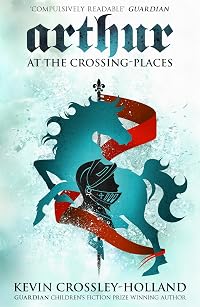
In late twelfth-century England, the thirteen-year-old Arthur goes to begin his new life as squire to Lord Stephen at Holt, where crusaders ready themselves.Tags
Recommendations















Member Recommendations

Member Reviews
At the Crossing Places by Kevin Crossley-Holland is the second book in his Arthur Trilogy, this is set in the middle ages but through the use of a seeing stone, flashes back onto the time of King Arthur.
I wasn’t taken with this book as much as the first, the jumping back and forth in time seemed forced and too pat as whatever the Middle Ages Arthur was experiencing, he saw King Arthur‘s version of the same problem in the stone.. As this second book opens, the Middle Ages Arthur is now ensconced at Holt Castle as squire to Sir Stephen and preparing to leave on Crusade. He has learned that the man he thought of as his uncle is really his father, and the girl he had wanted to marry is actually is half-sister. Meanwhile, Arthur in the show more stone has grown into his kingship, married Guinevere, formed the round table and is gathering his knights together.
What I found most interesting about this book was the many and varied descriptions of life in the middle ages for all classes. The descriptions of Arthur learning to be both squire and training to be an eventual knight were informative and well researched. The two stories didn’t seem to entwine as well in this book, with Middle Ages Arthur mostly just learning life lessons from the seeing stone, and the King Arthur part of the story didn’t seem to offer anything new, mostly just reworked stories from the original legend.
This story is unique, but I just didn’t have the patience to overlook the flaws and there is some doubt now that I will continue onto the third book. show less
I wasn’t taken with this book as much as the first, the jumping back and forth in time seemed forced and too pat as whatever the Middle Ages Arthur was experiencing, he saw King Arthur‘s version of the same problem in the stone.. As this second book opens, the Middle Ages Arthur is now ensconced at Holt Castle as squire to Sir Stephen and preparing to leave on Crusade. He has learned that the man he thought of as his uncle is really his father, and the girl he had wanted to marry is actually is half-sister. Meanwhile, Arthur in the show more stone has grown into his kingship, married Guinevere, formed the round table and is gathering his knights together.
What I found most interesting about this book was the many and varied descriptions of life in the middle ages for all classes. The descriptions of Arthur learning to be both squire and training to be an eventual knight were informative and well researched. The two stories didn’t seem to entwine as well in this book, with Middle Ages Arthur mostly just learning life lessons from the seeing stone, and the King Arthur part of the story didn’t seem to offer anything new, mostly just reworked stories from the original legend.
This story is unique, but I just didn’t have the patience to overlook the flaws and there is some doubt now that I will continue onto the third book. show less
In this second volume in Crossley-Holland's Arthur trilogy we get more of the story of young Arthur, the illegitimate son of a rather unpleasant knight, brought up in the home of another and now sent to become a squire in the home of a third. As we learned in Volume 1, The Seeing Stone, Arthur is also able to see major events in the life and court of his famous namesake by looking into a polished piece of obsidian he has been given. Bridging the years between the two Arthurs is Merlin who recedes into the background for most of this volume. The "crossing places" of the title carries multiple meanings, as young Arthur moves from youth into adulthood, crosses the channel for the first time and begins to make decisions and discoveries that show more will, no doubt, bear fruit in the concluding volume.
I read the first volume in this series a few years ago and liked it well enough that when a copy of the third volume turned up at our local library sale last year I didn't hesitate to scoop it up. I figured I could always borrow the middle volume, but then I found this copy at a used bookstore (Russell's in Victoria, BC - one of the best I've ever been in) last month and was able to complete the set. When all's read and done though, I suspect I'll eventually send all three books back to the library sale tables. There's just something about this series that doesn't work for me and I can't quite put my finger on what it is. It could be that, though I admire Mr. Crossley-Holland's skill at interweaving the two strands, all the back and forth makes it difficult for me to stay emotionally involved with young Arthur's story. And his is the story I want to stay focused on. I find myself becoming impatient with yet another retelling of yet another knight's tale. And though there's an admirable economy in these tellings, it can sometimes seem overly hasty, like a thumbnail sketch where something more is warranted, almost as if the author can't wait to get back to his main story, too, but having made the decision to include this other strand he now feels obliged to continue with it. The one exception is his version of Sir Gawain and the Green Knight, which he allows himself two chapters to tell, instead of the usual one, and the pay-off is a much richer, fully fleshed story.
I guess part of my frustration is that young Arthur's story really does have the potential to get under one's skin. He's a wonderful character and his conflicting thoughts and emotions as he arrives at his crossing places are beautifully rendered in a simple, straightforward way that feels right for a young man of this age and this time. I'll certainly finish the series at some point but if somewhere in the third volume Arthur were to lose his seeing stone I suspect I wouldn't miss it all that much. show less
I read the first volume in this series a few years ago and liked it well enough that when a copy of the third volume turned up at our local library sale last year I didn't hesitate to scoop it up. I figured I could always borrow the middle volume, but then I found this copy at a used bookstore (Russell's in Victoria, BC - one of the best I've ever been in) last month and was able to complete the set. When all's read and done though, I suspect I'll eventually send all three books back to the library sale tables. There's just something about this series that doesn't work for me and I can't quite put my finger on what it is. It could be that, though I admire Mr. Crossley-Holland's skill at interweaving the two strands, all the back and forth makes it difficult for me to stay emotionally involved with young Arthur's story. And his is the story I want to stay focused on. I find myself becoming impatient with yet another retelling of yet another knight's tale. And though there's an admirable economy in these tellings, it can sometimes seem overly hasty, like a thumbnail sketch where something more is warranted, almost as if the author can't wait to get back to his main story, too, but having made the decision to include this other strand he now feels obliged to continue with it. The one exception is his version of Sir Gawain and the Green Knight, which he allows himself two chapters to tell, instead of the usual one, and the pay-off is a much richer, fully fleshed story.
I guess part of my frustration is that young Arthur's story really does have the potential to get under one's skin. He's a wonderful character and his conflicting thoughts and emotions as he arrives at his crossing places are beautifully rendered in a simple, straightforward way that feels right for a young man of this age and this time. I'll certainly finish the series at some point but if somewhere in the third volume Arthur were to lose his seeing stone I suspect I wouldn't miss it all that much. show less
[This is a review I wrote in 2007]
** The second in the Arthur trilogy - not as good as the first**
This book continues the story of young Arthur, begun in "Arthur: The Seeing Stone". It is now the year 1200, one year on from the previous novel, and Arthur is all set to join Lord Stephen de Holt (the man to whom he is now squire) on the Fourth Crusade against the infidels. However, there are many preparations that have to be made before they can even think of crossing the Channel... Armour to get ready, horses... and will Arthur become betrothed??
This book, like the first in the trilogy, is cut short into 101 chapters, and the chapters chop and change between the story of Arthur of the Marches and the myth of King Arthur in the stone. show more Being used to the short chapters from the previous novel, I barely noticed them. Unfortunately, though, I just couldn't enjoy the story of the mythological Arthur in this novel. I found the sections about the legend of King Arthur seemed muddled and didn't have any continuity to them, making them difficult to read and follow. There also seems to be a greater emphasis on the mythology story in this novel as well, whereas in the first book it was used less often.
In all, although I still enjoyed the story of young Arthur in the Marches at his crossing point between boyhood and manhood, and the vivid descriptions of medieval life, I felt the legend of Arthur sections could have been used to tie the book together a lot better. As it is, they are just a confusing muddle and I was left disappointed. show less
** The second in the Arthur trilogy - not as good as the first**
This book continues the story of young Arthur, begun in "Arthur: The Seeing Stone". It is now the year 1200, one year on from the previous novel, and Arthur is all set to join Lord Stephen de Holt (the man to whom he is now squire) on the Fourth Crusade against the infidels. However, there are many preparations that have to be made before they can even think of crossing the Channel... Armour to get ready, horses... and will Arthur become betrothed??
This book, like the first in the trilogy, is cut short into 101 chapters, and the chapters chop and change between the story of Arthur of the Marches and the myth of King Arthur in the stone. show more Being used to the short chapters from the previous novel, I barely noticed them. Unfortunately, though, I just couldn't enjoy the story of the mythological Arthur in this novel. I found the sections about the legend of King Arthur seemed muddled and didn't have any continuity to them, making them difficult to read and follow. There also seems to be a greater emphasis on the mythology story in this novel as well, whereas in the first book it was used less often.
In all, although I still enjoyed the story of young Arthur in the Marches at his crossing point between boyhood and manhood, and the vivid descriptions of medieval life, I felt the legend of Arthur sections could have been used to tie the book together a lot better. As it is, they are just a confusing muddle and I was left disappointed. show less
A very smart book, however
1) King Arthur and his knights figure too prominently.
2) Gatty becomes a bit tiresome.
The descriptions of squire Arthur's life and adventures are generally vivid and interesting. The quandaries are very real. There are not a lot of pat solutions.
1) King Arthur and his knights figure too prominently.
2) Gatty becomes a bit tiresome.
The descriptions of squire Arthur's life and adventures are generally vivid and interesting. The quandaries are very real. There are not a lot of pat solutions.
The second volume in Crossley-Holland's Arthur trilogy.
When I was reading the first book in the trilogy, The Seeing Stone, I thought the Arthur-in-the-stone chapters were a clever device that made the book interesting. Reading At the Crossing-Places, I would have been more interested in the ordinary adventures of Arthur de Caldicot, the squire-in-making than the King Arthur and his knights in Arthur de Caldicot's obsidian.
Nonetheless, a readable fairly intelligent children's book that doesn't bore or embarrass an adult reader to death. Besides, I like history... so a book set in the past really has to be quite rubbish until I give up completely.
When I was reading the first book in the trilogy, The Seeing Stone, I thought the Arthur-in-the-stone chapters were a clever device that made the book interesting. Reading At the Crossing-Places, I would have been more interested in the ordinary adventures of Arthur de Caldicot, the squire-in-making than the King Arthur and his knights in Arthur de Caldicot's obsidian.
Nonetheless, a readable fairly intelligent children's book that doesn't bore or embarrass an adult reader to death. Besides, I like history... so a book set in the past really has to be quite rubbish until I give up completely.
Not as good as the first one, because there is a lot of emphasis on each of the major legends from King Arthur and the Knights of the Round Table, and not so much on the life of Arthur, the main character.
Arthur himself remains endearing. Keen to do the right thing, he is able to please his lord, yet also keep up his friendship with Gatty, the village girl. Would like to read Gatty's tale after reading the third instalment of this saga.
Arthur himself remains endearing. Keen to do the right thing, he is able to please his lord, yet also keep up his friendship with Gatty, the village girl. Would like to read Gatty's tale after reading the third instalment of this saga.
I read this for the "A Book With A Green Spine" part of my 2018 reading challenge. I feel it was more of a 2.5 than a 3, it was ok but I wasn't in love with it. I ended up with way more questions than answers. Maybe if I read more of the series I would like it more, but it didn't make me desperate to pick them up.
Members
- Recently Added By
Lists

Folio Society
831 works; 53 members
Author Information

128+ Works 11,727 Members
Kevin Crossley-Holland is a well-known poet, a prize-winning children's author, and a translator. Crossley-Holland has translated Beowulf and The Exeter Book of Riddles from the Anglo-Saxon. He has collaborated with composers Nicola Lefanu (The Green Children and The Wildman), Rupert Bawden (The Sailor's Tale), Sir Arthur Bliss, William Mathias, show more and Stephen Paulus. Crossley-Holland's book The Seeing Stone won the Guardian Children's Fiction Award, the Smarties Prize Bronze Medal, and the Tir na n-Og Award. The trilogy has won critical acclaim and been translated into twenty-five languages. His recent and forthcoming books are The Hidden Roads: A Memoir of Childhood, Bracelet of Bones and his new and selected poems The Mountains of Norfolk. Crossley-Holland often lectures abroad on behalf of the British Council and offers poetry and prose workshops and talks on the Anglo-Saxons and Vikings, King Arthur, heroines and heroes, and myth, legend and folk-tale. Kevin Crossley-Holland is an Honorary Fellow of St Edmund Hall, Oxford, a patron of the Society for Storytelling, and a Fellow of the Royal Society of Literature. He lives on the north Norfolk coast in East Anglia with his wife and children. (Bowker Author Biography) show less
Some Editions
Awards and Honors
Awards
Distinctions
Series

Work Relationships
Is contained in
Common Knowledge
- Canonical title
- At the Crossing Places
- Original title
- Arthur: At the Crossing Places
- Original publication date
- 2001
- People/Characters
- King Arthur; Guinevere; Lancelot du Lac; Arthur de Caldicot (Sir Arthur de Catmole); Lord Stephen de Holt; Gatty (show all 9); Winnie de Verdon; Gareth; Merlin
- Important places*
- Holt; Gortanore; Caldicot
- Dedication
- for Linda - with love
- Blurbers
- Fine, Anne
*Some information comes from Common Knowledge in other languages. Click "Edit" for more information.
Classifications
- Genres
- Fiction and Literature, Tween, Kids, Fantasy
- DDC/MDS
- 823.914 — Literature & rhetoric English & Old English literatures English fiction 1900- 1901-1999 1945-1999
- LCC
- PZ7 .C88284 .A — Language and Literature Fiction and juvenile belles lettres Fiction and juvenile belles lettres Juvenile belles lettres
- BISAC
Statistics
- Members
- 1,043
- Popularity
- 24,801
- Reviews
- 13
- Rating
- (3.45)
- Languages
- 11 — Catalan, Danish, Dutch, English, Finnish, French, German, Italian, Norwegian (Bokmål), Spanish, Swedish
- Media
- Paper, Audiobook, Ebook
- ISBNs
- 40
- ASINs
- 15