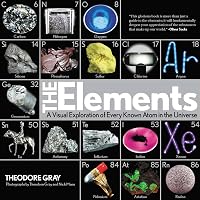
The Elements: A Visual Exploration of Every Known Atom in the Universe
by Theodore W. Gray, Nick Mann (Photographer)
Elements (Theodore Gray)
On This Page
Description
The elements are what we - and everything around us - are made of. But how many elements have you seen in their pure, raw, uncombined form? This book presents photographic representations of the 118 elements in the period table, along with facts, figures and stories about each one.Tags
Recommendations










Member Recommendations

Member Reviews
What a joy to read! The elements is truly “a visual exploration of every known element in the universe.” Author Theodore Gray (also a co-founder of Wolfram Research and its Mathematica), in a quirky and lively manner, discusses all the elements of the periodic table from #1 hydrogen to #118 ununoctium. (In my college days, lawrencium was the last element discovered. We’ve come a long way.) Stories range from the radioactive Eagle Scout to gray tin to vanadium tools. And the FBI’s confiscation of an element in the collection.
Gray and Nick Mann provided the photographs accompanying each element from Gray’s extensive element collection. Each element is pictured in pure form and items using the element are also pictured, from show more coins, jewelry and lead crystal to red fiestaware (containing uranium), light bulbs, common medicines like pepto-bismal and much more. Against a black background, the photos and layout were stunning. The paper was heavy coated paper which meant a book of considerable weight. Truly a coffee table book!
Gray also includes an explanation of the periodic table, orbitals with filling orders and other chemical properties than a non-chemist might want to skip. There is also a very short bibliography for further reading. If you want more information, Gray has a website with lots more photos and facts for students, teachers and professionals.
There was not a conventional periodic table as I remember it in the book, making it difficult for me to visualize where the element fit. It would have helped to have one in addition to the stylized table used throughout. I was also taken aback by his comment that when “oxygen combines with hydrogen and carbon, the result can be anything from water to …” Really! The comments about incandescent bulbs were also starting to wear thin after the 5th or 6th time. And the author is decidedly opinionated about other things so be prepared. However this in no way detracted from the book.
For someone who needs a more scholarly approach, there are many books on chemical elements and the periodic table. But for a light-hearted look at basic chemistry, this book is superb. show less
Gray and Nick Mann provided the photographs accompanying each element from Gray’s extensive element collection. Each element is pictured in pure form and items using the element are also pictured, from show more coins, jewelry and lead crystal to red fiestaware (containing uranium), light bulbs, common medicines like pepto-bismal and much more. Against a black background, the photos and layout were stunning. The paper was heavy coated paper which meant a book of considerable weight. Truly a coffee table book!
Gray also includes an explanation of the periodic table, orbitals with filling orders and other chemical properties than a non-chemist might want to skip. There is also a very short bibliography for further reading. If you want more information, Gray has a website with lots more photos and facts for students, teachers and professionals.
There was not a conventional periodic table as I remember it in the book, making it difficult for me to visualize where the element fit. It would have helped to have one in addition to the stylized table used throughout. I was also taken aback by his comment that when “oxygen combines with hydrogen and carbon, the result can be anything from water to …” Really! The comments about incandescent bulbs were also starting to wear thin after the 5th or 6th time. And the author is decidedly opinionated about other things so be prepared. However this in no way detracted from the book.
For someone who needs a more scholarly approach, there are many books on chemical elements and the periodic table. But for a light-hearted look at basic chemistry, this book is superb. show less
This book visits each of the 118 known elements in turn, offering up facts about them, their discoveries, and their applications (if any), as well as photographs of the element in its pure form, when possible, and of some of their compounds or bits of technology in which they're used. What truly amazed me about this book is that it's not just informative and pretty, but also surprisingly funny. I knew I was in for an entertaining treat from the first sentence, in which the author describes the periodic table as "the universal catalog of everything you can drop on your foot," and it did not disappoint. I even laughed out loud a number of times. That sense of humor really helped to keep things interesting, even when we were moving through show more endless ranks of nearly indistinguishable gray metals. Who knew chemistry could be so much fun? Not even me, and I'm a total science geek. show less
We've been reading this one, an element a day, since last spring's book fair. Each element of the periodic table has a two-page spread, with excellent photos (mostly of items that the author has collected) and an entertaining and informative blurb describing the history of the element and its uses. A lot of it likely went over Charlie's head, but he enjoyed it nonetheless and exposure to the Coolness of Science is essential, I think. I know *I* certainly enjoyed it; Gray is a hoot and we laughed out loud in some spots at his clever quips.
From Theodore Gray: "I started collecting elements in 2002 […and] by 2009, I had assembled nearly 2,300 objects representing every element, the possession of which is not forbidden by the laws of physics or the laws of man. […] Some elements can be experienced in large quantities, like the 135-pound iron ball I keep in my office for people to trip over. Others are best enjoyed in responsible moderation -- keep too much uranium in the office, and people start asking questions (keep over 15 pounds, and the Feds start asking questions)."
The Elements is a lush and visually stunning coffee-table book that showcases those samples and provides a terrific individual "biography" of each element.
Gray opens with an overview of the Periodic show more Table and its organization of elements into groups according to their similar characteristics. But then he explores them, element by element, in order of their atomic number rather than by group -- an effective method because the repeated returns to the various groups reinforce those group characteristics while familiarizing readers (YA and adult) with the individual elements.
Each biography is a two-page spread -- the left a full-page photo of one of those samples from Gray’s collection, and the right an array of text and pleasing images that detail the element’s history, uses, and technical specs (atomic weight; density; crystal structure; orbital electron arrangement; melting and boiling points; emission spectrum). Though it's a reference work, I read this book straight through -- often thinking, “okay, just one more” but then unable to resist that each element’s text ends with a teaser for the next one, and that Gray is liberal with trivia, personal experience, and wit. He dubs Tellurium the most melodic name and discusses the politics involved in naming new elements, finishing: “And so it is that we come to the end of our journey through the periodic table not with a bang, but with a committee.”
He’s the Bill Bryson of the Periodic Table! Highly recommended. show less
The Elements is a lush and visually stunning coffee-table book that showcases those samples and provides a terrific individual "biography" of each element.
Gray opens with an overview of the Periodic show more Table and its organization of elements into groups according to their similar characteristics. But then he explores them, element by element, in order of their atomic number rather than by group -- an effective method because the repeated returns to the various groups reinforce those group characteristics while familiarizing readers (YA and adult) with the individual elements.
Each biography is a two-page spread -- the left a full-page photo of one of those samples from Gray’s collection, and the right an array of text and pleasing images that detail the element’s history, uses, and technical specs (atomic weight; density; crystal structure; orbital electron arrangement; melting and boiling points; emission spectrum). Though it's a reference work, I read this book straight through -- often thinking, “okay, just one more” but then unable to resist that each element’s text ends with a teaser for the next one, and that Gray is liberal with trivia, personal experience, and wit. He dubs Tellurium the most melodic name and discusses the politics involved in naming new elements, finishing: “And so it is that we come to the end of our journey through the periodic table not with a bang, but with a committee.”
He’s the Bill Bryson of the Periodic Table! Highly recommended. show less
This beautiful book that is both a gorgeous “coffee table book” and an engrossing and informative guide to the 118 known elements makes both a beautiful and educational addition to any house or library.
Each double-page spread is devoted to one element. As the author quotes Lucretius claiming in 50 BC, “There is not anything which returns to nothing, but all things return dissolved into their elements.”
Gray begins with a brief introduction about the periodic table, and then goes through the elements in order. On the far right side of each spread, he gives technical information - atomic weight, density, and the like, but it is the main part of each presentation that is so fascinating.
He tells you what the element is like, how it show more is used, and some special applications of each. Lithium, for example, “has another trick up its sleeve: It keeps some people on an even emotional keel.” Copper has the second-highest electrical conductivity of any metal. Gallium is used in semiconductor crystals, and is also present in early all light-emitting diodes (LEDs). Phosphate fertilizers, he tells us, “are arguably responsible for the explosion of human populations to the point where water, not phosphorus, is now the limiting factor in many places.” Potassium is critical to nerve transmission in the human body. Bismuth makes up most of Pepto-Bismol. Boron is what gives Silly Putty its ability to be both soft and moldable. Uranium is an ingredient in both “vaseline glass” and Fiestaware.
All of these facts, fun as they are, are secondary to the visual aspects of the book, in which amazing large color photos (by both Theodore Gray and Nick Mann) of both the elements and products derived from them make up the bulk of the presentations.
Evaluation: If you ever thought chemistry was “boring,” you are in for a surprise and an intellectual and visual treat. This book is outstanding, and will stimulate your desire to know more about the elements, and how people figured out how to use them. show less
Each double-page spread is devoted to one element. As the author quotes Lucretius claiming in 50 BC, “There is not anything which returns to nothing, but all things return dissolved into their elements.”
Gray begins with a brief introduction about the periodic table, and then goes through the elements in order. On the far right side of each spread, he gives technical information - atomic weight, density, and the like, but it is the main part of each presentation that is so fascinating.
He tells you what the element is like, how it show more is used, and some special applications of each. Lithium, for example, “has another trick up its sleeve: It keeps some people on an even emotional keel.” Copper has the second-highest electrical conductivity of any metal. Gallium is used in semiconductor crystals, and is also present in early all light-emitting diodes (LEDs). Phosphate fertilizers, he tells us, “are arguably responsible for the explosion of human populations to the point where water, not phosphorus, is now the limiting factor in many places.” Potassium is critical to nerve transmission in the human body. Bismuth makes up most of Pepto-Bismol. Boron is what gives Silly Putty its ability to be both soft and moldable. Uranium is an ingredient in both “vaseline glass” and Fiestaware.
All of these facts, fun as they are, are secondary to the visual aspects of the book, in which amazing large color photos (by both Theodore Gray and Nick Mann) of both the elements and products derived from them make up the bulk of the presentations.
Evaluation: If you ever thought chemistry was “boring,” you are in for a surprise and an intellectual and visual treat. This book is outstanding, and will stimulate your desire to know more about the elements, and how people figured out how to use them. show less
I am a chemist and have always been fascinated by the Periodic Table of Elements. So, imagine my excitement when I saw this book sitting in the bookstore. Not only does it provide information on all 118 elements in the Periodic Table, it does it in a way that is interesting, accessible, and beautiful. This is a book that makes you want to touch it and turn the pages, you just can't resist. The picture of the elements are colorful and intriguing; they are all featured on a stylish black background...this is just a beautiful book.
Each element features a picture of the element in its purest form. The side of the page has a small strip that gives lots of technical data. The elements position on the periodic table is showm, atomic weight, show more density, atomic radius, crystal structure, electron order filing, atomic emissions spectrum, and state of matter are all given in this strip. The rest of the page is given over to a few paragraphs about the element. Then there are excellent pictures showing instances where the element is used and these pictures also have small descriptions. Most elements are given a two page spread, but some of the lucky elements get 4 pages!
In addition to the individual elements the beginning of the book discusses the different sections of the periodic table and how the periodic table of elements got its shape.
This is more of a coffee table book than an ultimate reference to the Periodic Table of Elements. Although it does provide a lot of information on the Elements. Much of the discussion on each Element is anecdotal and somewhat humorous. This makes the book an excellent reference for the layman interested in Elements, it also makes the book an entertaining read. You would have to go elsewhere to get into the gritty details of some of these elements though....for example if you were trying to synthesize something with them or something else deeply technical.
Overall I really loved this book. It is such an awesome book with such neat pictures. Everyone in the house from my computer loving husband to my three year old son has spent time looking through this book. It is just such an interesting book and it is presented in such a beautiful way. Not to mention it is even fun to read! I think everyone should have this book in their house; if nothing else it makes for interesting discussions as you see the bizarre forms of some of the elements. show less
Each element features a picture of the element in its purest form. The side of the page has a small strip that gives lots of technical data. The elements position on the periodic table is showm, atomic weight, show more density, atomic radius, crystal structure, electron order filing, atomic emissions spectrum, and state of matter are all given in this strip. The rest of the page is given over to a few paragraphs about the element. Then there are excellent pictures showing instances where the element is used and these pictures also have small descriptions. Most elements are given a two page spread, but some of the lucky elements get 4 pages!
In addition to the individual elements the beginning of the book discusses the different sections of the periodic table and how the periodic table of elements got its shape.
This is more of a coffee table book than an ultimate reference to the Periodic Table of Elements. Although it does provide a lot of information on the Elements. Much of the discussion on each Element is anecdotal and somewhat humorous. This makes the book an excellent reference for the layman interested in Elements, it also makes the book an entertaining read. You would have to go elsewhere to get into the gritty details of some of these elements though....for example if you were trying to synthesize something with them or something else deeply technical.
Overall I really loved this book. It is such an awesome book with such neat pictures. Everyone in the house from my computer loving husband to my three year old son has spent time looking through this book. It is just such an interesting book and it is presented in such a beautiful way. Not to mention it is even fun to read! I think everyone should have this book in their house; if nothing else it makes for interesting discussions as you see the bizarre forms of some of the elements. show less
I think if I'd had this book years ago, my high school chemistry course would have been less painful. The author here goes through each of the elements (as they existed at the time of publication), and in many cases, shows us examples of the element. (The author collects samples of the elements -- ones that are legal and possible to have, that is.) These are accompanied by occasionally funny asides, but much in the way of practical information. A very clever book, and one I recommend.
Members
- Recently Added By
Published Reviews
ThingScore 100
Because The Elements is, indeed, foremost a thing of beauty. It's actually the electronic version of a Gray's 2009 printed coffee table book of the same title, both shimmering with gorgeous images: the versatile element carbon is illustrated by the bright glitter of diamonds, the radioactive element radium is shown through the eerie blue-green glow of a vintage watch dial. But in the e-book show more version, these come playfully to virtual life. Some of the elements display in video; nitrogen as a flask swirling with an icy mist of the element in liquid form. Or the reader can set the still images spinning, the diamonds flashing, a vial of gold dust rotating front-label to back. The elements can even been seen in 3D if one purchases the special glasses (which I did not). And it includes an audio recording of Tom Lehrer's classic The Elements Song, which I have played so many times that I am now refusing to disclose the number.
In other words, it's game-like fun in a way that a coffee table book, even with same lovely photos by Gray's colleague, Nick Mann, cannot be. And it's worth noting that the e-version is sold as an app rather than an e-book. When I decided to give in and download it, I searched fruitlessly through iBooks before discovering it instead in the App Store (On the Touch Press website, it's offered strictly as an iPad app and an iPhone app.) I settled for the iPad version.
So is it actually a book, you might ask, if it's not even sold in a book store, if it's available on a few limited devices? Isn't one of the great achievements of the print publishing era, the ability to share information universally rather than limit it to a select few? And is my ability to spin a virtual copper necklace in comparable to what I learn from reading about that element in straightforward text? I think The Elements - and its undoubted success - raise all of those questions and more. And I think we're still figuring out the answers along with the future of the publishing business.
But let me briefly make a couple of other comparisons between this and its print version. Both do contain scientific data about each element (atomic number, weight, etc.) In the print book, of course, there's a treasure trove of this right there on the page. In the e-version, there's a compact summary but also much, much more through clicking on the Wolfram Alpha logo. You'll see the logo in the toolbar at the lower right on the image of the Bismuth page I've shown above; it looks like a fancy red star. This represents one of the ongoing tradeoffs as we move away from print - there's less likelihood of casual acquisition of information. But if we do seek out the online data, it's likely to be more current and more detailed - Wolfram Alpha allows you to go beyond its own database through links to a host of additional scholarly sources. show less
In other words, it's game-like fun in a way that a coffee table book, even with same lovely photos by Gray's colleague, Nick Mann, cannot be. And it's worth noting that the e-version is sold as an app rather than an e-book. When I decided to give in and download it, I searched fruitlessly through iBooks before discovering it instead in the App Store (On the Touch Press website, it's offered strictly as an iPad app and an iPhone app.) I settled for the iPad version.
So is it actually a book, you might ask, if it's not even sold in a book store, if it's available on a few limited devices? Isn't one of the great achievements of the print publishing era, the ability to share information universally rather than limit it to a select few? And is my ability to spin a virtual copper necklace in comparable to what I learn from reading about that element in straightforward text? I think The Elements - and its undoubted success - raise all of those questions and more. And I think we're still figuring out the answers along with the future of the publishing business.
But let me briefly make a couple of other comparisons between this and its print version. Both do contain scientific data about each element (atomic number, weight, etc.) In the print book, of course, there's a treasure trove of this right there on the page. In the e-version, there's a compact summary but also much, much more through clicking on the Wolfram Alpha logo. You'll see the logo in the toolbar at the lower right on the image of the Bismuth page I've shown above; it looks like a fancy red star. This represents one of the ongoing tradeoffs as we move away from print - there's less likelihood of casual acquisition of information. But if we do seek out the online data, it's likely to be more current and more detailed - Wolfram Alpha allows you to go beyond its own database through links to a host of additional scholarly sources. show less
added by jimroberts
Lists

Ambleside Books
459 works; 18 members

Hachette Book Group
152 works; 6 members

The r/Chemistry Recommended Books
87 works; 1 member

Read Alouds for CC Cycle 3
32 works; 1 member
Talk Discussions
Past Discussions
Chemistry coffee table book in Name that Book (July 2010)
Author Information

36+ Works 5,180 Members

Awards and Honors
Awards
Series

Common Knowledge
- Canonical title
- The Elements: A Visual Exploration of Every Known Atom in the Universe
- Alternate titles
- Die Elemente : Bausteine unserer Welt
- Original publication date
- 2009
- Epigraph
- There is not anything which returns to nothing, but all things return dissolved into their elements. Lucretius, De Rerum Natura, 50 BC
- First words
- The periodic table is the universal catalog of everything you can drop on your foot.
- Last words
- (Click to show. Warning: May contain spoilers.)And so it is that we come to the end of our journey through the periodic table not with a bang, but with a committee.
- Blurbers
- Sacks, Oliver; Hoffmann, Roald
Classifications
Statistics
- Members
- 2,911
- Popularity
- 6,184
- Reviews
- 21
- Rating
- (4.42)
- Languages
- 14 — Catalan, Chinese, Czech, Dutch, English, Finnish, French, German, Italian, Japanese, Slovenian, Spanish, Swedish, Portuguese (Portugal)
- Media
- Paper, Ebook
- ISBNs
- 30
- UPCs
- 1
- ASINs
- 6