On This Page
Description
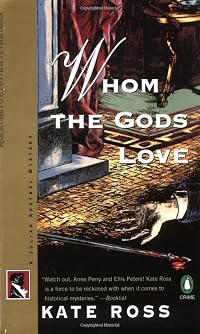
Fiction. Mystery. Historical Fiction. Fans of Regency-era romances will love this series, featuring the dashing Julian Kestrel. But it will also be catnip for devotees of classic gentlemen-sleuth mysteries, like those by Dorothy Sayers: with his quips, his impeccable tailoring and his knack for solving "problems" that baffle the police, Kestrel is the spiritual godfather to Lord Peter Wimsey.Tags
Recommendations





Member Recommendations

Member Reviews
Alexander Falkland, one of the darlings of English society, has just been murdered -- bashed over the head with a poker in the middle of a party at his own house. The Bow Street Runners are at a loss to discover the killer; after all, who would want to murder a man who was universally liked? When the official investigation goes nowhere, Alexander's father enlists the help of Regency dandy/sleuth Julian Kestrel. As a man of Alexander's own social class, Julian has unique access to his friends and associates that the Bow Street Runners could never obtain. Julian agrees to take the case, but he warns Alexander's father that unpleasant truths might emerge. And indeed, the further Julian digs into Alexander's life, the more shocking secrets show more he uncovers, including several motives for murder.
I absolutely loved the first two books in the Julian Kestrel series, and I'm thrilled to be able to say that I loved this one as well! The strength of most mystery series depends on the protagonist, and Julian Kestrel is a wonderful sleuth: intelligent, intuitive, willing to cooperate with the police (a rare trait!), and always impeccably dressed. I also think this book is very well-plotted. Obviously there is more to Alexander Falkland than meets the eye, but the various twists and turns of the plot kept me in suspense until almost the very end of the book. My only problem with the book is that I really liked one particular character who ended up doing a horrible thing in the course of the plot. Because of this, the resolution of the mystery wasn't completely satisfying for me; but I suppose that's a testament to the author for making me care so much about that character! In short, I'd definitely recommend this book (and the entire series) to anyone who enjoys mysteries or historical fiction! show less
I absolutely loved the first two books in the Julian Kestrel series, and I'm thrilled to be able to say that I loved this one as well! The strength of most mystery series depends on the protagonist, and Julian Kestrel is a wonderful sleuth: intelligent, intuitive, willing to cooperate with the police (a rare trait!), and always impeccably dressed. I also think this book is very well-plotted. Obviously there is more to Alexander Falkland than meets the eye, but the various twists and turns of the plot kept me in suspense until almost the very end of the book. My only problem with the book is that I really liked one particular character who ended up doing a horrible thing in the course of the plot. Because of this, the resolution of the mystery wasn't completely satisfying for me; but I suppose that's a testament to the author for making me care so much about that character! In short, I'd definitely recommend this book (and the entire series) to anyone who enjoys mysteries or historical fiction! show less
An outstanding mystery, and an unflinching look at some of the ugly undersides of Regency culture. The story is engaging, with more twists and turns than a backwoods mountain trail and plenty of surprises, and the ending is ultimately satisfying. Note: there is a (non-graphic) description of a rape, and some period-authentic but highly unpleasant self-blaming from the rape victim, which may be triggery for sexual abuse survivors. To counterbalance that, the victim is the only person who blames herself; the other characters to whom she eventually reveals this episode are uniformly supportive.
It is a deep sadness that the author died after writing only four books in this series, because it could have been the mystery-genre counterpart to show more Georgette Heyer. show less
It is a deep sadness that the author died after writing only four books in this series, because it could have been the mystery-genre counterpart to show more Georgette Heyer. show less
This gallops along at a very enjoyable clip for the first two-thirds or three-quarters, with the dandy and amateur sleuth Julian Kestrel roaming around 1820s London trying to solve the murder of another member of the Ton, the (perhaps too-charming) Alexander Falkland. Kate Ross writes a serviceable Regency-ish pastiche for the most part, although the servility of the working-class characters and their cod Cockney dialogue grated a bit.
And then it all sort of falls asunder a bit.
The unfolding of the whodunnit in the last part required suspension of disbelief about some very stagey, melodramatic elements and moustache-twirling villainy, all of which sat uncomfortably alongside some revelations that were far darker than you might expect show more to encounter in this particular genre of novel—in fact, darker than Ross seemed to have fully grasped. That Whom the Gods Love was written in the mid-90s is also pretty apparent in some of the dated ways it frames gender, sex, relationships, and ethnicity.
(This isn’t a straight-up reworking of The Merchant of Venice, but there are some nods to it. And that particular Shakespeare play has some beautiful language, but it’s also deeply messed up. Ross creates here a character who is the archetype of the Self-Loathing Rich Jew, one who nurtures a passion for a beautiful, blonde Christian woman whom he barely knows desperate enough that he’ll forgive her husband tens of thousands of pounds worth of debts for the chance to have sex with her—in other words, since she neither knows about this in advance nor is willing to do so, for the chance to rape her. Near the end of the book, we’re told that the woman in question “understands” why the man did it and that “she forgives [him]”, that they’re “two of a kind” and that this “was a great love squandered.” If you’re not wrinkling your nose after reading all of that, I don’t know what to tell you. Add to that a Portia-esque character who’s written in a way that today would probably be interpreted as non-binary/genderqueer but who ends the novel having reverted to heteronormative modes of dress and behaviour and seems happy to be married off to a man twice her age, and you get a book that really, truly lost me in the last few chapters.) show less
And then it all sort of falls asunder a bit.
The unfolding of the whodunnit in the last part required suspension of disbelief about some very stagey, melodramatic elements and moustache-twirling villainy, all of which sat uncomfortably alongside some revelations that were far darker than you might expect show more to encounter in this particular genre of novel—in fact, darker than Ross seemed to have fully grasped. That Whom the Gods Love was written in the mid-90s is also pretty apparent in some of the dated ways it frames gender, sex, relationships, and ethnicity.
Julian Kestrel knows 19th Century English society, dresses the part, and has taken up solving murder cases as a hobby. Using intelligence and sensitivity, he coaxes out the truth, and fills the gaps by reading between the lines, and giving serious consideration to all possibilities.
In Whom the Gods Love Juian is asked to investigate the murder of the successful and charming Alexander Falkland. The book is filled with all the ingredients that make a murder mystery so delicious: love, evil, red herrings, confessions, epiphanies, horror, new friends and more. The book is well-paced, always exciting and very readable.
I definitely recommend it!
In Whom the Gods Love Juian is asked to investigate the murder of the successful and charming Alexander Falkland. The book is filled with all the ingredients that make a murder mystery so delicious: love, evil, red herrings, confessions, epiphanies, horror, new friends and more. The book is well-paced, always exciting and very readable.
I definitely recommend it!
An excellent murder mystery, well crafted and meticulous in detail. It had me wondering and second guessing over and over again about who did it! Julian Kestrel, Regency London dandy of dubious lineage has made a name for himself as a solver of murder mysteries. Here he is enlisted by the victim's father to solve the murder of London's beloved Alexander Falkland who was found bludgeoned to death by a poker in his study. With a wealth of suspects, Julian sifts through the details and little evidence to come up with the unsettling truth of the real Alexander Falkland. I really enjoyed this, and was so happy with the ending! I highly recommend this mystery, a real treat!
Ross’s detective is Julian Kestrel, a rake who, with the help of Dipper, a reformed pickpocket, solves crimes that leave the Bow Street Runners (Scotland Yard’s predecessors) baffled. Naturally, I wanted to read the earlier Kestrel novels and I’m pleased to report that Ross’s first novel, Cut to the Quick (both in the paperback collection) lived up to my expectations. Julian has been invited to be best man at the wedding of Hugh Fontclair. He soon realizes something is amiss. The wedding is a forced one. The Fontclairs, members of “quality,” the English upper crust, would normally never stoop so low as to have one of their members marry the daughter of a mere tradesman, and one who had been forced from their service years show more before. Dipper finds himself in a fix, when a young woman is found murdered in Kestrel’s bed, behind locked doors. No one knows who the woman is, and Dipper is imprisoned for the crime when it is revealed that he had lied about his location at the time of the murder. Julian’s investigation uncovers a myriad of motives and secrets in the lives of the Fontclairs that they would sooner have remain hidden. No more clues. Ross’s novels take place in the early nineteenth century, and she has obviously done a lot of research into the language and morals of the class-based and hypocritical English society. show less
a well written mystery, whom the gods love takes the reader down many unexpected and intriguing twists and turns, plumbing the depths of human tragedy. while i enjoyed the previous book in this series (a broken vessel) a little more for some of the new characters introduced in it, this next installment offered a plot and mystery that was more masterfully structured and even more skillfully unraveled. a bit slow paced, but that's part of its charm. a great book.
Members
- Recently Added By
Lists

Books Read in 2019
4,052 works; 108 members
Author Information

6+ Works 2,439 Members
Some Editions
Series

Common Knowledge
- Canonical title
- Whom the Gods Love
- Original title
- Whom the Gods Love
- Original publication date
- 1995
- People/Characters
- Julian Kestrel; David Adams, broker of international loans; Nelson Beale (Mr. Falkland's footman); Bob Cheever (Sir Malcolm Falkland's coachman); Quentin Clare (law student); Verity Clare (Mr. Clare's sister) (show all 30); Marianne Desmond (adventuress associated with Cygnet's Court); Oliver de Witt (a dandy | rival to Julian Kestrel); Sir Henry Effingham (Member of Parliament | baronet); Alexander James Falkland; Belinda Falkland (widow of Alexander James Falkland); Sir Malcolm Falkland (King's Counsel | father of Alexander James Falkland); Lady Anthea FitzJohn (wealthy spinster, a guest at Mr. Falkland's party); Ben Foley (ostler associated with the Jolly Filly); Fanny Gates (Marianne Desmond's maidservant); Martha Gilmore (Mrs. Falkland's maid); Luke Hallam (Mr. Falkland's footman); Paul Nichols (Mr. Falkland's butler); Mike Nugent (Mrs. Falkland's groom); Jemmy Otis (urchin associated with Cygnet's Court); Ruth Piper (daughter of the landlord of the Jolly Filly); Felix Poynter (the Honourable); Joe Sampson (Mr. Falkland's coachman); Thomas Stokes (aka Dipper); Eugene Talmadge (Belinda Falkland's half-brother); George Tibbs (great-uncle to Quentin and Verity Clare); Giles Underhill (landlord of Cygnet's Court); Hippolyte Valère; Peter Vance (Bow Street Runner); Bill Watkins (Bow Street patrol)
- Important places
- London, England, UK
- Dedication
- To Steven Come, Reed Drews, Jay Harris, and Peter Mowschenson, without whom there would have been no Julian Kestrel
- First words
- Go through the holly archway, Sir Malcolm's letter had said, then take the long, straight path past the church.
- Quotations
- ALEXANDER JAMES FALKLAND
born 1800, died 1825
WHOM THE GODS LOVE DIE YOUNG
"In Greek, the words 'to admire' and 'to envy' are the same.
"I think you're extremely rude! And you're doing it on purpose!"
"Of course. One should never be rude except on purpose."
..."Why?"
..."Because one should never appear to anything without intent. It's the secret of p... (show all)oise."
"People suppose what I do must be right, because I do it with conviction. A true dandy ought to be able to walk down Pall Mall with an upturned bucket on his head, and have every young blood in London scrambling for one just ... (show all)like it. It's all conviction - sheer effrontery if you prefer. A kind of philosophical conjuring trick. I believe in myself, therefore I am...
"I highly recommend cleanliness. It pleases women and annoys men, which are two excellent ways to get on in society." - Last words
- (Click to show. Warning: May contain spoilers.)She thought a moment, then smiled and turned to Julian, inviting him to share a joke that only the three of them could fully understand:
"Zeus on Olympus dispenses many fates;
The gods bring many things surprisingly to pass.
That which we expected does not happen;
A god finds means to bring about the unexpected.
And so it happened here."
Classifications
Statistics
- Members
- 540
- Popularity
- 55,083
- Reviews
- 15
- Rating
- (4.13)
- Languages
- English, German, Italian, Japanese
- Media
- Paper, Ebook
- ISBNs
- 8
- ASINs
- 2