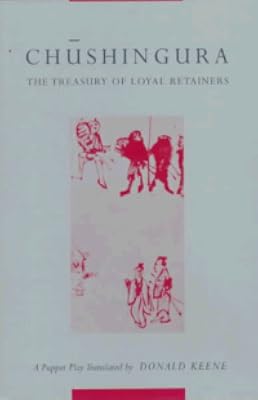
Chushingura (The Treasury of Loyal Retainers): A Puppet Play
by Takeda Izumo, Namiki Senryū (Author), Miyoshi Shōraku (Author)
On This Page
Description
"Chūshingura (The Treasury of Loyal Retainers), also known as the story of the Forty-Six (or Forty-Seven) Rōnin, is the most famous and perenially popular of all Japanese dramas. Written around 1748 as a puppet play, it is now better known in Kabuki performances. In the twentieth century, cinema and television versions have been equally successful. Donald Keene here presents a complete translation of the original text, with notes and an introduction that increase the reader's show more comprehension and enjoyment of the play. The introduction also elucidates the idea of loyalty. This traditional virtue, as exemplified in Chūshingura, has never completely lost its hold on audiences, in spite of twentieth-century changes in Japanese society and moral ideas. Moreover, as Professor Keene points out, the excitement, color and violence expressed in the play may be considered the counterpoint to the austere restraint and understatement which are more commonly thought to be "traditionally" Japanese."--Page 4 of cover. show lessTags
Recommendations









Member Reviews
This play is a retelling of a true story of Feudal Japan. The plot is filled with villians and heroes, and even if you aren't a fan of ritual suicide, much of the characters' motivations are easy to understand. Of all the renditions (and translations) of this classic tales, this is the best. It is essential reading for anyone interested in classical literature from East Asia.
I do not want to give too much of the plot away, since the play is very short and proves to be a very quick read. Chushingura is about samurai whose master is forced to commit seppuku (ritual suicide), making them ronin (master less samurai). They pledge to avenge the death of their late master and plan to attack the man who provoked their master to disgrace his honor. The play was written by three different playwrights, which is why some of the characters personalities change drastically throughout the play.
The play does an amazing job showing the devotion of samurai to their code of ethics and to their masters. The samurai believed in their duty to their master to the point that they would commit seppuku if they felt that they had show more disgraced their master in any way. It also shows how much the family of a samurai has to devote to the master, like the wives being sold as prostitutes to help fund the plan to avenge their late master.
The play was originally written for the puppet theater, bunraku, but was originally adapted into a play for the kabuki theater. Since the original play was written there have been numerous adaptations in film, novels, and television productions. The Sprouse twins (The Suite Life of Zack & Cody) have even made a graphic novel series called the 47 R.O.N.I.N., which has nothing to do with samurai's but involves ninjas and underground societies....
I would definitely recommend Chushingura to anyone who has a love of Japan or who find samurai interesting. I do not read many plays, but I was able to be enveloped in the story and was so compelled by it that I finished it the day that I started it. However if you have not seen any of the adaptations of the book, I would recommend saving the intro for last because it does give away many of the important twists and turns of the storyline which kind of ruined the shock factor of some of the famous parts of the play. show less
The play does an amazing job showing the devotion of samurai to their code of ethics and to their masters. The samurai believed in their duty to their master to the point that they would commit seppuku if they felt that they had show more disgraced their master in any way. It also shows how much the family of a samurai has to devote to the master, like the wives being sold as prostitutes to help fund the plan to avenge their late master.
The play was originally written for the puppet theater, bunraku, but was originally adapted into a play for the kabuki theater. Since the original play was written there have been numerous adaptations in film, novels, and television productions. The Sprouse twins (The Suite Life of Zack & Cody) have even made a graphic novel series called the 47 R.O.N.I.N., which has nothing to do with samurai's but involves ninjas and underground societies....
I would definitely recommend Chushingura to anyone who has a love of Japan or who find samurai interesting. I do not read many plays, but I was able to be enveloped in the story and was so compelled by it that I finished it the day that I started it. However if you have not seen any of the adaptations of the book, I would recommend saving the intro for last because it does give away many of the important twists and turns of the storyline which kind of ruined the shock factor of some of the famous parts of the play. show less
Translation of the most famous of the several plays based on the historical exploit of the 47 retainers who avnged the death of their lord
Oh, suicide and honor!
Ratings
Members
- Recently Added By
Author Information
6 Works 307 Members
Some Editions
Awards and Honors
Notable Lists
Series
Belongs to Publisher Series
Common Knowledge
- Original publication date
- 1748 (original Japanese) (original Japanese); 1971 (English: Keene) (English: Keene)
- People/Characters
- 47 Ronins
- First words
- NARRATOR:
"The sweetest food, if left untasted,
Remains unknown, its savor wasted."
The same holds true of a country at peace: the loyalty and courage of its fine soldiers remains hidden, but the stars, thoug... (show all)h invisible by day, at night reveal themselves, scattered over the firmament. - Last words
- (Click to show. Warning: May contain spoilers.)We have recorded here their glory, ever renewed like the leaves of the bamboo.
- Original language
- Japanese
Classifications
- Genre
- Fiction and Literature
- DDC/MDS
- 895.623 — Literature & rhetoric Literatures of other languages Literatures of East and Southeast Asia Japanese Japanese drama Edo period 1603–1868
- LCC
- PL794.6 .K3 .E5 — Language and Literature Languages and literatures of Eastern Asia, Africa, Oceania Languages of Eastern Asia, Africa, Oceania Japanese language and literature Japanese literature Individual authors and works
- BISAC
Statistics
- Members
- 288
- Popularity
- 112,098
- Reviews
- 4
- Rating
- (3.48)
- Languages
- English
- Media
- Paper
- ISBNs
- 4
- ASINs
- 4