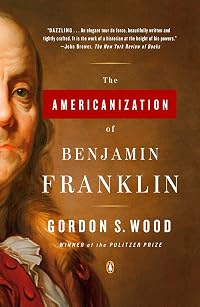
The Americanization of Benjamin Franklin
by Gordon S. Wood
On This Page
Description
Offers a portrait of the complex, often contradictory figure of Benjamin Franklin, a man who was at once the quintessential American and a cosmopolitan lover of Europe, and a one-time loyalist turned revolutionary.Tags
Recommendations









Member Reviews
This biography of Benjamin Franklin centers around how Franklin came to be viewed as the quintessential American and how he changed his views from a staunch loyalist to become one the key contributors to the American Revolution. It seeks to go beyond the familiar stories of his role as a founding father, writer of Poor Richard’s Almanac, and scientist conducting electricity experiments with kites. It shows Franklin as a man of many talents and experiences, who was decades older than his fellow founding fathers. It is definitely not a hagiography, as it shows Franklin’s foibles as well as his strengths. It provides a well-rounded view of Franklin as an author, printer, scientist, inventor, philosopher, and diplomat.
Franklin was born show more to a family of modest means and became a printer. He was looked down upon by the “gentlemen” of the era. A gentleman was born into wealth and was not required to work as a tradesman in order to produce income. Ironically, Franklin wanted to transform into a gentleman, a person of leisure who could be a patron to others, a goal which he eventually achieved. He has always been touted as the epitome of a self-made man but Franklin himself wanted to align with the landed gentry and benefitted from the assistance of wealthy patrons. It may come as a surprise to many Americans that Franklin started out as a confirmed British loyalist. He spent many years in England and would probably have stayed there if the British government has conceded to his requests. The narrative shows how his interactions with England’s government, and an attack on his character, changed his views drastically and led him to support the revolution. He was also a controversial figure during his lifetime and upon his death, was celebrated much more in France, where he spent eight of his happiest years, than in his home country.
Wood’s writing is organized, logical, well-researched, and focused. He cites many examples from various letters, journals, and Franklin’s autobiography, and uses them to highlight Franklin’s inconsistencies between what he outwardly stated and what he practiced in his private life. Wood provides insight on Ben Franklin’s character and brings to light many lesser known facts, exploding a few myths along the way.
The audio book is read by Peter Johnson, who does a good job with the performance. It kept me entertained for over eight hours on a driving trip. Recommended to those interested in US history, especially the lives of the founding fathers. show less
Franklin was born show more to a family of modest means and became a printer. He was looked down upon by the “gentlemen” of the era. A gentleman was born into wealth and was not required to work as a tradesman in order to produce income. Ironically, Franklin wanted to transform into a gentleman, a person of leisure who could be a patron to others, a goal which he eventually achieved. He has always been touted as the epitome of a self-made man but Franklin himself wanted to align with the landed gentry and benefitted from the assistance of wealthy patrons. It may come as a surprise to many Americans that Franklin started out as a confirmed British loyalist. He spent many years in England and would probably have stayed there if the British government has conceded to his requests. The narrative shows how his interactions with England’s government, and an attack on his character, changed his views drastically and led him to support the revolution. He was also a controversial figure during his lifetime and upon his death, was celebrated much more in France, where he spent eight of his happiest years, than in his home country.
Wood’s writing is organized, logical, well-researched, and focused. He cites many examples from various letters, journals, and Franklin’s autobiography, and uses them to highlight Franklin’s inconsistencies between what he outwardly stated and what he practiced in his private life. Wood provides insight on Ben Franklin’s character and brings to light many lesser known facts, exploding a few myths along the way.
The audio book is read by Peter Johnson, who does a good job with the performance. It kept me entertained for over eight hours on a driving trip. Recommended to those interested in US history, especially the lives of the founding fathers. show less
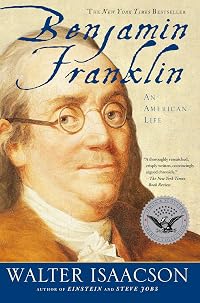
Over the past two months I have been reading two biographies about Benjamin Franklin. The biography written by Walter Isaacson is massive and aims for completeness. It describes every step in Franklin's life in meticulous detail. Hence, the amount of information is overwhelming and the whole is rather stodgy. Isaacson is the chief editor of CNN. Good scholarship, but obviously no vision.
The other biography focuses on one aspect of Benjamin Franklin, namely how he became the icon of America. The writing style of this book is much freer, much more enjoyable read. Wood provides a much clearer picture of Franklin, transcending the dusty sources, and doing more justice to other people in Franklin's life, particularly Deborah, his wife, and show more William, his son. Gordon S. Wood is a professor of history, specialized in the period of the formation of the American republic. His book is a pleasure to read, obviously Wood has a vision.
Obviously, it doesn't harm to read two books about Benjamin Franklin. show less
The other biography focuses on one aspect of Benjamin Franklin, namely how he became the icon of America. The writing style of this book is much freer, much more enjoyable read. Wood provides a much clearer picture of Franklin, transcending the dusty sources, and doing more justice to other people in Franklin's life, particularly Deborah, his wife, and show more William, his son. Gordon S. Wood is a professor of history, specialized in the period of the formation of the American republic. His book is a pleasure to read, obviously Wood has a vision.
Obviously, it doesn't harm to read two books about Benjamin Franklin. show less
Gordon Wood is really one of my favorite historians. What I think he does particularly well is to put the American revolution in the context of wider worldwide events and intellectual movements. The revolution for Wood is not in isolation but to be understood in wider circles of Enlightenment philosophy, European rivalry, as well as post-revolutionary needs for symbols. I'm not a fan of blatant revisionism for revisionism's sake, but I think Wood's original and creative ways of interpreting history adds to our understanding in a solid way. In his book about Benjamin Franklin he seriously challenges the myths that have grown up around the founding father. He's done a great job of both bebunking or at least qualifying some of the mythical show more characteristics as well as explaining how and why these myths arose in the first place. Wood really tries to dig into how Franklin felt and his ideologies, which are complex and dynamic; this makes the book somewhat speculative at points, but I think that's the nature of historical scholarship. The biography is structured well, focusing on some key moments rather than Franklin's entire life and written in a clear simple matter. One of Wood's greatest strengths is to express complicated ideas in simple language and make academica more accessible to all. A great short read for anyone interested in American history. show less
It’s important to understand that this is not a biography of Franklin in the normal sense. It does tell the story of his life and his rise to political influence, but it’s more about how his reputation and image was molded into something different over the years. Wood’s goal was to remove the myths and get to the heart of who Ben Franklin truly was, but answering that question isn’t as easy as it sounds.
Franklin was the youngest son of 17 children. Despite his huge family and low stature, he managed to get a position as a printer’s apprentice and start to learn a trade. He was one of the first truly a self-made men in America. Over the years he wrote columns for his newspaper under dozens of pseudonyms. He was vocal about his show more beliefs and never shied away from stating an opinion, though he might only do it anonymously.
He was a scientist, political leader, ambassador, inventor, post master, printer, free mason, and a self-made gentleman. He fell hard for London society and then later France, and lived in both places for years. It was interesting to learn that he was a staunch loyalist to the crown until late in life when he felt like he had been passed over for a position in England.
Over the centuries his image has been distorted by historians. He is sometimes painted as prudish, miserly, or as the all-American tradesman. Depending on what the historian decided he needed, Franklin’s legacy was warped to fit a mold. His incredible talent as an ambassador was often overlooked.
It felt like the author admired his influence, but he didn’t like him as a man. Honestly, the more I learned about his personal life the less I respected him. When he lived in England he left his wife and daughter in America, rarely writing them and skipping his daughter’s wedding. He took his illegitimate son with him, but later disowned the son when he was loyal to the country (England) that Ben Franklin had taught him to love.
BOTTOM LINE: Wood paints an honest portrait of Franklin. There are no rosy glasses with which to view his life, but he sticks to the facts and I appreciated the candid portrayal. I am in awe of how much Franklin did for our country, especially since he received little thanks for it. No man is perfect and Franklin’s impact on the founding of our Nation and the alliance that was formed with France was truly priceless.
“‘The players of our game are so many,’ he told a French correspondent. ‘Their ideas so different, their prejudices so strong and so various and their particular interests independent of the general, seeming so opposite that not a move can be made that is not contested. The numerous objections confound the understanding. The wisest must agree to some unreasonable things that reasonable ones of more consequence may be obtained and thus chance has its share in many of the determinations so that the play is more like trick track with a box of dice.’” show less
Franklin was the youngest son of 17 children. Despite his huge family and low stature, he managed to get a position as a printer’s apprentice and start to learn a trade. He was one of the first truly a self-made men in America. Over the years he wrote columns for his newspaper under dozens of pseudonyms. He was vocal about his show more beliefs and never shied away from stating an opinion, though he might only do it anonymously.
He was a scientist, political leader, ambassador, inventor, post master, printer, free mason, and a self-made gentleman. He fell hard for London society and then later France, and lived in both places for years. It was interesting to learn that he was a staunch loyalist to the crown until late in life when he felt like he had been passed over for a position in England.
Over the centuries his image has been distorted by historians. He is sometimes painted as prudish, miserly, or as the all-American tradesman. Depending on what the historian decided he needed, Franklin’s legacy was warped to fit a mold. His incredible talent as an ambassador was often overlooked.
It felt like the author admired his influence, but he didn’t like him as a man. Honestly, the more I learned about his personal life the less I respected him. When he lived in England he left his wife and daughter in America, rarely writing them and skipping his daughter’s wedding. He took his illegitimate son with him, but later disowned the son when he was loyal to the country (England) that Ben Franklin had taught him to love.
BOTTOM LINE: Wood paints an honest portrait of Franklin. There are no rosy glasses with which to view his life, but he sticks to the facts and I appreciated the candid portrayal. I am in awe of how much Franklin did for our country, especially since he received little thanks for it. No man is perfect and Franklin’s impact on the founding of our Nation and the alliance that was formed with France was truly priceless.
“‘The players of our game are so many,’ he told a French correspondent. ‘Their ideas so different, their prejudices so strong and so various and their particular interests independent of the general, seeming so opposite that not a move can be made that is not contested. The numerous objections confound the understanding. The wisest must agree to some unreasonable things that reasonable ones of more consequence may be obtained and thus chance has its share in many of the determinations so that the play is more like trick track with a box of dice.’” show less
What I admired most about Wood's writing in this brief so-called biography of good ol' Ben is his research. It's almost as if Wood spent the time reading as many books about BF as were available; then he sat back and gave his overall summation and discerning light on key aspects of BF's life--especially in the attempt to debunk the myths many of us have associated with BF over the 200+ years of our history. I appreciated this wide-scope approach and felt as if I were in capable hands as Wood expertly touched on how this once fervently loyal man to the English crown became as fervently loyal to the revolution against said crown and reemerged as one of our most zealous Founding Fathers.
I must say this was a tough dose of reality to read; Ben Franklin has been my favorite Founding Fathers for a while now, but I never really knew him in such a three dimensional way until now.
In modern times, the Founders are either lauded or loathed. I generally distrust the lamenting accounts of these men, and to a fault, I trust elevating biographies of our country's founders. Yet Gordon S. Wood writes a book which is flat out honest and does not power the chaff. I underlined two sentences from the book's introduction which illustrate the notion I have come to find from reading so many biographies.
The first line I think best speaks to the honest of The Americanization of Benjamin Franklin reads: "We have more than two hundred years show more of images imposed on Franklin that have to be peeled away before we can recover the man who existed before the Revolution." Mr Wood speaks to the cyclical pattern of biographical accounts across the centuries since Dr. Franklin's passing. First, authors were approbative over the first couple of generations post-Revolution which slowly evolved to antagonistic writings as in a counterculture vein to discredit his fixation on the monetary, but more recent, the pendulum has swung back to the laudatory, downplaying his shortcomings and misgivings.
This book appears to faithfully whisk the reader along as Franklin's star rises with his success, ingenuity, and industry. He becomes world renown for his science and philosophic works; always involved in politics, he is incrementally prepared for the world stage and falls in love with Europe. In modern times we might consider Dr. Franklin to have become wealthy enough for "early retirement" or a gentlemen. From this point he delves into international politics. This is where the book grows morose only for the reason Dr. Franklin's life becomes less cheerful as well. The best way to describe Benjamin Franklin in London is similar to the son of parents living in an abusive relationship. Franklin, working in a official capacity, continually attempts to maintain and repair relations, trying to smooth over rough patches between Continental Congress and Parliament. Like a child who witnesses abuse between his parents, he doesn't full grasp the climate of America and cannot see the detriment the Crown is causing to its relationship with its transatlantic colony. Trying to not pick sides, the child attempts to involve himself in a situation he does neither fully understand nor sees both sides, yet tries to help anyway. Minister Franklin loses the palpable pulse of America while soaking in the splendor of London and government life. As with a child of the couple who fights and threatens each other, Franklin is distrusted by Americans and later publicly berated by England's government. He will have a similar experience as he fails to understand his reputation is suffering while in France; he will be treated better by France than he was England. Unfortunately, the Americans, as Franklin writes later, will accuse him of something short of treason.
As a scientist he excelled, yet as a politician, he got by on his reputation. Like a book-smart person, who often lacks street-smarts, he greatly failed to understand (or purposely ignored out of indifference) the political implications and feelings most of the time. Mr Wood writes that, while in France, the country was crawling with spies, Dr. Franklin couldn't care less if he was involved with any because he knew personally he was above espionage; in a Pollyanna sense, he let his reputation insulate him from suspicion of being duplicitous in traitorous activity. It really didn't protect him. As the book concludes, it is very sad to realize Dr. Franklin received a less than reasonable eulogy and his legacy was shrouded in a cloud of near indifference.
As I began my review, I primarily had read books that presented Benjamin Franklin as a man who could do no wrong, mentally agile up to the day he died and shrewdly astute in politics just as he was with science. In some sense, he was knocked down a peg for me, but it simultaneously made him more human as well. He still has a great story of success in achieving what he wanted, reaching gentleman status and breaking the birthright barrier. Having labored as a printer to the chagrin of the class he emulated, he strove to become a member of the upper class, once only attainable by birthright and not merely monetary value. As his popularity waned in America he realized work was commendable, and once again championed the laborer just as much as he hailed the gentry.
The second passage I made note of speaks to this: "Consequently, despite hundreds of biographies and studies of Franklin and over three dozen volumes of papers,... we still do not fully know the man." Gordon S. Wood's book is a great start. show less
In modern times, the Founders are either lauded or loathed. I generally distrust the lamenting accounts of these men, and to a fault, I trust elevating biographies of our country's founders. Yet Gordon S. Wood writes a book which is flat out honest and does not power the chaff. I underlined two sentences from the book's introduction which illustrate the notion I have come to find from reading so many biographies.
The first line I think best speaks to the honest of The Americanization of Benjamin Franklin reads: "We have more than two hundred years show more of images imposed on Franklin that have to be peeled away before we can recover the man who existed before the Revolution." Mr Wood speaks to the cyclical pattern of biographical accounts across the centuries since Dr. Franklin's passing. First, authors were approbative over the first couple of generations post-Revolution which slowly evolved to antagonistic writings as in a counterculture vein to discredit his fixation on the monetary, but more recent, the pendulum has swung back to the laudatory, downplaying his shortcomings and misgivings.
This book appears to faithfully whisk the reader along as Franklin's star rises with his success, ingenuity, and industry. He becomes world renown for his science and philosophic works; always involved in politics, he is incrementally prepared for the world stage and falls in love with Europe. In modern times we might consider Dr. Franklin to have become wealthy enough for "early retirement" or a gentlemen. From this point he delves into international politics. This is where the book grows morose only for the reason Dr. Franklin's life becomes less cheerful as well. The best way to describe Benjamin Franklin in London is similar to the son of parents living in an abusive relationship. Franklin, working in a official capacity, continually attempts to maintain and repair relations, trying to smooth over rough patches between Continental Congress and Parliament. Like a child who witnesses abuse between his parents, he doesn't full grasp the climate of America and cannot see the detriment the Crown is causing to its relationship with its transatlantic colony. Trying to not pick sides, the child attempts to involve himself in a situation he does neither fully understand nor sees both sides, yet tries to help anyway. Minister Franklin loses the palpable pulse of America while soaking in the splendor of London and government life. As with a child of the couple who fights and threatens each other, Franklin is distrusted by Americans and later publicly berated by England's government. He will have a similar experience as he fails to understand his reputation is suffering while in France; he will be treated better by France than he was England. Unfortunately, the Americans, as Franklin writes later, will accuse him of something short of treason.
As a scientist he excelled, yet as a politician, he got by on his reputation. Like a book-smart person, who often lacks street-smarts, he greatly failed to understand (or purposely ignored out of indifference) the political implications and feelings most of the time. Mr Wood writes that, while in France, the country was crawling with spies, Dr. Franklin couldn't care less if he was involved with any because he knew personally he was above espionage; in a Pollyanna sense, he let his reputation insulate him from suspicion of being duplicitous in traitorous activity. It really didn't protect him. As the book concludes, it is very sad to realize Dr. Franklin received a less than reasonable eulogy and his legacy was shrouded in a cloud of near indifference.
As I began my review, I primarily had read books that presented Benjamin Franklin as a man who could do no wrong, mentally agile up to the day he died and shrewdly astute in politics just as he was with science. In some sense, he was knocked down a peg for me, but it simultaneously made him more human as well. He still has a great story of success in achieving what he wanted, reaching gentleman status and breaking the birthright barrier. Having labored as a printer to the chagrin of the class he emulated, he strove to become a member of the upper class, once only attainable by birthright and not merely monetary value. As his popularity waned in America he realized work was commendable, and once again championed the laborer just as much as he hailed the gentry.
The second passage I made note of speaks to this: "Consequently, despite hundreds of biographies and studies of Franklin and over three dozen volumes of papers,... we still do not fully know the man." Gordon S. Wood's book is a great start. show less
The Benjamin Franklin of this history is both a legendary Founding Father and a man who changes as the circumstances around him shift. He begins as a businessman, becomes a scientist, philosopher, and public servant. He spends many years in London and expresses views in line with British imperialism. Then, as the American colonies move towards revolution, Franklin shifts again - becoming an American and a diplomat. This volume highlights these changes in Franklin's views and makes for a fascinating read on one of the most remarkable founders.
Members
- Recently Added By
Author Information

37+ Works 10,155 Members
History professor and award-winning author Gordon S. Wood was born in Concord, Massachusetts on November 27, 1933. After graduating in 1955 from Tufts University he served in the US Air Force in Japan and earned his master's degree from Harvard University. In 1964, Wood earned his Ph. D. in history from Harvard, and he taught there, as well as at show more the College of William and Mary and the University of Michigan, before joining the Brown University faculty in 1969. Wood has published a number of articles and books, including The Creation of the American Republic, 1776-1787, which won the Bancroft Prize and the John H. Dunning Prize in 1970, and The Radicalism of the American Revolution, winner of the Pulitzer Prize for History and the Ralph Waldo Emerson Prize in 1993. He has won many other awards in the past five decades from organizations such as the American Historical Association, the New York Historical Society, and the Fraunces Tavern Museum. Wood is a fellow of both the American Academy of Arts and Sciences and the American Philosophical Society. In 2014, his book, The American Revolution: A History, was on the New York Times bestseller list. (Bowker Author Biography) show less
Some Editions
Awards and Honors
Awards
Distinctions
Common Knowledge
- Original publication date
- 2004
- People/Characters
- Benjamin Franklin; John Adams; Peter Collinson; Deborah Read Franklin; William Franklin; Thomas Hutchinson (show all 11); John Jay; Thomas Jefferson; Thomas Penn; William Strahan; George Washington
- Important places
- Boston, Massachusetts, USA; France; United Kingdom; Pennsylvania, USA; Philadelphia, Pennsylvania, USA
- Important events
- American Revolution (1775 | 1783)
- Dedication
- To Christopher, Elizabeth and Amy
- First words
Benjamin Franklin has a special place in the hearts and minds of Americans. He is, of course, one of the most preeminent of the founders, those heroic men from the era of wigs and knee breeches. Men as diverse as Henry C... (show all)abot Lodge to George Wills have ranked him along with Washington as the greatest of the Founders.- Last words
- (Click to show. Warning: May contain spoilers.)And as long as America is seen as the land of opportunity, where you can get ahead if you work hard, this image of Franklin will likely be the one that continues to dominate American culture.
- Blurbers
- Morgan, Edmund; Chernow, Ron; Isaacson, Walter; Oberg, Barbara; Ellis, Joseph J.
- Original language
- English US
Classifications
- Genres
- History, Nonfiction, Biography & Memoir, General Nonfiction
- DDC/MDS
- 973.3092 — History & geography History of North America United States Revolutionary War (1775-89) Personal narratives--American Revolution
- LCC
- E302.6 .F8 .W84 — History of the United States United States Revolution to the Civil War, 1775/1783-1861 Biography (Late eighteenth century)
- BISAC
Statistics
- Members
- 1,327
- Popularity
- 18,242
- Reviews
- 26
- Rating
- (3.85)
- Languages
- English
- Media
- Paper, Audiobook, Ebook
- ISBNs
- 12
- UPCs
- 1
- ASINs
- 8