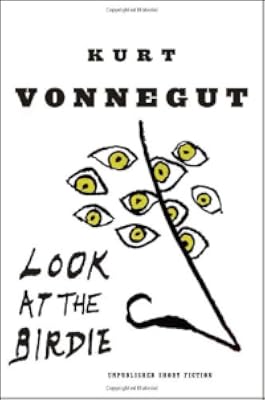
Look at the Birdie: Unpublished Short Fiction
by Kurt Vonnegut
On This Page
Description
A volume of fourteen early and previously unpublished short works offers insight into the social satirist's developing literary style and includes pieces that explore such themes as innocence, ironic twists of fate, and morality.Tags
Recommendations




















Member Reviews
Anyone who's read through any of my reviews could probably guess that the passing of Kurt Vonnegut two and a half years ago was, to me, a major and devastating loss for the literary world. Though I have always been ambivalent about posthumous collections, I still looked very much forward to Look at the Birdie, the first collection of fiction to be published since his death. And I am pleased to say that this volume does not disappoint.
As the brief introduction by Sidney Offit explains, though these works were left unpublished throughout the author's lifetime, it is hard to see why. Each story possesses Vonnegut's characteristic style: brevity, concision, and economy. Most every story in the collection is less than 20 pages, and gets to show more its point in a direct and efficient manner. The title story, for instance, consists almost entirely of a brief dialogue between two men, one of whom blackmails the other by manipulating a secret that is both absurd and horrifying. It's a perfect example of how Vonnegut does so much with so little.
Some of the stories, of course, fall a bit short of the mark. While the first tale in the collection, "Confido," has elements of vintage post-WWII Vonnegut--such as family life, a sci-fi element, and the function (and fear) of advancing technology--the ultimate resolution of the tale feels a bit more trite than I think Vonnegut would be satisfied with. However, even at their weakest moments, stories like this are surprisingly memorable because you get a sense that the author has, if nothing else, complete command of the theme. They may not be memorable, but they're certainly not forgettable.
There are, however, pure gems here, the most obvious of which is also the longest story in the collection, "Ed Luby's Key Club." Vonnegut does a masterful job of portraying the dark underbelly of small-town life by putting two well-meaning, innocent people in a horrible and desperate situation, set up to be convicted for a crime they had no part in. The story does an amazing job of establishing and maintaining a feeling of hopelessness, punctuated well by the glimmer of hope that refuses to die. The ending, sadly, is handled a bit sloppily, but the forty pages that lead up to it are, dare I say it, among some of the best Vonnegut has ever written.
Some of the other highlights of the collection include the darkly mysterious "Hall of Mirrors," the triumphant "FUBAR," and the O. Henry-esque "The Nice Little People." Each of those stories represents the variety of styles Vonnegut employs, and is a testament to his versatility as a craftsman. As a whole, the volume is perhaps best summarized through the final story, "The Good Explainer": it is, as the best of Vonnegut, all about people and the difficulty they have finding things as simple as happiness and satisfaction. It is yet another gift from beyond the grave, and I can only hope will become a point of entry from a whole new generation to explore and appreciate Vonnegut's genius. show less
As the brief introduction by Sidney Offit explains, though these works were left unpublished throughout the author's lifetime, it is hard to see why. Each story possesses Vonnegut's characteristic style: brevity, concision, and economy. Most every story in the collection is less than 20 pages, and gets to show more its point in a direct and efficient manner. The title story, for instance, consists almost entirely of a brief dialogue between two men, one of whom blackmails the other by manipulating a secret that is both absurd and horrifying. It's a perfect example of how Vonnegut does so much with so little.
Some of the stories, of course, fall a bit short of the mark. While the first tale in the collection, "Confido," has elements of vintage post-WWII Vonnegut--such as family life, a sci-fi element, and the function (and fear) of advancing technology--the ultimate resolution of the tale feels a bit more trite than I think Vonnegut would be satisfied with. However, even at their weakest moments, stories like this are surprisingly memorable because you get a sense that the author has, if nothing else, complete command of the theme. They may not be memorable, but they're certainly not forgettable.
There are, however, pure gems here, the most obvious of which is also the longest story in the collection, "Ed Luby's Key Club." Vonnegut does a masterful job of portraying the dark underbelly of small-town life by putting two well-meaning, innocent people in a horrible and desperate situation, set up to be convicted for a crime they had no part in. The story does an amazing job of establishing and maintaining a feeling of hopelessness, punctuated well by the glimmer of hope that refuses to die. The ending, sadly, is handled a bit sloppily, but the forty pages that lead up to it are, dare I say it, among some of the best Vonnegut has ever written.
Some of the other highlights of the collection include the darkly mysterious "Hall of Mirrors," the triumphant "FUBAR," and the O. Henry-esque "The Nice Little People." Each of those stories represents the variety of styles Vonnegut employs, and is a testament to his versatility as a craftsman. As a whole, the volume is perhaps best summarized through the final story, "The Good Explainer": it is, as the best of Vonnegut, all about people and the difficulty they have finding things as simple as happiness and satisfaction. It is yet another gift from beyond the grave, and I can only hope will become a point of entry from a whole new generation to explore and appreciate Vonnegut's genius. show less
I liked these much more than I expected, given the quality of so much of his later work. Or maybe it just hit me at the right time. I'd say at least one star is purely for nostalgia's sake.
At the very least, Ed Luby's Key Club is amazing and defiant. Like "First Blood" without the violence and "realism."
At the very least, Ed Luby's Key Club is amazing and defiant. Like "First Blood" without the violence and "realism."
I really enjoyed this collection from earlier in his career. Most of these lack the edge of some of his later works, but I enjoyed the way the stories were crafted and the simple humanity of them. I particularly enjoyed A Song for Selma and King and Queen of the Universe and I think it was that humanity that appealed to me.
This was another good collection of short stories by Kurt Vonnegut. He managed to surprise me with many of them, not only holding my attention and entertaining me, but providing meaning and closure in nearly all of his tales. If you're a Vonnegut fan, you really should read this collection.
4.25 stars.
4.25 stars.
I love the idea of sharing short stories with students. I was once told by a writer friend of mine that short stories are only read by writers of short stories. I hope to be a soldier of change in that I love the short story and I think everyone should read them. On top of my love for short stories, I love Kurt Vonnegut. This particular collection of his short stories, published after his death, has a few lesser known of his stories including a very funny story of a man in the clutches of bureaucracy, but finally set free by a young secretary. It is a quick read, and it may be a good way to set an author’s work against itself as many genres and varying styles are collected in a single book and by the same man.
Having not read any Vonnegut in many years, it was a pleasure to read these stories. Not all of them hit the high mark that I came to expect from the author, but it was fun to get back into his unique way of looking at things. He was great at building absurdity upon absurdity. Not sure how much younger readers are into Vonnegut but they should definitely read his classics.
I'm so glad someone decided to put all these "lost" stories in this fine collection. Hall of Mirrors and the title story; Look at the Birdie were probably my two favorite with Petrified Ants being my least. I have to admit though that Petrified Ants was not what I expected. I enjoyed the story of the ants more than I did the characters in the same story. All in all a good read for some previously unpublished stories.
Members
- Recently Added By
Published Reviews
ThingScore 88
The 14 stories in “Look at the Birdie,” none of them afraid to entertain, dabble in whodunnitry, science fiction and commanding fables of good versus evil. Why these stories went unpublished is hard to answer. They’re polished, they’re relentlessly fun to read, and every last one of them comes to a neat and satisfying end.
added by Shortride
This is a collection of fiction plus one letter of “sententious crap” unpublished in Vonnegut’s lifetime. The stories appear to have been written for the most part in the 1950s; one even mentions King Farouk. Sparingly interspersed through the book are Vonnegut’s own illustrations in his naïve style. They too appear of 1950s vintage though their copyright dates are much show more later.
Throughout, Vonnegut’s tendency to name his characters strikingly is to the fore; Ernest Groper, K Hollomon Weems, Felix Karadubian. Vonnegut’s characteristic dry style is also evident. He seems to have found his voice early. Though he made his name writing SF, before later disclaiming it, most of the tales here are devoid of speculative content.
The two stories that might vaguely be called SF are “Confido” and “The Petrified Ants.” In the first an ear piece designed to make people happy is “a combination of confidant and a household pet” but whispers only the worst of others. I trust Vonnegut was aware of the Latin pun of his title. The second is set in the Erzgebirge mountains in Soviet era Czechoslovakia where some newly uncovered fossils reveal ants once behaved individualistically. The revelation of their change to collectivity is hurried, though, and stretches credibility. The story is fun but too heavy-handed in its allegorisation of Soviet society.
As to the rest of the fiction, “FUBAR” is a gentle but utterly conventional story in which a crabbed bureaucrat begins to awaken to the possibility of a different kind of life when a newly trained young secretary is assigned to him. The 1950s ambience here is revealed by the F in FUBAR standing for “fouled” rather than anything more demotic.
“Shout About it from the Housetops” examines the deleterious consequences of publishing a novel whose characters are based on barely disguised neighbours, friends and the author’s spouse.
The two-part “Ed Luby’s Key Club” deals with Harve Elliot, who, along with his wife, Claire, witnesses a murder by the local gang boss. Both are then accused of it themselves. In the second part Harve alone escapes from custody and attempts to vindicate himself. The story’s conclusion, while worthy, is perhaps a little too complacent.
“A Song for Selma” tells how people’s aspirations can be transformed, for good or ill, by their expectations of themselves as mediated through those of others.
In “Hall of Mirrors” a hypnotist uses his powers to evade the police when they come to investigate the disappearances of his wealthy women clients.
“Hello, Red” is the story of a bitter wandering sailor’s return to his home town to try to claim guardianship of the distinctively flame haired daughter he fathered before his first trip abroad, and of her reaction to him.
“Little Drops of Water” concerns the subtle strategy employed by one former conquest to gain her revenge after being dumped by a confirmed ladies’ man of fixed habits.
In “Look at the Birdie” an encounter in a bar with a disgraced former psychiatrist who insists his wife photographs the narrator leads to a demand that can’t be refused.
“King and Queen of the Universe” has a very well to do teenaged couple in the Depression era on their way home from a party come face to face with the harsher realities of less privileged lives.
“The Good Explainer” is the doctor to whom a man and wife travel from Cincinnati to Chicago in order to have the reasons for their childlessness laid bare.
While all the stories in the book are never less than readable, they do not represent Vonnegut at his best. Among other faults they are too often prefaced by a brief paragraph or two of scene setting which are told to, rather than unfolded for, us and there is a tendency to repetition of such things as job titles.
Recommended to Vonnegut completists but not as an introduction to his work. show less
Throughout, Vonnegut’s tendency to name his characters strikingly is to the fore; Ernest Groper, K Hollomon Weems, Felix Karadubian. Vonnegut’s characteristic dry style is also evident. He seems to have found his voice early. Though he made his name writing SF, before later disclaiming it, most of the tales here are devoid of speculative content.
The two stories that might vaguely be called SF are “Confido” and “The Petrified Ants.” In the first an ear piece designed to make people happy is “a combination of confidant and a household pet” but whispers only the worst of others. I trust Vonnegut was aware of the Latin pun of his title. The second is set in the Erzgebirge mountains in Soviet era Czechoslovakia where some newly uncovered fossils reveal ants once behaved individualistically. The revelation of their change to collectivity is hurried, though, and stretches credibility. The story is fun but too heavy-handed in its allegorisation of Soviet society.
As to the rest of the fiction, “FUBAR” is a gentle but utterly conventional story in which a crabbed bureaucrat begins to awaken to the possibility of a different kind of life when a newly trained young secretary is assigned to him. The 1950s ambience here is revealed by the F in FUBAR standing for “fouled” rather than anything more demotic.
“Shout About it from the Housetops” examines the deleterious consequences of publishing a novel whose characters are based on barely disguised neighbours, friends and the author’s spouse.
The two-part “Ed Luby’s Key Club” deals with Harve Elliot, who, along with his wife, Claire, witnesses a murder by the local gang boss. Both are then accused of it themselves. In the second part Harve alone escapes from custody and attempts to vindicate himself. The story’s conclusion, while worthy, is perhaps a little too complacent.
“A Song for Selma” tells how people’s aspirations can be transformed, for good or ill, by their expectations of themselves as mediated through those of others.
In “Hall of Mirrors” a hypnotist uses his powers to evade the police when they come to investigate the disappearances of his wealthy women clients.
“Hello, Red” is the story of a bitter wandering sailor’s return to his home town to try to claim guardianship of the distinctively flame haired daughter he fathered before his first trip abroad, and of her reaction to him.
“Little Drops of Water” concerns the subtle strategy employed by one former conquest to gain her revenge after being dumped by a confirmed ladies’ man of fixed habits.
In “Look at the Birdie” an encounter in a bar with a disgraced former psychiatrist who insists his wife photographs the narrator leads to a demand that can’t be refused.
“King and Queen of the Universe” has a very well to do teenaged couple in the Depression era on their way home from a party come face to face with the harsher realities of less privileged lives.
“The Good Explainer” is the doctor to whom a man and wife travel from Cincinnati to Chicago in order to have the reasons for their childlessness laid bare.
While all the stories in the book are never less than readable, they do not represent Vonnegut at his best. Among other faults they are too often prefaced by a brief paragraph or two of scene setting which are told to, rather than unfolded for, us and there is a tendency to repetition of such things as job titles.
Recommended to Vonnegut completists but not as an introduction to his work. show less
added by jackdeighton
Lists

Books Read in 2015
3,299 works; 129 members

Penguin Random House
458 works; 4 members
Author Information

296+ Works 201,526 Members
The appeal of Kurt Vonnegut, especially to bright younger readers of the past few decades, may be attributed partly to the fact that he is one of the few writers who have successfully straddled the imaginary line between science-fiction/fantasy and "real literature." He was born in Indianapolis and attended Cornell University, but his college show more education was interrupted by World War II. Captured during the Battle of the Bulge and imprisoned in Dresden, he received a Purple Heart for what he calls a "ludicrously negligible wound." After the war he returned to Cornell and then earned his M.A. at the University of Chicago.He worked as a police reporter and in public relations before placing several short stories in the popular magazines and beginning his career as a novelist. His first novel, Player Piano (1952), is a highly credible account of a future mechanistic society in which people count for little and machines for much. The Sirens of Titan (1959), is the story of a playboy whisked off to Mars and outer space in order to learn some humbling lessons about Earth's modest function in the total scheme of things. Mother Night (1962) satirizes the Nazi mentality in its narrative about an American writer who broadcasts propaganda in Germany during the war as an Allied agent. Cat's Cradle (1963) makes use of some of Vonnegut's experiences in General Electric laboratories in its story about the discovery of a special kind of ice that destroys the world. God Bless You, Mr. Rosewater (1965) satirizes a benevolent foundation set up to foster the salvation of the world through love, an endeavor with, of course, disastrous results. Slaughterhouse-Five; or The Children's Crusade (1969) is the book that marked a turning point in Vonnegut's career. Based on his experiences in Dresden, it is the story of another Vonnegut surrogate named Billy Pilgrim who travels back and forth in time and becomes a kind of modern-day Everyman. The novel was something of a cult book during the Vietnam era for its antiwar sentiments. Breakfast of Champions (1973), the story of a Pontiac dealer who goes crazy after reading a science fiction novel by "Kilgore Trout," received generally unfavorable reviews but was a commercial success. Slapstick (1976), dedicated to the memory of Laurel and Hardy, is the somewhat wacky memoir of a 100-year-old ex-president who thinks he can solve society's problems by giving everyone a new middle name. In addition to his fiction, Vonnegut has published nonfiction on social problems and other topics, some of which is collected in Wampeters, Foma and Granfalloons (1974). He died from head injuries sustained in a fall on April 11, 2007. (Bowker Author Biography) show less
Some Editions
Series
Belongs to Publisher Series
Work Relationships
Contains
Common Knowledge
- Canonical title
- Look at the Birdie: Unpublished Short Fiction
- Original title
- Look at the Birdie: Unpublished Short Fiction
- Original publication date
- 2009-10-20
- First words
- Dear Miller:
Thought, rather fuzzily, about something I want to add to my recent letter to you. - Original language
- English
- Disambiguation notice
- A collection containing the following stories and essays:
- Foreword (by Sidney Offit)
- Letter from Kurt Vonnegut, Jr., to Miller Harris, 1951
- Confido
- FUBAR
- Shout About It from the Housetops<... (show all)br>
- Ed Luby's Key Club
- A Song for Selma
- Hall of Mirrors
- The Nice Little People
- Hello, Red
- Little Drops of Water
- The Petrified Ants
- The Honor of a Newsboy
- Look at the Birdie
- King and Queen of the Universe
- The Good Explainer
Classifications
Statistics
- Members
- 1,174
- Popularity
- 21,399
- Reviews
- 18
- Rating
- (3.81)
- Languages
- 12 — Czech, English, French, German, Hungarian, Italian, Japanese, Polish, Romanian, Russian, Spanish, Turkish
- Media
- Paper, Audiobook, Ebook
- ISBNs
- 22
- ASINs
- 11