The Trees of Pride
by G. K. Chesterton
On This Page
Description
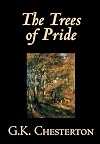
The Trees of Pride is another bestselling novella by the G.K. Chesterton. It is basically a four-chapter mystery story with the usual overtones Chesterton often adorns his stories with, overtones related to the belief in paranormal phenomena and in metaphysics. The victim of Chesterton's satire and sarcasm this time is a noble man from Cornwall named Squire Vane. Vane is a too rationalist man who rejects all form of belief in the supernatural. He strongly dismisses the superstitions becoming show more more and more popular in the village and which hover around a number of exotic trees that his ancestors brought from Africa. The legend goes that such trees are malignant and are responsible for the spread of disease and malevolence in the village. When Squire Vane is once provoked by the comments of his friends on the subject of the trees, he challenges them by deciding to go to see the trees by night in order to prove all superstitions wrong. However, his act only succeeds in reinforcing the villagers' suspicions when he mysteriously disappears that very night. By refusing to provide any rational explanation of the squire's disappearance, the author of The Trees of Pride obviously warns his readers of the Christian sin of pride.. show less
Tags
Recommendations


















Member Reviews
If you've read a lot of Chesterton's mysteries, you see many of the twists of this one coming. Upon the first meeting of the poet and the nobleman's daughter, you can guess how that's going to turn out- it's a favorite Chesterton trope. Likewise with the eventual resolution, which I'll admit I didn't have pegged down exactly, but with Chesterton you know that there's going to be something that reveals the story as not exactly how you assumed it to be. I really should have guessed the solution given that one of Chesterton's favorite drums to beat (which I find incredibly annoying) is the wisdom of the superstitions of the poor and the foolishness of the nobility for not paying those superstitions more heed. In both essays and stories show more alike Chesterton asserts that the educated world doesn't believe in things like ghosts because the common person does, and because the common person does the rest reject it out of hand. This never struck me as true- people of all classes believe such things, since money can't buy an understanding of the scientific method.
Anyway, back to the story, it didn't have many memorable lines like I'm used to for Chesterton, as there wasn't any character energetic enough and Chesterton-esque enough to deliver them. In some ways this was one of the most straight-forward mysteries I've ever read by Chesterton, with the main characters questioning suspects and gathering clues and analyzing the evidence. Unfortunately, the boilerplate mystery elements aren't what I go to Chesterton for. There wasn't the joy and happiness that usually characterizes many of Chesterton's stories, even those stories that are murder mysteries. In the end, therefore, I found this story serviceable, but it's not as good as the best Chesterton mysteries- Father Brown mysteries and The Club of Queer Trades both outshine this story in a myriad of ways. Still, I'd take mediocre Chesterton over the best works of most other authors any day of the week. show less
Anyway, back to the story, it didn't have many memorable lines like I'm used to for Chesterton, as there wasn't any character energetic enough and Chesterton-esque enough to deliver them. In some ways this was one of the most straight-forward mysteries I've ever read by Chesterton, with the main characters questioning suspects and gathering clues and analyzing the evidence. Unfortunately, the boilerplate mystery elements aren't what I go to Chesterton for. There wasn't the joy and happiness that usually characterizes many of Chesterton's stories, even those stories that are murder mysteries. In the end, therefore, I found this story serviceable, but it's not as good as the best Chesterton mysteries- Father Brown mysteries and The Club of Queer Trades both outshine this story in a myriad of ways. Still, I'd take mediocre Chesterton over the best works of most other authors any day of the week. show less
Další z Chestertonových "detektivek", varujících různým způsobem klasickou detektivkovou formu a zároveň, sdělující v autorových očích určité podstatné a zásadní postřehy a myšlenky. Příběhy rozhodně nejsou tak dobré jako ty Brownovy, ale jejich literární kvality, stejně jako míru humoru jest dost těžké hodnotit. Český překlad z dvacátých let je opět neobyčejně mizerný...
Apr 4, 2012Czech
Ratings
Members
- Recently Added By
Author Information

797+ Works 60,048 Members
Gilbert Keith Chesterton was born in London, England, in 1874. He began his education at St Paul's School, and later went on to study art at the Slade School, and literature at University College in London. Chesterton wrote a great deal of poetry, as well as works of social and literary criticism. Among his most notable books are The Man Who Was show more Thursday, a metaphysical thriller, and The Everlasting Man, a history of humankind's spiritual progress. After Chesterton converted to Catholicism in 1922, he wrote mainly on religious topics. Chesterton is most known for creating the famous priest-detective character Father Brown, who first appeared in "The Innocence of Father Brown." Chesterton died in 1936 at the age of 62. (Bowker Author Biography) show less
Series
Belongs to Publisher Series
Renart (2)
Work Relationships
Common Knowledge
- Canonical title*
- Gli alberi dell'orgoglio [racconto]
- Original title
- The Trees of Pride [short story]
- Original publication date
- 1922
*Some information comes from Common Knowledge in other languages. Click "Edit" for more information.
Classifications
Statistics
- Members
- 63
- Popularity
- 494,386
- Reviews
- 3
- Rating
- (2.70)
- Languages
- Czech, English, French, Italian
- Media
- Paper, Ebook
- ISBNs
- 29
- ASINs
- 3