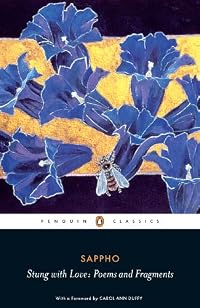
Stung with Love: Poems and Fragments (Penguin Classics)
by Sappho (Author), Aaron Poochigian (Translator)
On This Page
Description
Collects the poems and fragments of the ancient Greek poet's surviving work, displaying the wide variety of themes in her work, from amorous songs celebrating adolescent females to poems of invocation, desire, spite, celebration, and remembrance.Tags
Recommendations



Member Reviews
No matter how good the translation, there is always going to be something lost when modern readers attempt to tackle the classics from ancient Greece, or Rome, or wherever. This is true even of well-known, substantial works like Homer's Odyssey, and is doubly apparent when the work is as sparse as what remains of Sappho's. This collection is accurately subtitled 'Poems and Fragments', for little of Sappho's work survives today, and much of what does is missing stanzas, words or context. The introduction to this collection notes the surprising ways in which Sapphic fragments have come to light, including as scraps of paper used as stuffing in coffins and mummified remains.
The lack of a really substantial body of Sappho's work inhibits show more one's appreciation for the poet's prowess, but thanks to the efforts of the likes of Aaron Poochigian (who translates the poems in this collection and provides illuminating analysis), one can still marvel at what little remains. Sappho's fragments hint at a poet of great versatility; whilst she is mostly known today for the erotic homosexuality of some of her lyrics, Poochigian's selections demonstrate her true range. She is predominantly concerned with youth and innocence, emotion and hope, of which love and eroticism represent just a small but significant part. Indeed, it is remarkable just how ably she intermixes eroticism with innocence in a way which, due to the morals of modern society, would not be possible for today's poets.
As I have said, some of Sappho's power is bound to be lost in translation, but it is a sign of her greatness that what remains still speaks so strongly; as Carol Ann Duffy puts it in her preface, one is impressed by 'how much life is conveyed by so little'. I came to the poems of Sappho as a complete novice (the only time I'd heard of her was a passing mention in the lyrics of a Nick Cave song), but even I was struck by some of the poems on offer here, even the fragmentary ones. There is enough here to suggest that Sappho was indeed a great poet, but all we have are fragments, hints, questions. As Poochigian explains, with most things Sappho 'we must content ourselves with probabilities' and accept the limitations. But whilst much of her poetry is gone, her legacy is secured. The roll-call of poets throughout the centuries who venerate Sappho is impressive, and her influence on those who followed in her footsteps never in doubt. It is just rather tragic that this slim volume comprises just about all we have left of her. show less
The lack of a really substantial body of Sappho's work inhibits show more one's appreciation for the poet's prowess, but thanks to the efforts of the likes of Aaron Poochigian (who translates the poems in this collection and provides illuminating analysis), one can still marvel at what little remains. Sappho's fragments hint at a poet of great versatility; whilst she is mostly known today for the erotic homosexuality of some of her lyrics, Poochigian's selections demonstrate her true range. She is predominantly concerned with youth and innocence, emotion and hope, of which love and eroticism represent just a small but significant part. Indeed, it is remarkable just how ably she intermixes eroticism with innocence in a way which, due to the morals of modern society, would not be possible for today's poets.
As I have said, some of Sappho's power is bound to be lost in translation, but it is a sign of her greatness that what remains still speaks so strongly; as Carol Ann Duffy puts it in her preface, one is impressed by 'how much life is conveyed by so little'. I came to the poems of Sappho as a complete novice (the only time I'd heard of her was a passing mention in the lyrics of a Nick Cave song), but even I was struck by some of the poems on offer here, even the fragmentary ones. There is enough here to suggest that Sappho was indeed a great poet, but all we have are fragments, hints, questions. As Poochigian explains, with most things Sappho 'we must content ourselves with probabilities' and accept the limitations. But whilst much of her poetry is gone, her legacy is secured. The roll-call of poets throughout the centuries who venerate Sappho is impressive, and her influence on those who followed in her footsteps never in doubt. It is just rather tragic that this slim volume comprises just about all we have left of her. show less
"I declare
That later on,
Even in an age unlike our own,
Someone will remember who we are."
A 2500-year-old fragment sparks a connection between a poet and her reader.
Sappho's world is one of honey, blossoms, sweet longing and glittering sunlight. Perhaps 90% of her work has been lost, and what remains is in fragments. Yet in a way even its fragmentary nature seems to enhance it, as if by clutching these tatters we can catch a glimpse of something beautiful.
Sappho is the first recorded female poet in western history, she was said to have invented a type of lyre and the plectrum, and her fame is such that the words "sapphic" and "lesbian" are still used today. In fact, the use of the term "Lesbian" in this book to actually refer to someone show more from Lesbos conjured some strange images in my mind. The "Lesbian dialect", for example, seems most intriguing!
The translation of one of Sappho's most famous fragments here to indicate the poetess is longing for "a boy" is a little controversial, and I think we could have done with a note to explain that the original word was not gendered. We do not know whether Sappho longed for a boy or a girl in that fragment, but in many others she very much longs for female intimacy. show less
That later on,
Even in an age unlike our own,
Someone will remember who we are."
A 2500-year-old fragment sparks a connection between a poet and her reader.
Sappho's world is one of honey, blossoms, sweet longing and glittering sunlight. Perhaps 90% of her work has been lost, and what remains is in fragments. Yet in a way even its fragmentary nature seems to enhance it, as if by clutching these tatters we can catch a glimpse of something beautiful.
Sappho is the first recorded female poet in western history, she was said to have invented a type of lyre and the plectrum, and her fame is such that the words "sapphic" and "lesbian" are still used today. In fact, the use of the term "Lesbian" in this book to actually refer to someone show more from Lesbos conjured some strange images in my mind. The "Lesbian dialect", for example, seems most intriguing!
The translation of one of Sappho's most famous fragments here to indicate the poetess is longing for "a boy" is a little controversial, and I think we could have done with a note to explain that the original word was not gendered. We do not know whether Sappho longed for a boy or a girl in that fragment, but in many others she very much longs for female intimacy. show less
Sappho of Lesbos: Both her name and that of her native island have long designated homoerotic love between women. But she was more than that. Aristotle called her the tenth muse. As Homer was remembered as the paragon of the epic, she was of the lyric—texts meant to be sung accompanied by the lyre (she also seems to have invented one model of that instrument).
So high was the esteem she was held in that two librarians in Alexandria commissioned a collection of her works, which filled nine volumes. But, unfortunately, those have been lost like the rest of the Great Library. For centuries, the little of her preserved writing was in quotations in surviving books by others. More recently, this has been supplemented by papyrus finds show more (sometimes used as mummy wrapping).
It remains a fraction of what she created, perhaps ten percent. This book presents, in English translation, what we have. By my count, 479 lines. About one-third of the 150 or so pages in this volume are preface (by Carol Ann Duffy) and introduction by the translator, Aaron Poochigian. The poems and fragments themselves are printed with commentary on each facing page.
I found the editorial matter, both introduction and commentary, helpful. The introduction provides historical context and the various interpretations drawn from the little known of Sappho’s life. While the nineteenth-century suggestion that Sappho ran a boarding school was too much of its time, the reality might not have been far off. Sappho seems to have been entrusted with the care of maidens between puberty and marriage. In addition to matters of grooming and adornment, she instructed them in music and dance. Her lyrics were meant to be performed, whether solo or chorally. A good number of her works that survive are wedding hymns (epithalamia), suggesting that the group played an active role in wedding rituals as each was married off one by one. In the meantime, Sappho and her girls formed romantic attachments among themselves. The poems make clear that the boundaries between companion, teacher, role model, and lover were fluid and were no impediment to marriage (as an affair with a boy would have been).
Poochigian also explains his translation aims. He reports his disappointment that existing translations focus on the content, neglecting formal elements. On the other hand, he feels that attempts to reproduce the original meter of ancient Greek are flawed. Although Sappho didn’t, he opts to use rhyme to convey to English-speaking readers that these were song lyrics and to correspond to the emphatic line-endings Sappho often employed.
The commentary identifies geographical references and the various gods Sappho addresses (I can never keep Greek mythology straight). In the extant poems, Sappho doesn’t address male gods and only rarely refers to them. Most frequently, she appeals to Aphrodite, often addressed as Kypris (Cyprus, the island origin of the love goddess). It also identifies where a given lyric was cited by other antique authors.
And the poems themselves? I was surprised by how well they transcend the vast distance of time and language. They are the words of a woman who achieved a surprising degree of autonomy when I can’t imagine it was easy. She sings of tenderness, longing, jealousy, of the pleasure of memory. One poem I particularly enjoyed is the voice of a woman grown old, whose knees no longer permit her to join the dance. She encourages her girls to “chase the violet-bosomed Muses’ bright gifts and the plangent lyre, lover of hymns.” There is acceptance in her melancholy: “I groan much but to what end? Humans simply cannot be ageless like divinities.”
The poems and fragments are arranged according to theme: Goddesses, Desire and Death-Longing, Her Girls and Family, Troy, Maidens and Marriages, and The Wisdom of Sappho. I found this arrangement sensible. An appendix to this edition (2015) prints the two newest poems recovered. We can only hope that there are more to be discovered, whether in mummy wrappings or ancient trash heaps. show less
So high was the esteem she was held in that two librarians in Alexandria commissioned a collection of her works, which filled nine volumes. But, unfortunately, those have been lost like the rest of the Great Library. For centuries, the little of her preserved writing was in quotations in surviving books by others. More recently, this has been supplemented by papyrus finds show more (sometimes used as mummy wrapping).
It remains a fraction of what she created, perhaps ten percent. This book presents, in English translation, what we have. By my count, 479 lines. About one-third of the 150 or so pages in this volume are preface (by Carol Ann Duffy) and introduction by the translator, Aaron Poochigian. The poems and fragments themselves are printed with commentary on each facing page.
I found the editorial matter, both introduction and commentary, helpful. The introduction provides historical context and the various interpretations drawn from the little known of Sappho’s life. While the nineteenth-century suggestion that Sappho ran a boarding school was too much of its time, the reality might not have been far off. Sappho seems to have been entrusted with the care of maidens between puberty and marriage. In addition to matters of grooming and adornment, she instructed them in music and dance. Her lyrics were meant to be performed, whether solo or chorally. A good number of her works that survive are wedding hymns (epithalamia), suggesting that the group played an active role in wedding rituals as each was married off one by one. In the meantime, Sappho and her girls formed romantic attachments among themselves. The poems make clear that the boundaries between companion, teacher, role model, and lover were fluid and were no impediment to marriage (as an affair with a boy would have been).
Poochigian also explains his translation aims. He reports his disappointment that existing translations focus on the content, neglecting formal elements. On the other hand, he feels that attempts to reproduce the original meter of ancient Greek are flawed. Although Sappho didn’t, he opts to use rhyme to convey to English-speaking readers that these were song lyrics and to correspond to the emphatic line-endings Sappho often employed.
The commentary identifies geographical references and the various gods Sappho addresses (I can never keep Greek mythology straight). In the extant poems, Sappho doesn’t address male gods and only rarely refers to them. Most frequently, she appeals to Aphrodite, often addressed as Kypris (Cyprus, the island origin of the love goddess). It also identifies where a given lyric was cited by other antique authors.
And the poems themselves? I was surprised by how well they transcend the vast distance of time and language. They are the words of a woman who achieved a surprising degree of autonomy when I can’t imagine it was easy. She sings of tenderness, longing, jealousy, of the pleasure of memory. One poem I particularly enjoyed is the voice of a woman grown old, whose knees no longer permit her to join the dance. She encourages her girls to “chase the violet-bosomed Muses’ bright gifts and the plangent lyre, lover of hymns.” There is acceptance in her melancholy: “I groan much but to what end? Humans simply cannot be ageless like divinities.”
The poems and fragments are arranged according to theme: Goddesses, Desire and Death-Longing, Her Girls and Family, Troy, Maidens and Marriages, and The Wisdom of Sappho. I found this arrangement sensible. An appendix to this edition (2015) prints the two newest poems recovered. We can only hope that there are more to be discovered, whether in mummy wrappings or ancient trash heaps. show less
https://fromtheheartofeurope.eu/stung-with-love-poems-and-fragments-by-sappho-tr...
Translated poetry is always a bit problematic; you just can’t get the nuances exactly as intended by the original writer – especially when the original writer wrote in a dead language more than two and a half thousand years ago, and most of her known poetry survives only in fragments. But Poochigan seems to me to have made a good effort here. I’m not familiar enough with other translations to make a firm judgement, but I also appreciate his explanatory notes for each poem.
Most of the fragments are short, and have been preserved because of a single arresting image or turn of phrase. A couple of the longer ones jumped out at me. There’s an intense show more moment of jealousy (pp 22-23 here) when she sees the girl she likes talking to (?flirting with?) a man, and her heart throbs and her tongue “shatters”. The next poem (pp 24-25) is a break-up story, of the last conversation with your lover when you both realise it is over. The langauge is ancient but the sentiments are eternal.
The (very short) book ends with two poems which were very recently discovered on scraps of papyri, one about Sappho’s brother not yet having returned from a sea voyage, one a brief entreaty to Aphrodite about love. Poochigan does not mention it, because the scandal had not yet broken, but both of these passed through the hands of the notorious Dirk Obbink, so their provenance is very murky indeed; on the other hand, scholars do seem united in believing that these are genuine Sappho texts. It is awful and shameful that Obbink muddied the waters so much, both in this case and in the more notorious cases of the New Testament manuscripts. show less
Translated poetry is always a bit problematic; you just can’t get the nuances exactly as intended by the original writer – especially when the original writer wrote in a dead language more than two and a half thousand years ago, and most of her known poetry survives only in fragments. But Poochigan seems to me to have made a good effort here. I’m not familiar enough with other translations to make a firm judgement, but I also appreciate his explanatory notes for each poem.
Most of the fragments are short, and have been preserved because of a single arresting image or turn of phrase. A couple of the longer ones jumped out at me. There’s an intense show more moment of jealousy (pp 22-23 here) when she sees the girl she likes talking to (?flirting with?) a man, and her heart throbs and her tongue “shatters”. The next poem (pp 24-25) is a break-up story, of the last conversation with your lover when you both realise it is over. The langauge is ancient but the sentiments are eternal.
The (very short) book ends with two poems which were very recently discovered on scraps of papyri, one about Sappho’s brother not yet having returned from a sea voyage, one a brief entreaty to Aphrodite about love. Poochigan does not mention it, because the scandal had not yet broken, but both of these passed through the hands of the notorious Dirk Obbink, so their provenance is very murky indeed; on the other hand, scholars do seem united in believing that these are genuine Sappho texts. It is awful and shameful that Obbink muddied the waters so much, both in this case and in the more notorious cases of the New Testament manuscripts. show less
While the title of this collection highlights the erotic attitude of the poems of Sappho, there is a wonderful fragment of a poem entitled "Troy" that presents a mythic narrative. In doing so she veers away from the emphasis of the Homeric epic and focuses on a conventionally 'feminine' theme, a wedding scene. She elevates the wedding to epic magnitude, all the while featuring excellence rather than the morality of good and evil.
Other poems and fragments present themes of goddesses, desire, girls and their family, and marriage. The result in an excellent translation is a delightful selection. Here is a typical quatrain:
Untainted Graces
With wrists like roses,
Please come close,
You daughters of Zeus.
Sappho lived in a time of transition for show more Greece, after the Homeric era but before the more famous Golden Age of Athens. I, like others, find her language enchanting, and the gathering of poems and fragments by subject lends an order to this collection. Her passion shines through both the millennia and the translation to charm the reader while leaving a bit of sadness that we do not have more of her oeuvre. show less
Other poems and fragments present themes of goddesses, desire, girls and their family, and marriage. The result in an excellent translation is a delightful selection. Here is a typical quatrain:
Untainted Graces
With wrists like roses,
Please come close,
You daughters of Zeus.
Sappho lived in a time of transition for show more Greece, after the Homeric era but before the more famous Golden Age of Athens. I, like others, find her language enchanting, and the gathering of poems and fragments by subject lends an order to this collection. Her passion shines through both the millennia and the translation to charm the reader while leaving a bit of sadness that we do not have more of her oeuvre. show less
•Greek Lyric: Sappho · Alcaeus, tr. David A Campbell, Loeb 1990
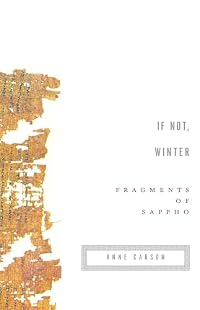
•If Not, Winter: Fragments of Sappho, tr. Anne Carson, Virago 2002
•Stung With Love: Poems and Fragments, tr. Aaron Poochigian, Penguin 2015
SAPPHICS FOR SAPPHO
Each ellipsis teases, inviting dreams – dreams
Formed from torn papyruses' single words. Bare,
Lonely scrawls of sigmas and psis that sing, still,
Sticky with meaning.
Fragments all. What's left is the one percent, rich,
Rare. When Alexandria burned, the whole world
Choked to breathe the smoke of the ninety-nine. Now,
Desperate to get you
Back, we trawl millennia-old unearthed dumps,
Hunting out your clotted Aeolic strung lines.
Lone hendecasyllables' sounds that awed Greeks
After you quoted.
Questing, reading, show more marvelling – so we search on,
Poets seeking answers to questions all lost
Lovers ask. Your answers still reach us, drenched, fresh
From the Aegean.
A LIFE IN FRAGMENTS
Towards the end of the second century AD, in the last flickering light of classical Greece, a philosopher called Maximus, in a city on the Levantine coast, wrote a grammatical textbook about figures of speech. Casting around in old books for examples of how poets have described love, he writes: ‘Diotima says that Love flourishes when he has abundance but dies when he is in need: Sappho combined these ideas and called Love bitter-sweet and “ἀλγεσίδωρον”.’
So we have this one word that Sappho wrote, some eight centuries before Maximus was born. This is what we mean when we talk about her poetry existing in ‘fragments’. The Canadian poet Anne Carson translates this example as:
171
paingiver
Very often these remnants are quoted with no regard to any poetic quality, but rather in illustration of some grammatical point. Apollonius Dyscolus, for instance, writing again some time in the 100s AD, included a throwaway remark on variant dialects during an essay on pronouns. ‘The Aeolians,’ he said, ‘spell ὅς [‘his, hers, its’] with digamma in all cases and genders, as in Sappho's τὸν ϝὸν παῖδα κάλει.’ Again Carson's translation gives us just the phrase in question:
164
she summons her son
Carson's translation of Sappho's oeuvre is well subtitled ‘Fragments of Sappho’, since most of what's left is of this nature. It's certainly nice to have everything collected in this way in English, though it must be admitted that her book sometimes seems more an exercise in completionism than in poetic expression. That said, as other reviewers have pointed out, reading pages and pages of these deracinated terms (‘holder…crossable…I might go…downrushing’) can succeed in generating a certain hypnotic, Zen-like appeal.
Nevertheless, such things lose a lot by being read in isolation; the as it were archaeological pleasure of digging them out of their original context, in works of grammar or rhetoric, is completely absent. For that, the Loeb edition translated by David A. Campbell is far preferable, for all that he has no pretensions to being a poet, just because you get Sappho delivered in that context of other writers. The fonts used for the Greek are also much more readable in the Loeb. (The Carson edition does include the original Greek, and points for that – though there are some strange editorial…choices? mistakes? – such as printing ς for σ in all positions.)
MUSIC AND LYRICS
To the Ancient Greeks, Homer was simply ‘The Poet’ – and ‘The Poetess’ was Sappho. She was held in extraordinarily high esteem, which makes it the more frustrating that so much of her has been lost: ninety-nine percent, according to some experts. Only one or two poems remain that can be said to be more or less complete.
Her poetry is mainly ‘lyric’, that is, designed to be sung while strumming along on the lyre. Sappho was, in modern terms, a singer-songwriter; she was known to be an extremely talented musician, designing a new kind of lyre and perhaps even inventing the plectrum. When we read her poetry now, we have to remember that we're looking at something like a shredded collection of Bob Dylan or Georges Brassens lyrics, with no idea of how their meaning would have interacted with the music.
But however important the lost melodies, we do know that she was revered for the beauty of her phrasing. This is something translators struggle with. Fragment 146, a proverb about not wanting to take the bad with the good, is rendered literally by Campbell as ‘I want neither the honey nor the bee’ and by Carson, ‘Neither for me honey nor the honey bee’ – which is better, but consider the alliterative dazzle of the original:
μήτε μοι μέλι μήτε μέλισσα
[mēte moi meli mēte melissa]
Reading the Greek, even if you don't understand what any of the words mean, will often get you halfway there with Sappho. Say it out loud and you'll get a tingle, as it starts to dawn on you what all the fuss might have been about.
But the rest of the job has to be done by translators. The Loeb edition will not help you here: its prose translations are only a crib to help you study the original. Carson's approach is slightly conflicted. She quotes approvingly a well-known statement from Walter Benjamin to the effect that a translation should ‘find that intended effect…which produces in it the echo of the original’, i.e. that one should translate ideas and feelings rather than words. But she also claims to be trying to use ‘where possible the same order of words and thoughts as Sappho did’, which is the sort of thing that makes me instantly suspicious.
Here's her version of Fragment 2, which is one of the more complete poems we have, scratched on to a broken piece of pottery which has miraculously survived from the second century AD. The first stanza (an invocation to Aphrodite) is probably missing, but the next two run like this:
]
here to me from Krete to this holy temple
where is your graceful grove
of apple trees and altars smoking
with frankincense.
And it in cold water makes a clear sound through
apple branches and with roses the whole place
is shadowed and down from radiant-shaking leaves
sleep comes dropping.
This is not bad. I think the word order is unnecessarily foreign at times, but it does sound good and Carson even includes a few of Sappho's famous hendecasyllabic lines – though they are not true ‘Sapphic’ verses, a very strict form which is not well adapted to English (as you may be able to tell from my attempt at the top of this review).
Aaron Poochigian, in a selected edition for Penguin Classics, takes a different approach. ‘Sappho did not compose free verse,’ he chides, perhaps with one eye on Carson, ‘and free-verse translations, however faithful they may be to her words, betray her poems by their very nature.’ Poochigian's version of the stanzas above goes like this:
Leave Crete and sweep to this blest temple
Where apple-orchard's elegance
Is yours, and smouldering altars, ample
Frankincense.
Here under boughs a bracing spring
Percolates, roses without number
Umber the earth and, rustling,
The leaves drip slumber.
I think that's pretty great. It takes much more liberties with Sappho's actual words but, to the extent that it produces a sensual thrill in English, it more faithfully reproduces the effect that Sappho had on her original audience. At least, to me it does. Poochigian's selection, called Stung with Love, is much shorter than the other two I read, but a very good encapsulation of her qualities. It also has by far the best introduction, a brilliant essay which puts Sappho in her context extremely well. And because it's the most recently published, it's also able to include the magic new Sappho poem discovered in 2013, written on a scrap of papyrus used to stuff a mummy.
BIGGER THAN A BIG MAN
‘Someone will remember us / I say / even in another time.’ Another fragment. The irony of this one upset me at first, because she should have survived in far greater quantities than she did. But even so, the thrill of hearing the voice of a woman who lived six centuries before Christ was enough to catch my breath over and over again. Generally speaking, women in antiquity are pretty silent. But Sappho isn't, and her influence, despite the meagre remains we have, is ginormous.
It might sound hyperbolic to claim that all modern love poetry is inherited from Sappho, but in fact there's a very real sense in which that's true – so great was her reputation among Classical writers and the Europeans who, in turn, studied them, that it's quite possible to trace a direct line from Sappho, through Catullus, to the Romantic poets and from them to contemporary pop lyrics. Every song about the pain of unrequited love owes something to Sappho's Fragment 31, for example – ideas now so clichéd that we forget they have an ancestry at all. That's just natural, surely – just the way people speak? But no, it isn't natural, it's Sappho. She's part of our inheritance, part of our language. She's under our tongue. show less
•If Not, Winter: Fragments of Sappho, tr. Anne Carson, Virago 2002
•Stung With Love: Poems and Fragments, tr. Aaron Poochigian, Penguin 2015
SAPPHICS FOR SAPPHO
Each ellipsis teases, inviting dreams – dreams
Formed from torn papyruses' single words. Bare,
Lonely scrawls of sigmas and psis that sing, still,
Sticky with meaning.
Fragments all. What's left is the one percent, rich,
Rare. When Alexandria burned, the whole world
Choked to breathe the smoke of the ninety-nine. Now,
Desperate to get you
Back, we trawl millennia-old unearthed dumps,
Hunting out your clotted Aeolic strung lines.
Lone hendecasyllables' sounds that awed Greeks
After you quoted.
Questing, reading, show more marvelling – so we search on,
Poets seeking answers to questions all lost
Lovers ask. Your answers still reach us, drenched, fresh
From the Aegean.
A LIFE IN FRAGMENTS
Towards the end of the second century AD, in the last flickering light of classical Greece, a philosopher called Maximus, in a city on the Levantine coast, wrote a grammatical textbook about figures of speech. Casting around in old books for examples of how poets have described love, he writes: ‘Diotima says that Love flourishes when he has abundance but dies when he is in need: Sappho combined these ideas and called Love bitter-sweet and “ἀλγεσίδωρον”.’
So we have this one word that Sappho wrote, some eight centuries before Maximus was born. This is what we mean when we talk about her poetry existing in ‘fragments’. The Canadian poet Anne Carson translates this example as:
171
paingiver
Very often these remnants are quoted with no regard to any poetic quality, but rather in illustration of some grammatical point. Apollonius Dyscolus, for instance, writing again some time in the 100s AD, included a throwaway remark on variant dialects during an essay on pronouns. ‘The Aeolians,’ he said, ‘spell ὅς [‘his, hers, its’] with digamma in all cases and genders, as in Sappho's τὸν ϝὸν παῖδα κάλει.’ Again Carson's translation gives us just the phrase in question:
164
she summons her son
Carson's translation of Sappho's oeuvre is well subtitled ‘Fragments of Sappho’, since most of what's left is of this nature. It's certainly nice to have everything collected in this way in English, though it must be admitted that her book sometimes seems more an exercise in completionism than in poetic expression. That said, as other reviewers have pointed out, reading pages and pages of these deracinated terms (‘holder…crossable…I might go…downrushing’) can succeed in generating a certain hypnotic, Zen-like appeal.
Nevertheless, such things lose a lot by being read in isolation; the as it were archaeological pleasure of digging them out of their original context, in works of grammar or rhetoric, is completely absent. For that, the Loeb edition translated by David A. Campbell is far preferable, for all that he has no pretensions to being a poet, just because you get Sappho delivered in that context of other writers. The fonts used for the Greek are also much more readable in the Loeb. (The Carson edition does include the original Greek, and points for that – though there are some strange editorial…choices? mistakes? – such as printing ς for σ in all positions.)
MUSIC AND LYRICS
To the Ancient Greeks, Homer was simply ‘The Poet’ – and ‘The Poetess’ was Sappho. She was held in extraordinarily high esteem, which makes it the more frustrating that so much of her has been lost: ninety-nine percent, according to some experts. Only one or two poems remain that can be said to be more or less complete.
Her poetry is mainly ‘lyric’, that is, designed to be sung while strumming along on the lyre. Sappho was, in modern terms, a singer-songwriter; she was known to be an extremely talented musician, designing a new kind of lyre and perhaps even inventing the plectrum. When we read her poetry now, we have to remember that we're looking at something like a shredded collection of Bob Dylan or Georges Brassens lyrics, with no idea of how their meaning would have interacted with the music.
But however important the lost melodies, we do know that she was revered for the beauty of her phrasing. This is something translators struggle with. Fragment 146, a proverb about not wanting to take the bad with the good, is rendered literally by Campbell as ‘I want neither the honey nor the bee’ and by Carson, ‘Neither for me honey nor the honey bee’ – which is better, but consider the alliterative dazzle of the original:
μήτε μοι μέλι μήτε μέλισσα
[mēte moi meli mēte melissa]
Reading the Greek, even if you don't understand what any of the words mean, will often get you halfway there with Sappho. Say it out loud and you'll get a tingle, as it starts to dawn on you what all the fuss might have been about.
But the rest of the job has to be done by translators. The Loeb edition will not help you here: its prose translations are only a crib to help you study the original. Carson's approach is slightly conflicted. She quotes approvingly a well-known statement from Walter Benjamin to the effect that a translation should ‘find that intended effect…which produces in it the echo of the original’, i.e. that one should translate ideas and feelings rather than words. But she also claims to be trying to use ‘where possible the same order of words and thoughts as Sappho did’, which is the sort of thing that makes me instantly suspicious.
Here's her version of Fragment 2, which is one of the more complete poems we have, scratched on to a broken piece of pottery which has miraculously survived from the second century AD. The first stanza (an invocation to Aphrodite) is probably missing, but the next two run like this:
]
here to me from Krete to this holy temple
where is your graceful grove
of apple trees and altars smoking
with frankincense.
And it in cold water makes a clear sound through
apple branches and with roses the whole place
is shadowed and down from radiant-shaking leaves
sleep comes dropping.
This is not bad. I think the word order is unnecessarily foreign at times, but it does sound good and Carson even includes a few of Sappho's famous hendecasyllabic lines – though they are not true ‘Sapphic’ verses, a very strict form which is not well adapted to English (as you may be able to tell from my attempt at the top of this review).
Aaron Poochigian, in a selected edition for Penguin Classics, takes a different approach. ‘Sappho did not compose free verse,’ he chides, perhaps with one eye on Carson, ‘and free-verse translations, however faithful they may be to her words, betray her poems by their very nature.’ Poochigian's version of the stanzas above goes like this:
Leave Crete and sweep to this blest temple
Where apple-orchard's elegance
Is yours, and smouldering altars, ample
Frankincense.
Here under boughs a bracing spring
Percolates, roses without number
Umber the earth and, rustling,
The leaves drip slumber.
I think that's pretty great. It takes much more liberties with Sappho's actual words but, to the extent that it produces a sensual thrill in English, it more faithfully reproduces the effect that Sappho had on her original audience. At least, to me it does. Poochigian's selection, called Stung with Love, is much shorter than the other two I read, but a very good encapsulation of her qualities. It also has by far the best introduction, a brilliant essay which puts Sappho in her context extremely well. And because it's the most recently published, it's also able to include the magic new Sappho poem discovered in 2013, written on a scrap of papyrus used to stuff a mummy.
BIGGER THAN A BIG MAN
‘Someone will remember us / I say / even in another time.’ Another fragment. The irony of this one upset me at first, because she should have survived in far greater quantities than she did. But even so, the thrill of hearing the voice of a woman who lived six centuries before Christ was enough to catch my breath over and over again. Generally speaking, women in antiquity are pretty silent. But Sappho isn't, and her influence, despite the meagre remains we have, is ginormous.
It might sound hyperbolic to claim that all modern love poetry is inherited from Sappho, but in fact there's a very real sense in which that's true – so great was her reputation among Classical writers and the Europeans who, in turn, studied them, that it's quite possible to trace a direct line from Sappho, through Catullus, to the Romantic poets and from them to contemporary pop lyrics. Every song about the pain of unrequited love owes something to Sappho's Fragment 31, for example – ideas now so clichéd that we forget they have an ancestry at all. That's just natural, surely – just the way people speak? But no, it isn't natural, it's Sappho. She's part of our inheritance, part of our language. She's under our tongue. show less
This book collects the entire known surviving works of the Greek poet, Sappho, who managed to cause her native island of Lesbos to become permanently associated with female homosexuality and have her own name modified into an adjective. Unfortunately for such an influential woman, her extant works sum to a slim volume of fragments from larger poems. This seems to be a great loss, as what does remain is remarkable.
Sappho famously dealt with the love and life of women as seriously as Homer dealt with the feuds and plots of men and gods and she did so in delightful, vivacious language, if these translations are any kind of reliable guide to the original.
The translator has placed a commentary facing each fragment as well as providing a show more concise introduction to what is known about Sappho and the society she lived in. These commentaries are often longer than the fragments they annotate, but they do illuminate and are worth the little amount of extra time they take to read. The entire book can be read with attention in an afternoon and if you are a fan of poetry generally, or of Greek literature, I strongly recommend you invest the time to do so. show less
Sappho famously dealt with the love and life of women as seriously as Homer dealt with the feuds and plots of men and gods and she did so in delightful, vivacious language, if these translations are any kind of reliable guide to the original.
The translator has placed a commentary facing each fragment as well as providing a show more concise introduction to what is known about Sappho and the society she lived in. These commentaries are often longer than the fragments they annotate, but they do illuminate and are worth the little amount of extra time they take to read. The entire book can be read with attention in an afternoon and if you are a fan of poetry generally, or of Greek literature, I strongly recommend you invest the time to do so. show less
Members
- Recently Added By
Lists

Tonikat reading completed on Librarything journals
329 works; 2 members

Books Read in 2022
5,164 works; 111 members
Author Information

Sappho, whom Plato (see Vols. 3 and 4) called "the tenth Muse," was the greatest of the early Greek lyric poets. She was born at Mytilene on Lesbos and was a member---perhaps the head---of a group of women who honored the Muses and Aphrodite. Her family was aristocratic; it is said that she was married and had a daughter. Her brilliant love show more lyrics, marriage songs, and hymns to the gods are written in Aeolic dialect in many meters, one of which is named for her---the Sapphic. Mostly fragments survive of the nine books she is thought to have authored. Her verse is simple and direct, exquisitely passionate and vivid. Catullus, Ovid, and Swinburne (see Vol. 1) were among the many later poets she influenced. (Bowker Author Biography) show less
All Editions
Work Relationships
Contains
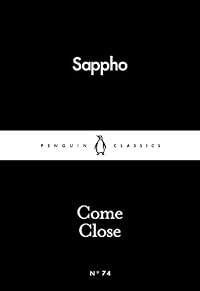
Come Close by Sappho
Common Knowledge
Classifications
Statistics
- Members
- 324
- Popularity
- 98,066
- Reviews
- 10
- Rating
- (4.28)
- Languages
- English
- Media
- Paper, Ebook
- ISBNs
- 2
- ASINs
- 2