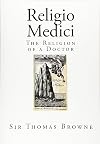
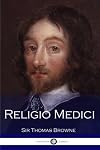
Religio Medici
by Thomas Browne
On This Page
Description
The son of a London mercer, Thomas Browne pursued a career as doctor and scholar; after extensive travels in Europe he settled down in Yorkshire and wrote, over time, the series of reflections now known as Religio Medici. As a self-portrait of a mind and soul and a prominent landmark in the history of ideas, Religio Medici proved a document of inexhaustible interest and persisting value; and ever since its first publication in 1642 it has exerted a powerful influence on its readers. This show more classic edition, first published in 1953, offers a carefully edited version of the 'authorised' edition of 1643, including readings preserved in extant manuscript copies of the work. show lessTags
Recommendations



















Member Reviews
Wow. I went into this book not knowing at all what to expect. The musings of a middle ages doctor on the nature of religion is probably not typical of my reading. But it's a book I intend to find a copy of and can see myself reading it again. It's not an easy read, the language is dated, the sentence structure is extremely unfamiliar to the modern reader. It is not a structured philosophy, it's more stream of consciousness, moving from one topic to another based on where the previous thought hand ended up, it's not a proof of something, nor a rebuttal, it is simply his thoughts and ideas written down.
He's writing this in the 1630s (date unknown, it was never intended for publication, although he had it published in 1660 after a number show more of unauthorised and incomplete copies had been published) and he is a creature of his time. In another 100 years we'd be in the middle of the enlightenment and thought would sound far more modern, back another 100 years and you're in the middle ages and another world. He is living on the cusp, when there is so much change in thought about nature, religion, science and the place of mankind, and that is reflected in his writings. As times he sounds entirely from the middle ages:
"Thus it is impossible, by any solid or demonstrative reasons, to persuade a man to believe the conversion of the Needle to the North; though this be positive and true, and easily credible, upon a single experiment unto sense." He doesn't have the knowledge that the earth's core is magnetic and the compass points to the magnetic pole. That was first postulated at the beginning of the century, but he's not convinced, as the proof isn't easy to see. Similarly, he doubts the heliocentric solar system "Some have held that Snow is black, that the earth moves, that the Soul is Air, Fire and Water; but all this is Philosophy:" It's a denying of scientific theory that has behind it a religious sensibility and an apparent contradiction - he's prepared to believe in a God without any proof, but not a scientific theory.
At other times he is startlingly contemporary. Ignoring the language, tell me this isn't a thought from the modern era, "... we vainly accuse the fury of guns, and the new inventions of death:- it is in the power of every hand to destroy us, and we are beholden unto every one we meet, he doth not kill us."
This is something entirely outside my usual reading experience, but I'm very glad I read it. This is one man I want to meet, I want to meet the owner of the brain that produced such a wide ranging set of thoughts. At times he is frustrating, at times he is dated, but he is more than that. He is open to ideas, he is open to learning, and he thinks himself unknowing yet pities those who have no learning (the thought behind this sentence could have been written by me: I cannot contemn a man for ignorance, but behold him with as much pity as I do Lazarus.). He wants to explore the world that he believes has been created by God. This is a man from a vastly different time, yet I sense a meeting of minds. show less
He's writing this in the 1630s (date unknown, it was never intended for publication, although he had it published in 1660 after a number show more of unauthorised and incomplete copies had been published) and he is a creature of his time. In another 100 years we'd be in the middle of the enlightenment and thought would sound far more modern, back another 100 years and you're in the middle ages and another world. He is living on the cusp, when there is so much change in thought about nature, religion, science and the place of mankind, and that is reflected in his writings. As times he sounds entirely from the middle ages:
"Thus it is impossible, by any solid or demonstrative reasons, to persuade a man to believe the conversion of the Needle to the North; though this be positive and true, and easily credible, upon a single experiment unto sense." He doesn't have the knowledge that the earth's core is magnetic and the compass points to the magnetic pole. That was first postulated at the beginning of the century, but he's not convinced, as the proof isn't easy to see. Similarly, he doubts the heliocentric solar system "Some have held that Snow is black, that the earth moves, that the Soul is Air, Fire and Water; but all this is Philosophy:" It's a denying of scientific theory that has behind it a religious sensibility and an apparent contradiction - he's prepared to believe in a God without any proof, but not a scientific theory.
At other times he is startlingly contemporary. Ignoring the language, tell me this isn't a thought from the modern era, "... we vainly accuse the fury of guns, and the new inventions of death:- it is in the power of every hand to destroy us, and we are beholden unto every one we meet, he doth not kill us."
This is something entirely outside my usual reading experience, but I'm very glad I read it. This is one man I want to meet, I want to meet the owner of the brain that produced such a wide ranging set of thoughts. At times he is frustrating, at times he is dated, but he is more than that. He is open to ideas, he is open to learning, and he thinks himself unknowing yet pities those who have no learning (the thought behind this sentence could have been written by me: I cannot contemn a man for ignorance, but behold him with as much pity as I do Lazarus.). He wants to explore the world that he believes has been created by God. This is a man from a vastly different time, yet I sense a meeting of minds. show less
A beautifully edifying meditation written by a great prose stylist whose life and thought, like his near contemporary Giordino Bruno, embody the transition from the Renaissance to modernity. It is splendid to spend an evening or two with such a sensible and probing mind.
Bound together with Urne Burial, with notes by the author. The laguage of Religio Medici takes more wrestling with than Urne Burial. I would describe it as a book one ought to have read, rather than one anyone would recommend.
Written without the intention to publish. Browne was born in London in 1605, and trained for Medicine. After traveling the Continent, he settled and practiced in Norwich, raised 10 children, and died on his 77th birthday.
The writing covers a variety of subjects -- religious, antiquarian, and scientific -- and revealing a humorous if surprisingly credulous charm.
The writing covers a variety of subjects -- religious, antiquarian, and scientific -- and revealing a humorous if surprisingly credulous charm.
The first relection on being a doctor.
The first relection on being a doctor.
Ratings
Members
- Recently Added By
Lists

100 Books to Read in a Lifetime (That Are Older Than 200 Years)
415 works; 175 members

Books Read in 2013
1,630 works; 51 members

Harold Bloom - The Western Canon: B. The Aristocratic Age
231 works; 13 members

AlphaKIT: Brown
21 works; 4 members

Greatest Books, allegedly
484 works; 9 members
Author Information

37+ Works 631 Members
Some Editions
Work Relationships
Common Knowledge
- Original publication date
- 1643
Classifications
- Genres
- Religion & Spirituality, Nonfiction, Fiction and Literature
- DDC/MDS
- 828.3 — Literature & rhetoric English & Old English literatures English miscellaneous writings English miscellaneous writings 1558-1625
- LCC
- PR3327 .A73 — Language and Literature English English Literature 17th and 18th centuries (1640-1770)
- BISAC
Statistics
- Members
- 257
- Popularity
- 126,148
- Reviews
- 6
- Rating
- (4.30)
- Languages
- 9 — Dutch, English, Finnish, French, German, Italian, Latin, Spanish, Swedish
- Media
- Paper, Audiobook, Ebook
- ISBNs
- 30
- ASINs
- 23