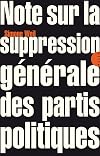
On the Abolition of All Political Parties
by Simone Weil
On This Page
Description
'Political parties are a marvellous mechanism ... If one were to entrust the organisation of public life to the devil, he could not invent a more clever device.'Here Simon Leys translates for the first time into English an essay by the remarkable Simone Weil - philosopher, activist, mystic - which makes a case for the corrupting effect of political parties on political life, and calls for their abolition. This is a dazzling account of the perils of political conformity, written with show more brilliant clarity and wit.It is combined with an essay by the Nobel Prize-winner Czeslaw Milosz 'on the importan show lessTags
Recommendations


























Member Reviews
Simone Weil’s essay talks about how people are pulled either into the light of truth through a sense of unbiased reason, or away into the darkness through the bouts and vicissitudes of passionate desire. But each person’s pull away from the light is in a different direct, and each person’s pull towards it is in the same direction. This is a basic assumption of the goodness of democracy. (If democracy is not good, it is not what we should be practicing. If Hitler had never risen to power but the Weimar Republic still committed the atrocities of World War II through a democratic process it does not make those atrocities somehow less atrocious.) Political parties, on the other hand, serve to focus and align the chaotic desires of show more darkness and bundle them together into a force with power. It makes no sense, these days, to criticize someone for saying “As a democrat,” or “as a republican,” but these statements are parroted nonsense. It is not interesting or useful to know what a representative’s party stands for when we purportedly elected them for their ability to represent our own or on their views being a close enough reflection of our own. For this and other reasons all political parties should be abolished. We should replace them with a kind of informal forum, or as she calls them a series of journals, to which one may read or contribute, but to which one would not belong, but orbit, or be a reader of, or a writer in, but never a member, or subordinate, or a parrot of. In that way each person, each representative evaluates for themselves the plans and policies and proposals of the others, asking questions and offering criticism, and each shall cast their votes, when the time comes, in the light of their own reason and the will of those whom they represent.
I basically agree with everything she says. The trouble is that it makes action difficult. One of the ways in which she criticizes political parties is how they develop a binary stance towards or against something, how they drain from the issue all nuance and use propaganda and slander to vie for power. The trouble is that our votes work this way, most of the time. One piece of legislation, arguments for or against. She doesn’t talk about it much, but in an ideal congress there would be a deliberation, proposals sent out and digested, discussion had, amendments made, and the best and most just proposal would succeed. That takes a long time, though. Maybe it should. I don’t know. But I agree with her. And her words are stark and piercing in the firelight of the current political climate. show less
I basically agree with everything she says. The trouble is that it makes action difficult. One of the ways in which she criticizes political parties is how they develop a binary stance towards or against something, how they drain from the issue all nuance and use propaganda and slander to vie for power. The trouble is that our votes work this way, most of the time. One piece of legislation, arguments for or against. She doesn’t talk about it much, but in an ideal congress there would be a deliberation, proposals sent out and digested, discussion had, amendments made, and the best and most just proposal would succeed. That takes a long time, though. Maybe it should. I don’t know. But I agree with her. And her words are stark and piercing in the firelight of the current political climate. show less
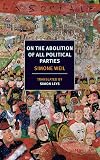
The only thing I needed to know about this was that Ensor's 'Christ's Entry into Brussels' was on the cover. It helped that I'm curious about Weil, and that NYRB put it out, and that sometimes I just want a book I can finish in an hour or two. And the title helped a lot. But really I just needed the cover.
Weil's argument is quite clear, and seems pretty accurate: partisanship distorts thought, whereas disinterested thought helps politics. The relevance to our present political rhetoric is pretty clear. Consider, "Nearly everywhere - often even when dealing with purely technical problems - instead of thinking, one merely takes sides: for or against. Such a choice replaces the activity of the mind." Now consider the political 'debates' show more about [insert any contentious political issue here.]
The essay is padded out with another essay by Milosz, which I found very puzzling at times and insightful at others; and one by Simon Leys, which was unnecessary.
A beautiful little artifact, anyway, and a stimulating after-lunch read. show less
Weil's argument is quite clear, and seems pretty accurate: partisanship distorts thought, whereas disinterested thought helps politics. The relevance to our present political rhetoric is pretty clear. Consider, "Nearly everywhere - often even when dealing with purely technical problems - instead of thinking, one merely takes sides: for or against. Such a choice replaces the activity of the mind." Now consider the political 'debates' show more about [insert any contentious political issue here.]
The essay is padded out with another essay by Milosz, which I found very puzzling at times and insightful at others; and one by Simon Leys, which was unnecessary.
A beautiful little artifact, anyway, and a stimulating after-lunch read. show less
As one can surmise from the title alone, Weil was not a fan of political parties. She considered them totalitarian in nature, and felt they reduced their members to mindlessness. Her vision of democracy involved individuals standing alone, making clear their beliefs issue by issue. Clear and thoughtful with a supplemental essay suggesting her place in western thought.
une critique des risques que font courir les passions collectives (qui nourrissent les partis) ; mais dans l'esquisse d'un paradigme qui permet de fonder sa cause (comme l'essaie Stirner) la tentation de l'éclairage mystique, alors que "l'histoire réellement en marche" sort les personnes de l'excitation des passions collectives pour les mettre en face de la libido vitale, mais ça ne dure pas longtemps
Mar 6, 2012French
Bien sûr, note indispensable pour le renouveau des dicussions démocratiques, loin des machines à faire gagner le pouvoir.
Jun 11, 2025French
Ratings
Members
- Recently Added By
Lists

Top Five Books of 2020
982 works; 350 members
Author Information

220+ Works 7,514 Members
Born in Paris, Weil came from a highly intellectual family. After a brilliant academic career at school and university, she taught philosophy interspersed with periods of hard manual labor on farms and in factories. Throughout her life she combined sophisticated and scholarly interests with an extreme moral intensity and identification with the show more poor and oppressed. A twentieth-century Pascal (see Vol. 4), this ardently spiritual woman was a social thinker, sensitive to the crises of modern humanity. Jewish by birth, Christian by vocation, and Greek by aesthetic choice, Weil has influenced religious thinking profoundly in the years since her death. "Humility is the root of love," she said as she questioned traditional theologians and held that the apostles had badly interpreted Christ's teaching. Christianity was, she thought, to blame for the heresy of progress. During World War II, Weil starved herself to death, refusing to eat while victims of the war still suffered. (Bowker Author Biography) show less
Some Editions
Series
Belongs to Publisher Series
Work Relationships
Is contained in
Common Knowledge
Classifications
- Genres
- Politics and Government, Philosophy, Nonfiction, General Nonfiction
- DDC/MDS
- 324.2 — Society, government, & culture Political science Politics & Elections Political parties
- LCC
- JC261 .W45 .W4513 — Political Science Political theory Political theory. The state. Theories of the state Modern state
- BISAC
Statistics
- Members
- 353
- Popularity
- 89,731
- Reviews
- 5
- Rating
- (3.59)
- Languages
- 7 — English, French, German, Italian, Portuguese (Portugal), Spanish, Swedish
- Media
- Paper, Ebook
- ISBNs
- 30
- ASINs
- 10