On This Page
Description
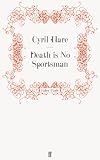
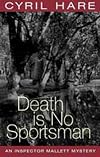
Death is No Sportsman (1938) was the second crime novel by 'Cyril Hare', nom de plume of Alfred Gordon Clark and one of the best-loved names in English 'Golden Age' crime writing. The banks of the river Didder in the summertime appear idyllic: the sun is shining, the trout rising. But when the body of a local landowner is discovered, the peace of the countryside is shattered. It soon becomes apparent that quite a few local people disliked the deceased. Inspector Mallett is brought in from show more Scotland Yard to find the killer; and, though quick to disentangle the complex relationships linking suspects and victim, Mallett must master the subtleties of fly-fishing in order to uncover the incriminating evidence he seeks. 'A "fair play" thriller with no outrageously red herrings drawn across the trail.' Daily Mirror 'More than well worth reading.' Observer show lessTags
Recommendations













Member Reviews
I always enjoy a Cyril Hare book. Even though, as with all mysteries, I can never figure out whodunnit. This one, with its contorted timeline, was especially out of my reach.
I wish that Cyril Hares weren't so hard to find; they're so nice to read.
I like the following excerpt, not only for the observation of one (of many) affliction of getting older, but also how it works to the advantage of those who want to know where you're going to be at any given time:
Regularity of habit is a disease that grows with old age, and ... makes the patient particularly vulnerable to the attention of those whose plans depend on their being in or out of the way at a given moment.
I wish that Cyril Hares weren't so hard to find; they're so nice to read.
I like the following excerpt, not only for the observation of one (of many) affliction of getting older, but also how it works to the advantage of those who want to know where you're going to be at any given time:
Regularity of habit is a disease that grows with old age, and ... makes the patient particularly vulnerable to the attention of those whose plans depend on their being in or out of the way at a given moment.
This early entry in Hare's small output only features Inspector Mallett, not Francis Pettigrew. The background is a small and highly exclusive fly-fishing syndicate, all of whom may be implicated in the murder (on the river path where they do their fishing) of the unpopular local squire. Love and money are the two main possible motives. Mallett, as usual, is a highly likeable character, but the denouement probably won't be too surprising to the experienced detective-story reader.
While I figured out a few aspects of the case early on, the actual solution was a surprise since my 'deductions' (really guesses) turned out to be misleading!
I am glad that there was a map of the area at the beginning of the book, as I referred to it several times while reading. Also, it was nice that Inspector Mallett, being a Londoner, needed to have some aspects of fly fishing explained to him so that I the reader could learn them too.
I am glad that there was a map of the area at the beginning of the book, as I referred to it several times while reading. Also, it was nice that Inspector Mallett, being a Londoner, needed to have some aspects of fly fishing explained to him so that I the reader could learn them too.
Murder of an unpleasant rich man who behavior has threatened the peace of a group of fly fishermen at a small resort hotel; investigated by Inspector Mallett who is capable but a bit colorless compared to Hare's barrister detective Pettigrew,.
Ratings
Members
- Recently Added By
Author Information

21+ Works 2,739 Members
Some Editions
Series

Belongs to Publisher Series
Work Relationships
Common Knowledge
- Canonical title
- Death is No Sportsman
- Original title
- Death Is No Sportsman
- Original publication date
- 1938
- People/Characters
- Inspector Mallett; Stephen Smithers; Mr Wrigley-Bell; Jimmy Rendel; Robert Matheson; Euphemia Matheson (show all 13); Lady Marian Packer; Dr Philip Latymer; Mrs Large; Superintendent White; Major Strode; Philip Carter; Constable Bowyer
- Important places
- Didford Magna, Markshire, England, UK; Polworthy Water, Markshire, England, UK
- Dedication
- To
H. H. G. C.
In gratitude, and with
apologies - First words
- Shortly after the Treaty of Versailles, four business men, who had made enough money during the war to be able at last to attend to the really important things in life, formed a syndicate among themselves and bought the fishi... (show all)ng rights of a reach of the River Didder.
- Last words
- (Click to show. Warning: May contain spoilers.)They are a devoted pair.
Classifications
Statistics
- Members
- 163
- Popularity
- 200,310
- Reviews
- 4
- Rating
- (3.83)
- Languages
- English, Finnish, German, Swedish
- Media
- Paper
- ISBNs
- 8
- ASINs
- 5