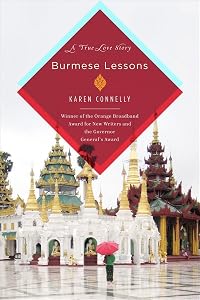
Burmese Lessons: A true love story
by Karen Connelly
On This Page
Description
Orange Prize-winner Karen Connelly's compelling memoir about her journey to Burma, where she fell in love with a leader of the Burmese rebel army. When Karen Connelly goes to Burma in 1996 to gather information for a series of articles, she discovers a place of unexpected beauty and generosity. She also encounters a country ruled by a brutal military dictatorship that imposes a code of censorship and terror. Carefully seeking out the regime's critics, she witnesses mass demonstrations, show more attends protests, interviews detained opposition leader Aung San Suu Kyi and flees from police. When it gets too risky for her to stay, Connelly flies back to Thailand, but she cannot leave Burma behind. nbsp; Connelly's interest in the political turns more personal on the Thai-Burmese border, where she falls in love with Maung, the handsome and charismatic leader of one of Burma's many resistance groups. After visiting Maung's military camp in the jungle, she faces an agonizing decision: Maung wants to marry Connelly and have a family with her, but if she marries this man she also weds his world and his lifelong cause. Struggling to weigh the idealism of her convictions against the harsh realities of life on the border, Connelly transports the reader into a world as dangerous as it is enchanting. nbsp; In radiant prose layered with passion, regret, sensuality and wry humor, Burmese Lessons tells the captivating story of how one woman came to love a wounded, beautiful country and a gifted man who has given his life to the struggle for political change. show lessTags
Recommendations













Member Recommendations
Member Reviews
I was certainly warned. The subtitle of Burmese Lessons is A True Love Story. Somehow, I expected that the love was for the people and land of Burma, and that is true as far as it goes. Ms. Connelly went into Burma to investigate the fate of a Burmese writer under arrest by the generals of the State Law and Order Restoration Council. As she got in touch with other dissidents, she did fall under the spell of the country, and the best parts of the book relate her experiences in student protests and in life on the border of Thailand and Burma with Burmese refugees. She also fell in love with a Burmese resistance leader, and so, was invited to join the life of these freedom fighters.
What I was not prepared for was being invited to show more participate in vicarious sex with this man for page upon page upon page. I could sympathize with her conflict as she decided whether to give up her life as a writer in order to become part of his mission, but I hadn’t chosen the book in hopes of titillation. In fact, while I valued her honesty and idealism, I came away disliking her personally. “Most people won’t take a woman seriously if she’s under thirty. If she’s under thirty and beautiful, too many men want to fuck her and too many women are jealous of her. And still none of them take her seriously. I look forward to being over forty, wrinkled and tough.” Perhaps my problem was that I am not under thirty and beautiful.
I also reacted negatively as she named herself an artist. I never liked her writing. First person, present tense narrative annoys me beyond belief. I find it precious and artificial rather than immediate and compelling. I also tired quickly of long pages of simple declarative sentences. She can write gracefully and rhythmically when she is thinking philosophically, but for most of this book that was not her choice. All in all, I have to say I found not enough Burma but too much love and too much Karen Connelly. show less
What I was not prepared for was being invited to show more participate in vicarious sex with this man for page upon page upon page. I could sympathize with her conflict as she decided whether to give up her life as a writer in order to become part of his mission, but I hadn’t chosen the book in hopes of titillation. In fact, while I valued her honesty and idealism, I came away disliking her personally. “Most people won’t take a woman seriously if she’s under thirty. If she’s under thirty and beautiful, too many men want to fuck her and too many women are jealous of her. And still none of them take her seriously. I look forward to being over forty, wrinkled and tough.” Perhaps my problem was that I am not under thirty and beautiful.
I also reacted negatively as she named herself an artist. I never liked her writing. First person, present tense narrative annoys me beyond belief. I find it precious and artificial rather than immediate and compelling. I also tired quickly of long pages of simple declarative sentences. She can write gracefully and rhythmically when she is thinking philosophically, but for most of this book that was not her choice. All in all, I have to say I found not enough Burma but too much love and too much Karen Connelly. show less
 This review was written for LibraryThing Early Reviewers.
I would suggest to you that Karen Connelly is not a writer. Instead, I would put forward the argument that she is an artist who paints pictures with words. The sentences she writes exude literary color and vibrancy like thousands of Bollywood dancers all dressed in the brightest and most eye catching Saris performing their greatest routine. On more than one occasion I found tears streaming down my face when I took myself out of the narrative. I had become overwhelmed by the sheer beauty of the pictures she had painted through the strokes of her words. At times I felt submerged in the environments described to the point I was almost feeling the Buddhist serenity and smelling the Burmese foods. The page truly is her canvas upon which she show more paints vivid imagery using the brush of her heart and the paints of her soul.
'Burmese Lessons' dissolves Ms Connelly's personal experiences and the day to day lives of the Burmese people, who live under a military dictatorship, into a memoir. Like the proverbial tea and sugar they start out as separate entities but one is added to the other and the stirring of a relationship takes place that has Ms Connelly drinking from the cup of love. Outside of this cup the Burmese table, on which the cup sits, is covered with dishes filled with oppression and injustice. Intimately linked to the Burmese culture Ms Connelly puts her safety on the line so we too can sample the foods that cover this table, digest the sociopolitical situation and taste for ourselves the life changing events of which she partook in the mid 1990s.
Reading this book was the literary equivalent of making love one last time to your soul mate in a four poster bed, on a balmy night, on top of the finest satin sheets and never wanting that night to end. It was bittersweet...full to the brim of joy and love yet overflowing with hurt and pain. So wonderful is the writing that the book itself is like a living, breathing entity that is full of life, love and sorrow. If you want to read a factual work that will move you and leave a lasting impression on your heart then look no further than 'Burmese Lessons'. show less
'Burmese Lessons' dissolves Ms Connelly's personal experiences and the day to day lives of the Burmese people, who live under a military dictatorship, into a memoir. Like the proverbial tea and sugar they start out as separate entities but one is added to the other and the stirring of a relationship takes place that has Ms Connelly drinking from the cup of love. Outside of this cup the Burmese table, on which the cup sits, is covered with dishes filled with oppression and injustice. Intimately linked to the Burmese culture Ms Connelly puts her safety on the line so we too can sample the foods that cover this table, digest the sociopolitical situation and taste for ourselves the life changing events of which she partook in the mid 1990s.
Reading this book was the literary equivalent of making love one last time to your soul mate in a four poster bed, on a balmy night, on top of the finest satin sheets and never wanting that night to end. It was bittersweet...full to the brim of joy and love yet overflowing with hurt and pain. So wonderful is the writing that the book itself is like a living, breathing entity that is full of life, love and sorrow. If you want to read a factual work that will move you and leave a lasting impression on your heart then look no further than 'Burmese Lessons'. show less
I thought Connelly’s The Lizard Cage, was one of the best novels I had read in a long time so I was quite interested to read her Burmese Lessons. I was not disappointed. The book is subtitled A Love Story, and it is that: a passionate, sexual story of falling deeply in love with one of the leading Burmese dissidents, but it also a story about love for the Burmese people and culture, love for the political cause of freedom and rights that the dissidents champion, love for the individuals swept up in events that dictate, disrupt and sometimes destroy their lives, love for her vocation as a writer. With all this going on, there are bound to be conflicts. There are, and Connelly expands honestly on her uncertainties, her fears, her hopes, show more and her insights. She perceives, early on, that:
“Burma will change me. Is changing me. How peculiar to have this foreknowledge, to perceive the power that awaits me in this experience, if I care to make use of it. Or to allow it to make use of me. I know that what I see here, what I choose to write about, could be transformative, changing me from a writer who observes to a writer whose observation becomes a form of action.”
This is something she worries about quite a lot: what is she contributing to the cause of the Burmese opposition, what can she contribute, what is writing a book compared to doctors/medics/aid workers who dedicate their lives to helping individuals. She feels this insecurity, but in the end realizes that writing is in her blood, it is her calling, and that through it she can contribute by bringing international attention to the horrors and repression of the Burmese generals. She thinks about the nature of evil and the courage of opposition and her own role in fighting it:
“I believe in acting when I see injustice. I believe in speaking out against violence of all kinds, especially if it means risking my own comfort. But that’s too noble: my big mouth never thinks of comfort, it has its own designs. It’s hard to know when speaking out makes any difference, or if the course of action chosen is the right one. But it is wrong to do nothing. It is criminal to be silent in the face of an outrage. The pathology of the bystander pretends to be a minor forgivable pathology, but is the mildest, most common face of evil.” And, “I cry because I have learned not only the horror of evil but also its oppressive stupidity, the sheer waste, the way it takes promise, intelligence, youth, all human rightness and possibility, and destroys them—consciously—tears them apart and swallows them down like Saturn devouring his children. What can I wield against such a force? Scratches on paper. My good intentions are laughable. Such powerlessness makes me angry, and beyond my anger is despair, a grief that cracks open my rib cage and pins me to the bed.”
The physical love affair does not last: realities intrude, interests diverge, separations ensue; Connelly reminds herself of the essence of the Buddha’s teaching about the permanence of change. But her love for Burma and its people not only endures but strengthens: “…the qualities I admire most in the Burmese people: their love of literature and art, their openness to the world, their ability to bring the world into their own experience, their intellectual generosity, their enthusiasm for learning and for teaching.”
Connelly was beginning to write The Lizard Cage while in Burma and Thailand in the period described in this book. Readers of the former will be intrigued to see the origin of characters and events and themes eventually featured in The Lizard Cage. One of these is the idea of taking care: “To take care is the great human act. It is part of the answer to the brutality that may not touch people here directly but affects them deeply. On the physical and metaphorical border these people inhabit, it is a daily challenge to take care of themselves, let alone others, but that is what they all do. Every single person….each one has done more than survive. They have remained or they have become tender, alive to their own suffering and the suffering of their people.”
An excellent, thoughtful book. show less
“Burma will change me. Is changing me. How peculiar to have this foreknowledge, to perceive the power that awaits me in this experience, if I care to make use of it. Or to allow it to make use of me. I know that what I see here, what I choose to write about, could be transformative, changing me from a writer who observes to a writer whose observation becomes a form of action.”
This is something she worries about quite a lot: what is she contributing to the cause of the Burmese opposition, what can she contribute, what is writing a book compared to doctors/medics/aid workers who dedicate their lives to helping individuals. She feels this insecurity, but in the end realizes that writing is in her blood, it is her calling, and that through it she can contribute by bringing international attention to the horrors and repression of the Burmese generals. She thinks about the nature of evil and the courage of opposition and her own role in fighting it:
“I believe in acting when I see injustice. I believe in speaking out against violence of all kinds, especially if it means risking my own comfort. But that’s too noble: my big mouth never thinks of comfort, it has its own designs. It’s hard to know when speaking out makes any difference, or if the course of action chosen is the right one. But it is wrong to do nothing. It is criminal to be silent in the face of an outrage. The pathology of the bystander pretends to be a minor forgivable pathology, but is the mildest, most common face of evil.” And, “I cry because I have learned not only the horror of evil but also its oppressive stupidity, the sheer waste, the way it takes promise, intelligence, youth, all human rightness and possibility, and destroys them—consciously—tears them apart and swallows them down like Saturn devouring his children. What can I wield against such a force? Scratches on paper. My good intentions are laughable. Such powerlessness makes me angry, and beyond my anger is despair, a grief that cracks open my rib cage and pins me to the bed.”
The physical love affair does not last: realities intrude, interests diverge, separations ensue; Connelly reminds herself of the essence of the Buddha’s teaching about the permanence of change. But her love for Burma and its people not only endures but strengthens: “…the qualities I admire most in the Burmese people: their love of literature and art, their openness to the world, their ability to bring the world into their own experience, their intellectual generosity, their enthusiasm for learning and for teaching.”
Connelly was beginning to write The Lizard Cage while in Burma and Thailand in the period described in this book. Readers of the former will be intrigued to see the origin of characters and events and themes eventually featured in The Lizard Cage. One of these is the idea of taking care: “To take care is the great human act. It is part of the answer to the brutality that may not touch people here directly but affects them deeply. On the physical and metaphorical border these people inhabit, it is a daily challenge to take care of themselves, let alone others, but that is what they all do. Every single person….each one has done more than survive. They have remained or they have become tender, alive to their own suffering and the suffering of their people.”
An excellent, thoughtful book. show less
Reading this book was a sometimes difficult, but profound experience. Karen Connelly brings to life her experiences in Burma and Thailand, and illuminates the Burmese struggle for independence from a military regime, in this memoir/ love story.
In bits and pieces, we get the history of Burma and the revolutionary dissidents, as well as an overview of the various rebel groups, representatives, and artists/ writers who have been imprisoned and tortured by the regime for their efforts at shedding light on the brutalities occurring in their homeland. Connelly interviews several of these people throughout the course of the novel. She has an insider's view into the underground in which the dissidents move; she soon realizes, however, that show more she is naive as to the delicate workings and history of this world in ways she did not realize.
She meets Maung, a leader of one of the dissident groups, who has pledged his life to the cause. The two fall in love, and for the majority of the novel, the story moves back and forth from the larger scope of the Burmese struggle to the more intimate world of Karen and Maung's budding love.
The writing is diamond-like, hard and brilliant, and spares nothing. Scenes of torture and brutality are described unflinchingly; there is nothing watered down here. This is what makes it effective at what the author intended-- to bring Burma to life, to expose the effects of a military regime on ordinary people, to juxtapose a passionate, sweet love affair with the bitter realities of living in refugee jungle camps, malaria, war, and death.
The one shortcoming, for me, was that this relentless honesty carried into the very intimate relationship between Karen and Maung. I always appreciated the candor of Karen's thought process about her relationship with him, her relationship with Asia, and her life as an author-- it made her human, flaws and all. But the vivid, detailed descriptions of the sexual relationship between Karen and Maung felt to me a bit self-indulgent, as though these bits became more of a personal journal than a memoir. I'm a big fan of brutal honesty, but these scenes felt a bit voyeuristic to me, and in the end, not necessary to the overall message of the book.
That aside, it was a very worthwhile read which sheds light on a struggle that's not mentioned on the news. The author's quest is an admirable one and her writing has a lovely flow to it that makes it difficult to look away even during the most horrifying of scenes. show less
In bits and pieces, we get the history of Burma and the revolutionary dissidents, as well as an overview of the various rebel groups, representatives, and artists/ writers who have been imprisoned and tortured by the regime for their efforts at shedding light on the brutalities occurring in their homeland. Connelly interviews several of these people throughout the course of the novel. She has an insider's view into the underground in which the dissidents move; she soon realizes, however, that show more she is naive as to the delicate workings and history of this world in ways she did not realize.
She meets Maung, a leader of one of the dissident groups, who has pledged his life to the cause. The two fall in love, and for the majority of the novel, the story moves back and forth from the larger scope of the Burmese struggle to the more intimate world of Karen and Maung's budding love.
The writing is diamond-like, hard and brilliant, and spares nothing. Scenes of torture and brutality are described unflinchingly; there is nothing watered down here. This is what makes it effective at what the author intended-- to bring Burma to life, to expose the effects of a military regime on ordinary people, to juxtapose a passionate, sweet love affair with the bitter realities of living in refugee jungle camps, malaria, war, and death.
The one shortcoming, for me, was that this relentless honesty carried into the very intimate relationship between Karen and Maung. I always appreciated the candor of Karen's thought process about her relationship with him, her relationship with Asia, and her life as an author-- it made her human, flaws and all. But the vivid, detailed descriptions of the sexual relationship between Karen and Maung felt to me a bit self-indulgent, as though these bits became more of a personal journal than a memoir. I'm a big fan of brutal honesty, but these scenes felt a bit voyeuristic to me, and in the end, not necessary to the overall message of the book.
That aside, it was a very worthwhile read which sheds light on a struggle that's not mentioned on the news. The author's quest is an admirable one and her writing has a lovely flow to it that makes it difficult to look away even during the most horrifying of scenes. show less
This review was written for LibraryThing Early Reviewers.Excellent piece of non-fiction which reads like a novel. I could not put it down. The author's journey in Burma and "on the border" are informatively transformed into a gripping narrative. I learned about Burmese politics and the opposition to the status quo. The sections about student protestors and political prisoners were really well written! Just shy of 400 pages, it felt like 100!
This review was written for LibraryThing Early Reviewers.Connelly's Burmese Lessons is a kind of non-fictional followup to her novel The Lizard Cage. At least it appears in most respects to be non-fictional or memoir-ish.
One gets the sense that most of it is true with maybe some names being changed. It's as much a love story between the narrator Connelly and a Burmese disident Maung as it is a book about the repressive nature of a Burmese military dictatorship which has murdered, tortured, imprisoned and/or exiled hundreds of thousands of its own citizens for anything akin to opposition to its legitimacy. Above and beyond that it is a glimpse into Southeast Asia--not just Burma but Thailand in particular where most of the action in the book actually takes place.
The character of Maung is show more certainly problematical for Connelly. Smooth talking and sharp--Connelly hears whispers of his philanderings with other women. To many of her friends--English speakers in particular he is 'not a good man'. Questions of whether he's taken part in executions of so-called traitors to the Burmese cause--which may in fact have been only a struggle for power within the Burmese movement also arise.
Connelly for her part takes the reader into the communities and settlements in Thailand where the Burmese opposition have settled. Many of these are primitive developments set in the jungle with very few amenities and rife with disease--particularly malaria. Not afraid to get her hands dirty she lives and works alongside the other women living there while also gathering extra material for the book she intends to write. It is an interesting picture of the life there.
As a writer Connelly is excellent. The novel The lizard cage--is compelling and well plotted. Burmese Lessons does not so much depend on plot--is more dependent on the haphazard nature of events and opportunitiest that come her way. IMO both books are well worth reading and make excellent companion pieces--not necessarily indispensable but enhancing each other. Recommended for sure. show less
One gets the sense that most of it is true with maybe some names being changed. It's as much a love story between the narrator Connelly and a Burmese disident Maung as it is a book about the repressive nature of a Burmese military dictatorship which has murdered, tortured, imprisoned and/or exiled hundreds of thousands of its own citizens for anything akin to opposition to its legitimacy. Above and beyond that it is a glimpse into Southeast Asia--not just Burma but Thailand in particular where most of the action in the book actually takes place.
The character of Maung is show more certainly problematical for Connelly. Smooth talking and sharp--Connelly hears whispers of his philanderings with other women. To many of her friends--English speakers in particular he is 'not a good man'. Questions of whether he's taken part in executions of so-called traitors to the Burmese cause--which may in fact have been only a struggle for power within the Burmese movement also arise.
Connelly for her part takes the reader into the communities and settlements in Thailand where the Burmese opposition have settled. Many of these are primitive developments set in the jungle with very few amenities and rife with disease--particularly malaria. Not afraid to get her hands dirty she lives and works alongside the other women living there while also gathering extra material for the book she intends to write. It is an interesting picture of the life there.
As a writer Connelly is excellent. The novel The lizard cage--is compelling and well plotted. Burmese Lessons does not so much depend on plot--is more dependent on the haphazard nature of events and opportunitiest that come her way. IMO both books are well worth reading and make excellent companion pieces--not necessarily indispensable but enhancing each other. Recommended for sure. show less
This review was written for LibraryThing Early Reviewers.This is a review of two books; the first two hundred pages vs. the last two hundred pages. For this reader, that’s how this memoir played out. As the book opens, Karen Connelly has arrived in Burma (renamed Myanmar by the military dictatorship, SLORC, that runs the country). Life is a dicey proposition here and especially along the border between Burma and Thailand, as fighting between the Burmese partisans and the Burmese military continues. Although she arrived in Thailand originally as a 17 year old and lived with a Thai family looking to become a writer, this memoir focuses on her time in Burma, during her late twenties, when she was trying to research information in preparation for the writing of her extremely well-received first show more novel, “The Lizard Cage.”
In the first half of the book, the author has returned to Burma for her research and in the course of doing so, meets Maung, a Burmese partisan with a lofty position in the ABSDF, the student group opposing the military junta. He’s self serving, but then, so is she, and they strike up a relationship which causes Connelly to decide that they are in love. The highpoint of the first part of the book is the demonstration at the house of Aung San Suu Kiy, the Burmese woman who has been under house arrest for the most part of twenty years, after being elected in a landslide by the Burmese people as their leader. It showed the passion of the Burmese people as they risked their own lives by appearing in a demonstration to support her, while SLORC operatives combed the crowd with cameras and notepads. Connelly finds fault with her, through an interview, because she does not fight for women’s rights in particular, but for the rights and democracy of all the people. This struck me as petty and missing the point entirely. The rest of the first hundred pages failed to engage me. It fell flat and I was tired of the author’s whining because Maung was not a very attentive lover, preferring his meetings with other ABSFD members, to her company, and letting her down in so many ways.
The second half of the book, though, redeemed the author. She brought to life the horrifying conditions on the border, where the partisans lived on whatever they could hunt down, which meant, they were starving and suffering from malaria, dysentery and other tropical diseases, with little opportunity for treatment and the horror of the young Burmese girls, brought by Thai men over the border with promises of well-paid domestic or factory work, only to become part of the sex trade. It became apparent that the living conditions in Burma are horrific and, towards the end Connelly realizes how impotent she is to solve any of the overwhelming problems. The beautiful writing that I grew to love in “The Lizard Cage” brings the narrative to life:
“ I cry because I have learned not only the horror of evil but also its oppressive stupidity---the sheer waste, the way it takes promise, intelligence, youth, all human rightness and possibility, and destroys them, consciously, tears them apart and swallows them down like Saturn devouring his children. What can I yield against such a force? Scratches on paper. My good intentions are laughable. Such powerlessness makes me angry, and beyond my anger is despair, a grief that cracks open my rib cage and pins me to the bed.” (Page 343)
So I will say 2 stars for the first half and 4.5 stars for the second half. show less
In the first half of the book, the author has returned to Burma for her research and in the course of doing so, meets Maung, a Burmese partisan with a lofty position in the ABSDF, the student group opposing the military junta. He’s self serving, but then, so is she, and they strike up a relationship which causes Connelly to decide that they are in love. The highpoint of the first part of the book is the demonstration at the house of Aung San Suu Kiy, the Burmese woman who has been under house arrest for the most part of twenty years, after being elected in a landslide by the Burmese people as their leader. It showed the passion of the Burmese people as they risked their own lives by appearing in a demonstration to support her, while SLORC operatives combed the crowd with cameras and notepads. Connelly finds fault with her, through an interview, because she does not fight for women’s rights in particular, but for the rights and democracy of all the people. This struck me as petty and missing the point entirely. The rest of the first hundred pages failed to engage me. It fell flat and I was tired of the author’s whining because Maung was not a very attentive lover, preferring his meetings with other ABSFD members, to her company, and letting her down in so many ways.
The second half of the book, though, redeemed the author. She brought to life the horrifying conditions on the border, where the partisans lived on whatever they could hunt down, which meant, they were starving and suffering from malaria, dysentery and other tropical diseases, with little opportunity for treatment and the horror of the young Burmese girls, brought by Thai men over the border with promises of well-paid domestic or factory work, only to become part of the sex trade. It became apparent that the living conditions in Burma are horrific and, towards the end Connelly realizes how impotent she is to solve any of the overwhelming problems. The beautiful writing that I grew to love in “The Lizard Cage” brings the narrative to life:
“ I cry because I have learned not only the horror of evil but also its oppressive stupidity---the sheer waste, the way it takes promise, intelligence, youth, all human rightness and possibility, and destroys them, consciously, tears them apart and swallows them down like Saturn devouring his children. What can I yield against such a force? Scratches on paper. My good intentions are laughable. Such powerlessness makes me angry, and beyond my anger is despair, a grief that cracks open my rib cage and pins me to the bed.” (Page 343)
So I will say 2 stars for the first half and 4.5 stars for the second half. show less
This review was written for LibraryThing Early Reviewers.Members
- Recently Added By
Lists

CBC's 100 True Stories
100 works; 6 members

Evergreen Award™ Winners and Nominees 2005–2024
200 works; 3 members
Author Information

16+ Works 893 Members
Awards and Honors
Work Relationships
Common Knowledge
Classifications
- Genres
- Nonfiction, Biography & Memoir, Travel, General Nonfiction
- DDC/MDS
- 959.1053092 — History & geography History of Asia Southeast Asia: Myanmar, Thailand, Laos, Cambodia, Vietnam Burma (Myanmar)
- LCC
- DS527.7 .C66 — History of Europe, Asia, Africa and Oceania Asia History of Asia Southeast Asia Burma
- BISAC
Statistics
- Members
- 139
- Popularity
- 235,457
- Reviews
- 19
- Rating
- (3.26)
- Languages
- English
- Media
- Paper, Ebook
- ISBNs
- 4
- ASINs
- 1