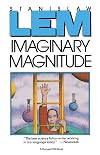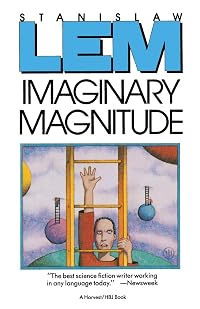
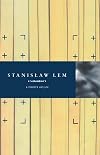
Imaginary Magnitude
by Stanisław Lem
On This Page
Description
These wickedly authentic introductions to twenty-first-century books preface tomes on teaching English to bacteria, using animated X-rays to create "pornograms," and analyzing computer-generated literature through the science of "bitistics." "Lem, a science fiction Bach, plays in this book a googleplex of variations on his basic themes" (New York Times Book Review). Translated by Marc E. Heine. A Helen and Kurt Wolff BookTags
Recommendations































Member Recommendations
Member Reviews
This is one of those what we might call non-novel novels, a novel entirely made up of nonnovelistic material, like Nabokov's Pale Fire. In this case, Imaginary Magnitude is a collection of introductions to other books: Necrobes by Cezary Strzybisz, Eruntics by Reginald Gulliver, A History of Bitic Literature (2nd ed.) by J. Rambellais (ed.), Vestrand's Extelopedia, and GOLEM XIV by GOLEM XIV. They're all from the "future" (i.e., some are from 2009 and 2011, but the book was published in Poland in 1981), and they seem to be from the same future history-- almost all of them are concerned with non-human forms of writing. What does it mean for a computer to write literature, or an essay? Or, can bacteria write if guided by the right show more evolutionary pressures? There's also an introduction by Lem himself on the subject of writing introductions. (It's not as funny as it should be, but there are a couple good lines.)
This is certainly Lem at his most esoteric. Each introduction is a weird mix of humor and earnest speculation, and the balance tips too far to the latter sometimes. My favorite part was definitely the introduction to the Extelopedia, which explains how now that encyclopedias go out of date as soon as they are published, the Extelopedia stays up-to-date by being about future knowledge. To generate this future knowledge, they asked futurists about their predictions, and then included none of them, since futurists are invariably wrong. But then there's some actual excerpts from the content of the Extelopedia, and this was not interesting at all.
Straying from the book's supposed remit is its biggest mistake. GOLEM XIV is a collection of lectures by a superintelligent supercomputer, and here we get not only an introduction, but a foreword, two lectures, and an afterword. Lem trying to be profound in a lecture from a know-it-all computer is dull; he had already covered much of the same ground (speculation about man and evolution) in his Summa Technologiae back in the 1960s, and I'm not sure why he covered it again here under this conceit. Unfortunately, the excerpts from GOLEM are over half the book.
Definitely more interesting in concept than execution, and definitely my least favorite Lem novel so far. show less
This is certainly Lem at his most esoteric. Each introduction is a weird mix of humor and earnest speculation, and the balance tips too far to the latter sometimes. My favorite part was definitely the introduction to the Extelopedia, which explains how now that encyclopedias go out of date as soon as they are published, the Extelopedia stays up-to-date by being about future knowledge. To generate this future knowledge, they asked futurists about their predictions, and then included none of them, since futurists are invariably wrong. But then there's some actual excerpts from the content of the Extelopedia, and this was not interesting at all.
Straying from the book's supposed remit is its biggest mistake. GOLEM XIV is a collection of lectures by a superintelligent supercomputer, and here we get not only an introduction, but a foreword, two lectures, and an afterword. Lem trying to be profound in a lecture from a know-it-all computer is dull; he had already covered much of the same ground (speculation about man and evolution) in his Summa Technologiae back in the 1960s, and I'm not sure why he covered it again here under this conceit. Unfortunately, the excerpts from GOLEM are over half the book.
Definitely more interesting in concept than execution, and definitely my least favorite Lem novel so far. show less
This was Stanislaw Lem's first collection of reviews of non-existent books, also known as "pseudepigraphy" because every stylistic tic clearly deserves its own distinct Greco-Latinate title. As with most disciples of Borges this student doesn't trump the master, but this was flawed even compared to A Perfect Vacuum, which I highly enjoyed.
The main problem was that though these pieces are "funny", in that they are usually written to parody various styles of writing, they're not typically actually that amusing. The opening "Introduction" might be the best piece in the whole lot in a way, its supercharged bombast namedropping Linnaeus, John the Baptist, Bach, Heidegger, and the Book of Genesis in an entertaining way while also highlighting show more the uselessness of most real introductions. However, the humor quickly vanishes. "Necrobes" is about an artist who makes X-ray artwork out of porn, and is essentially humor-free. Same with "Eruntics", which covers the Lysenko-ish efforts of a scientist to teach bacteria to read, "A History of Bitic Literature", which reviews various styles of computer-generated literature, and "Vestrand's Extelopedia in 44 Magnetomes", a futuristic encyclopedia. These are mildly interesting, but might have worked better in actual sci-fi form instead of this pseudepigraphical sketches. The goal of the Borges style is to save a lazy author from having to concoct an entire story when all he really wants to do is write about an idea for a story, but even Lem's formidable literary pyrotechnics can't make these outlines interesting.
The last story "Golem XIV", the longest section in the book, is the perfect example of that. It's purportedly the transcript of a lecture to humanity delivered by a hyperintelligent computer, framed by some commentary and background on the political situation at the time. Pages and pages of quite sophisticated verbiage about mankind, computers, evolution, intelligence, and reality rain over the reader, but even though Lem is deliberately making this as pretentious as possible for effect, the computer's dense theorizing doesn't have much of an impact, and it simply isn't as enjoyable as the more light-hearted literary parodies in A Perfect Vacuum. Lem should have made these ideas into full-fledged stories, his forte, because they simply didn't work too well in this format. show less
The main problem was that though these pieces are "funny", in that they are usually written to parody various styles of writing, they're not typically actually that amusing. The opening "Introduction" might be the best piece in the whole lot in a way, its supercharged bombast namedropping Linnaeus, John the Baptist, Bach, Heidegger, and the Book of Genesis in an entertaining way while also highlighting show more the uselessness of most real introductions. However, the humor quickly vanishes. "Necrobes" is about an artist who makes X-ray artwork out of porn, and is essentially humor-free. Same with "Eruntics", which covers the Lysenko-ish efforts of a scientist to teach bacteria to read, "A History of Bitic Literature", which reviews various styles of computer-generated literature, and "Vestrand's Extelopedia in 44 Magnetomes", a futuristic encyclopedia. These are mildly interesting, but might have worked better in actual sci-fi form instead of this pseudepigraphical sketches. The goal of the Borges style is to save a lazy author from having to concoct an entire story when all he really wants to do is write about an idea for a story, but even Lem's formidable literary pyrotechnics can't make these outlines interesting.
The last story "Golem XIV", the longest section in the book, is the perfect example of that. It's purportedly the transcript of a lecture to humanity delivered by a hyperintelligent computer, framed by some commentary and background on the political situation at the time. Pages and pages of quite sophisticated verbiage about mankind, computers, evolution, intelligence, and reality rain over the reader, but even though Lem is deliberately making this as pretentious as possible for effect, the computer's dense theorizing doesn't have much of an impact, and it simply isn't as enjoyable as the more light-hearted literary parodies in A Perfect Vacuum. Lem should have made these ideas into full-fledged stories, his forte, because they simply didn't work too well in this format. show less
Insufferable. I don't know Latin, Lem! Says very little in very many words. Doesn't live up to the promise in the forward of freeing introductions from the chains of full works, either -- several chapters, decidedly non-introductory, are reproduced in full! It's like reading communist theory but without an interesting and novel analysis underlying all the verbosity.
So I thought this was going to be a bunch of reviews/introductions to books that didn't exist. It sounded like a really cool idea and a good way for an author to use ideas that weren't really big enough to write a novel or even a short story about.
So that's how it started off and it was fun for the first 96 pages. Then the next 152 pages were about humans building a computer AI that was smarter than any human. I read the first 40 or so pages of the AI story but then gave up and skipped to the 22 page afterword, which was the afterword about the AI story, not about the book "Imaginary Magnitude".
So while the AI story was interesting up to a point, it really did seem to ramble on and most of all it destroyed the concept of the book. It show more was very jarring and I kept waiting for it to get back on course but it felt like Mr. Lem got distracted and then never came back to what he meant to write about. show less
So that's how it started off and it was fun for the first 96 pages. Then the next 152 pages were about humans building a computer AI that was smarter than any human. I read the first 40 or so pages of the AI story but then gave up and skipped to the 22 page afterword, which was the afterword about the AI story, not about the book "Imaginary Magnitude".
So while the AI story was interesting up to a point, it really did seem to ramble on and most of all it destroyed the concept of the book. It show more was very jarring and I kept waiting for it to get back on course but it felt like Mr. Lem got distracted and then never came back to what he meant to write about. show less
Ratings
Members
- Recently Added By
Lists


Author Information

362+ Works 32,356 Members
Polish science fiction writer Stanislaw Lem was born on September 12, 1921. A medical graduate of Cracow University, he is at home both in the sciences and in philosophy, and this broad erudition gives his writings genuine depth. He has published extensively, not only fiction, but also theoretical studies. His books have been translated into 41 show more languages and sold over 27 million copies. He gained international acclaim for The Cyberiad, a series of short stories, which was first published in 1974. A trend toward increasingly serious philosophical speculation is found in his later works, such as Solaris (1961), which was made into a Soviet film by Russian director Andrei Tarkovsky in 1972 and remade by Steven Soderbergh in 2002. He died on March 27, 2006 in Krakow at the age of 84. (Bowker Author Biography) show less
Some Editions
Series
Belongs to Publisher Series
Work Relationships
Common Knowledge
- Canonical title*
- 虚数
- Original publication date
- 1973
*Some information comes from Common Knowledge in other languages. Click "Edit" for more information.
Classifications
- Genres
- Fiction and Literature, Science Fiction
- DDC/MDS
- 891.8537 — Literature & rhetoric Literatures of other languages East Indo-European and Celtic literatures West and South Slavic languages (Bulgarian, Slovene, Polish, Czech, Slovak, Serbo-Croatian, and Macedonian) Polish Polish fiction 1919–1989
- LCC
- PG7158 .L39 .W513 — Language and Literature Slavic languages and literatures. Baltic languages. Albanian language Slavic. Baltic. Albanian Slavic Polish
- BISAC
Statistics
- Members
- 538
- Popularity
- 55,391
- Reviews
- 4
- Rating
- (3.87)
- Languages
- 8 — English, German, Hungarian, Japanese, Polish, Russian, Spanish, Turkish
- Media
- Paper, Ebook
- ISBNs
- 16
- ASINs
- 6