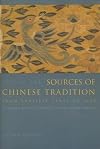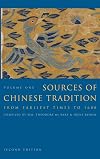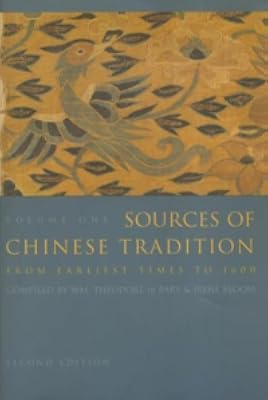
Sources of Chinese Tradition volume I : From Earliest Times to 1600
by Wm. Theodore de Bary, Irene Bloom (Editor)
Sources of Chinese Tradition (1)
On This Page
Description
A collection of seminal primary readings on the social, intellectual, and religious traditions of China, Sources of Chinese Tradition, Volume 1 has been widely used and praised for almost forty years as an authoritative resource for scholars and students and as a thorough and engaging introduction for general readers. Here at last is a completely revised and expanded edition of this classic sourcebook, compiled by noted China scholars Wm. Theodore de Bary and Irene Bloom. Updated to reflect show more recent scholarly developments, with extensive material on popular thought and religion, social roles, and women's education, this edition features new translations of more than half the works from the first edition, as well as many new selections. Arranged chronologically, this anthology is divided into four parts, beginning at the dawn of literate Chinese civilization with the Oracle-Bone inscriptions of the late Shang dynasty (1571-1045 B.C.E.) and continuing through the end of the Ming dynasty (C.E. 1644). Each chapter has an introduction that provides useful historical context and offers interpretive strategies for understanding the readings. The first part, The Chinese Tradition in Antiquity, considers the early development of Chinese civilization and includes selections from Confucius's Analects, the texts of Mencius and Laozi, as well as other key texts from the Confucian, Daoist, and Legalist schools. Part 2, The Making of a Classical Culture, focuses on Han China with readings from the Classic of Changes (I Jing), the Classic of Filiality, major Han syntheses, and the great historians of the Han dynasty. The development of Buddhism, from the earliest translations from Sanskrit to the central texts of the Chan school (which became Zen in Japan), is the subject of the third section of the book. Titled Later Daoism and Mahayana Buddhism in China, this part also covers the teachings of Wang Bi, Daoist religion, and texts of the major schools of Buddhist doctrine and practice. The final part, The Confucian Revival and Neo-Confucianism, details the revival of Confucian thought in the Tang, Song, and Ming periods, with historical documents that link philosophical thought to political, social, and educational developments in late imperial China. With annotations, a detailed chronology, glossary, and a new introduction by the editors, Sources of Chinese Tradition will continue to be a standard resource, guidebook, and introduction to Chinese civilization well into the twenty-first century. show lessTags
Recommendations








Member Reviews
Members
- Recently Added By
Author Information

55+ Works 2,792 Members
William Theodore de Bary was born in the Bronx, New York on August 9, 1919. He graduated from Columbia College in 1941 and began pursuing Japanese studies at Harvard University. When the Japanese attacked Pearl Harbor, he was recruited by naval intelligence. He served at Pearl Harbor and later in Tokyo and Washington. After the war, he received a show more master's degree and a doctorate from Columbia. He taught Asian courses at Columbia and soon became head of Asian studies. From 1971 until 1978, he served as a vice president for academic affairs and provost. After formally retiring in 1989, he continued to teach with emeritus status until May 2017. He wrote or edited more than 30 books including The Great Civilized Conversation: Education for a World Community and Sources of Chinese Tradition. In 2013, he received the National Humanities Medal. He died on July 14, 2017 at the age of 97. (Bowker Author Biography) show less
Some Editions
Awards and Honors
Notable Lists
Series

Belongs to Publisher Series
Common Knowledge
- Canonical title
- Sources of Chinese Tradition volume I : From Earliest Times to 1600
- Original publication date
- 1960
- Important places
- China
- First words
- Any attempt to describe the thought of the most ancient or pre-Confucian period of Chinese history is immediately faced with two difficulties.
- Last words
- (Click to show. Warning: May contain spoilers.)In such circumstances it was difficult to take seriously a challenge form the West which had only been tendered at the hands of gentle missionaries and was not as yet backed by overwhelming force.
- Original language
- English
Classifications
Statistics
- Members
- 468
- Popularity
- 65,178
- Rating
- (3.81)
- Languages
- English
- Media
- Paper
- ISBNs
- 3
- ASINs
- 8