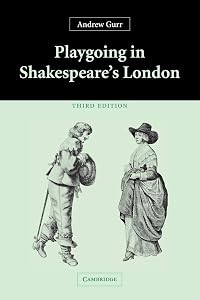
Playgoing in Shakespeare's London
by Andrew Gurr
On This Page
Description
This is a new edition of Andrew Gurr's classic account of the people for whom Shakespeare wrote his plays. Gurr assembles all the evidence from the writings of the time to describe the physical structure of the different types of playhouse, the services provided in the auditorium, the cost of a ticket and a cushion, the size of the crowds, the smells, the pickpockets, and the collective feelings generated by the plays. Since 1987 there have been many new discoveries about Shakespeare's show more theatres. Gurr introduces fresh evidence about the experience of attending a play in Shakespeare's time, adds more than thirty new entries to his account of the early playgoers and provides a select bibliography. show lessTags
Recommendations







Member Reviews
[Playgoing in Shakespeare's London] - Andrew Gurr (second edition)
There were no theatre critics in the period 1580-1642 and so what happened at the theatres has to be pieced together from, letters, epigrams, poems, chronicles, pamphlets and legal documents. Anthony Gurr has identified 195 people identified as having attended a theatre of some sort between 1567 and 1642 (he lists their names with a brief reference in an appendix). Of those 195 only three of them provided eye witness accounts. In a further appendix there are 210 entries that mention the theatre in one context or another: Here is an example from a letter by Sir John Davies.
Fuscus is free, and hath the world at will;
Yet in the course of life that he doth lead,
He's like a show more horse which, turning round a mill,
Doth always in the self-same circle tread:
First, he doth rise at ten; and at eleuen
He goes to Gyls, where he doth eate till one;
Then sees a Play till sixe, and sups at seven;
And after supper, straight to bed is gone;
And there till ten next day he doth remaine,
And then he dines, and sees a Comedy;
And then he suppes, and goes to bed againe:
Thus round he runs without variety,
Saue that sometimes he comes not to the Play,
But falls into a whore-house by the way.
If there is so little contemporary information about the plays themselves there is even less about the public that would count as theatregoers. Gurr estimates that there were 50 million visitors to the theatre during the period and so what has come down to us is a small sample of information. It is inevitable that a book such as this would soon exhaust the topic of the theatregoers and move onto a survey of the types of plays produced.
After an introduction Gurr describes the physical conditions that people had to endure to see the plays. There is more information here with sketches and plans of the theatre that were either built or converted. There is a very good chapter on the social composition of London and so he is able to give the reader a description of the likely theatregoers and how they would be accommodated at the theatres. A chapter on the mental composition of theatregoers surmises the levels of education that would be required to understand many of the references in the words of the plays themselves. He makes an interesting point that the theatre may have been many peoples only connection with literature and the artistic world, because if they were not skilled readers there was nothing else. The theatre bought comedy, history and current events in a live format straight to the paying public.
The longest chapter is entitled the evolution of taste and this is where Gurr moves further away from the theatregoing public and surmises what they would have been able to see at the theatre and how this changed during the period. Certainly from the 1580's the morality plays were being replaced by something that we might understand as modern theatre; increasingly plays were designed to entertain and inform. Christopher Marlowe's plays and Thomas Kyd's 'The Spanish Tragedy' paved the way, becoming perennial classics being performed throughout the whole period. Gurr thinks that these popular plays with their spectacular effects would have entertained people from all levels of society. John Lyly's plays harked back to classical theatre and were performed by boys theatre groups in closed theatres and would have been patronised by those connected with the court of the Queen. As the period progressed the nature of the plays changed and it was Gurr's survey of the productions that I found most interesting. Some new theatres were built and others converted from building of different use, but this did not have such an effect on the plays as the changing tastes of some of the public.
This is a well researched book that would appeal to anybody interested in early English (London) theatre. It is written for the general public, but the appendices contain more than enough information for further research. A four star read. show less
There were no theatre critics in the period 1580-1642 and so what happened at the theatres has to be pieced together from, letters, epigrams, poems, chronicles, pamphlets and legal documents. Anthony Gurr has identified 195 people identified as having attended a theatre of some sort between 1567 and 1642 (he lists their names with a brief reference in an appendix). Of those 195 only three of them provided eye witness accounts. In a further appendix there are 210 entries that mention the theatre in one context or another: Here is an example from a letter by Sir John Davies.
Fuscus is free, and hath the world at will;
Yet in the course of life that he doth lead,
He's like a show more horse which, turning round a mill,
Doth always in the self-same circle tread:
First, he doth rise at ten; and at eleuen
He goes to Gyls, where he doth eate till one;
Then sees a Play till sixe, and sups at seven;
And after supper, straight to bed is gone;
And there till ten next day he doth remaine,
And then he dines, and sees a Comedy;
And then he suppes, and goes to bed againe:
Thus round he runs without variety,
Saue that sometimes he comes not to the Play,
But falls into a whore-house by the way.
If there is so little contemporary information about the plays themselves there is even less about the public that would count as theatregoers. Gurr estimates that there were 50 million visitors to the theatre during the period and so what has come down to us is a small sample of information. It is inevitable that a book such as this would soon exhaust the topic of the theatregoers and move onto a survey of the types of plays produced.
After an introduction Gurr describes the physical conditions that people had to endure to see the plays. There is more information here with sketches and plans of the theatre that were either built or converted. There is a very good chapter on the social composition of London and so he is able to give the reader a description of the likely theatregoers and how they would be accommodated at the theatres. A chapter on the mental composition of theatregoers surmises the levels of education that would be required to understand many of the references in the words of the plays themselves. He makes an interesting point that the theatre may have been many peoples only connection with literature and the artistic world, because if they were not skilled readers there was nothing else. The theatre bought comedy, history and current events in a live format straight to the paying public.
The longest chapter is entitled the evolution of taste and this is where Gurr moves further away from the theatregoing public and surmises what they would have been able to see at the theatre and how this changed during the period. Certainly from the 1580's the morality plays were being replaced by something that we might understand as modern theatre; increasingly plays were designed to entertain and inform. Christopher Marlowe's plays and Thomas Kyd's 'The Spanish Tragedy' paved the way, becoming perennial classics being performed throughout the whole period. Gurr thinks that these popular plays with their spectacular effects would have entertained people from all levels of society. John Lyly's plays harked back to classical theatre and were performed by boys theatre groups in closed theatres and would have been patronised by those connected with the court of the Queen. As the period progressed the nature of the plays changed and it was Gurr's survey of the productions that I found most interesting. Some new theatres were built and others converted from building of different use, but this did not have such an effect on the plays as the changing tastes of some of the public.
This is a well researched book that would appeal to anybody interested in early English (London) theatre. It is written for the general public, but the appendices contain more than enough information for further research. A four star read. show less
Ratings
Members
- Recently Added By
Author Information

21+ Works 604 Members
Andrew Gurr is Emeritus Professor of English at the University of Reading. As chief academic advisor, he was a key figure in the project to rebuild Shakespeare's Globe Theatre in London. His many publications include Shakespeare's Opposites. The Admiral's Company 1594-1625 (2009). The Shakespearean Stage 1574-1642, 4th Edn. (2009) and Playgoing in show more Shakespeare's London, 3rd Edn. (2004). Professor Gurr regularly contributes articles on Shakespeare to publications ranging from Shakespeare Survey to the Times Literary Supplement. show less
Common Knowledge
- People/Characters
- Edward Alleyn; Bacon, Francis, 1561-1626; Francis Beaumont; Christopher Beeston; Richard Brome; Cuthbert Burbage (show all 64); James Burbage; Richard Burbage; Thomas Carew; George Carey, 2nd Baron Hunsdon; Henry Carey, 1st Baron Hunsdon; Sir Dudley Carleton; Sir John Chamberlain; Charles I, King of England, Scotland, and Ireland; Samuel Daniel; William Davenant; John Davies of Hereford; Sir John Davies; Sir John Davies of Oxford; John Day; Johannes de Witt; Thomas Dekker; Leonard Digges; Michael Drayton; Robert Devereux, 2nd Earl of Essex; Robert Devereux, 3rd Earl of Essex; Elizabeth I, Queen of England; Elizabeth of Bohemia; Frances Howard (as Countess of Essex); George Villiers, 1st Duke of Buckingham; Nathan Field, 1587 - 1620 (as Nathaniel Field); Henry Fitzgeoffery; John Fletcher; Simon Forman; Thomas Gainsford; Stephen Gosson; Robert Greene; Joseph Hall (doctor); Gabriel Harvey; John Heminges; Henrietta Maria, Queen Consort of England, Scotland, and Ireland; Philip Henslowe; Henry Herbert, 2nd Earl of Pembroke; Philip Herbert, 4th Earl of Pembroke and 1st Earl of Montgomery; William Herbert, 3rd Earl of Pembroke; Raphael Holinshed; John Holles; James VI and I, King of Scots and King of England; Inigo Jones; Ben Jonson; John Lyly; John Marston; Philip Massinger; Thomas Middleton; Sir Humphrey Mildmay; Thomas Nashe; James Butler, 1st Duke of Ormonde; Henry Peacham; William Shakespeare; Sir Philip Sidney; James Stuart, 2nd Duke of Lennox; Richard Tarlton; John Webster; Henry Wriothesley, 3rd Earl of Southampton
- Important places
- London, England, UK; Drury Lane, London, England, UK; Globe Theatre, Bankside, Southwark, London, England, UK; Rose Theatre, Bankside, Southwark, London, England, UK
Classifications
- Genres
- Nonfiction, Literature Studies and Criticism, History, General Nonfiction
- DDC/MDS
- 792.09421 — Arts & recreation Recreation, sports, and performing arts Theater: Plays, Ballet, Opera modified standard subdivisions History, geographic treatment, biography; Description, critical appraisal of specific theatres and companies Europe England & Wales London
- LCC
- PN2596 .L6 .G87 — Language and Literature Literature (General) Literature (General) Drama Dramatic representation. The theater Special regions or countries
- BISAC
Statistics
- Members
- 129
- Popularity
- 252,432
- Reviews
- 1
- Rating
- (4.15)
- Languages
- English
- Media
- Paper
- ISBNs
- 6