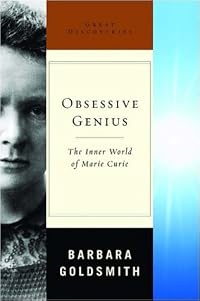
Obsessive Genius: The Inner World of Marie Curie
by Barbara Goldsmith
On This Page
Description
Draws on diaries, letters, and family interviews to discuss the lesser-known achievements and scientific insights of the Nobel Prize-winning scientist, documenting how she was compromised by the prejudices of a male-dominated society.Tags
Recommendations












Member Reviews
Barbara Goldsmith's biography of Marie Curie is a wonderful portrait of the scientist and the woman. Her work is placed in the context of the science in Europe in the early 1900s, so that you can truly understand its groundbreaking nature. You learn about other scientists whose work intersected with and competed against the Curies, such as Roentgen, Becquerel and many others. Goldsmith also addresses Marie Curie's struggle for recognition, for simple acceptance, as a woman in a male-dominated world: how she would have been passed over for the Nobel Prize if her husband, Pierre Curie, had not stood up for her, how she was rejected from scientific academies, how she had to beg for money even after winning the Nobel Prize. Her personal show more struggles with depression as well as her relationships with her loving husband, children and others in her world are also finely depicted. Altogether a very worthwhile read. show less
Starts off well, but author Barbara Goldsmith quickly gets in over her head. This is one of a series on great scientific discoveries; the editors made an idiosyncratic choice of Goldsmith, a best-selling and well regarded biographer but with no discernible scientific background, to do a life of Marie Curie. The result tells a lot about Marie Curie as a person, but it could have just as easily been about a great artist or a great writer overcoming adversity rather than a great scientist doing the same. Goldsmith spends a lot of time telling us how rough Curie’s early life was – and it was – and how much prejudice there was against her as woman – and there was – but not enough about what she did. Thus we get the trials of show more growing up in Russian-dominated Poland, living in a garret in Paris while attending the Sorbonne, working in a laboratory not much better than a cow barn, grudgingly bestowed awards, loss of the love of her life, difficulties with the establishment, alienation from her children, and unpleasant death from the side of effects of her work. And, oh yeah, that radium stuff.
Even when there is some scientific detail, it’s not all that appropriate. There’s a discussion – including a line drawing – of a Curie electrometer, but the main emphasis is on how difficult it was to operate, as if Marie Curie’s principal genius was manual dexterity. (I will mention one thing that really impressed me – Marie Curie may be the only person who ever saw, or who ever will see, radium. Not a radium compound or a radium spectroscopic line, but actual radium metal – she prepared a miniscule sample apparently just to show that she could. Magnificent).
Don’t get me wrong; Marie Curie wins the race for greatest scientist with the roughest life in a walk. But I fear the message here is wrong – it’s if you want to be a scientist you’ll have to overcome prejudice against you race or gender or ethnicity, you’ll have to deal with disrespect from the public and your peers and the Establishment, and you’ll risk alienating your family and friends. What the message should be is that if you want to be a scientist it will be so fascinating you won’t even notice the other stuff. show less
Even when there is some scientific detail, it’s not all that appropriate. There’s a discussion – including a line drawing – of a Curie electrometer, but the main emphasis is on how difficult it was to operate, as if Marie Curie’s principal genius was manual dexterity. (I will mention one thing that really impressed me – Marie Curie may be the only person who ever saw, or who ever will see, radium. Not a radium compound or a radium spectroscopic line, but actual radium metal – she prepared a miniscule sample apparently just to show that she could. Magnificent).
Don’t get me wrong; Marie Curie wins the race for greatest scientist with the roughest life in a walk. But I fear the message here is wrong – it’s if you want to be a scientist you’ll have to overcome prejudice against you race or gender or ethnicity, you’ll have to deal with disrespect from the public and your peers and the Establishment, and you’ll risk alienating your family and friends. What the message should be is that if you want to be a scientist it will be so fascinating you won’t even notice the other stuff. show less
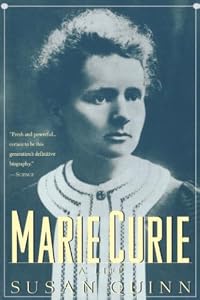
Obsessive Genius: The Inner World of Marie Curie by Barbara Goldsmith purports to tell the real story behind the mythical woman. Goldsmith was able to access new materials including Curie's letters and other papers, many of which had been sequestered because they were radioactive. She also interviewed family members and friends. The portrait she paints is not at all flattering but perhaps not surprising. In a world where women were not welcome in the scientific world, she created a space for herself that she managed to keep even after Pierre died. But she did so, Goldsmith suggests, at the expense of her children, especially her youngest, Eve, who did not have the scientific inclinations of her older sister Irene.
I read a few Amazon show more reviews and agree with one reviewer: Goldsmith seems sympathetic to her subject at the beginning as she describes her childhood and her battle with depression. But, as the biography unfolds, she seems to like her subject less and less and that attitude may color the later stages of the book as she delves into Curie's private life beyond the laboratory.
I read this for the CATWoman July book: women in science. It had been sitting on the shelf for awhile and for someone who had little or no knowledge about Curie beyond what Goldsmith would call the myth, it was an introduction and an easy read. I don't think I need to explore Curie any further and can only half-heartedly recommend the book. show less
I read a few Amazon show more reviews and agree with one reviewer: Goldsmith seems sympathetic to her subject at the beginning as she describes her childhood and her battle with depression. But, as the biography unfolds, she seems to like her subject less and less and that attitude may color the later stages of the book as she delves into Curie's private life beyond the laboratory.
I read this for the CATWoman July book: women in science. It had been sitting on the shelf for awhile and for someone who had little or no knowledge about Curie beyond what Goldsmith would call the myth, it was an introduction and an easy read. I don't think I need to explore Curie any further and can only half-heartedly recommend the book. show less
An oddly bloodless biography, offered almost as a corrective, it feels rushed and, at the end, as if the author were trying to extend it to make up a page count. In all, a disappointment to me. But it does give a complex portrait of a woman more often idolized than understood.
I honestly really liked this book a lot. It gave so much great information about Marie Curies career and life. I taught me a lot about the BS she went through aswell as her work before and after her death. I really liked the writing, it was easy to follow and understand. I was able to read this 274 (233) page book all in a day. I love this topic and book, would recommend if you want to know more about this subject beacuse it does a great job. 11/7/25
Just what I wanted to know about Curie, this is a quick and clear study of the woman at the heart of her own mythology. Worth it for the description of her daughters alone.
I enjoyed this. It was readable & interesting. I'm not sure of all of the author's conclusions; she told us that when Pierre died Marie closed herself off from the world...but then she quoted from the passionate letters that Marie wrote to Paul Langevin. I had a little trouble following the meaning of the science.
Members
- Recently Added By
Published Reviews
Best-selling author Barbara Goldsmith brings us an inspiring biography of Marie Curie, exploring the real woman behind the scientist whose discoveries changed our world.
added by libraryuser59
Lists

Best Science Books for Non-Scientists
113 works; 54 members

Best Biographies
216 works; 26 members

For Science!
39 works; 5 members

In Our Time books
4,934 works; 2 members
Author Information

6+ Works 1,116 Members
Barbara Goldsmith was born Barbara Joan Lubin on May 18, 1931 in Manhattan, New York. She received a bachelor's degree in English and art history from Wellesley College in 1953. After college, she worked for Art News as a critic before becoming an editor at Woman's Home Companion, where she created an entertainment section. Later, she worked at show more Town and Country, where she started a series called The Creative Environment, for which she interviewed important figures in the arts. She wrote for The New York Herald Tribune and then became one of the founding editors of New York magazine. She was a senior editor at Harper's Bazaar in the early 1970s, but soon left to write the novel The Straw Man. Her account of the 1934 custody battle over Gloria Vanderbilt entitled Little Gloria ¿ Happy at Last was published in 1980 and was turned into an NBC mini-series in 1982. Her other non-fiction works included Johnson v. Johnson; Other Powers: The Age of Suffrage, Spiritualism and the Scandalous Victoria Woodhull; and Obsessive Genius: The Inner World of Marie Curie. She died from heart failure on June 26, 2016 at the age of 85. (Bowker Author Biography) show less
Some Editions
Awards and Honors
Awards
Notable Lists
Series
Belongs to Publisher Series
Common Knowledge
- Canonical title
- Obsessive Genius: The Inner World of Marie Curie
- Original publication date
- 2005
- People/Characters
- Marie Curie; Pierre Curie; Irène Joliot-Curie; Paul Langevin
- Important places
- Paris, France
- Dedication
- For these children
Evelyn
Gillian
Jack
Jenna
Lillian
Max
and their "spirit of adventure" - First words
- Introduction
Paris, April 20, 1995: the white carpet stretched block after block down the rue Soufflot ending in front of the Panthéon, which was draped in tricolor banners that extended from the dome to the pav... (show all)ement. - Quotations
- One of only twenty-three women among almost two thousand students enrolled in the School of Sciences, she made no comment on this disparity but noted only that she was being taught by such illustrious professors as Paul Appel... (show all)l, who was to become the dean of that institution and Gabriel Lippmann, who in 1908 would win a Nobel Prize for developing color photography.
- Last words
- (Click to show. Warning: May contain spoilers.)If I see anything vital around me, it is precisely that spirit of adventure, which seems indestructible.
Classifications
Statistics
- Members
- 530
- Popularity
- 56,008
- Reviews
- 12
- Rating
- (3.78)
- Languages
- 8 — English, French, German, Italian, Polish, Portuguese, Spanish, Turkish
- Media
- Paper, Audiobook, Ebook
- ISBNs
- 16
- ASINs
- 8