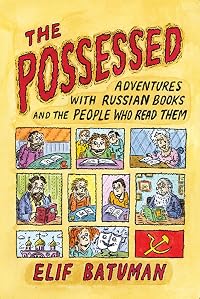
The Possessed: Adventures with Russian Books and the People Who Read Them
by Elif Batuman
On This Page
Description
Literally and metaphorically following the footsteps of her favorite authors, Batuman searches for the answers to the big questions in the details of lived experience, combining fresh readings of the great Russians, from Pushkin to Platonov, with the sad and funny stories of the lives they continue to influence--including her own.Tags
Recommendations







Member Recommendations
Schadenfreude, A Love Story: Me, the Germans, and 20 Years of Attempted Transformations, Unfortunate Miscommunications, and Humiliating Situations That Only They Have Words For by Rebecca Schuman
akblanchard The joys and challenges of graduate study in the humanities.
JuliaMaria Humorvolle, kenntnisreiche und inspirierende Essays über das Lesen und Leben mit russischer Literatur.
Member Reviews
So how many literary-travelogue-memoirs written by and for comp lit majors can there be? I was totally chuffed to find a story I thought no one outside the increasingly arcane world of literary study could possibly care about be so engaging and accessible, without compromising a real scholar's interest in literature or dumbing down questions of theory. It's a thoughtful meditation on the relationship between literature and life (or literatures and lives, including the author's own), with a different master Russian author serving as the presiding spirit for each chapter. It's all good, but her description of the Isaac Babel Conference at Stanford stands out like a lighthouse--it ought to rank with the greatest satiric portraits of the show more academic life ever written. It's all here: the horror and the humor, the posturing, absurdity and abject misery. It's the first thing I can remember laughing out loud at while shuddering in body terror at the same time. But that's the life of the mind, folks. show less
Every morning I called Aeroflot to ask about my suitcase. "Oh, it's you," sighed the clerk, "Yes, I have your request right here. Address: Yasnaya Polyana, Tolstoy's house. When we find the suitcase we will send it to you. In the meantime, are you familiar with our Russian phrase resignation of the soul?
This is a collection of personal essays centering on Batuman's time working towards her Ph.D in Russian literature. She goes to a Tolstoy conference in Russia, helps host a Babel conference at Stanford University and studies Uzbek in Samarkand for a summer and tours the more obscure corners of Turkey for Let's Go.
Batuman is a likable main character in her accounts. She appears to be a hapless victim of circumstance, having accidentally show more fallen into Russian literature, but she's also someone who is relentlessly curious about the world around her and willing to jump into circumstances most people would balk at. She cheerfully endures weird and trying experiences and turns them into funny stories. My favorite essays are the ones set during her summer in Samarkand, a city which sounds endlessly exotic, but is also in a former Soviet satellite state still struggling to regain its feet. Most of the stories are set among graduate students and visiting scholars and if that sounds even halfway interesting to you, this is a book you'll like; it's witty and intelligent and has a great sense of the absurd. And if you've read either of her novels, you'll get to read about the experiences that she later fictionalized. show less
The Possessed: Adventures With Russian Books And The People Who Read Them is Elif Batuman's memoir of life as a Turkish-American postgraduate at Stanford, trying to figure out Russian literature, the Russian language, Russian (and Soviet) society, and of course other people who do the same. It's packed to the rafters with analyses of Tolstoy, Dostoevsky, Tjechov and mediaeval Uzbek poetry.
And it's absolutely hilarious.
Sure, part of that is Batuman's writing, dry and incredibly quotable, often dipping into fond satire of literary criticism. But just as often it's the sheer absurdity of the situations she finds herself in. A dinner party for the daughters of the long-dead Isaak Babel, who are greeted as celebrities but turn out to have show more nothing new to offer about a writer nobody seems to know anything about. A summer-long excursion to Samarkand which ends up in complete chaos. An newly discovered plot to murder Tolstoy, the investigation of which gets thwarted by an excursion to Tjechov's home - not because it has anything to do with Tolstoy, it's just conveniently close. An attempt to understand why the hell Empress Anna built a palace of ice in St Petersburg and forced her jesters to have marital relations in it. How Dostoevsky's Demons is a lot like the complex interpersonal relationships at a university. And obviously, the similarity between King Kong and diaries from the Soviet-Polish war, but that goes without saying.
And the thing is, it works. Batuman is funny, but she also knows what she's talking about, and she comes up with a lot of fascinating insights. But above all, she captures the sheer joy of immersing yourself in reading, in needing to find out what makes it tick, chasing after the tangible bits - the houses, the writing desks, the writers - as a substitute for getting to the actual story. I love this. I just wish there was more of it. show less
And it's absolutely hilarious.
Sure, part of that is Batuman's writing, dry and incredibly quotable, often dipping into fond satire of literary criticism. But just as often it's the sheer absurdity of the situations she finds herself in. A dinner party for the daughters of the long-dead Isaak Babel, who are greeted as celebrities but turn out to have show more nothing new to offer about a writer nobody seems to know anything about. A summer-long excursion to Samarkand which ends up in complete chaos. An newly discovered plot to murder Tolstoy, the investigation of which gets thwarted by an excursion to Tjechov's home - not because it has anything to do with Tolstoy, it's just conveniently close. An attempt to understand why the hell Empress Anna built a palace of ice in St Petersburg and forced her jesters to have marital relations in it. How Dostoevsky's Demons is a lot like the complex interpersonal relationships at a university. And obviously, the similarity between King Kong and diaries from the Soviet-Polish war, but that goes without saying.
And the thing is, it works. Batuman is funny, but she also knows what she's talking about, and she comes up with a lot of fascinating insights. But above all, she captures the sheer joy of immersing yourself in reading, in needing to find out what makes it tick, chasing after the tangible bits - the houses, the writing desks, the writers - as a substitute for getting to the actual story. I love this. I just wish there was more of it. show less
I’m inclined to classify ‘The Possessed’ with [b:Underfoot in Show Business|125037|Underfoot in Show Business|Helene Hanff|https://images.gr-assets.com/books/1387747244s/125037.jpg|2484239] and [b:You Must Go and Win: Essays|9042873|You Must Go and Win Essays|Alina Simone|https://images.gr-assets.com/books/1312050210s/9042873.jpg|13920686] as ‘very funny and clever anecdotal autobiographies of the professional and personal lives of women who I’d like to be friends with’. This one has the added advantage of being concerned with postgraduate life, although PhDs in the US are very different to those in the UK. As I understand it, across the pond they take longer, involve exams and compulsory teaching, and constitute more of an show more academic apprenticeship. In the UK you’re lucky to get more than three years of funding, teaching experience is ad hoc, and you’re basically undertaking an independent spirit quest of some sort. (I refer to the social sciences and humanities here; in the sciences you get to be in a lab.) Anyway, Batuman recounts strange tales of her PhD in literature, involving much travel and many encounters with odd people, not all of whom were academics. I found the whole thing very entertaining, as she has an eye (ear?) for absurdity and tells historical and literary anecdotes very well. Her writing style is amusing throughout. To pick a couple of random examples:
Highlights of the book include Batuman’s attempt to get university funding on the basis of a theory that Tolstoy was murdered, an extremely awkward conference on Isaac Babel, and the strange tale of an ice house commissioned by Empress Anna Ioannovna. What a lovely compendium of historical and literary ephemera. It has definitely encouraged me to read more Russian literature. show less
What did you know about Uzbekistan once you learned that Old Uzbek had a hundred different words for crying? I wasn’t sure, but it didn’t seem to bode well for my summer vacation.
When the Russian Academy of Sciences puts together an author’s Collected Works, they aren’t aiming for something you can put in a suitcase and run away with. The ‘millennium’ edition of Tolstoy fills a hundred volumes and weighs as much as a newborn beluga whale.
Highlights of the book include Batuman’s attempt to get university funding on the basis of a theory that Tolstoy was murdered, an extremely awkward conference on Isaac Babel, and the strange tale of an ice house commissioned by Empress Anna Ioannovna. What a lovely compendium of historical and literary ephemera. It has definitely encouraged me to read more Russian literature. show less
The Possessed: Adventures with Russian Books and the People Who Read Them I found I liked for many of the reasons others don't -- its lack of focus, its myopia, its attempts at sarcastic humor confronting the hair-splitting obsessions of the lit crit crowd that come off more bitter than funny (although the account of the Tolstoy conference is pretty hilarious), its utter lack of profundity. "This has nothing new to say about Russian Literature!" reviewers tend to bitch. Instead, it is an extended account -- in a series of collected essays, of Batuman's own love -- or love/hate -- relationship with the books in her life. And that...that I totally get.
The only section I didn't like so much was the one that gives the title to the book, show more about Dostoyevsky's The Possessed, which I read in college as The Demons. That section is taken up with a fairly long and unnecessary recap of the novel that irritated me, such that by the time she gets into the question of how flawed the book is or may be, I was too annoyed to pay close attention.
But I was willingly drawn in to her arguments with fellow grad students about Isaac Babel -- her summation of him as "an accountant" perversely making me go back to his stories just to see if I could see what she did. (I couldn't). Her account of the Ice Palace in St. Petersburg, a stellar example of a failed travel piece, nevertheless has me hunting around for a copy of Ivan Lazhechnikov's The Ice House -- so far without success. And Batuman's extended account of a summer spent in Samarkand studying Uzbek poetry that other readers found off topic, kept me fairly riveted. She was there because of an accident of grant funding, but then this is how most of my own travels through the land of literature have occurred -- serendipitously, by accident and whim rather than design. Why study Uzbek poetry? Why climb a mountain? show less
The only section I didn't like so much was the one that gives the title to the book, show more about Dostoyevsky's The Possessed, which I read in college as The Demons. That section is taken up with a fairly long and unnecessary recap of the novel that irritated me, such that by the time she gets into the question of how flawed the book is or may be, I was too annoyed to pay close attention.
But I was willingly drawn in to her arguments with fellow grad students about Isaac Babel -- her summation of him as "an accountant" perversely making me go back to his stories just to see if I could see what she did. (I couldn't). Her account of the Ice Palace in St. Petersburg, a stellar example of a failed travel piece, nevertheless has me hunting around for a copy of Ivan Lazhechnikov's The Ice House -- so far without success. And Batuman's extended account of a summer spent in Samarkand studying Uzbek poetry that other readers found off topic, kept me fairly riveted. She was there because of an accident of grant funding, but then this is how most of my own travels through the land of literature have occurred -- serendipitously, by accident and whim rather than design. Why study Uzbek poetry? Why climb a mountain? show less
The subtitle sounds irresistible: "Adventures with Russian Books and the People Who Read Them." And the book starts engagingly, but by the time I reached the halfway point, I realized that it was simply a cobbling together of magazine pieces with no through-line. Batuman writes in a Bright Young Thing tone (unfortunately rather generic), and her humorous phrasings are occasionally reminiscent of Daniel Kalder, who also writes about Russia. But Kalder really something to say; Batuman does not, and her attitudinizing eventually becomes wearisome. When she states with mock rue that after her summer in Uzbekistan, she was done with poetry, "the Caucasus, the Russian East, and the literatures of the peripheries," all I could think was, who show more really cares what you are done with? To be fair, there are glimmers of interest scattered throughout the book that, although they don't amount to a lot, perhaps barely justify the time a Russophile might spend reading it: a clear account of Rene Girard's literary theory in relation to Dostoevsky's novel "Demons," for example. So at best, and not wanting to come down too hard on a young writer who could develop, I give this a borderline recommendation. show less
I've known people like Elif Batuman--brilliant people who can't reply to the question "How are you today?" without a.) quoting literature, and then b.) quoting some obscure but relevant work of critical theory (and then maybe c.) adding an interesting bit of historical trivia, just for fun). It can take awhile to realize that, for this kind of person, that is actually how they feel--they've answered your question, you just might have to work a little harder to translate it into an "I'm fine" or an "I've been better." The Possessed is a book by, about, and for this kind of person, and for those of us who enjoy following them down their twisty, sometimes obsessive, often wise and utterly delightful paths. (I also feel like Batuman wins show more bonus points for making me want to re-read Pushkin--I didn't think that could happen, but This Kind of Person is notoriously persuasive...) show less
Members
- Recently Added By
Published Reviews
ThingScore 94
The dull pewter of Uzbekistan’s literary offerings makes Russia’s great names seem all the more lustrous, but this book is only secondarily about literature: its main attraction is Elif Batuman herself.
added by Shortride
Hilarious, wide-ranging, erudite and memorable, “The Possessed” is a sui generis feast for the mind and the fancy... Batuman’s exaltations of Russian literature could have ended up in scholarly treatises gathering dust in university stacks. Instead, she has made her subject glow with the energy of the enigma that drew her to it in the first place: “the riddle of human behavior and the show more nature of love” bound up, indeed, with Russian. As a soulful Russian-language teacher might say as she hands out a piece of chocolate to her pet student: Molodets. Way to go. show less
added by Shortride
Elif Batuman is clearly one of those people whom Babel described, in one of his Odessa stories, as having “spectacles on his nose and autumn in his heart.” Her autumnal impulses are balanced by jumpy, satirical ones. It’s a deep pleasure to read over her shoulder.
added by Shortride
Lists

Best books about books
209 works; 106 members

Bibliomemoirs
46 works; 8 members

Memoirs - Mary Karr
14 works; 1 member

Russian Literature
184 works; 35 members

Vulture's 100 Best Books of the 21st Century (So Far)
98 works; 9 members

Books Read in 2023
5,638 works; 147 members

Books Read in 2024
4,727 works; 128 members

On Books
70 works; 1 member
Talk Discussions
Past Discussions
TIOLI - Group Read - The Possessed in 75 Books Challenge for 2011 (March 2011)
Author Information

7+ Works 4,362 Members
Some Editions
Awards and Honors
Awards
Distinctions
Common Knowledge
- Canonical title
- The Possessed: Adventures with Russian Books and the People Who Read Them
- Original title
- The Possessed. Adventures with Russian Books and the People Who Read Them
- Alternate titles
- The Possessed
- Original publication date
- 2010
- People/Characters
- Isaac Babel; Leo Tolstoy; Ivan Lazhechnikov
- Important places
- Stanford University, Stanford, California, USA; Samarkand, Uzbekistan
- First words
- When the Russian Academy of Sciences puts together an author's Collected Works, they aren't aiming for something you can put in a suitcase and run away with.
In Thomas Mann's 'Magic Mountain', a young man named Hans Castorp arrives at a Swiss sanatorium to visit his tubercular cousin for three weeks. [Introduction] - Quotations*
- Ich erinnere mich besonders an die Passage, in der er beschreibt, dass jeder Mensch zwei Leben hat - ein offenes und sichtbares mit Arbeit, Konventionen, Verantwortung, Scherzen, un das andere, das "im Geheimen verläuft" - u... (show all)nd wie mühelos sich die Umstände so fügen, dass alles, was einem besonders wichtig, interessant und bedeutsam ist, sich in dem zweiten, dem geheimen Leben abspielt.
Eine Stadt hieß Tokat, was wörtlich "ein Schlag ins Gesicht" heißt. SO lautet auch der Titel eines berühmten Manifests der russischen Futuristen: "Ein Schlag ins Gesicht des öffentlichen Geschmacks" - oder auf Türkisch ... (show all)"Toplumsal zwevke bir tokat". Die "osmanische Ohrfeige" - eine in dier osmanischen Armee entwickelte Technik, wo Fausthiebe als schlechtes Benehmen galten - ist als Osmanli tokat (oder, grammatisch korrekter, Osmanh toakadi) bekannt und wenn man den Begriff in YouTube aufruft, sieht man auf Hunderten von Videos türkische Menschen, die geohrfeigt werden, meist von anderen türkischen Menschen, allerdings in einem Fall auch von einem Affen. Allein der Gedanke an meine Reise nach Tokat bereitete meiner Mutter schlafloser Nächte.
Muzaffar gab sich die größte Mühe, mir beizubringen, wie man eine gute Wassermelone kauft. Manche Leute seien der Ansicht, sagte er, dass eine Wassermelone schwer und fest sein sollte. Andere meinten, die besten Melonen se... (show all)ien groß und und leicht. Damt war mir also nicht geholfen. Eine gute Wassermelone musste einen orangefarbenen Fleck haben, an dem man sehen konnte, wo sie in der Sonne gelegen, und einen trockenen Nabel, der zeigt, dass sich der Stiel von selbst gelöst hatte. Wenn man mit der rechten Hand an die Melone klopfte, musste si in der linken Hand mitschwingen. Bei der Schale war das wichtigste nicht die Farbe, sondern der Kontrast zwischen den verschiedenen Farben. [...] Unterdessen hatte er mir so überzeugend eingeredet, dass man versuchen werde, mir die schlechteste Wassermelone anzudrehen und mir zu viel dafür abzuknöpfen, dass ich den Mut verlor und überhaupt keine Melonen kaufte.
Böse Geister ist die Geschichte gewisser "sehr sonderbarer Ereignisse" in einer "bislang in keiner Weise bemerkenswerten" russischen Provinzstadt. Der Erzähler, dessen weitschweifig-exzentrische Chronik Vorkommnisse enthäl... (show all)t, die er unmöglich selbst miterlebt haben kann, ist der Freund einer der Hauptfiguren des Romans, des alternden Pädagogen, Dichters und früheren Glehrten Stephan Trofimowitsch, dessen akademischer Ruf darauf beruht, dass es ihm gelang, eine brillante Dissertation zu verteidigen über "die in der Zeit zwischen 1413 und 1428 sich gerade entwickelnde politische und hanseatische Bedeutung des deutschen Städtchens Hanau und zugleich über die speziellen und unklaren Gründe, weshalb diese Bedeutung ausblieb." - Last words
- (Click to show. Warning: May contain spoilers.)If I could start over today, I would choose literature again. If the answers exist in the world or in the universe, I still think that's where we're going to find them.
- Blurbers
- Kunkel, Benjamin; Crosley, Sloane; Meek, James
*Some information comes from Common Knowledge in other languages. Click "Edit" for more information.
Classifications
- Genres
- Literature Studies and Criticism, Nonfiction, Biography & Memoir
- DDC/MDS
- 891.709 — Literature & rhetoric Literatures of other languages East Indo-European and Celtic literatures Russian and East Slavic languages Russian literature History and criticism of Russian literature
- LCC
- PG2986 .B33 — Language and Literature Slavic languages and literatures. Baltic languages. Albanian language Slavic. Baltic. Albanian Russian literature General
- BISAC
Statistics
- Members
- 1,242
- Popularity
- 19,885
- Reviews
- 52
- Rating
- (3.65)
- Languages
- 10 — Danish, Dutch, English, French, German, Italian, Portuguese, Spanish, Swedish, Turkish
- Media
- Paper, Audiobook, Ebook
- ISBNs
- 27
- ASINs
- 11